A complete reference blog for Indian Government Employees

Showing posts with label 7th pay commission reference. Show all posts

Tuesday, 4 October 2016

Who are entitled to 7th Pay Commission Bunching Benefit of Pay Commission report ?

Who are entitled to 7th Pay Commission Bunching Benefit as per Para 5.1.36 of Pay Commission report ?  The meaning of Stage defined now in the OM dated 07.09.2016

In Para 5.1.36 of its report, 7th Pay Commission had recommended that one additional increment will be given while fixing of every two stages of pre-revised basic pay (pay in pay band and Grade pay) or scale  in the same pay in the new pay matrix.  This recommendation has been accepted by Govt and an OM has been issued on 7th September 2016 to this effect.

Check the following link to read OM dated 7th September 2016 on Bunching benefits

The Govt has also defined now the meaning of "Stage" in the OM dated 7th September 2016.  Pay drawn by two Government servants in a given Pay Band and Grade pay or scale where the higher pay is at least 3% more than the lower pay shall constitute two stages.

The illustration provided in 7th Pay Commission report for the purpose of granting Bunching Increment was relating to Entry Pay only in the the new Pay Matrix viz., As per Illustration provided in the report Employees in GP 10,000 who are fitted in to minimum of Level 14 of New Pay Matrix will be eligible for one additional increment and would be fitted in to next cell of Level 14.

However, as per the OM dated 7th September 2016, which has clearly defined the meaning of Stage as far as 6th CPC pay is concerned, the bunching benefit will also be applicable to fixation of 7th CPC pay for all the indices of new pay matrix in addition to entry pay.

7th Pay Commission Pay Fixation:

As per Para 5.1.28 of 7th Pay Commission Report, pay fixation in the new pay structure will have to be made as follows

Step 1: Identify Basic Pay (Pay in the pay band plus Grade Pay) drawn by an employee as on the date of implementation. This figure is 'A'.
Step 2: Multiply 'A' with 2.57, round-off to the nearest rupee, and obtain result 'B'.
Step 3: The figure so arrived at, i.e., 'B' or the next higher figure closest to it in the Level assigned to his/her grade pay, will be the new pay in the new pay matrix. In case the value of 'B' is less than the starting pay of the Level, then the pay will be equal to the starting pay of that level

7th Pay Commission bunching Benefit:

In addition to above, 7th Pay Commission proposes bunching benefit in Para 5.1.36 whenever more than two stages are bunched together for fixation of pay in 7th CPC pay matrix, one additional increment equal to 3 percent may be given for every two stages bunched, and pay fixed in the subsequent cell in the pay matrix.
Further, Para 5.1.37 of the report provides an illustration for fixation of pay of two employees who are drawing pay of Rs.53,000 and Rs.54,590 in the GP 10000.

As per this illustration, after applying 7CPC multiplication factor of 2.57, both of these employees will have to be fixed in first cell of level 15 in the pay of Rs.1,44,200 as their revisesd pay are worked out to Rs.1,36,210 and Rs.1,40,296 respectively which are not more than the first cell of level 15 (Rs.1,44,200)
But to avoid bunching of these two stages of pay, the person drawing pay of Rs.54,590 will get fixed in second cell of level 15 in the pay of Rs.1,48,500, while the other who is drawing pay of Rs. 53,000 will have to be fixed in Rs.1,44,200.

Based on this illustration, a table containing Entry pay of Rs. 53,000 in GP 10000, subsequent stages for this pay (pay with increment of 3% for every year) and 7th Pay Commission pay fixation for the same has been prepared as below.

Applying same principles, we could find that next stage in entry pay in respect of Grade Pay 1800, 1900. 2000, PB-3-5400, 6600, 7600 and 8900 would be entitled to one additional increment as bunching benefit.

7th Pay Commission Pay with Bunching Benefit in respect of 6th CPC Pay in Pay band with GP of 10,000/- (Pay Band (Rs. 37400-67000)

6cpc Basic Pay7CPC pay fixationGP 10000
bp*2.577CPC pay fixation with bunching benefit
53000136210144200144200
54590140296144200148500
56230144511148500153000
57920148854153000157600
59660153326157600162300
61450157927162300167200
63300162681167200172200
65200167564172200177400
67160172601177400182700
69180177793182700188200
71260183138188200193800
73400188638193800199600
75610194318199600205600
77880200152205600211800
80220206165211800218200

7th Pay Commission Pay with Bunching Benefit in respect of 6th CPC Pay in Pay band with GP of Rs. 8900/- (Pay Band 4 - Rs. 37400 to 67000)

GP 8900
6cpc Basic pay6cpc*2.577cpc pay fixation7CPC pay fixation with bunching benefit
49100126187131100131100
50580129991131100135000
52100133897135000139100
53670137932139100143300
55290142095143300147600
56950146362147600152000
58660150756152000156600
60420155279156600161300
62240159957161300166100
64110164763166100171100
66040169723171100176200
68030174837176200181500
70080180106181500186900
72190185528186900192500
74360191105192500198300
76600196862198300204200
78900202773204200210300
81270208864210300216600

7th Pay Commission Pay with Bunching Benefit in respect of 6th CPC Pay in Pay band with GP of of Rs 7600/- (Pay Band 3 - Rs. 15600 - 39100)

GP 7600
6cpc Basic pay6cpc*2.577cpc pay fixation7CPC pay fixation with bunching benefit
29500758157880078800
30390781027880081200
31310804678120083600
32250828838360086100
33220853758610088700
34220879458870091400
35250905939140094100
36310933179410096900
37400961189690099800
385309902299800102800
39690102003102800105900
40890105087105900109100
42120108248109100112400
43390111512112400115800
44700114879115800119300
46050118349119300122900
47440121921122900126600
48870125596126600130400
50340129374130400134300
51860133280134300138300
53420137289138300142400
55030141427142400146700
56690145693146700151100
58400150088151100155600
60160154611155600160300
61970159263160300165100
63830164043165100170100
65750168978170100175200
67730174066175200180500
69770179309180500185900
71870184706185900191500
74030190257191500197200
76260195988197200203100
78550201874203100209200

7th Pay Commission Pay with Bunching Benefit in respect of 6th CPC Pay in Pay band with GP of Rs. 6600/- (Pay Band 3 - Rs. 15600 - 39100)

GP 6600
6cpc Basic pay6cpc*2.577cpc pay fixation7CPC pay fixation with bunching benefit
25350651506770067700
26120671286770069700
26910691596970071800
27720712407180074000
28560733997400076200
29420756097620078500
30310778977850080900
31220802358090083300
32160826518330085800
33130851448580088400
34130877148840091100
35160903619110093800
36220930859380096600
37310958879660099500
384309876599500102500
39590101746102500105600
40780104805105600108800
42010107966108800112100
43280111230112100115500
44580114571115500119000
45920118014119000122600
47300121561122600126300
48720125210126300130100
50190128988130100134000
51700132869134000138000
53260136878138000142100
54860140990142100146400
56510145231146400150800
58210149600150800155300
59960154097155300160000
61760158723160000164800
63620163503164800169700
65530168412169700174800
67500173475174800180000
69530178692180000185400
71620184063185400191000
73770189589191000196700
75990195294196700202600
78270201154202600208700

7th Pay Commission Pay with Bunching Benefit in respect of 6th CPC Pay in Pay band with GP of Rs. 5400/- (Pay Band 3 - Rs. 15600 - 39100)

GP 5400
6cpc Basic pay6cpc*2.577cpc pay fixation7CPC pay fixation with bunching benefit
21000539705610056100
21630555895610057800
22280572605780059500
22950589825950061300
23640607556130063100
24350625806310065000
25090644816500067000
25850664356700069000
26630684396900071100
27430704957110073200
28260726287320075400
29110748137540077700
29990770747770080000
30890793878000082400
31820817778240084900
32780842458490087400
33770867898740090000
34790894109000092700
35840921099270095500
36920948849550098400
380309773798400101400
39180100693101400104400
40360103725104400107500
41580106861107500110700
42830110073110700114000
44120113388114000117400
45450116807117400120900
46820120327120900124500
48230123951124500128200
49680127678128200132000
51180131533132000136000
52720135490136000140100
54310139577140100144300
55940143766144300148600
57620148083148600153100
59350152530153100157700
61140157130157700162400
62980161859162400167300
64870166716167300172300
66820171727172300177500

7th Pay Commission Pay with Bunching Benefit in respect of 6th CPC Pay in Pay band with GP of Rs. 2400/- (Pay Band 1 - Rs. 5200 - 20200)

GP 2400
6cpc Basic pay6cpc*2.577cpc pay fixation7CPC pay fixation with bunching benefit
9910254692550025500
10210262402630026300
10520270362710027100
10840278592790027900
11170287072960029600
11510295813050030500
11860304803050031400
12220314053230032300
12590323563330033300
12970333333430034300
13360343353530035300
13770353893640036400
14190364683750037500
14620375733860038600
15060387043980039800
15520398864100041000
15990410944220042200
16470423284350043500
16970436134480044800
17480449244610046100
18010462864750047500
18560476994890048900
19120491385040050400
19700506295190051900
20300521715350053500
20910537395510055100
21540553585680056800
22190570285850058500
22860587506030060300
23550605246210062100
24260623486400064000
24990642246590065900
25740661526790067900
26520681566990069900
27320702127200072000
28140723207420074200
28990745047640076400
29860767407870078700
30760790538110081100

7th Pay Commission Pay with Bunching Benefit in respect of 6th CPC Pay in Pay band with GP of Rs. 2000/- (Pay Band 1 - Rs. 5200 - 20200)

GP 2000
6cpc Basic pay6cpc*2.577cpc pay fixation7CPC pay fixation with bunching benefit
8460217422240022400
8720224102310023100
8990231042380023800
9260237982380024500
9540245182520025200
9830252632600026000
10130260342680026800
10440268312760027600
10760276532840028400
11090285012930029300
11430293753020030200
11780302753110031100
12140312003200032000
12510321513300033000
12890331273400034000
13280341303500035000
13680351583610036100
14100362373720037200
14530373423830038300
14970384733940039400
15420396294060040600
15890408374180041800
16370420714310043100
16870433564440044400
17380446674570045700
17910460294710047100
18450474174850048500
19010488565000050000
19590503465150051500
20180518635300053000
20790534305460054600
21420550495620056200
22070567205790057900
22740584425960059600
23430602156140061400
24140620406320063200
24870639166510065100
25620658436710067100
26390678226910069100

7th Pay Commission Pay with Bunching Benefit in respect of 6th CPC Pay in Pay band with GP of Rs. 1900/-

GP 1900
6cpc Basic pay6cpc*2.577cpc pay fixation7CPC pay fixation with bunching benefit
7730198661990019900
7970204832050020500
8210211002110021100
8460217422170022400
8720224102240023100
8990231042310023800
9260237982380024500
9540245182520025200
9830252632600026000
10130260342680026800
10440268312760027600
10760276532840028400
11090285012930029300
11430293753020030200
11780302753110031100
12140312003200032000
12510321513300033000
12890331273400034000
13280341303500035000
13680351583610036100
14100362373720037200
14530373423830038300
14970384733940039400
15420396294060040600
15890408374180041800
16370420714310043100
16870433564440044400
17380446674570045700
17910460294710047100
18450474174850048500
19010488565000050000
19590503465150051500
20180518635300053000
20790534305460054600
21420550495620056200
22070567205790057900
22740584425960059600
23430602156140061400
24140620406320063200

7th Pay Commission Pay with Bunching Benefit in respect of 6th CPC Pay in Pay band with GP of Rs. 1800/-

GP 1800
6cpc Basic pay6cpc*2.577cpc pay fixation7CPC pay fixation with bunching benefit
7000179901800018000
7210185301910019100
7430190951910019700
7660196861970020300
7890202772030020900
8130208942090021500
8380215372210022100
8640222052280022800
8900228732350023500
9170235672420024200
9450242872490024900
9740250322560025600
10040258032640026400
10350266002720027200
10670274222800028000
11000282702880028800
11330291182970029700
11670299923060030600
12030309173150031500
12400318683240032400
12780328453340033400
13170338473440034400
13570348753540035400
13980359293650036500
14400370083760037600
14840381393870038700
15290392953990039900
15750404784110041100
16230417114230042300
16720429704360043600
17230442814490044900
17750456184620046200
18290470054760047600
18840484194900049000
19410498845050050500
20000514005200052000
20600529425360053600
21220545355520055200
21860561805690056900

7th Pay Commission Report submitted - Download Report
Share:

Thursday, 26 May 2016

Impact of 7th Pay Commission only 25K crore and not 100K crore – Confederation

Impact of 7th Pay Commission only 25K crore and not 100K crore – Confederation

Central Government Employees of Karnataka State has expressed its views that Government of India has to spend an additional Rs.25,000/- crores and not Rs.1,00,000/- crores as a result of implementation of 7th Pay Commission contrary to media reports. This will amount to 0.4 per cent of GDP.

Expenditure towards Salary of Central Government Employees on implementation of 7th Pay Commission will be around 25000 Cr and not Rs.1 lakh Crore as projected by media reports says Confederation
Confederation of Central Government Employees and Workers, Karnataka State has come up with a detailed report on actual expenditure involved out of 7th Pay Commission recommendations.
Comrades,
There are various reports in the media about the impact of the 7th Pay Commission recommendations on the common man and the government resources at large, the reports suggest that amount of Rs.one lakh crores of public money has been spent for implementation of the 7th Pay Commission recommendations for 35 lakhs central Government employees, Perhaps the strongest criticism of Pay Commission awards is that they play havoc with government finances and also state government demand support to implement the 7th Pay Commission recommendations. At the aggregate level, these concerns are somewhat exaggerated and which is totally wrong.

Let us examine the 7th Pay Commission report vide para no 3.65 and 3.66 and the website of Government of India Ministry of Finance Department of Expenditure Pay Research Unit for Brochure on Pay and Allowances of Central Government Civilian Employees visit website PayAllowance2013-14


The 7th Pay Commission report para number 3.65 and 3.66
3.65 The total expenditure on pay and allowances for civil personnel of Central Government in the recent years is brought out in Table 9.

Table 9: Expenditure on Pay and Allowances

Year 2007-08 2008-09 2009-10 2010-11 2011-12 2012-13
Amount (Rs.crore) 51,664 80,110 1,07,402 1,07,550 1,17,565 1,29,599
As a percent of GDP 1.04 1.42 1.66 1.38 1.33 1.30

The 7th Pay Commission report para number 3.65 and 3.66

3.65 The total expenditure on pay and allowances for civil personnel of Central Government in the recent years is brought out in Table 9.

Table 9: Expenditure on Pay and Allowances

3.66 The expenditure per capita on pay and allowances for Civil Central Government personnel for FY 2012-13 was Rs..3.92 lakh per annum i.e Rs..32666/- per month.

Add 35% DA for the period 1/4/2013 to 1/1/2016 average salary of Civil Central Government personnel as on 1/1/2016 at 125% DA which works around Rs.37500/- per month (Rs.4.50 lakhs per annum ) without 7th CPC recommendations . i.e., Rs..1.57,000 crores.

Add average 16% wage increase due to 7th Pay Commission which works out to Rs 43500/- per month (Rs.5.22 lakhs per annum) with 7th Pay Commission implementation .

Total Expenditure for 35 lakhs for Civil Central Government personnel for FY 2016-17 is around Rs..1,83,000 crores In respect of pensions expenditure for 55 lakhs pensioners amount is around Rs..81,000/ crores as on 1/1/2016. which is against the revenue receipts of Rs..19 lakh crores. The percentage of revenue receipt and wages is just around 13% of the total revenue is spent on the wages and pension for the Central Government personnel. In fact it is just at 1.3% of the GDP.

This clearly shows that that the increase in impact for the government of India finances is just additional Rs..25,000/- crores not additional Rs..1,00,000/- crores as per the media reports.

The 7th Pay Commission recommendations’ impact need not give jitters to the government because the rise in government wages will amount to only 0.4 per cent of GDP.

One more aspect is that technically, the recommendations of a Central Pay Commission are only for Central Government employees and States are not bound to follow suit. Indeed, up to the 1980s, States constituted their own Pay Commissions and prescribed their own pay scales, based upon their fiscal capacity.

Let us not be carried over by the media or press reports, hence we should educate each and every employee for struggle and so that a decent wage hike is achieved.
Comradely yours
(P.S.Prasad)
General Secretary
Click to view the report by Confederation of Central Government Employees and Workers, Karnataka
Share:

Sunday, 15 May 2016

7th Pay Commission recommended that Family Planning Allowance should be abolished.

7th CPC has recommended for abolition of Family Planning Allowance since the level of awareness regarding appropriate family size has gone up among the government servants. 7th CPC is of the view that many benefits relates to children, viz., Children Education Allowance, Maternity Leave, LTC, etc., are available now.

7th Pay Commission famil planning Allowance Abolished


7th Pay Commission recommended that Family Planning Allowance should be abolished.


7th Pay Commission has proposed for abolishing Family Planning Allowance. Analysis and Recommendations of 7th Pay Commission on FPA is as follows:

Family Planning Allowance (FPA) is granted to Central Government employees as an encouragement to adhere to small family norms. The existing rates are as under:

Grade Pay Family Planning Allowance
1300-2400
210
2800
250
4200
400
4600
450
4800
500
5400
550
6600
650
7600
750
8700
800
8900
900
>10,000
1000

There are demands to make it equal to one increment. Representations have also been received requesting that the allowance should be double for those employees who adopt family planning norms after just one child.

Analysis and Recommendations

The Commission recognizes the fact that most of the benefits related to children, viz., Children Education Allowance, Maternity Leave, LTC, etc., are available for two children only. Moreover the level of awareness regarding appropriate family size has also gone up among the government servants. Hence, a separate allowance aimed towards population control is not required now. Accordingly, it is recommended that Family Planning Allowance should be abolished.
Share:

Tuesday, 23 February 2016

7th Pay Commission Latest News – Railways Senior Citizens Welfare Society’s Memorandum

7th Pay Commission Latest News – Railways Senior Citizens Welfare Society’s Memorandum

RSCWS demands for revising 7th pay commission multiplication factor, Parity of Pension, and revision of Fixed Medical Allowance – Submits memorandum to 7th pay commission empowered committee

7th Pay Commission Latest News – Railway Senior Citizen Welfare Society has submitted representation to 7th Pay Commission Implementation Cell highlighting the need for reviewing the recommendations for the benefit of Pensioners

No. RSCWS/ CHD / Memo 7th CPC Emp Com/2016-3
Dated: 6-2-2016
1. Cabinet Secretary, Government of India & CHAIRMAN, EMPOWERED COMMITTEE OF SECRETARIES ON 7TH CPC, Cabinet Secretariat, Rashtrapati Bhawan, New Delhi – 110 004
CC to:cabinet@nic.in

2. ALL MEMBERS OF EMPOWERED COMMITTEE ON 7TH CPC

Dear Sir,
Subject: Recommendations of the 7th Pay Commission relating to Pension & Retirement Benefits

We would like to draw your kind attention to the following major points & serious inadequacies & consequential serious injustice to the Pensioners. We earnestly request you for consideration of the following issues:

1. MULTIPLE FACTOR (REF: PARA 10.1.67):

I) The 7th Pay Commission has very unjustly & arbitrarily recommended the multiple factor of 2.57 for fixation of Pay & Pension. It is tantamount to less than 14.3% rise of emoluments as on 1-1-2016 (with expected DA of 125%) as against over 21% rise proposed by 6th CPC. This is especially very much unjustified in view of much high price rise in the last 10 years.

II) Long pending demand may please be accepted for merger of DA for fixing the Revised Pay & Pension;

III) It is, therefore, requested that the multiple factor should, therefore, be raised to 3.15 times of Sixth CPC Basic Pay & Pension if the merger of DA is agreed to or at least to 2.65 if merger of DA is not agreed to.

IV) The Minimum wage of Rs.18000 proposed by 7th Pay Commission is based on Dr Aykroyed formula for Minimum Need Based Wage. This has already been overruled by the Supreme Court as it does not reflect the present day needs for Housing, Social obligations and Children Education etc. The Apex Court had already modified the said formula by adding appropriate weightage for these Factors – which may please be considered for fixing the Minimum Pay and the Pay at higher Levels as well as the Pension as based thereon.

2. PARITY OF PENSION (PARA (10.1.53 & 10.1.67):

a) We welcome the recommendation of 7th CPC and thank the COMMISSION for accepting the long pending demand of Parity between pre and post 7th CPC Retirees. However the method suggested by the Pay Commission for the above purpose, needs to be revised & simplified in view of the following reasons:
i) It may not be possible to implement this Option in many cases for fixation Revised Pension of Pre-2016 Pensioners in the absence of Service Records of the old Pensioners to check the number of increments earned in the Grade from which the Pensioner retired in cases where the Service Records of the old Pensioners are not available thus depriving them of the benefit of the same permanently or for many years till their records are rebuilt – which will be like groping in the dark;
ii) Basing of Pay Matrix & Pension on disproportionate Rise of Pay & Pension – given after 6th CPC – will be unjustified – as the rise given after 6th CPC was 3 times or more in PB 4 as against 2.26 times in PB 2 & PB 3;
iii) Using lower Index of only 2.57 at lower levels and 2.62 at Middle Levels as compared to 2.67, 2.72 and 2.81 at higher Levels of Posts will further accentuate the discrimination caused by the 6th CPC. The Index of 2.81 should be uniformly applied at all Levels.
iv) In the past, while fixing the salary of serving personnel in the revised scale under the 4th CPC recommendations, point to point fixation based on the number of increments already earned was not undertaken and one increment was allowed for every 3 (three) increments earned in the pre-revised scale thereby suppressing the number of increments earned in relation to the number of years actually spent in the grade.
The same principle of allowing one increment for every 3 earned in the 4th CPC scale was also followed while fixing salary of serving employees in 5th CPC scales. This has resulted in artificially suppressing the time spent in a particular level.
v) Senior Pre-2006 Pensioners will get lesser higher pension than even the Pre-2006 junior Pensioners who retired later from the same Post with slightly longer or more years of service in that Grade;
vi) Senior Pre-2016 Pensioners who retired in higher Level of Posts will get lesser pension than the juniors who retired from one or even more Levels below just because Either the Juniors could not get promoted to higher grade but had earned more increments in the lower Grade than the seniors who retired from a higher grade.
Or the two Pay Scale got merged after the retirement of the senior and thus the junior will get the benefit of all increments earned in either of the two scales while the senior will get the benefit of the increments earned only in the higher grade.

All this would be greatly unjustified.

a) It is, therefore, requested to please simplify the method for the purpose and the same should be based only on the information available in the PPO.

b) It is requested that – in order to remove the above infirmities – the Pension of Pre-2016 Civilian Pensioners be fixed at the higher of the following two formulations:
i) a) Pension of Pre 2016 Pensioners be fixed at par with Average of the Pension of Post-2016 Pensioners based on the 50% of the Average Pay in the Pay Matrix or such other formula as may be universally implementable as per readily available records of all concerned / based on the information available in the PPO;
b) Till such time the above said dispensation is implemented, minimum Pension of Pre-2016 Pensioners should not be less than 50% of the minimum of Pay in the Pay Matrix of 7th CPC for the Pay Level corresponding to the Pay Scale or the Grade Pay from which the Pensioner had retired;
ii) Pension fixed after Sixth CPC be multiplied by Multiple Factor of 3.15 if the merger of DA is agreed to or at least to 2.65 if merger of DA is not agreed to (as proposed in Para 3 above)\
iii) Increments earned or the number of years spent in either of the merged scales should be taken into consideration for fixing the Revised Pension.
Pensioners may please be fixed at the higher of the above – without getting any option from the Pensioner as it is an obvious matter that all will opt for the higher Pension.

3. ADDITIONAL PENSION (Para 10.1.28):

7th CPC has totally ignored the reasons of extra expenses on medical care & treatment in old age for the demand for reducing the age for grant of Additional Pension of 5% from 65 years of age, 10% from 70 years and 15% from 75 years. It has also ignored even the recommendations of DOP&PW for starting it at the age of 75 years. This has greatly hurt the Pensioners.

It is, therefore, requested that the Additional Pension may please be granted @ 5% from 65 years of age, 10% from 70 years and 15% from 75 years of age, besides continuing with Additional Pension of 20% from 80 years, 30% from 85 years, 40% from 90 years, 50% from 95 years and 100 % from 100 years of age as granted after 6th CPC.

4. FIXED MEDICAL ALLOWANCE(Ref: Para 8.17.52):

It is regretted that the 7th CPC has recommended no enhancement of Fixed Medical Allowance (FMA) for Pensioners for day- to-day medical treatment not requiring hospitalization, merely on the ground that “this Allowance was last enhanced from Rs.300 to Rs.500 pm from 19/11/2014” – even without going into the merits of the following valid reasons advanced for the revision thereof:
i) FMA should have been revised from 1-9-2008 – like all other Allowances after the 6th CPC. The belated revision done in 2014 was itself delayed by 6 years;
ii) The cost had exorbitantly increased for the Medicines, Consultation Fee and cost of Pathological Tests required for day-to-day medical treatment since 1999 (when the FMA was initially granted) and this had risen at a much steeper rate than the Price Index.
iii) Average expenditure per pensioner/per Patient on OPD in CGHS Hospitals has increased manifold and is at present over Rs.2500 per patient. This reflects the exorbitant increase in the cost of Medicines, Consultation Fee and cost of Pathological Tests etc. required for day-to-day medical treatment. The FMA of Rs.500 per month is thus a pittance of the actual expenditure on day-to-day Medical Treatment by the Pensioners who are residing in non-CGHS /RELHS areas and have thus opted out of the same.
iv) A large proportion of Pensioners were residing in remote areas or villages having no excess to CGHS Dispensaries & Railway Hospitals and as such, are wholly dependent on the paltry amount of FMA for day-to-day treatment of self & spouse.
v) It is, therefore, requested that the FMA may please be revised to at least Rs.2000 p.m. or at par with the average expenditure on OPD Treatment per month per Pensioner / Patient.
Hoping for a favorable consideration;
Thanking you
Yours faithfully
(Harchandan Singh)
Secretary General, RSCWS
Source: IRTSA
Share:

Thursday, 21 January 2016

7th CPC recommends that Heads of NDC, NDA and DSSC institutions should be upgraded to Apex Scale

7th Pay Commission recommends that heads of three institutions viz., National Defence College (NDC), New Delhi, National Defence Academy (NDA), Khadakwasla, Pune and Defence Services Staff College (DSSC), Wellington should be upgraded to Apex Scale

7th CPC recommends that Heads of NDC, NDA and DSSC institutions should be upgraded to Apex Scale

7th Pay Commission has recommended CGWB Technical Operator (Drilling) be given GP 1900 and be combined with the post of Compressor

National Academies

The Commission has received a number of demands from both the civilian and defence employees that the heads of National Academies should be upgraded to Apex Scale.

The Commission finds merit in upgrading only the heads of tri-services institutions of the defence forces. Accordingly, it is recommended that the heads of the following three tri- services institutions should be upgraded to Apex Scale:
a.   National Defence College (NDC), New Delhi

b.  National Defence Academy (NDA), Khadakwasla, Pune

c.   Defence Services Staff College (DSSC), Wellington

Only those  officers should  be posted  as  heads  of these establishments  who have minimum two years of service left before superannuation. No extension in service should be granted based on these recommendations.
Share:

7th CPC recommends higher grade pay for JPA, SPA, Off-set Machine Operator, Machine Man and Electrical Supervisor

7th CPC recommends Junior Press Assistant (JPA) , Senior Press Assistant (SPA), Off-set Machine Operator, Machine Man and Electrical Supervisor, grade pay of 1800, 1900, 2400, 1900, and 4200 respectively

7th CPC recommends higher grade pay for JPA, SPA, Off-set Machine Operator, Machine Man and Electrical Supervisor

7th Pay Commission has recommended higher grade pay for JPA, SPA, Machine Man and Electrical Supervisor

Press Stream

    In IBM, the post of Junior Press Assistant (JPA) is placed in GP 1800, Senior Press Assistant (SPA) is in GP 1900 and Off-set Machine Operator is in GP 2400. Direct entry is at the level of JPA for which the qualification of Class X+ITI is required. In GSI, direct entry is at the level of Pressman, with GP 1900 and identical qualification requirements as that of JPA in IBM. JPAs of IBM have demanded parity with the Pressman post of GSI.

Analysis and Recommendations

    The posts of JPA and SPA should be merged in IBM. The merged cadre should be called Pressman cadre. It should be initially fixed in GP 1900 with  appropriate placement in the pay matrix. No discrepancy is noticed with regards to the post of Off-set Machine Operator. Hence, they should be granted normal fixation in the pay matrix.

Machine Man

    The post of Machine Man in IBM lies in GP 1800 with qualification requirement of Class X+ITI. This post has had horizontal parity with the post of Junior Press Assistant (JPA). Since we are recommending upgradation of JPA from GP 1800 to GP 1900, upgrading the post of Machine Man also to GP 1900 is warranted. Accordingly, the same is recommended.

Electrical Supervisor

The post of Electrical Supervisor in IBM lies in GP 2800 with qualification requirement of Diploma in Engineering. This post has had horizontal parity with the post of Junior Technical Assistant (JTA). Since we are recommending upgradation of JTA from GP 2800 to GP 4200, upgrading the post of Electrical Supervisor also to GP 4200 is warranted. Accordingly, the same is recommended
Share:

Monday, 18 January 2016

Who are entitled to 7th Pay Commission additional Bunching increment ?

Who are entitled to 7th Pay Commission additional Bunching increment ?

Analysis on 7th Pay Commission bunching Benefit discussed in Para 5.1.36 and Para 5.1.37 of 7th Pay Commission report – Pay in Grade Pay of Rs. 5400, 6600, 7600 and 8900 will be entitled to additional increment as bunching benefit

Who are entitled to 7th Pay Commission Bunching Benefit as per Para 5.1.36 of Pay Commission report ? – As per Illustration provided in the report Employees in GP 10,000 who are fitted in to minimum of Level 14 of New Pay Matrix will be eligible for one additional increment and would be fitted in to next cell of Level 14.

7th Pay Commission Pay Fixation:

As per Para 5.1.28 of 7th Pay Commission Report, pay fixation in the new pay structure will have to be made as follows

Step 1: Identify Basic Pay (Pay in the pay band plus Grade Pay) drawn by an employee as on the date of implementation. This figure is ‘A’.

Step 2: Multiply ‘A’ with 2.57, round-off to the nearest rupee, and obtain result ‘B’.

Step 3: The figure so arrived at, i.e., ‘B’ or the next higher figure closest to it in the Level assigned to his/her grade pay, will be the new pay in the new pay matrix. In case the value of ‘B’ is less than the starting pay of the Level, then the pay will be equal to the starting pay of that level

7th Pay Commission bunching Benefit:

In addition to above, 7th Pay Commission proposes bunching benefit in Para 5.1.36 whenever more than two stages are bunched together for fixation of pay in 7th CPC pay matrix, one additional increment equal to 3 percent may be given for every two stages bunched, and pay fixed in the subsequent cell in the pay matrix.

Further, Para 5.1.37 of the report provides an illustration for fixation of pay of two employees who are drawing pay of Rs.53,000 and Rs.54,590 in the GP 10000.

As per this illustration, after applying 7CPC multiplication factor of 2.57, both of these employees will have to be fixed in first cell of level 15 in the pay of Rs.1,44,200 as their revisesd pay are worked out to Rs.1,36,210 and Rs.1,40,296 respectively which are not more than the first cell of level 15 (Rs.1,44,200)

But to avoid bunching of these two stages of pay, the person drawing pay of Rs.54,590 will get fixed in second cell of level 15 in the pay of Rs.1,48,500, while the other who is drawing pay of Rs. 53,000 will have to be fixed in Rs.1,44,200.

Based on this illustration, a table containing Entry pay of Rs. 53,000 in GP 10000, subsequent stages for this pay (pay with increment of 3% for every year) and 7th Pay Commission pay fixation for the same has been prepared as below.

7CPC pay fixation for GP 10,000
6cpc pay basic pay X 2.57 7cpc pay matrix Fixation in 7CPC pay with bunching increment if applicable
53000 136210 144200 144200
54590 140296 144200 **148500
56230 144511 148500 148500
** One increment as bunching benefit

Employees in Grade Pay 5400, 6600, 7600 and 8700 who are fixed in stages next to entry pay will also be entitled to 7th Pay Commission Bunching Benefit

Applying same principles, we could find that next stage in entry pay in respect of Grade Pay 5400, 6600, 7600 and 8700 would be entitled to one additional increment as bunching benefit

1. Grade pay 5400 corresponding to pay band 15600-39100 (Entry Pay Rs. 21000 and subsequent stages of pay with increment of 3% for every year)

7CPC pay fixation for GP 5400 (15600-39100)
6cpc pay basic pay X 2.57 7cpc pay matrix Fixation in 7CPC pay with bunching increment if applicable
21000 53970 56100 56100
21630 55589
56100
57800 **
22280 57260 57800 57800
22950 58982 59500 59500
** One increment as bunching benefit

2. Grade pay 6600 (Entry Pay Rs. 25350 and subsequent stages of pay with increment of 3% for every year)

7CPC pay fixation for GP 6600
6cpc pay
basic pay X 2.57
7cpc pay matrix
Fixation in 7CPC pay with bunching increment if applicable
25350
65150
67700
67700
26120
67128
67700
69700 **
26910
69159
69700
69700
27720
71240
71800
71800
** One increment as bunching benefit

3. Grade pay 7600 (Entry Pay Rs. 29500 and subsequent stages of pay with increment of 3% for every year)

7CPC pay fixation for GP 7600
6cpc pay
basic pay X 2.57
7cpc pay matrix
Fixation in 7CPC pay with bunching increment if applicable
29500 75815 78800
78800
30390 78102
78800
81200 **
31310 80467 81200
81200
32250 82883 83600
83600
** One increment as bunching benefit

4. Grade pay 8900 (Entry Pay Rs. 49100 and subsequent stages of pay with increment of 3% for every year)

7CPC pay fixation for GP 8900
6cpc pay
basic pay X 2.57
7cpc pay matrix
Fixation in 7CPC pay with bunching increment if applicable
49100 126187 131100
131100
50580 129991 131100
135000 **
52100 133897 135000
135000
53670 137932 139100
139100
** One increment as bunching benefit

Whether Employees in who are fixed in the middle stages of new 7th CPC pay matrix will be eligible for Bunching Benefit ?

Relevant portions of 7th Pay Commission report (para 5.1.36 and Para 5.1.37) that discuss about Bunching increment are given under the heading “Entry Pay”.

The illustration provided by 7th CPC for fixation of pay with bunching increment also discusses only about entry pay in a grade pay.

Also, Para 5.1.28 of 7th Pay Commission Report which explains the method of fitment of existing 6th CPC pay in all stages in to 7th Pay Commission Pay Matrix does not contain any explanation about Bunching increment

Hence, it is not clear from the 7CPC report whether bunching benefit would apply to employees who are fixed in middle stages of new pay matrix.

For instance, we analysed the pay fixation of entry pay pertaining to Grade Pay Rs. 1800 and Grade Pay Rs. 2400 and its subsequent stages of pay with increment of 3% for every year

7CPC pay fixation for GP 1800
6cpc pay
basic pay X 2.57
7cpc pay matrix
Fixation in 7CPC pay
7000 17990 18000
18000
7210 18530 19100
19100
7430 19095 19100
19100 ##
7660 19686 20300
20300
7890 20277 20900 20900
## Bunching of 6cpc pay in two stages in to one stage of 7CPC Pay Matrix

7CPC pay fixation for GP 2400
6cpc pay
basic pay X 2.57
7cpc pay matrix
Fixation in 7CPC pay
11170 28707 29600 29600
11510 29581 30500 30500
11860 30480 30500 30500 ##
12220 31405 32300 32300
12590 32356 33300 33300

From the above, it could be seen that Pay pertains to Grade Pay of Rs. 1800 and Rs. 2400 in middle stages are getting bunched and fitted in to one stage of new pay structure as per the methods of fitment envisaged by 7th Pay Commission.

However, 7th pay Commission report has not discussed about applicability of Bunching Benefit in respect of pay fixation in middle stages of new pay matrix. It is also not clear whether bunching increment would apply to subsequent stages of pay when bunching increment is given to previous stage in the same level. For instance, 7th Pay Commission has recommended that pay of Rs. 54590 in GP 10,000 will be eligible for bunching increment and will be fitted in new of pay of Rs. 148,500. However, there is no discussion about the subsequent stage to Rs. 54,490 in GP 10,000 which is also getting fixed in same new Pay of Rs. 148,500/-

We are of the opinion that to clarify all these doubts, Govt has to come up clear-cut Clarification on Bunching Increment issue while 7th Pay Commission report is implemented

Source: gconnect
Share:

Sunday, 27 December 2015

Higher Grade Pay for Railway Commercial clerk, Reservation Clerk and ticket checking staff

7th CPC has recommended that Posts of Railway Commercial Clerks, Enquiry Cum Reservation Clerks (ECRCs) and Ticket Checking staff (TTEs and TCs) are merged as Commercial and Ticketing Staff and then placed in the appropriate level in the new pay matrix


7th CPC recommends higher grade pay for Railway Commercial clerk, Reservation Clerk and ticket checking staff- Three categories to be merged and then placed in the appropriate level in the new pay matrix


7th Pay Commission proposes that all these cadres are to be merged and called as Railway Commercial ant Ticketing Staff.  50% posts which require class XII qualification will have to selected and like wise 50% of posts for which graduation will be eligibility will be selected through RRB.  Both these posts will be upgraded to Grade Pay of Rs 2000 and Rs. 2800 respectively prior fixation of new pay under 7CPC.  The remaining post after selection through RRB will have to be filled through promotion


Commercial Staff

There are three categories of Commercial Staff–Commercial Clerks, Enquiry Cum Reservation Clerks (ECRCs) and Ticket Checking staff (TTEs and TCs). They are responsible for commercial duties like issuing of tickets–unreserved as well as reserved, handling enquiries, checking of tickets on board trains, etc. Their present structure, along with the employee strength in each GP is as follows:


  Grade Pay  Commercial
Clerks
  ECRCs   Ticket
Checking Staff
  % of Total
Strength

4600
  5975   2320
7021
  20.28
  4200   13648   5800   16072   47.03

2800

6572
  2425
  11.91
  2400

7723
  10.23
  2000
3679


  4.87
  1900
4287
  5.68


For Commercial Clerks, the minimum educational qualification stipulated is Class X.  Entry into the cadre is only at GP 2000 – 50 percent direct recruitment through RRB; 33 1/3% through LDCE from eligible erstwhile Gr.D staff of Traffic and Commercial Departments with three years of continuous service; 16 2/3% through promotion of matriculate employees in GP 1800 from eligible categories.

For ECRCs, graduation is the minimum requirement, with entry GP2800.

Entry in Ticket Checking staff is at GP 1900–50% direct recruitment by RRB with the minimum educational qualification of Class X and the remaining 50 percent filled by promotion–33.33% by General Selection and 16.66 percent by LDCE with minimum qualification of Class X.

All the three categories have demanded improvement in their pay structure. Representations have also been received to upgrade the entry level qualification of Commercial Clerks and Ticket Checking staff from the current level of Class X to graduation. It has also been stated that with the proliferation of technology for booking unreserved and reserved tickets, the requirement of Commercial Clerks and ECRCs is going down. At the same time, with an increase in the number of trains, the need for Ticket Checking staff is on the rise. Hence, it has been suggested that these three cadres should be merged.

Analysis and Recommendations

The Commission analysed the year-wise data pertaining to the percentage of reserved tickets booked at the counters vis-à-vis those booked through the internet:

Reservations on Indian Railways


Reservations on Indian Railways

A clear trend towards increase in internet booking is visible, so much so that internet booking has now exceeded the counter booking. With the introduction of innovative technological solutions for the unreserved sector, like the recently launched mobile application, the counter sales of unreserved tickets are also likely to go down.

Hence, the Commission finds merit in the argument that the three categories of Commercial staff should be unified into a single cadre. Accordingly, it is recommended that they should be consolidated into one cadre called Commercial and Ticketing Staff. The cadre will have the following structure after merger:

Grade Pay   Level   % Distribution of Posts
 
4600
 
7
 
20
 
4200
 
6
 
47
 
2800
 
5
 
22
 
2000
 
3
 
11

Employees in GP 1900 should be upgraded to GP 2000; those in GP 2400 should be upgraded to GP 2800 and then placed in the appropriate level in the new pay matrix. The inter-se seniority will be as per normal rules of seniority. Proper training will have to be imparted to the employees as per the requirements. The recruitment in the cadre should be at two levels:

a.   At Level 3: 50% from open market through RRB, with minimum qualification of Class XII, 33 1/3 % through General Selection from Traffic and Commercial staff in GP 1800 fulfilling the eligibility criterion, and 16 2/3% through LDCE.

b.   At Level 5: 50%from open market through RRB, with minimum qualification of Graduation, and 50% through promotion.

With this merger, employees in GP 1900 and GP 2400 will get the benefit of upgradation. At the same time, the job content of all three categories will be enriched, as they will be able to join any of the three streams. Organizational flexibility will be enhanced as the department will have a larger pool of employees for optimal utilization, as per the requirement.
Share:

Sunday, 20 December 2015

7th Pay Commission recommends that Junior Agriculture Assistant to get higher grade pay

7th Pay Commission recommends that Junior Agriculture Assistant to get higher grade pay

7th CPC recommends higher grade pay for Junior Agriculture Assistant and Junior Soil Conservation Assistant from GP 2400 to GP 2800 and merged with Agriculture Assistant/Soil Conservation Assistant

7th Pay Commission has recommended higher grade pay for Junior Agriculture Assistant/Junior Soil Conservation Assistant presently in PB-1, GP- 2400 are recommended to be upgraded and merged with the posts of Agriculture Assistant/Soil Conservation Assistant in the pay scale of PB-1, GP-2800.

Agriculture Department

Demand for pay hike in respect of posts in Agriculture Department are:

    i.      Agriculture Assistant/Soil Conservation Assistant from GP 2800 to GP 4600

    ii.      Agriculture Field Assistant/Soil Conservation Field Assistant from GP 1900 to GP 2800

    iii.     Junior Agriculture Assistant/Junior Soil Conservation Assistant from GP 2400 to GP 4200

    iv.      Agriculture  Officer  from  GP  4200  to  GP  4800  at  par  with  PGT  of  Education Department

    v.      Assistant Director (Agriculture/Soil) from GP 4600 to GP 5400 (PB-3)

    vi.      Lab Assistant from GP 2000 to GP 2800.

Analysis and Recommendations

Taking into consideration the essential educational qualification of BSc (Agriculture) and the hierarchical pattern in the cadre, the posts of Junior Agriculture Assistant/Junior Soil Conservation Assistant presently in PB-1, GP- 2400 are recommended to be upgraded and merged with the posts of Agriculture Assistant/Soil Conservation Assistant in the pay scale of PB-1, GP-2800. Since the posts above GP 2800 in the cadre are already placed in appropriate level, the demand for pay hike is not justified and status quo is recommended
Share:

7th Pay Commission has recommended higher grade pay for Junior ECG Technicians.

7th Pay Commission recommends higher grade pay of Rs. 2800 for Junior ECG Technicians who are presently in receipt of grade pay of Rs. 2400.

7th Pay Commission has recommended higher grade pay for Junior ECG Technicians.

Cardiology Staff of Dr. RML Hospital

Representations have been received from Cardiology Staff of Dr. RML Hospital for grant of higher pay, introduction of technical allowance, increase in transport allowance, time scale promotion etc. Their hierarchy is as under:
Hierarchy of Cardiology Staff of Dr. RML Hospital
  S.No.  
Name of the Post
 
Present
Grade Pay
 
Grade Pay
Sought
  1.   Technical Officer  
5400
 
6600
  2.   Technical Supervisor  
4600
 
5400
  3.   Senior Technical Assistant  
4200
 
4800
  4.   Senior ECG Technician/ Senior Cardiac Technician  
4200
 
4600
  5.   Junior ECG Technician/Junior Cardiac Technician  
2400
 
4200

The qualification prescribed for recruitment to the post of Junior ECG Technician is Class XII in Science with Physics, Chemistry and Biology plus Diploma in Electronics and Communication Engineering with two years experience.

The Cardiology Staff perform ECG, operate cardiac laboratory machines and assist the doctors in invasive procedures. Taking into account the job content of the Junior ECG Technicians, the Commission recommends that their grade pay may be upgraded to GP 2800. Further, the Commission recommends replacement pay levels for other posts in the hierarchical cadre of Cardiology Staff.
Share:

7th Pay Commission has recommended higher grade pay for Auditors.

7th Pay Commission has recommended higher grade pay for Auditors.

7th CPC recommends that officers in organised accounts cadres viz., Indian Audit and Accounts Department, Defence Accounts Department, Indian Civil Accounts Organisation, Railways, Post and Telecommunications who are in GP 4800 will be upgraded, on completion of four years’ service to GP 5400 (PB-2) and will be placed in Pay level 9, in the pay matrix.

Officers in accounts cadres to get higher grade pay – 7th CPC Recommendations

7th Pay Commission recommends higher grade pay for officers in organised accounts cadres from GP 4800 to GP 5400 PB-2.

Organised Accounts Staff

11.12.134 The demands made in respect of the organised accounts cadre of the Ministry of Defence by the Confederation of Defence Recognised Association are focused on two posts viz., Senior Auditors and Assistant Accounts Officers.

Senior Auditors

They have contended that Senior Auditor of organised Accounts cadres have traditionally been at par with Assistants and that the existing parity between them has been disturbed by the government upgrading the level of Assistant from GP 4200 to GP 4600, while Senior Auditors remains at GP 4200. To advance their case, they have stated that a job evaluation of the Audit staff of IA&AD and Assistants of CSS carried out by Administrative Staff College, Hyderabad at instance of III CPC, gave a higher job rating to Auditors than Assistants of CSS.

In 1984, the government bifurcated the Audit cadre of IA&AD into Auditors (20 percent) and Senior Auditors (80 percent) and granted the pay scale of Assistant of CSS to Senior Auditors. The IV CPC, had, after above consideration, taken the view that there should be broad parity in the pay scales of the staff in IA&AD and other accounts organisations. The recommendation  of  IV  CPC  was  accepted  by  the  government  and implemented  w.e.f. 01.01.1986 for audit and from 1 April, 1987 for accounts in case of IA&AD and other Accounts Departments and Senior Auditors have been given same pay scale of Assistant of CSS.

Analysis and Recommendations
The Commission, in Chapter 7.1, has already taken a view with regard to pay level of Assistants of CSS. The recommendation there in will settle the parities as have been sought to be established.

Assistant Accounts Officers


They have contended that the existing parity between Assistant Account Officer (AAO) of organised accounts cadre and Section Officers of CSS was disturbed by granting Non Functional upgradation to GP 5400 (PB-3) after four years of service to the latter. They have stated that in the original scheme of things, Section Officer(A)/ Assistant Accounts Officer of organised accounts were also included for non functional upgradation to GP 5400 (PB-3) after four years as evident from English release dated 14 August, 2008 of Press Information Bureau. Para 10 (v) of this English release reads “Government has continued the present position of granting Group `A’ scale to Group `B’ officers after 4 years of service and these officers would be placed in PB-3 instead of PB-2 recommended by the VI CPC. This would benefit Group `B’ officers of the Railways, Accounts Services, CSS, CSSS and DANICS and DANIPS.”

Analysis and Recommendations

The Commission notes that non-functional upgradation from GP 4800 to GP 5400 (PB-3), on completion of four years of service, has been accorded to a number of posts by the government in 2008 viz., Delhi and Andaman and Nicobar Islands Civil Service, Delhi and Andaman and Nicobar Islands Police Service, Officers of the Central Secretariat Service and those of Central Secretariat Stenographers Service as well as other similarly placed Headquarters Services. This has also been extended to Group `B’ Officers of the Departments of Posts and Revenue. While extending this benefit, officers in GP 4800, both in Headquarters and in the field formations of these two organisations have been covered. In 2015, this benefit was also extended to Section Officers in the Indian Coast Guard.

The Commission is therefore of the view that there is no justification for excluding officers in the organised accounting departments who are at GP 4800 from this dispensation. It therefore recommends that all officers in organised accounts cadres (in the Indian Audit and Accounts Department, Defence Accounts Department, Indian Civil Accounts Organisation, Railways, Post and Telecommunications) who are in GP 4800 should be upgraded, on completion of four years’ service to GP 5400 (PB-2), viz., Pay level 9, in the pay matrix.
Share:

Saturday, 19 December 2015

Assistant Archivists, Archivists and Scientific Officer to get Higher Grade Pay -7th CPC recommendation

Assistant Archivists, Archivists and Scientific Officer to get Higher Grade Pay -7th CPC recommendation

7th Pay Commission has recommended higher Grade Pay for National Archives of India Posts – Assistant Archivists (GP 4200 to GP 4600), Archivists(GP 4600 to GP 4800) and Scientific Officers (GP 4600 to GP 4800) and a non-functional upgrade to GP 5400 (PB-2) after four years. These employees should be placed at the appropriate level in the Pay Matrix.

7th Pay Commission has recommended higher Grade Pay for Assistant Archivists, Archivists and Scientific Officer of National Archives of India

Seventh Pay Commission has recommended higher Grade Pay for Assistant Archivists (GP 4200 to GP 4600), Archivists(GP 4600 to GP 4800) and Scientific Officers (GP 4600 to GP 4800) of National Archives of India


National Archives of India

Assistant Archivists


Assistant Archivists, presently in GP 4200 are being currently recruited through the Staff Selection Commission. They are the feeder cadre for Archivists who are in the GP 4600.

The Commission has received representation for a higher entry pay scale with GP 4800 for Assistant Archivists. To advance their case they have stated that the entry level education qualification for the post is post-graduation and one year diploma in archival studies or two years experience of research in modern Indian History.

Analysis and Recommendations

The Commission notes that that Assistant Archivists are being currently recruited through the Staff Selection Commission. The ministry in its reply to the Commission have supported the demand of the Association of Indian Archivists and suggested a GP 4800 for Assistant Archivists which is slightly higher than the GP 4600 available for the Assistants of CSS. For the post of Archivists, the ministry has suggested GP 5400 (PB-3).

The Commission taking note of the demands made, reply of the ministry, the role of Archivists and the entry level qualifications recommends as under:

  • The existing cadre of Assistant Archivists should be upgraded to GP 4600 from the existing GP 4200, and then placed at the appropriate level in the Pay Matrix.
  • Accordingly, the Commission recommends upgradation in the pay for the cadre of Archivists to GP 4800 from the existing GP 4600. After upgradation, these employees should be placed at the appropriate level in the Pay Matrix.


Assistant  Microphotographist/Assistant  Chemist  and  Microphotographist/ScientificOfficer

The Commission has received representation for a higher entry pay scale with GP 4800 in place of the current GP 4200 for Assistant Microphotographist and Assistant Chemists.

To advance their case they have stated that they are professionals in conservation/preservation of records and have lower entry level pay scales than their counterparts in the National Museum. Similarly for the post of Micro-photographist and Scientific Officer a higher GP 5400 (PB-3) has been sought.

Analysis and Recommendations

The Commission notes that that Assistant Microphotographist and Assistant Chemist are being currently recruited through the Staff Selection Commission and their entry level qualification is graduation. They are the feeder cadre for Microphotographist and Scientific Officer respectively who are in the GP 4600. The essential qualifications for a Scientific Officer is post graduation/Bachelor of Engineering in paper technology with three years experience in research/teaching in a recognised educational institution etc.

The ministry in its reply to the Commission have endorsed the demand of the Association for revision to GP 4800 for the cadre of Assistant Microphotographist and Assistant Chemist. For Microphotographist/Scientific Officer the ministry has recommended GP 5400 (PB-2).

The Commission taking note of the entry level qualification of graduation does not recommend any upgradation in the pay of Assistant Microphotographist and Assistant Chemist.

The Commission is recommending upgradation in the pay for the post of Scientific Officer from the existing GP 4600 to GP 4800, and a non-functional upgrade to GP 5400 (PB-2) after four years. After upgradation, these employees should be placed at the appropriate level in the Pay Matrix.
Share:

Friday, 11 December 2015

7th Pay commission report on determination of minimum pay

7th Pay commission report on determination of minimum pay

7CPC_minimum_pay_7th_pay_commission


7th CPC has fixed the Minimum Pay at Rs.18000/- as per Indian Labor Conference recommendations considering 3 units of a family of 2 + 2. The amount was arrived by the prices sourced from Labor Bureau, Shimla. 7th CPC claims that this amount is more than twice than that of a private sector employee.
Minimum Wage Fixed by 7th Pay Commission at Rs.18000/- and along with allowance proposed, total salary in the lowest cadre would be around Rs,22500

7th Pay Commission has fixed the minimum wages for the lowest cadre employee is Rs.18000 w.e.f 01.01.2016.

Determination of Minimum Pay

The first step in Wage Revision is to fix the  minimum wage that is required to be paid to the lowest ranked Staff to meet the expenditure for himself and his family in a dignified manner.

Minimum Pay Estimated by the V and VI CPC

V CPC adopted the ‘Constant Relative Income Approach’ which means the real minimum pay should grow in line with the cost of living and added to it the DA of Rs.1,110 to arrive at the ‘price protected’ minimum pay of Rs.1,860 as on 01.01.1996 and finally increased to Rs.2550 at the implementation stage.
To estimate the minimum pay in the government, the VI CPC used the norms set by the 15th Indian Labor Conference (ILC) in 1957 to determine the need-based minimum wage for a single industrial worker. The norms set by the ILC are as below:
i.      A need-based minimum wage for a single worker should cover all the needs of a worker’s family. The normative family is taken to consist of a spouse and two children below the age of 14. With the husband assigned 1 unit, wife, 0.8 unit and two children, 0.6 units each, the minimum wage needs to address 3 consumption units;
ii.      The food requirement were derived from the recommendations of Dr. Wallace Aykroyd, the noted nutritionist, which stated that an average Indian adult engaged in moderate activity should, on a daily basis, consume 2,700 calories comprising 65 grams of protein and around 45-60 grams of fat. The animal proteins, such as milk, eggs, fish, liver and meat, are biologically more efficient than vegetable proteins and suggested that they should form at least one-fifth of the total protein intake;
iii.       The clothing requirements should be based on per capita consumption of 18 yards per annum, which gives 72 yards per annum (5.5 meters per month) for the average worker’s family.
iv.      For  housing,  the  rent  corresponding  to  the  minimum  area  provided  under  the government’s industrial housing schemes is to be taken. The 15th  ILC kept it at 7.5 percent of the total minimum wage;
v.      Fuel, lighting and other items of expenditure should constitute an additional 20 percent of the total minimum wage.
As per Supreme Court Directives the VI CPC considered additional components of expenditure towards Children’s education, medical treatment, recreation, festivals and ceremonies which this amount at 25 percent of the total minimum wage calculated from the first five components.  Since Government is providing medical facilities to all its employees the VI CPC arrived at a minimum wage of Rs.5,479. This was enhanced by about 22 percent to Rs.6,660, which was recommended as the minimum pay in the government. The enhancement quantified the skill factor that Group D staff would acquire through training, upon their merger into Group `C’. Ultimately, at the implementation stage, the minimum pay was fixed at Rs.7,000 per month on 01.01.2006.


Demand made by JCM-Staff Side to the Commission

In  its  representation  the JCM-Staff Side has  submitted that the Commission must determine a ‘need-based minimum pay’.  In addition they have also sought the inclusion of a quantified skill factor on the lines of the VI CPC’s approach for addressing the merger of the Group D staff into Group `C’.  They insisted on seven components (five ILS components + additional 25 percent provisioning + skill factor).
JCM-Staff Side has reported that the minimum pay should be Rs.26,000 per month, as on 01.01.2014, the date from which it wants the Commission’s recommendations to be implemented.

Approach of the Commission

VI CPC adopted the 15th ILC norms to arrive at a base figure, to which was added additional 25 percent for various additional items plus the skill factor. The Commission has thus noted that directly or indirectly, the ILC norms have always been at the core of the minimum pay calculations made by the previous Pay Commissions. The Commission is also of the view that the ILC norms, along with other supplements (the entire set of seven components), are the best approach to estimating the minimum pay as it is a need-based wage calculation that directly costs the requirements, normatively prescribed to ensure a healthy and a dignified standard of living.

The 7th Pay Commission has estimated the minimum pay (the calculations for which have been tabulated below) through the following steps:

Step 1:   The food, clothing and  detergent  products  listed  and  their respective quantities specified by the 15th ILC have been adopted. These quantities indicate the monthly consumption of the listed products by a family comprising three consumption units. [For e.g. for the product ‘Dal’ the quantity specified for daily consumption is 80 grams per consumption unit per day. The monthly consumption of Dal by a consumption unit thus works out to 2.4 kg (80 x 30). Accordingly the monthly consumption of Dal by a family comprising 3 units is 7.2 kgs (2.4 x 3).]

Step 2:   The quantities have been multiplied by their respective product prices to arrive at product wise cost. The price of an item is the average of its prices prevailing in each month from July, 2014-June, 2015
The prices of all items have been sourced from Labor Bureau, Shimla. These prices are used in the calculation of the CPI (IW) and subsequently the calculation of Dearness Allowance. In the current exercise the prices of all items are for the period July 2014-June 2015 and have been used in the calculation of DA at 119 percent operative from 01.07.2015.

Step 3:   The cost of food, clothing and detergent products obtained from Step 2 has been divided by 0.8 to arrive at a total, of which 20 percent provides for fuel and lighting expenses.

Step 4:   The cost estimated from Step 3 is divided by 0.85 to arrive at a total, of which 15 percent is towards recreation, ceremonies and festivities. The prescribed provision of  25 percent to cover education, recreation, ceremonies, festivals and medical expenses has been moderated to 15 percent because expenses on educational and medical necessities are being separately provided for through relevant allowances and facilities and thus need not be provided here. This partially addresses the first of the two components outside the 15th ILC norms.

Step 5:   The cost estimated from Step 4 is increased by 25 percent to account for the skill factor, following the reasoning that there is no unskilled staff in the government after the merger of Group D staff in Group `C’. This addresses the second of the two components outside the 15th ILC norms.

Step 6:   The cost estimated from Step 5 is divided by 0.97 to arrive at a total, of which 3 percent provides for housing expenses. This is done in view of the observation that license fees for government accommodation is about 3 percent of the total pay. This addresses the fourth component stated under para 3 but partially so, as the 15th ILC norms had fixed the housing provision at 7.5 percent.

Step 7:   The cost estimated from Step 6 is as on 1 July, 2015 when the DA was 119 percent. The DA is assumed to be 125 percent as on 1 January, 2016, the day from which the Commission expects its recommendations to be implemented by the government. Accordingly the cost estimated from Step 6 has been increased by 3 percent (2.25/2.19 = 1.027 or nearly 3%).

The cost estimated from Step 7 is next rounded off to Rs.18,000, which is the minimum pay being recommended by the Commission, operative from 01.01.2016. This is 2.57 times the minimum pay of Rs.7,000 fixed by the government while implementing the VI CPC’s recommendations from 01.01.2006. Accordingly, basic pay at any level on 01.01.2016 (pay in the pay band + grade pay) would need to be multiplied by 2.57 to fix the pay of an employee in the new pay structure. Of this multiple, 2.25 provides for merging of basic pay with DA, assumed at 125 percent on 01.01.2016, while the balance is the real increase being recommended by the Commission. The real increase works out to 14.2 percent (2.57÷2.25 = 1.1429). The following table shows the real increase given by each CPC/Government over the previously set minimum pay:
(in percent)
II CPC 14.2
III CPC  20.6
 IV CPC
27.6
 V CPC  31.0
 VI CPC  54.0
 VII CPC  14.3
The real pay in government is protected by providing Dearness Allowance (DA), which is  that  percentage  of  pay  by  which  the  CPI  (IW)   increases  over  a  fixed  base  value.

Consequently the absolute amount of DA keeps on growing with every point increase in CPI (IW). On the other hand the real value of the industrial minimum wage is protected by providing Variable Dearness Allowance (VDA), which is a fixed amount of money given per point increase in CPI (IW) as notified by the Chief Labour Commissioner (central sphere) from time to time. Consequently, over a period of time, the minimum pay + DA in government becomes larger than the minimum wage + VDA in the private sector even though the basic minimum wage in both the sectors is calculated on the basis of the 15th  ILC norms. As on 01.01.2015 the minimum pay in government was Rs.14,910 whereas minimum wage for a skilled worker was in the range of Rs.9,000–Rs.11,000 per month.

Besides DA, government provides house rent, transport, location and function specific allowances besides Leave Travel Allowance (LTA) which, along with the basic pay, constitute the gross pay of a government employee. If one were to only take HRA at 30 percent of the basic pay and transport allowance at Rs.400+DA, as are admissible in A1/A class cities, together with educational allowances for two children at the rate of Rs.1,500 per month, the gross pay further increases to Rs.20,870 (20870 = 14910 +2100+860+3000) as on 01.01.2015. In addition government gives a host of other benefits that can be measured under the CTG (Cost to Government of an employee) concept. From these numbers it is clear that benefits given to the lowest ranked government employees, whether monetized or not, are significantly higher than the minimum basic pay and also much higher than the emoluments of skilled industrial workers.
On comparison with the private sector emoluments of a Govt General Helper, who is the lowest ranked employee in the government is Rs.22,579, more than two times the emoluments of a General Helper in the private sector organizations surveyed at Rs.8,000-Rs.9,500.

After considering all relevant factors the Commission is of the view that the minimum pay in government recommended at Rs.18,000 per month, w.e.f. 01.01.2016, is fair and reasonable and one which, along with other allowances and facilities, would ensure a decent standard of living for the lowest ranked employee in the Central Government.

Annexure to Chapter 4.2
Calculation of Minimum Pay as on 01.01.2016 by the Commission


Per dayPCU Unit Per month3 PCU Unit
Price/ Unit
(Rs.)
Expenses(Rs.)
1. Rice/Wheat
475
gm 42.75
kg
25.93 1108.30
2. Dal (Toor/Urad/Moong)
80
gm
7.20
kg
97.84 704.44
3. Raw Vegetables
100
gm
9.00
kg
58.48 526.28
4. Green Vegetables
125
gm 11.25
kg
38.12 428.85
5. Other Vegetables
75
gm
6.75
kg
32.80 221.42
6. Fruits
120
gm 10.80
kg
64.16 692.93
7. Milk
200
ml 18.00 litre 37.74 679.26
8. Sugar/Jaggery
56
gm
5.04
kg
37.40 188.48
9. Edible Oil
40
gm
3.60
kg
114.02 410.46
10. Fish

2.50
kg
268.38 670.95
11. Meat

5.00
kg
400.90 2004.51
12. Egg

90.00
no.
4.27 383.98
13. Detergents etc

Rs./month
291.31 291.31
14. Clothing

5.50
meter 164.88 906.83
15.
Total (1-14)
9217.99
16. Fuel, Electricity, Water Charges 2304.50
17.
Total-(15) divided by 0.8
11522.49
18. Marriage, Recreation, Festivals, etc. 2033.38
19. Total-(17) divided by 0.85 13555.87
20. Provide for Skill by adding 25% to (19) 3388.97
21.
Sum (19+20)
16944.84
22.
Housing @
524.07
23. Total-Divide no.21 by 0.97 17468.91
24. Step up of 3% on No.23 as DA is projected at 125% on 01.01.2016 524.07
25. Final Minimum Pay as on 01.01.2016 (23+24) 17992.98
26.
Rounding off
18000
Source: gconnect.in
Share:

Featured post

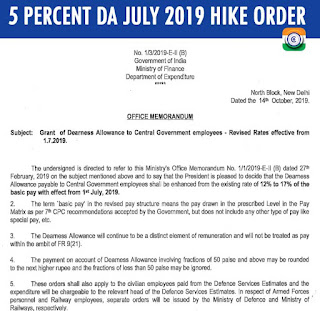
5 Percent DA July 2019 Hike Order - Grant of Dearness Allowance to Central Government employees

Grant of Dearness Allowance to Central Government employees 5 Percent DA July 2019 Hike Order  No. 1/3/2019-E- II (B) Government of...

Blog Archive

About The Author