A complete reference blog for Indian Government Employees

Saturday, 28 December 2019

7th CPC Date of next increment under Rule 10 of Central Civil Services Revised Pay Rules 2016

7th CPC Date of next increment under Rule 10 of Central Civil Services Revised Pay Rules 2016

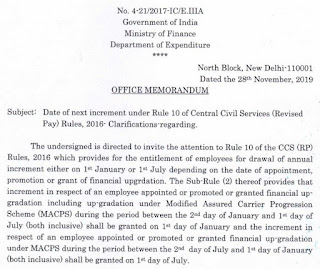
No. 4-21/2017-IC/E.IIIA
Government of India
Ministry of Finance
Department of Expenditure


North Block, New Delhi-110001
Dated the 28th November, 2019

OFFICE MEMORANDUM

Subject: Date of next increment under Rule 10 of Central Civil Services (Revised Pay) Rules, 2016 - Clarifications - regarding.

The undersigned is directed to invite the attention to Rule 10 of the CCS (RP) Rules, 2016 which provides for the entitlement of employees for drawal of annual increment either on 1st January or 1st July depending on the date of appointment, promotion or grant of financial upgrdation. The Sub-Rule (2) thereof provides that increment in respect of an employee appointed or promoted or granted financial up­-gradation including up-gradation under Modified Assured Carrier Progression Scheme (MACPS) during the period between the 2nd day of January and 1stday of July (both inclusive) shall be granted on 1st day of January and the increment in respect of an employee appointed or promoted or granted financial up-gradation under MACPS during the period between the 2nd day of July and 1st day of January (both inclusive) shall be granted on 1st day of July.


2. A number of references were received in the Ministry of Finance seeking clarifications regarding drawal of next increment by the employees promoted on 1st July, 2016. On consideration of the matter, Department of Expenditure vide it’s Office Memorandum of even number dated 31.07.2018 has clarified that in case an employee is promoted or granted financial up-gradation including up-gradation under the MACP scheme on 1st January or 1st July, where the pay is fixed in the Level applicable to the post on which promotion is made in accordance with the Rule 13 of the CCS (RP) Rules, 2016, the first increment in the Level applicable to the post on which promotion is made shall accrue on the following 1st July or 1st January, as the case may be, provided a period of 6 months qualifying service is strictly fulfilled. The next increment thereafter shall, however, accrue only after completion of one year.

3. Consequent upon issue of Office Memorandum dated 31.07.2018 different Ministries/ Departments have sought clarification on applicability of DOE's O.M dated 31.07.2018 keeping in view the provisions of Rule 10 of CCS (RP) Rules 2016 , Rule 22(I)(a)(1) of Fundamental Rules & provisions of Stepping up of pay. The issues on which various Ministries / Departments have sought clarifications and decisions thereon are brought in the succeeding paragraphs.
Issue No. 1: Whether after promotion on 1st July and fixation of pay with two increments the date of next increment will be 1st January or 1st July
4. During the regime of 6th CPC, when the annual increment was admissible uniformly on 1st July every year, employees completing 6 months and above in the revised pay structure as on 1st July were eligible for grant of increment. In the 7th CPC regime there are two dates of increments pt January and 1st July. Keeping in view the spirit of 6th CPC, O.M dated 31.07.2018 was issued providing for accrual of next increment on 1st July/1st January in respect of employees getting promotion on , 1st January/ 1st July provided 6 months qualifying service is strictly fulfilled.

5. The instructions contained in the O.M. dated 31.07.2018 are self-explanatory in respect of the cases of promotion/ financial up-gradation falling on 1st July or 1st January. These instructions provide that in case of promotion/ financial up­ gradation on 1st July and 1st January and getting fixation of pay in the Level applicable to the post in which promotion is made in accordance with Rule 13 of the CCS (RP) Rules 2016, the first increment in the level in which promotion is made shall accrue on the following 1st January or 1st July, as the case may be, provided a period of 6 months’ qualifying service is fulfilled.
Issue No.2 : Accrual of next increment in case of regular promotion / financial up­ gradation of an employee on any date other than the date of annual increment and option for pay fixation is exercised under FR 22(I)(a)(1).
The opportunity to exercise of option for pay fixation under FR 22(I)(a)(1) is available to employees in case of promotion / financial up-gradation. Therefore, the Central Government Employee promoted on regular basis/granted financial up­ gradation on any date other than the date of his/ her annual increment in lower grade and exercises the option under FR 22(I)(a)(1) read with Department of Personnel & Training’s OM No.13/02/2017-Estt.(Pay-I) dated 27.07.2017 for fixation of pay from the date of accrual of next increment in the scale of pay in lower grade, he may be allowed the 1st increment in promotional grade on 1st January/ 1st July as the case may be after completion of 6 months’ qualifying service after such fixation on 1st July/ 1st January (i.e., the date of increment in lower grade) on the analogy of Department of Expenditure’s OM dated 31.07.2018. The next increment, thereafter, shall however, accrue only after completion of one year.

Since there is material change, it has also been approved that the employees who have been regularly promoted or granted financial up-gradation on or after 01.01.2016 and desire to exercise/ re-exercise option for pay fixation under FR22(I)(a) (l) shall be given an opportunity to exercise or re-exercise of the option there under. Such an option shall be exercised within one month of issue of this O.M.
These instructions will be applicable with effect from 01.01.2016.

In so far as persons serving in the Indian Audit and Accounts Department are concerned, these orders issue after consultation with the Comptroller and Auditor General of India.

Hindi version of these orders is attached.

(B.K.Manthan)
Deputy Secretary to the Government of India
7th CPC Date of next increment under Rule 10 of Central Civil Services Revised Pay Rules 2016

Source: DoE
Share:

Friday, 27 December 2019

Highlights of Ministry of Home Affairs 2019

Highlights of Ministry of Home Affairs 2019

Ministry of Home Affairs

Year End Review 2019 Ministry of Home Affairs

Highlights of Major Decisions / Initiatives of MHA

(Separate Press Releases issued on each topic listed below)

Highlights of Ministry of Home Affairs 2019


26 DEC 2019

Important Bills Passed by Parliament

  1. Jammu and Kashmir - Abrogation of Article 370 and 35A ; The Jammu and Kashmir (Reorganisation) Act, 2019; The Jammu and Kashmir Reservation (Amendment) Act, 2019
  2. National Investigation Agency (Amendment) Act, 2019
  3. Unlawful Activities (Prevention) Amendment Act, 2019
  4. Special Protection Group (Amendment) Bill, 2019 – aims to increase operational efficiency of SPG in ensuring the security of the Prime Minister of India.
  5. Citizenship (Amendment) Bill 2019 – focus on granting Indian Citizenship to persons belonging to Hindu, Sikh, Buddhist, Jain, Parsi and Christian communities on ground of religious persecution in Pakistan, Afghanistan and Bangladesh. Marathon deliberations held by Union Home Minister with various stakeholders from North East and their concerns against the CAB 2019 addressed in the final Amendment Act.
  6. Arms (Amendment) Bill, 2019 – enhances the punishment for existing offences like illegal manufacture, sale, transfer and illegal acquiring, possessing or carrying prohibited arms or prohibited ammunition; illicit trafficking of firearms; celebratory gunfire endangering human life. Arms licenses to be issued for 5 years in electronic form, which would prevent forgery. The Amendment would reduce possession of illegal firearms and commission of criminal offences by limiting 2 licenses per person. Ownership of arms by retired and serving personnel of armed forces and sportspersons remains unaffected by the Amendment. Further, Ancestral guns may be retained in a Deactivated State.
  7. Protection of Human Rights (Amendment) Bill, 2019 - to make the constitution of NHRC and SHRCs broader and more inclusive.
  8. Dadra and Nagar Haveli and Daman and Diu (Merger of Union Territories) Bill, 2019 - Administrative efficiency, better service delivery and effective implementation of Central and State Government Schemes to be the focus.

Jammu & Kashmir and Ladakh

1. Abrogation of Article 370 and 35A
  • Historic step to remove Article 370 and 35A of Constitution of India
  • Brought JK & Ladakh at par with other States and UTs
  • All provisions of Constitution of India, without any modifications or exceptions, to now apply to JK & Ladakh
  • Laws of Union Government wrt education, empowerment of SC, ST, Minorities etc to be applicable to JK & Ladakh
  • Boost to local economy and employment opportunities by increasing investment; Reservation to EWS of society in jobs & educational institutions to apply in JK & Ladakh
  • Betterment of socio-economic infrastructure in JK & Ladakh The Jammu and Kashmir (Reorganisation) Act, 2019
2. Jammu and Kashmir reorganised into
  • Union Territory of Jammu and Kashmir with legislature, and
  • Union Territory of Ladakh without Legislature
  • Formally came into force on 31st October, 2019
  • Maps of newly formed UTs of Jammu & Kashmir and Ladakh released
  • 1st Winter-grade Diesel outlet for Ladakh inaugurated by Union Home Minister; move to boost tourism in extreme weather conditions
3. The Jammu and Kashmir Reservation (Amendment) Act, 2019
3% reservation in services and educational institutions extended to people living near the International Border (IB) in J&K, in line with reservation given to people living near the Line of Control (LoC)
4. Amarnath Yatra
  • 3,42,883 yatris had safe and secure Darshan
  • Higher by nearly 20%, as compared to 2018
5. Cabinet approved Inclusion of 5,300 Displaced Persons families of J&K in the Rehabilitation Package for Displaced Families of PoJK and Chhamb, under the PM’s Development Package 2015 for Jammu & Kashmir
6. Government Employees of UTs of J&K and Ladakh to get all 7th Central Pay Commission Allowances from 31st October 2019 - allowances worth around Rs. 4800 crores approved for Government employees.

Kartarpur Sahib Corridor

  1. Union Cabinet passed a resolution on 22nd November 2018 to celebrate the historic occasion of 550th Birth Anniversary of Sri Guru Nanak Devji in a grand and befitting manner, throughout the country and across the globe
  2. India signed the Kartarpur Sahib Corridor Agreement with Pakistan on 24th October, 2019
  3. Indian pilgrims of all faiths to undertake year-round Visa-free travel to Gurudwara Kartarpur Sahib through Kartarpur Sahib Corridor – a long standing demand of followers of Guru Nanak Dev ji
  4. State of art Passenger Terminal Building (PTB) developed (estd. project cost – Rs. 400 crore), having modern public amenities and security features; architecture reflecting cultural heritage of Punjab
  5. 54 Immigrations counters at PTB for facilitating travel of over 5000 pilgrims per day
  6. 4.19 km long, 4-lane highway worth Rs. 120.05 crores built, in record time of 6 months, on Indian side for giving accessibility for pilgrims to the PTB
  7. Special Trains run from across the country to facilitate pilgrims to visit Sultanpur Lodhi, the place where Guru Nanak Devji attained enlightenment and developed as Heritage Town
  8. 300ft. Monumental National Flag at PTB
  9. Online portal (prakashpurb550.mha.gov.in) created to facilitate registration of pilgrims and provide other important information including Do’s & Dont’s and FAQs

Strict Action on Terror and Insurgency

1. National Investigation Agency (Amendment) Act, 2019
  • NIA empowered with extra territorial jurisdiction for investigation of terrorism related offences taking place outside India, in which Indian property/citizens are victims
  • The mandate of NIA is expanded by inclusion of new offences viz. explosive substances, human trafficking, manufacturing/sale of prohibited arms and cyber terrorism, to its Schedule
2. Unlawful Activities (Prevention) Amendment Act, 2019
  • Central Government empowered to designate individual as terrorist
  • NIA empowered to seize/forfeit property representing proceeds of terrorism in cases investigated by NIA
  • After recent amendment, 4 Individuals viz., Maulana Masood Azhar, Hafiz Muhammad Saeed, Zaki ur Rehman Lakhvi and Dawood Ibrahim proscribed as Terrorists
  • Liberation Tigers of Tamil Eelam (LTTE) banned for another five years under sub-sections of UAPA, 1967
3. Cyber Crime Control
  • National Cyber Crime Reporting Portal (www.cybercrime.gov.in) launched as a citizen centric initiative to facilitate public for reporting of all types of Cyber Crimes without visiting Police Station
  • The complaints reported on this portal are accessible online to the law enforcement agencies of respective States/UTs for taking appropriate action as per law
  • 12th India Security Summit on ‘Towards New National Cyber Security Strategy’ held in New Delhi
4. Review Meeting on Left Wing Extremism (LWE)
  • Incidents of LWE violence down from 2258 in 2009 to 833 in 2018
  • Number of deaths dropped from 1005 in 2009 to 240 in 2018
  • Districts affected by naxal violence reduced from 96 in 2010 to 60 in 2018
5. Smart Fencing - Union Home Minister launched BOLD-QIT (Border Electronically Dominated QRT Interception Technique) under Comprehensive Integrated Border Management System (CIBMS) on Indo-Bangladesh border in Dhubri district of Assam, as an effective deterrence against illegal infiltration. Two pilot projects covering about 71 Kms on Indo-Pakistan Border (10 Kms) and Indo-Bangladesh Border (61 Kms) of Comprehensive Integrated Border Management System (CIBMS) have been completed.

6. International Drug Syndicate busted - largest seizure of contraband drugs by NCB in India - 20 Kgs of Cocaine, worth Rs. 100 crores, seized.

PIB
Share:

Wednesday, 25 December 2019

Revised Training Module of Non-Gazetted Staff of Medical Department

Revised Training Module of Non-Gazetted Staff of Medical Department

NFIR

Government of India (Bharat Sarkar)
Ministry of Railways (Rail Mantralaya)
(Railway Board)

RBE No.206/2019
No. E(MPP)2019/3/51

New Delhi, Dated 27.11.2019

To
The General Managers,

Sub: Revised Training Module of Non-Gazetted Staff of Medical Department.

Ref: chairman/Railway Board's letter No. E(MPP)/ 2016/3/20 dated 28.11.2018 and Board's letter dated 06.12.2018

Vide Board (CRB) letter No. E(MPP)/ 2016/3/20 dated 28.11.2,018, DG/NAIR had been authorized as the Head of the Academic Council of all CTIs to develop Training Modules of all categories of Non-Gazetted staff. Accordingly, training module of Medical Department was finalized and sent to this office.

2. Ministry of Railways (Railway Board) has reviewed the above Training Modules proposed and submitted by DG/NAIR. Board (DG/Health & MS) has approved the revised training module.

3. The revised module prepared have been scanned and uploaded under E(MPP) Training Circulars and can be viewed or downloaded from railnet.

4. General Manager / PHOD shall identify and decide the locations for conducting training of staff on the above revised module in their respective Zones.

5. Kindly acknowledge receipt.

(Alka Arora Misra)
Principal Executive Director/MPP
Railway Board.

Source: NFIR
Share:

Tuesday, 24 December 2019

Cabinet approves Atal Bhujal Yojana


Cabinet
Cabinet approves Atal Bhujal Yojana

24 DEC 2019

The Union Cabinet chaired by the Prime Minister Shri Narendra Modi has given its approval for the implementation of the Atal Bhujal Yojana (ATAL JAL), a Central Sector Scheme with a total outlay of Rs.6000 crore to be implemented over a period of 5 years (2020-21 to 2024-25).

Also check: World Bank approves Rs. 6,000 crore Atal Bhujal Yojana

The scheme aims to improve ground water management through community participation in identified priority areas in seven States, viz. Gujarat, Haryana, Karnataka, Madhya Pradesh, Maharashtra, Rajasthan and Uttar Pradesh. Implementation of the scheme is expected to benefit nearly 8350 Gram Panchayats in 78 districts in these States. ATAL JAL will promote panchayat led ground water management and behavioural change with primary focus on demand side management
Out of the total outlay of Rs. 6000 crore, 50% shall be in the form of World Bank loan, and be repaid by the Central Government. The remaining 50% shall be through Central Assistance from regular budgetary support. The entire World Bank's loan component and Central Assistance shall be passed on to the States as Grants.

ATAL JAL has two major components:
A. Institutional Strengthening and Capacity Building Component for strengthening institutional arrangements for sustainable ground water management in the States including improving monitoring networks, capacity building, strengthening of Water User Associations, etc.

B. Incentive Component for incentivising the States for achievements in improved groundwater management practices namely, data dissemination, preparation of water security plans, implementation of management interventions through convergence of ongoing schemes, adopting demand side management practices etc.
ATAL JAL will result in:
  • Institutional strengthening for improving ground water monitoring networks and capacity building of stakeholders at different levels which will enhance ground water data storage, exchange, analysis and dissemination.
  • Improved and realistic water budgeting based on an improved database and preparation of community-led Water Security Plans at Panchayat level
  • Implementation of Water Security Plans through convergence of various ongoing/ new schemes of the Government of India and State Governments to facilitate judicious and effective utilization of funds for sustainable ground water management.
  • Efficient use of available ground water resources with emphasis on demand side measures such as micro-irrigation, crop diversification, electricity feeder separation etc.
Impact:
  • Source sustainability for Jal Jeevan Mission in the project area with active participation of local communities.
  • Will contribute towards the goal of doubling the farmers' income.
  • Will promote participatory ground water management.
  • Improved water use efficiency on a mass scale and improved cropping pattern;
  • Promotion of efficient and equitable use of ground water resources and behavioral change at the community level;
Background:
Ground water contributes to nearly 65% of total irrigated area of the country and nearly 85% of the rural drinking water supply. The limited ground water resources in the country are under threat due to the increasing demands of growing population, urbanization and industrialization. Intensive, and unregulated ground water pumping in many areas has caused rapid and widespread decline in ground water levels as well as reduction in the sustainability of ground water abstraction structures. The problem of reduction in ground water availability is further compounded by deteriorating ground water quality in some parts of the country. The increasing stress on ground water due to over- exploitation, contamination and associated environmental impacts threaten to endanger the food security of the nation, unless necessary preventive / remedial measures are taken on priority.
The Department of Water Resources, River Development & Ganga Rejuvenation, Ministry of Jal Shakti has taken a pioneering initiative for ensuring long term sustainability of ground water resources in the country through the Atal Bhujal Yojana (ATAL JAL) by adopting a mix of 'top down' and 'bottom up' approaches in identified ground water stressed blocks in seven states, representing a range of geomorphic, climatic and hydrogeologic and cultural settings. ATAL JAL has been designed with the principal objective of strengthening the institutional framework for participatory ground water management and bringing about behavioral changes at the community level for sustainable ground water resource management. The scheme envisages undertaking this through various interventions, including awareness programmes, capacity building, convergence of ongoing/ new schemes and improved agricultural practices etc.

PIB
Share:

DoPT - Engagement of Retired government officials in the Department of Drinking Water and Sanitation as Section Officer

Latest DoPT Orders 2019

Engagement of Retired government officials in the Department of Drinking Water and Sanitation as Section Officer

F.No.21/07/2019-CS-I(P)
Ministry of Personnel, Public Grievances Pension
Department of Personnel & Training
(C.S.I Division)

2nd Floor, 'A' wing,
Lok Nayak Bhawan,
Khan Market,
New Delhi
Dated 23 December, 2019

OFFICE MEMORANDUM

Subject:- Engagement of Retired Government Officials as Section Officer on retainer-ship basis in the Department of Drinking Water and Sanitation

The undersigned is directed to circulate the Office Memorandum No. A-41020/1/2019 - Admin dated 17th December, 2019 (along-with enclosures) received from Ministry of Jal Shakti, proposes to engage retired Government Officials as Section Officer (SO) on retainer-ship basis in the Department of Drinking Water and Sanitation.

2. In case of any further clarification, applicants are requested to contact the concerned Ministries/Departments.

Also check: Engagement of retired central Government officers as consultants at Section Officer & Assistant Section Officer level

(Sanjay Kumar Das Gupta)
Under Secretary to the Government of India 

CIRCULAR

It is proposed to engage retired Government employees to work as Retainers against the vacant posts of Section Officer (SO) in the Department of Drinking Water & Sanitation as per the following criteria:
(a) Must have retired from Central Government Ministries / Departments.
(b) Must have retired as SO or above and well acquainted with functioning of Government Ministries.
(c) Should have good communication and interpersonal skills and excellent knowledge of Computer usage.
(d) Work profile and responsibility would be similar to post in the Central Government.

Also check: Engagement of Retired Government Officers as Consultant on contract basis in the Directorate General of Health Services as Under Secretary level

The engagement of retainers shall be subject to the following conditions:

(i) Persons must be below 64 years of age as on the last date of application.
(ii) Engagement shall initially be for a period of six months or until regular incumbents are available, whichever is earlier.
(iii) Extension of engagement, if any, shall be at the sole discretion of competent authority.
(iv) Working hours shall be from 9.00 a.m. to 5.30 p.m. during working days including half an hour lunch break in between. However, in exigencies of work, he/she may be required to sit late and may be called on Saturdays/Sundays and other Gazetted Holidays.
(v) Individual will be required to mark his attendance in Biometric Attendance System (BAS).
(vi) Shall be entitled to 4 days leave in six calendar months. The un-availed leave cannot be carried forward or encashed. (vii) Individual will give one month notice for leaving the services of the Ministry.
(viii) Engagement may be terminated at any time by the Government without assigning any reason \without any notice.
(ix) Ministry of Drinking Water and Sanitation shall not be responsible for any loss, accident, damage or injury suffered by the individual arising out of execution of his/her official duty.
(x) The selected officers will be paid a consolidated fee (TDS as applicable). He/She shall not be entitled for any allowances such as Dearness Allowance, residential, telephone, transport, etc.
(xi) He/She will not be allowed any foreign travel at Government Expenses.
(xii) Individual engaged shall not directly or indirectly communicate or reveal to any person or persons any matter collected for the purpose of his/her assignment or during the course of his/her assignment, without the express written consent of the office.
(xiii) Individual engaged shall not represent or give opinion or advice in any matter which is adverse to the interest of this Office. He/She is not permitted to take up any other assignment during his period of engagement.
(xiv) Preference would be given to those retired in the last one year.

Source: DoPT

Share:

DoPT - Submission of Immovable Property Return (IPR) for the year 2019 by CSS Officers

DoPT - Submission of Immovable Property Return (IPR) for the year 2019 by CSS Officers

Latest DoPT Orders 2019

F. No. 26/01/2018-CS.I (PR/CMS)
Government of India
Ministry of Personnel, Public Grievances and Pensions,
Department of Personnel & Training

2nd Floor, Lok Nayak Bhawan,
Khan Market, New Delhi
Dated December 20th , 2019.

OFFICE MEMORANDUM

Subject:- Submission of Immovable Property Return (IPR) for the year 2019 (as on 31.12.2019) by the Officers of Central Secretariat Services (CSS) reg.

In terms of Rule 18 of CCS (Conduct) Rules, 1964, the Immovable Property Return is required to be furnished by the CSS Officers in the grade of Under Secretary and above, latest by 31 .01.2020. IPR should be submitted by all the CSS Officers through Web Based Cadre Management System which is hosted at cscms.nic.in. A copy of the print out (IPR submitted online) duly signed, should also be submitted to CS.I (PR/CMS) Section, which is the custodian of Immovable Property Return (IPR) of these Officers. Assistant Section Officers and Section Officers of CSS will also submit the print out (IPR) duly signed, to their respective Admin/ Vigilance Division.

Ministries/ Departments are therefore, requested that the contents of this O.M. may be widely circulated to the notice of all CSS Officers/Officials working under their respective control. They should also ensure that the IPR for the year 2019 (as on 31.12.2019) is submitted within the stipulated time by all the CSS Officers. The officers are also informed that non-submission of IPR within the stipulated date, would invite the denial of vigilance clearance for empanelment, deputation and applying to sensitive posts and assignment to training programme (except mandatory training) as the IPR status needs to be checked for the said purpose(s).

Also check: Submission of Immovable Property Return (IPR) for the year 2018
It is, therefore, requested that all the CSS Officers may be directed to file their Immovable Property Return (IPR) for the year 2019 (as on 31.12.2019) well in time, latest by 31.01.2020, through Web Based Cadre Management System only. IPRs received beyond the stipulated date, shall not be regarded as conforming to the extant guidelines. It is also stated that the date of filing of IPR will start from 01st January, 2020 and the "Immovable Property Returns" window shall be opened/provided at cscms.nic.in. automatically from that date only.

In case of any doubt/ difficulty about filing the IPR, Shri Vijay Pal, Section Officer (PR/CMS)/ Shri Krishnandan Kumar, Assistant Section Officer (PR/CMS) may be contacted at Telephone No. 24629414.

(Sanjay Kumar Das Gupta)
Under Secretary to the Government of India
Source: DoPT
Share:

Post Office Savings Account Scheme 2019


Post Office Savings Account Scheme 2019 - Gazette Notification

Post Office Savings Account Scheme 2019


NOTIFICATION

New Delhi, the 12th December, 2019

G.S.R. 921(E).- In exercise of the powers conferred by section 3A of the Government Savings Promotion Act, 1873 (5 of 1873), the Central Government hereby makes the following Scheme, namely:-

1. Short title and commencement:
(1) This Scheme may be called the Post Office Savings Account Scheme, 2019.
(2) It shall come into force on the date of its publication in the Official Gazette.

2. Definitions:
(1) In this Scheme, unless the context otherwise requires,-
(a) "account" means an account opened under this Scheme;
(b) "account holder" means an individual in whose name the Account is held;
(c) "Act" means the Government Savings Promotion Act, 1873 (5 of 1873);
(d) "Form" means forms appended to this Scheme;
(e) "General Rules" means the Government Savings Promotion General Rules, 2018;
(f) "year" means a period of twelve months commencing on the 1st day of April.
(2) Words and expressions used herein but not defined shall have the meanings assigned to them in the Act and in the General Rules.

Also check: Income Tax benefits from Post Office Saving Schemes

3. Type of Account:
(1) An account may be opened by making an application in Form-1 by the following:-
(a) a single adult;
(b) two adults jointly;
(c) a guardian on behalf of a minor;(d) a guardian on behalf of a person of unsound mind;
(e) a minor who has attained the age of ten years, in his own name:
Provided that only one account can be opened by an individual as a single account:
Provided further that an account under clause (e) can only be opened if an account under clause (c) does not exist in the name of the minor or vice versa.

(2) The share of an individual in the balance in a joint account shall be in equal proportion. On the death of one of the account holder in a joint account, the surviving account holder shall be treated as the sole owner of the account and he may continue the account in accordance with the provisions of this Scheme provided another single account is not held in his name. In case a single account exists in the name of the surviving holder, the account shall have to be closed.

4. Deposits and withdrawals:
(1) The account may be opened with a minimum deposit of five hundred rupees and no subsequent deposit shall be accepted for an amount less than ten rupees.

(2) There shall be no maximum limit of deposit in an account.

(3) Withdrawals from the account for not less than fifty rupees may be made by presenting pass book alongwith Form-2 duly filled in and signed. Withdrawals from the account may also be made subject to the availability of balance above minimum prescribed limit by way of cheque or electronic means.

(4) No withdrawal shall be permitted which has the effect of reducing the balance to less than five hundred rupees.

(5) In case of an account having a balance of less than five hundred rupees immediately before the commencement of this Scheme, the account holder shall deposit the difference amount within a period of one year from the date of commencement of this Scheme, so as to bring the balance in the account to a minimum of five hundred rupees and the accounts office shall be responsible for advising the account holder through appropriate mode to make the required deposits within the specified date.

(6) If the account holder fails to make such deposit within the specified period, an account maintenance fee of one hundred rupees shall be deducted from the account on the last working day of each financial year and after deduction of the account maintenance fee, if the balance in the account becomes nil, the account shall stand automatically closed and the account holder shall be notified accordingly. This provision shall be applicable to all accounts including Silent Account.

(7) All deposits and withdrawals shall be made in whole rupees only.

Also check:  Mandatory use opening of Savings Account in CBS Post Offices

5. Interest on deposits in an account:
(1) The interest at the rate of four per cent per annum shall be allowed for a calendar month on the lowest balance at the credit of an account between the close of the tenth day and the end of the month, and such interest shall be calculated and credited in the account at the end of each year.

(2) The interest shall be allowed only on sums of whole rupees and shall be rounded off to the nearest rupee and for this purpose any amount of fifty paisa or more shall be treated as one rupee and any amount less than fifty paisa shall be ignored.

(3) No interest shall be allowed on an account for any month in which the balance at credit is below five hundred rupees at any time between the tenth and the last day of the month.

(4) If an account is closed during a year, interest shall be allowed upto the end of the month preceding the month in which the account is closed.

(5) In the event of death of an account holder, the interest in his account shall be paid only in the end of the month preceeding the month in which the account is closed.

6. Confirmation of balance
A pass book or statement of account of the account holder shall be issued by the accounts office. The account holder may confirm balance in his account by presenting his pass book during office hours.

7. Issue of cheque book
A cheque book containing ten leaves may be issued to the account holder on an application, free of charge in a year. Subsequent issue of cheque book shall be charged at two rupees per cheque.

8. Silent Account:
(1) An account in which a deposit or a withdrawal has not taken place for three complete years, shall be treated as a Silent Account and credit of interest in a Silent Account shall not be treated as a transaction.
(2) Transaction in a Silent Account shall be allowed only after revival of account. The account can be revived through an application by the account holder and after completion of the due process by the accounts office.

9. Final withdrawal on closure:
The account may be closed at any time by the account holder by surrendering the pass book, unused or partially used cheque book, if any, etc. to the accounts office, along with the application in Form-2 for closure of the account.

10. Application of General Rules:
The provisions of the General Rules shall, so far as may be, apply in relation to the matters for which no provision has been made in this Scheme.

11. Power to relax:
Where the Central Government is satisfied that the operation of any of the provision of this Scheme causes undue hardship to an account holder, it may, by order for reasons to be recorded in writing, relax the requirements of that provision in a manner not inconsistent with the provisions of the Act.

[F.No.2/2/2018 NS (Pt.I)]
RAJAT KUMAR MISHRA, Jt. Secy.
Share:

Featured post

5 Percent DA July 2019 Hike Order - Grant of Dearness Allowance to Central Government employees

Grant of Dearness Allowance to Central Government employees 5 Percent DA July 2019 Hike Order  No. 1/3/2019-E- II (B) Government of...

Blog Archive

About The Author