A complete reference blog for Indian Government Employees

Sunday, 29 January 2017

GST: Finance Minister may hike service tax to 16-18% in Budget


GST: Finance Minister may hike service tax to 16-18% in Budget

New Delhi: Finance Minister Arun Jaitley may hike service tax rate to 16-18 per cent from the current 15 per cent in the Budget, due on Wednesday, as a precursor to the Goods and Services Tax (GST) rollout.

The move, that will make flying, eating out, phone bills and a host of other services expensive, would be an attempt to take the rates closer to the proposed tax slabs for GST.

GST, which will subsume central and state levies like excise duty, service tax and VAT, is scheduled to be rolled out from July 1.

The tax slabs decided for the GST are 5, 12, 18 and 28 per cent and taking service tax closer to one of the slabs is a logical move in the Budget, tax experts said.

Tax experts say, Jaitley, who had in his previous budget hiked service tax rate by 0.5 per cent to 15 per cent, may raise the levy by at least one percentage point to 16 per cent.

Some others feel there could be different service tax rates with a lower 12 per cent for basic services and a higher 18 per cent for the rest.

Also, a higher service tax for April-June will help the government garner more revenue to meet expenses on schemes and programmes it may be planning to contain the impact of demonetisation.

A service tax rate closer to the GST rate will also help consumers avoid a greater price shock when the new national sales tax is rolled out.

While service tax until now is a central levy, it will be equally split between the Centre and states under the new GST regime. Most services, except essential ones like primary healthcare and basic education, will be covered by GST.

Service tax was budgeted to provide Rs 2.31 lakh crore in 2016-17, more than 14 per cent of the Centre’s total tax revenues of Rs 16.30 lakh crore.

This will be the third time that Jaitley will raise service tax rate. Service tax from June 1, 2015 was hiked from 12.36 per cent to 14 per cent. A 0.5 per cent Swachh Bharat Cess was levied on all services, taking the total incidence of service tax to 14.5 per cent from November 15, 2015.

In the last Budget, he imposed a Krishi Kalyan Cess at the rate of 0.5 per cent on all taxable services to take the levy to 15 per cent.

PTI
Share:

Government may make Aadhaar must for rail concession in Budget 2017


Government may make Aadhaar must for rail concession in Budget 2017

New Delhi: Government is contemplating to make Aadhaar or Unique Identification (UID) card mandatory to avail rail concession, and an announcement is likely to be made by Finance Minister Arun Jaitley while presenting the first combined General and Railway Budget on February 1.

The move will help the government in better targetting of benefits and check misuse of the facility, sources said.

The Railways provides concession on tickets to more than 50 categories of passengers which include senior citizens, students, research scholars, teacher, doctor, nurse, patients, sports people, unemployed youth, Arjun awardees among others.

At present, Railways is running a pilot project for senior citizens who are entitled for rail concessions.

The concessional tickets cost the Railways about Rs 1,600 crore in 2015-16, with the bulk being accounted for senior citizens.

As per the government data, over 100 crore Aadhaar cards have been issued so for covering bulk of India’s population.

The government has decided to end the 92-year-old practice of presenting a separate Railway budget and merged it with the General Budget.

Jaitley, according to sources, will contribute few pages of his Budget to programmes and schemes related to Indian Railways.

Although there will be a single budget, the Railways will continue to have autonomy as commercial undertaking and the existing financial arrangement will remain.

The Railways is expected to get exemption from payment of dividend to the Union government, a move which will help strengthening its finances.

The organisation will also get budget support to meet part of its capital expenditure and will be allowed to raise extra budgetary resources.

According to sources, Railways would continue to bear the expenditure on social and public service obligations.

It is also expected that Jaitley will present a separate statement of budget estimates and demand for grants for Railways in the General Budget.

There will also be a single Appropriation bill, including the estimates of Railways, to the Parliament.

PTI
Share:

Officers to face action for delay in GPF payments to retiring employees


Officers to face action for delay in GPF payments to retiring employees

New Delhi: Action will be taken against the officers concerned in cases of delay in processing payment of General Provident Fund (GPF) to retiring employees, the Centre has said.

The move comes after it was noticed that GPF final payment in many cases was not being made to the government servants immediately after retirement leading to payment of interest for the period delayed.

In an order, the Ministry of Personnel said in order to ensure timely final payment of GPF and to avoid unnecessary financial burden on account of interest, it has now been decided that every case, in which payment of interest on General Provident Fund becomes necessary beyond the date of retirement, shall be put up for consideration to the Secretary of the administrative ministry.

"In all such cases the Secretary of the administrative ministry or department will fix responsibility at all levels to take appropriate action against the government servant or servants who are found responsible for the delay in the payment of General Provident Fund," it said in the directive to all central government departments.

Senior Personnel Ministry officials also said there have been a few instances in which there were complaint of delay in giving final amount of GPF to the retiring employees.

Rules clearly provide that when the amount standing at the credit of a subscriber in the General Provident Fund becomes payable, it shall be the duty of the Accounts Officer to make the payment.

The authority for the amount payable is to be issued at least a month before the date of superannuation, but payable on the date of superannuation, the rules say.

The Centre had in 1996 dispensed with the requirement of submitting a written application by the retiring government servant for GPF final payment.

As per the rules, in case the GPF balance is not paid on retirement, interest on the GPF balance is required to be paid for the period beyond the date of retirement also.

PTI
Share:

Pay element relating to Running Staff after the recommendations of 7th CPC


Pay element relating to Running Staff after the recommendations of 7th CPC

GOVERNMENT OF INDIA
MINISTRY OF RAILWAYS
RAILWAY BOARD

No.E(P&A)II-2015/RS-25
New Delhi, dated: 24.01.2017
The General Manager,
All Indian Railways
and Production Units.

Sub: Pay element relating to Running Staff after the recommendations of Seventh CPC.

It has come to notice that on some of the zonal railways add-on pay element of 55% is not being reckoned for calculation of emoluments for the purpose of retirement benefits for the running staff on the basic pay fixed in the 7th CPC pay structure. As per Rule 924 (iii) of IREM-I that is still valid, 55% of Basic Pay is recokoned as add-on pay element for calculation of pension and DCRG of the Running Sitff. It is therefore advised that calculation of retirement benefits of the running staff may be made as per extant Rule 924 (iii) of IREM-I on the revised basic pay in the 7th CPC.

2. This issues with the concurrence of the Finance Directoiate of the Ministry of Railways.

(Dhruv Singh)
Executive Director
Pay Commission-I
Railway Board
Source: NFIR
Share:

Saturday, 28 January 2017

7th Pay Commission: In 70 years, senior government officials salary hiked from Rs 2,000 to Rs 2.50 lakh


7th Pay Commission: In 70 years, senior government officials salary hiked from Rs 2,000 to Rs 2.50 lakh


7th Pay Commission


The 7th pay commission has recommended a 14.27% increase in the basic pay of government employees.
1. In the last 70 years, the government has announced 7 pay commissions.
2. In 1947, govt officials lowest salary was Rs 55 per month.
3. The 7th pay commission has recommended a hike of 14.27 pc in govt employees salary.
In the last 70 years, the Central government has announced seven central pay commissions. The 7th pay commission has recommended a 14.27 per cent increase in the basic pay of govt employees.

In 1947, after India's Independence, the lowest salary of a central government employee was Rs 55 per month while the senior most officials took home a salary of Rs 2000 per month. After the 6th pay commission, the monthly salary of senior government officials rose to Rs 90,000 with the lowest salary being Rs 7000 per month.

Central Pay Commission's previous recommendations:
Central Pay Commission previous recommendations

Following was the salary slabs of government employees in different pay commissions:
 salary slabs of government employees in different pay commissions

The government employees' salaries saw a significant rise with the 7th pay commission. Now, after the 14.27 per cent increase in basic salary, the lowest salary has been increased to Rs 18,000 from Rs 7,000 while the salary of senior government officials has gone up to Rs 2.50 lakh from Rs 90,000.
In the last 70 years, the Centre has increased the minimum salary of its employees from Rs 55 to Rs 18,000 per month - a hike of 32,727 per cent.

Whereas the salary of senior officials has seen a quantum jump of 12,500 per cent in the same period, from Rs 2,000 per month to Rs 2.50 lakh.

Source: Indiatoday
Share:

GST will not lead to job losses at central excise dept, assures Jaitley


GST will not lead to job losses at central excise dept, assures Jaitley

New Delhi: Ahead of the rollout of GST, Finance Minister Arun Jaitley today sought to address concerns of job loss from reduced work of central excise and service tax officials, saying they should have no insecurity as enough work and opportunities will be available to them in the new indirect tax regime.

"I see no reason really for disquiet for the simple reason (that) opportunities which are available to people in service and the matter of policy and constitutional guarantee are all protected," he said at the Investiture Ceremony 2017 and International Customs Day 2017 organised by CBEC here.

Only the nature of activity will change because there will be one national sales tax replacing an array of central and state levies like excise duty, service tax and VAT.

"Important changes and evolutions which take place are never put on the back burner" just because the people who conduct the activity would now have to work in an altered form and environment, he said.

"The number of people required, the kind of opportunity will remain unchanged except that the nature of activity itself changes," he said.

GST, he said, has for last several yeas been considered as a larger part of policy consensus in India and an important taxation reform that will lead to the economic integration of the country.

"Once it takes place you have a situation where taxes (that) are levied by the state (and) by Centre (will) all be integrated into one and therefore resulting in one assessment.

"Multiple systems on assessment which is there at present will evolve into a newer kind of system," he said.

He was responding to Central Board of Excise and Customs (CBEC) Chairman Najib Shah’s remarks drawing his attention to "the rising disquiet in the cadre", saying there were human resource issues in the service.

Jaitley said the revenue to be collected is going to expand and there will be expansion of economic activity as well.

"Therefore even though you have two parallel machineries which could now be converging into similar kind of activities and shared responsibility, I think the future will stand witness to the fact that there will be adequate amount of opportunities to be created and therefore the kind of disquiet in service, the kind of personal pressure I see on you should reduce as there is no real occasion for a fear of this kind or a sense of insecurity for anyone in this service," he said.

The Finance Minister said change and evolution are an integral part of any economic order, and they are never held back because the nature of responsibility is going to change.

"This is an ongoing process it will continue and we will all have to adjust ourselves with this particular change. I can only assure you that there is no reason for disquiet, you can go and have a comfortable sleep tonight,” he told the revenue officials.

Revenue Secretary Hasmukh Adhia told the officers that they will have enough work to do under GST.

The Indian Revenue Service (Customs and Central Excise) Officers Association has asked the government to protect the sanctity of their service amid attempts by officers of state government VAT departments to equate themselves with IRS (Customs and Central Excise) officers.

PTI
Share:

TDS on approved Provident and Superannuation Funds as per Income-Tax Act

TDS on approved Provident and Superannuation Funds as per Income-Tax Act

TDS on payment of accumulated balance under recognised provident fund and contribution from approved superannuation fund

Ministry of Finance has issued a circular about details of TDS on approved Provident and Superannuation Funds as per Income-Tax Act

TDS ON PAYMENT OF ACCUMULATED BALANCE UNDER RECOGNISED PROVIDENT FUND AND CONTRIBUTION FROM APPROVED SUPERANNUATION FUND:

    The   trustees of a Recognized Provident Fund, or any person   authorized   by the regulations of the Fund   to  make payment of  accumulated   balances due   to  employees, shall   in   cases where sub-rule(1) of Rule 9 of Part A of the Fourth Schedule   to the Act applies, at the time   when the accumulated   balance due to an employee is paid, make therefrom   the deduction specified in Rule 10 of Part A of the Fourth Schedule to the Act.

The accumulated balance is treated as income chargeable under the head “Salaries”.

Where any contribution   made by an  employer,  including   interest on  such  contributions,  if any, in  an approved Superannuation Fund is paid to the employee,  tax on the  amount so paid shall be deducted by the trustees of the Fund  to the extent provided in Rule 6 of Part B of the Fourth Schedule to the Act. TDS should be at the average rate of tax at which, the employee was liable to be taxed during the preceding three years or during the period, if that period is less than three years, when he was member of the fund.

The deductor shall remain liable to deduct tax on any sum paid on account of returned contributions (including interest, if any)  even if a fund or part of a fund ceases to be an approved Superannuation fund.

As per section 192A of the Act, w. e. f. 01.06.2015 the trustees of the EPF Scheme 1952 framed under section 5 of the EPF & Misc. Provisions Act, 1952 or any person authorized under the scheme to make payment of accumulated balance due to employees, shall, in a case where the accumulated balance due to an employee participating in a recognized provident fund is includible in his total income owing to the provisions of Rule 8  of Part A of Fourth Schedule not being applicable at the time of payment of accumulated balance due to the employee, deduct income tax thereon @ 10% if the amount of such payment or aggregate of such payment exceeds Rs 50,000/-. In case the employee does not provide his/her PAN No., then the deduction will have to be made at maximum marginal rate.

Check the Circular
Share:

Featured post

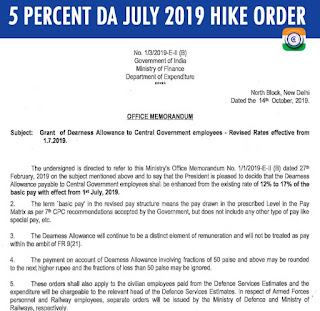
5 Percent DA July 2019 Hike Order - Grant of Dearness Allowance to Central Government employees

Grant of Dearness Allowance to Central Government employees 5 Percent DA July 2019 Hike Order  No. 1/3/2019-E- II (B) Government of...

Blog Archive

About The Author