A complete reference blog for Indian Government Employees

Wednesday, 21 December 2016

Review of CSSS officers in the Grade of Private Secretary (PS) under FR 56(j) and Rule 48 of CCS (Pension) Rules, 1972

Review of CSSS officers in the Grade of Private Secretary (PS) under FR 56(j) and Rule 48 of CCS (Pension) Rules, 1972
Reminder-II
4/3/2016-CS.II(A)
Government of India
Ministry of Personnel, Public Grievances and Pension
Department of Personnel & Training

Lok Nayak Bhavan, Khan Market,
New Delhi-110003, 20th December, 2016

OFFICE MEMORANDUM

Subject: Review of CSSS officers in the Grade of Private Secretary (PS) under FR 560) and Rule 48 of CCS (Pension) Rules, 1972 - reg.

The undersigned is directed to refer to this Department's D.O. letter No 3/8/2015-CS.I (D) dated 26.02.2016 and subsequent reminders dated 09.06.2016 & 08.11.2016 vide which all the cadre units of CSSS were requested to furnish the inputs in the format annexed therewith with respect to the officers who in the opinion of the Ministry/Department, are covered under extant provisions of FR 56G)/Rule 48 of CCS (Pension) Rule, 1972. However, the inputs sought in respect of PS Grade are still awaited from several Cadre Units.

2. All defaulting Cadre Units (as per Annexure) are ,therefore, requested to furnish the requisite information in respect of PSs Grade who are due for review under the provisions of FR 560) to this Department without further delay.
(Umesh Kumar Bhatia)
Under Secretary to the Government of India
Tel.No.24623157
To
Under Secretaries of all the defaulting cadre units of CSSS
Get the circular here
Share:

Filling up the post of Executive Director (North), Delhi, in Food Corporation of India under Department of Food and Public Distribution


F.No. 9/6/2016-EO(SM-I)
Government of India
Ministry of Personnel, Public Grievances and Pensions
Department of Personnel and Training
Office of the Establishment Officer

North Block, New Delhi, 15th December, 2016
To
1. The Chief Secretaries, All State Governments.
2. The Secretaries of all the Ministries/Departments of Government of India.

Subject: Filling up the post of Executive Director (North), Delhi, in Food Corporation of India under Department of Food and Public Distribution.

Sir/Madam,
It is proposed to fill up the post of Executive Director (North), Delhi, in Food Corporation of India in the pay band of Rs. 37,400-67,000/- (PB-4) + Grade Pay Rs. 10,000/- (prerevised) on deputation basis vice Shri Bhagwan Shankar, lAS (SK:88). The post is a Non-Central Staffing Scheme post to be filled up through the Civil Services Board (CSB) procedure.

2. Names of willing and eligible officers, who have been empanelled to hold Joint Secretary or equivalent posts at the Centre, may be recommended to this office along with cadre clearance, vigilance clearance, detailed bio-data, viz. name, date of birth, service, batch, contact telephone number, e-mail address, educational qualifications, complete experience/posting detailsetc. CR dossiers/certified ACRs for the last five years, details of debarment & cooling off in respect of past central deputation. In case the officers are currently on Central deputation, their nomination may be forwarded with the approval of the Minister-in-charge concerned.

3. The post is a Non-Central Staffing Scheme post to be filled up through the Civil Services Board (CSB) procedure. It may be noted that no 'Mandatory Posting Certificate' for allotment/retention of Government accommodation would be issued by this office to the officer appointed on the above referred post. However, those officers who have served and are currently serving on Central Staffing Scheme post in Delhi for at least four years and require to retain Government accommodation, would be issued a certificate to the effect that the officer concerned has served for at least four years in CSS post and he/she needs to retain Government accommodation for his/her tenure on non-CSS post.

4. It is requested that the applications of the eligible candidates may be forwarded so as to reach this Department within one month from the date of issue of this circular.
Yours faithfully,
(Rajender Kumar)
Deputy Secretary to Government of India
Source: persmin.nic.in
Share:

Bonanza for Central government employees: 7th Pay Commission recommendations rolled out

Bonanza for Central government employees: 7th Pay Commission recommendations rolled out

New Delhi: The government had in January 2016 had set up the high-powered panel to process the recommendations of the 7th Pay Commission which will have bearing on the remuneration of nearly 50 lakh central government employees and 58 lakh pensioners.

The Union Cabinet on June 29 cleared the recommendations of the 7th Pay Commission headed by AK Mathur in respect of the hike in basic pay and pension. However, the decision on 7th Pay Commission suggestions relating to allowances had been referred to a Committee headed by the Finance Secretary.
The Committee will complete its work in a time bound manner and submit its reports within a period of 4 months. Till a final decision, all existing allowances will continue to be paid at the existing rates.
The 7th Pay Commission examined a total of 196 existing allowances and, by way of rationalization, recommended abolition of 51 allowances and subsuming of 37 allowances. Given the significant changes in the existing provisions for allowances which may have wide ranging implications, the Cabinet decided to constitute a Committee headed by Finance Secretary for further examination of the recommendations of 7th CPC on allowances.

On 29 June 2016, Government accepted the recommendation of 7th Pay Commission Report with meager increase in salary of 14 percent after six month of intense evaluation and successive discussions. The Finance Minister of India claimed it historical increase of salaries due to little knowledge of Sixth Pay Commission.

The new scales of pay provide for entry-level basic are now up from Rs 7,000 per month to Rs 18,000, while at the highest level i.e. Secretary, it would go up from Rs 90,000 to Rs 2.5 lakh. For Class 1 officers, the starting salary will be Rs 56,100.

The recommendations will benefit over 1 crore employees. This includes over 47 lakh central government employees and 53 lakh pensioners, of which 14 lakh employees and 18 lakh pensioners are from the defence forces.

Here are the Key Highlights
  • Gratuity ceiling doubled to Rs 20 lakh
  • Housing loan allowance hiked from Rs 7.5 lakh to Rs 25 lakh
  • Minimum pension increased from Rs 3,500 to Rs 9,000
  • 7th Pay Commission recommendations to be implemented within 6 months from due date
  • Existing rates of monthly contribution towards Group Insurance to continue
  • Total annual burden of pay, pensions and arrears of 7th Pay Commission recommendations: Rs 1, 02,100 crore
  • 7th Pay Commission recommendations on allowances to be referred to a Committee headed by Secretary
  • Based on minimum pay, fitment factor of 2.57 approved for revising pay of all employees uniformly across all level
  • Minimum pay fixed at Rs 18,000 per month; maximum pay at Rs 2.25 lakh
    The Cabinet approval will benefit nearly 50 lakh central government employees and 58 lakh pensioners
  • Pay hike to be implemented from January 1, 2016
  • Budgetary allocation
While the Budget for 2016-17 fiscal did not provide an explicit provision for implementation of the 7th Pay Commission, the government had said the once-in-a-decade pay hike for government employees has been built in as interim allocation for different ministries. Around Rs 70,000 crore has been provisioned for it.

Source: zeenews
Share:

Government Clarification on Amendment to Payment of Wages Act

Government Clarification on Amendment to Payment of Wages Act

It is seen from the media reports that there is a general impression that is being created that the Government is bringing an amendment to the Payment of Wages Act to make mandatory the payment of wages to the workers only through cheque or accounts transfers. This is not the correct position.
It is clarified that the government proposes to bring an amendment to Section 6 of the Payment of Wages Act which will further provide crediting the wages in the bank account of the employees or payment through cheque along with the existing provisions of payment in current coin or currency notes.

This is being done to facilitate the employers from making payment of wages using the banking facilities also in addition to the existing modes of payment of wages in current coin or currency notes.
Also, the appropriate Government (Centre or State) will have to come up with the notification to specify the industrial or other establishments where the employer shall pay wages through cheque or by crediting the wages in employees’ bank account. It is, therefore, clear that the option of payment through cash is still available with the employers for payment of wages.

It may be understood that the Payment of Wages Act was passed in the year 1936 (eighty years ago) and the situation prevailing at that point of time has completely undergone a technological revolution. Most of the transactions now take place through the banking channels. The proposal of Ministry of Labour and Employment to bring an amendment to Section 6 of the Act is an additional facility of crediting the wages in the bank account of the employees or payment through cheque along with the existing provisions of payment in current coin or currency notes.

The above proposed amendment will also ensure that minimum wages are paid to the employees and their social security rights can be protected. Thus the employers can no longer under-quote the number of employees employed by them in their establishments to avoid becoming a subscriber to the EPFO or ESIC schemes.

It is also pointed out that the states like Andhra Pradesh/Telangana, Kerala, Uttarakhand, Punjab and Haryana have already come out with notifications to provide for payment through banking channels.

PIB

Share:

Ex-gratia lump sum compensation - Recommendations of the Seventh Central Pay Commission.

Ex-gratia lump sum compensation - Recommendations of the Seventh Central Pay Commission.
Office of the CGDA, Ulan Batar Road, Palarn, Delhi Cantt-10

No.5613/AT-P/Vol.XXXI/Ex-Grata
Dated: 20/12/2016
To,
The PCDA (P),
Allahabad-211014

Subject: Ex-gratia lump sum compensation - Recommendations of the Seventh Central Pay Commission.

Government of India, Ministry of Defence D(Pay/Services) vide their letter No.20(2)/2016/D(Pay/Services) dated 2nd November,2016 has issued order on the above subject matter. The same has been uploaded on HQrs. Office website viz. www.cgda.nic.in that may please be downloaded and circulated to all concerned with necessary implementation instructions. The copy of the implementation instructions may also be uploaded on your website under intimation to this HQrs. Office.
Jt.CGDA (Pen) has seen
(A.K. Maiviya)
Sr.AO (AT-Pen)
Original Copy
Share:

Tuesday, 20 December 2016

7th Pay Commission benefits to autonomous bodies and Contract Employees - Government reply

7th Pay Commission benefits to autonomous bodies and Contract Employees - Government reply

Minister's reply to Loksabha on 7th Pay Commission benefits to autonomous bodies and Contract Employees

Loksabha has published Shri Arjun Ram Meghwal reply regarding 7th Pay Commission benefits to autonomous bodies and Contract Employees.

GOVERNMENT OF INDIA
MINISTRY OF FINANCE
LOK SABHA
UNSTARRED QUESTION NO: 4128
ANSWERED ON: 09.12.2016
R.P. MARUTHARAJAA
JANARDAN SINGH SIGRIWAL
LALLU SINGH

Will the Minister of FINANCE be pleased to state:-

(a) whether the Government proposes to implement the recommendations of the Seventh Central Pay Commission(CPC) also for the employees of the autonomous bodies including the Council of Advancement of Peoples Action and Rural Technology(CAPART) and the employees working on contract basis under Central Government;

(b) if so, the details thereof and if not, the reasons therefor; and

(c) the details of the amount paid to the employees after implementing the recommendations of the Commission?

ANSWER

MINISTER OF STATE FOR FINANCE
(SHRI ARJUN RAM MEGHWAL)

(a) to (c): An appropriate decision in regard to extension of the recommendations of the 7th Central Pay Commission pertaining to pay matters, as already accepted and notified by the Central Government in respect of Central Government employees, in regard to employees of the Quasi-Government Organizations, Autonomous Organizations and Statutory Bodies, etc set up and funded/controlled by the Central Government, would be taken having regard to all relevant factors. However, there is no proposal at present under consideration to extend revised pay based on the 7th Central Pay Commission, as accepted by the Government in case of regular Central Government employees, in regard to contract employees.

Source : Loksabha
Share:

7th Pay Commission: Central Govt employee union calls nationwide strike on February 15, demand settlement of 21 points charter demand

7th Pay Commission: Central Govt employee union calls nationwide strike on February 15, demand settlement of 21 points charter demand

After a massive Parliament march conducted by the central government employees on December 15, the union has called again for a nationwide strike on February 15, 2017, demanding the Union Government to make an immediate settlement of their 21 points charter demands in 7th Pay Commission (7CPC). The strike has been called in a joint cooperation by several central government employees union against what they say “the betrayal and breach of assurance by Home Minister Rajnath Singh, Finance Minister Arun Jaitley and Railway Minister Suresh Prabhu”.

On 15th December a massive Parliament march was conducted in which around 15,000 central government employees from all over the states participated. In the Parliament march autonomous bodies employees and pensioners also extended their support by joining the rally. During the rally which the central government employees union view as a success also declared a one-day nationwide strike on February 15.

The strike has been announced by the National President of the Confederation KKN Kutty, Secretary General M Krishnan and several other leaders present at the rally.

According to reports, the rally condemned the authoritarian attitude of the NDA Government and also the breach of an assurance given by the trio Union Ministers to NJCA leaders who met them after the implementation of 7th Pay Commission.

What are 21 Points Charter Demands made by central government employees:

1) The central government employees union asked the government to settle the demands raised by NJCA regarding modifications of 7th Pay Commission recommendations as submitted in the memorandum to Cabinet Secretary on 10th December 2015. Honour the assurance given by the Union Ministers to NJCA on 30th June 2016 and 6th July 2016, especially increase in minimum wage and fitment factor. Grant revised HRA at the existing percentage itself ie: 30 per cent, 20 per cent and 10 per cent. Accept the proposal of the staff side regarding transport allowance. Settle all anomalies arising out of implementation of 7th CPC recommendations, in a time bound manner.

2) Implement option-I recommended by 7th Pay Commission and accepted by the Government regarding parity in pension of pre-2016 pensioners, without any further delay. Settle the pension related issues raised by NJCA against item 13 of its memorandum submitted to Cabinet Secretary on 10th December 2015.

3) Scrap PFRDA Act and New Pension System (NPS) and grant pension and Family Pension to all Central Government employees recruited after 1st January 2004, under CCS (Pension) Rules 1972.

4) Treat Gramin Dak Sewaks of postal department as civil servants, and extend all benefits like pay, pension, allowances etc. of departmental employees to GDS. Publish GDS Committee report immediately.

5) Regularise all casual, contract, part-time, contingent and Daily rated mazdoors and grant equal pay
and other benefits. Revise the wages as per 7th CPC minimum pay.

6) No downsizing, privatisation, outsourcing and contractorisation of government functions.

7) Withdraw the arbitrary decision of the Government to enhance the benchmark for performance appraisal for promotion and financial up-gradations under MACP from “GOOD” to VERY GOOD” and also decision to withhold annual increments in the case of those employees who are not able to meet the bench march either for MACP or for regular promotion within the first 20 years of service. Grant MACP pay fixation benefits on promotional hierarchy and not on pay-matrix hierarchy. Personnel promoted on the basis of examination should be treated as fresh entrants to the cadre for grant of MACP.

8) Withdraw the draconian FR 56 (J) and Rule 48 of CCs (Pension) Rules 1972 which is being misused as a short cut as purity measure to punish and victimize the employees.

9) Fill up all vacant posts including promotional posts in a time bound manner. Lift ban on creation of posts. Undertake cadre Review to access the requirement of employees and their cadre prospects. Modify recruitment rules of Group-‘C’ cadre and make recruitment on Regional basis.

10) Remove 5% ceiling on compassionate appointments and grant appointment in all deserving cases.

11) Grant five promotions in the service career to all Central Govt. employees.

12) Abolish and upgrade all Lower Division Clerks to Upper Division Clerks.

13) Ensure parity in pay for all stenographers, Assistants, Ministerial Staff in subordinate offices and in all organized Accounts cadres with Central Secretariat staff by upgrading their pay scales. Grant pay scale of Drivers in Loksabha Secretariat to Drivers working in all other Central Government Departments.

14) Reject the stipulation of 7th CPC to reduce the salary to 80 per cent for the second year of Child Care leave and retain the existing provision.

15) Introduce Productivity Linked bonus in all department and continue the existing bi-lateral agreement on PLB wherever it exists.

16) Ensure cashless medical treatment to all Central Government employees & Pensioners in all recognized Government and Private hospitals.

17) Revision of Overtime Allowance (OTA) and Night Duty Allowance (NDA) w.e.f 01.01.2016 based on 7th CPC pay scale.

18) Revision of wages of Central Government employees in every five years.

19) Revive JCM functioning at all levels. Grant recognition of the unions/Associations under CCS (RSA) Rules 1993 within a time frame to facilitate effective JCM functioning.

20) Implementation of the Revised Pay structure in respect of employees and pensioners of autonomous bodies consequent on implementation of CCS (Revised Pay) Rules 2016 in respect of Central Government employees and pensioners w.e.f. 01.01.2016.

21) Implementation of the “equal pay for equal work” judgement of the Supreme Court in all departments of the Central Government.

Source: India
Share:

Featured post

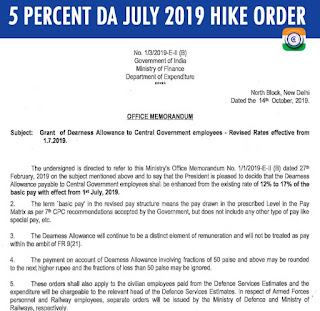
5 Percent DA July 2019 Hike Order - Grant of Dearness Allowance to Central Government employees

Grant of Dearness Allowance to Central Government employees 5 Percent DA July 2019 Hike Order  No. 1/3/2019-E- II (B) Government of...

Blog Archive

About The Author