A complete reference blog for Indian Government Employees

Showing posts with label 7thCPC. Show all posts

Friday, 24 November 2017

Deputation (Duty) Allowance to Central Government Employees - Recommendations of the 7th Pay Commission - DOPT Orders

Deputation (Duty) Allowance to Central Government Employees - Recommendations of the 7th Pay Commission - DOPT Orders

7th-CPC-Deputation-Duty-Allowance-DoPT


No.2/11/2017-Estt.(Pay-II)
Government of India
Ministry of Personnel, Public Grievances & Pensions
Department of Personnel & Training

North Block, New Delhi
Dated the 24th November, 2017

OFFICE MEMORANDUM

Subject:- Grant of Deputation (Duty) Allowance - Recommendations of the Seventh Central Pay Commission - Regarding.

This Department’s OM No. 6/8/2009-Estt.(Pay-II) dated 17.6.2010 inter-alia provides for rates of Deputation (Duty) Allowance admissible to Central Government employees.

2. As provided in para 7 of Ministry of Finance, Department of Expenditure’s Resolution No.1-2/2016-IC dated 25th July, 2016, the matter regarding allowances (except Dearness Allowance) based on the recommendations of the 7th Central Pay Commission (CPC) was referred to a Committee under the Chairmanship of Finance Secretary and until a final decision thereon, all Allowances have been paid at the existing rates in the existing pay structure.

3. The decision of the Government on various allowances based on the recommendations of the 7th CPC and in the light of the recommendations of the Committee under the Chairmanship of the Finance Secretary has since been issued as per the Resolution No.11-1/2016-IC dated 6th July 2017 of Department of Expenditure.

4. As mentioned at Sl.No.46 of the Appendix-II of the said Resolution dated 6th July 2017, the recommendation of the 7th CPC for enhancement of ceiling of Deputation (Duty) Allowance for civilians by 2.25 times has been accepted and this decision is effective from 1st July, 2017. Accordingly, the President is pleased to decide that the rates of Deputation (Duty) Allowance and certain other conditions relating to grant of Deputation (Duty) Allowance shall be as under:-

The Deputation (Duty) Allowance admissible shall be at the following rates:

(a) In case of deputation within the same station the Deputation (Duty) Allowance will be payable at the rate of 5% of basic pay subject to a maximum of Rs.4500 p.m.

(b) In case of deputation involving change of station, the Deputation (Duty) Allowance will be payable at the rate of 10% of the basic pay subject to a maximum of Rs.9000 p.m.

(c) The ceilings will further rise by 25 percent each time Dearness Allowance increases by 50 percent.

(d) Basic Pay, from time to time, plus Deputation (Duty) Allowance shall not exceed the basic pay in the apex level i.e. Rs. 2,25,000/-. In the case of Government servants receiving Non Practising Allowance, their basic pay plus Non-Practising Allowance plus Deputation (Duty) Allowance shall not exceed the average of basic pay of the revised scale applicable to the Apex Level and the Level of the Cabinet Secretary i.e. Rs.2,37,500/-.

Note: 1 ‘Basic pay’ in the revised pay structure (the pay structure based on 7th Central Pay Commission recommendations) means the pay drawn by the deputationist, from time to time, in the prescribed Level, in Pay Matrix, of the post held by him substantively in the parent cadre, but does not include any other type of pay like personal pay, etc.

Note: 2 In cases where the basic pay in parent cadre has been upgraded on account of non-functional upgradation (NFU), Modified Assured Career Progression Scheme (MACP), Non Functional Selection Grade (NFSG), etc., the upgraded basic pay under such upgradations shall not be taken into account for the purpose of Deputation (Duty) Allowance.

Note 3 In the case of a Proforma Promotion under Next Below Rule (NBR): If such a Proforma Promotion is in a Level of the Pay Matrix which is higher than that of the ex-cadre post, the basic pay under such Proforma Promotion shall not be taken into account for the purpose of Deputation (Duty) Allowance. However, if such a Proforma Promotion under NBR is in a Level of the pay matrix which is equal to or below that of the ex-cadre post, Deputation (Duty) Allowance shall be admissible on the basic pay of the parent cadre post allowed under the proforma promotion, if opted by the deputationist.

Note 4 In case of Reverse Foreign Service, if the appointment is made to post whose pay structure and/ or Dearness Allowance (DA) pattern is dissimilar to that in the parent organisation, the option for electing to draw the basic pay in the parent cadre [alongwith the Deputation (Duty) Allowance thereon and the personal pay, if any] will not be available to such employee.

Note: 5 The term ‘same station’ for the purpose will be determined with reference to the station where the person was on duty before proceeding on deputation.

Note: 6 Where there is no change in the headquarters with reference to the last post held, the transfer should be treated as within the same station and when there is change in headquarters it would be treated as not in the same station. So far as places falling within the same urban agglomeration of the old headquarters are concerned, they would be treated as transfer within the same station.

5. Para 6.1 of this Department’s OM No.6/8/2009-Estt(Pay-II) dated 17.6.2010 stands amended to the above effect.

6. In so far as persons serving in the Indian Audit & Accounts Department are concerned, these orders issue after consultation with the Comptroller & Auditor General of India.

7. These orders shall take effect from 1st July, 2017

(Rajeev Bahree)
Under Secretary to the Government of India

Source: DOPT
Share:

Tuesday, 20 December 2016

7th Pay Commission: Central Govt employee union calls nationwide strike on February 15, demand settlement of 21 points charter demand

7th Pay Commission: Central Govt employee union calls nationwide strike on February 15, demand settlement of 21 points charter demand

After a massive Parliament march conducted by the central government employees on December 15, the union has called again for a nationwide strike on February 15, 2017, demanding the Union Government to make an immediate settlement of their 21 points charter demands in 7th Pay Commission (7CPC). The strike has been called in a joint cooperation by several central government employees union against what they say “the betrayal and breach of assurance by Home Minister Rajnath Singh, Finance Minister Arun Jaitley and Railway Minister Suresh Prabhu”.

On 15th December a massive Parliament march was conducted in which around 15,000 central government employees from all over the states participated. In the Parliament march autonomous bodies employees and pensioners also extended their support by joining the rally. During the rally which the central government employees union view as a success also declared a one-day nationwide strike on February 15.

The strike has been announced by the National President of the Confederation KKN Kutty, Secretary General M Krishnan and several other leaders present at the rally.

According to reports, the rally condemned the authoritarian attitude of the NDA Government and also the breach of an assurance given by the trio Union Ministers to NJCA leaders who met them after the implementation of 7th Pay Commission.

What are 21 Points Charter Demands made by central government employees:

1) The central government employees union asked the government to settle the demands raised by NJCA regarding modifications of 7th Pay Commission recommendations as submitted in the memorandum to Cabinet Secretary on 10th December 2015. Honour the assurance given by the Union Ministers to NJCA on 30th June 2016 and 6th July 2016, especially increase in minimum wage and fitment factor. Grant revised HRA at the existing percentage itself ie: 30 per cent, 20 per cent and 10 per cent. Accept the proposal of the staff side regarding transport allowance. Settle all anomalies arising out of implementation of 7th CPC recommendations, in a time bound manner.

2) Implement option-I recommended by 7th Pay Commission and accepted by the Government regarding parity in pension of pre-2016 pensioners, without any further delay. Settle the pension related issues raised by NJCA against item 13 of its memorandum submitted to Cabinet Secretary on 10th December 2015.

3) Scrap PFRDA Act and New Pension System (NPS) and grant pension and Family Pension to all Central Government employees recruited after 1st January 2004, under CCS (Pension) Rules 1972.

4) Treat Gramin Dak Sewaks of postal department as civil servants, and extend all benefits like pay, pension, allowances etc. of departmental employees to GDS. Publish GDS Committee report immediately.

5) Regularise all casual, contract, part-time, contingent and Daily rated mazdoors and grant equal pay
and other benefits. Revise the wages as per 7th CPC minimum pay.

6) No downsizing, privatisation, outsourcing and contractorisation of government functions.

7) Withdraw the arbitrary decision of the Government to enhance the benchmark for performance appraisal for promotion and financial up-gradations under MACP from “GOOD” to VERY GOOD” and also decision to withhold annual increments in the case of those employees who are not able to meet the bench march either for MACP or for regular promotion within the first 20 years of service. Grant MACP pay fixation benefits on promotional hierarchy and not on pay-matrix hierarchy. Personnel promoted on the basis of examination should be treated as fresh entrants to the cadre for grant of MACP.

8) Withdraw the draconian FR 56 (J) and Rule 48 of CCs (Pension) Rules 1972 which is being misused as a short cut as purity measure to punish and victimize the employees.

9) Fill up all vacant posts including promotional posts in a time bound manner. Lift ban on creation of posts. Undertake cadre Review to access the requirement of employees and their cadre prospects. Modify recruitment rules of Group-‘C’ cadre and make recruitment on Regional basis.

10) Remove 5% ceiling on compassionate appointments and grant appointment in all deserving cases.

11) Grant five promotions in the service career to all Central Govt. employees.

12) Abolish and upgrade all Lower Division Clerks to Upper Division Clerks.

13) Ensure parity in pay for all stenographers, Assistants, Ministerial Staff in subordinate offices and in all organized Accounts cadres with Central Secretariat staff by upgrading their pay scales. Grant pay scale of Drivers in Loksabha Secretariat to Drivers working in all other Central Government Departments.

14) Reject the stipulation of 7th CPC to reduce the salary to 80 per cent for the second year of Child Care leave and retain the existing provision.

15) Introduce Productivity Linked bonus in all department and continue the existing bi-lateral agreement on PLB wherever it exists.

16) Ensure cashless medical treatment to all Central Government employees & Pensioners in all recognized Government and Private hospitals.

17) Revision of Overtime Allowance (OTA) and Night Duty Allowance (NDA) w.e.f 01.01.2016 based on 7th CPC pay scale.

18) Revision of wages of Central Government employees in every five years.

19) Revive JCM functioning at all levels. Grant recognition of the unions/Associations under CCS (RSA) Rules 1993 within a time frame to facilitate effective JCM functioning.

20) Implementation of the Revised Pay structure in respect of employees and pensioners of autonomous bodies consequent on implementation of CCS (Revised Pay) Rules 2016 in respect of Central Government employees and pensioners w.e.f. 01.01.2016.

21) Implementation of the “equal pay for equal work” judgement of the Supreme Court in all departments of the Central Government.

Source: India
Share:

Friday, 24 June 2016

How did Media arrive the 7th CPC Minimum Pay as Rs.23400?

How did Media arrive the 7th CPC Minimum Pay as Rs.23400?

For the past few days some News Agencies belongs to TV networks are blabbering about 7th CPC Minimum Pay and Implementation.

They repeatedly claimed that Empowered Committee recommends 30% Increase in minimum wage. Thus Minimum Pay will be increased from 18000 to 23400 and highest pay will be increased from 250000 to 325000.

They actually exposing their ignorance by saying 30% increase will increase the Minimum Pay to 23400/-
The 7th CP recommended 14.29 % increase in minimum Pay

The Minimum Pay in Sixth CPC = 7000
Total DA as on 1.1.2016 125% = 8750
Total Pay = 15750
Minimum Pay Recommended by 7th CPC = 18000
Increase Over Sixth CPC Pay = 14.29%

If the Cabinet Committee decides to increase 30% , The Minimum Pay will be Rs. 20475. Rounding of to 1000 may take it to Rs.21000.

How are Some familiar and Established news Media telling that 30% increase will take the Minimum Wage to Rs.23400?

Without knowing the fundamentals of fixing Minimum Pay, they simply calculated 30% increase over Rs.18000 (which already has 14.29% inbuilt increase) and predicted Rs.23400 will be the Minimum Wage. This false news created buss among cg employees. Now everybody talking about Rs.23400 as Minimum Pay.

The NCJCM demanded to fix Rs.26000 as Minimum Wage according to Dr. Akroyd Formula based on the retail prices as on 1.1.2014. This is 65% increase over sixth CPC Minimum Wage +125% DA (7000+8750=15750).

If the government decide to increase the Minimum Wage 30% level, then the Minimum Pay will be Rs.21000 and Fitment factor will be fixed at 3.0.

Source: Govtstaffnews.in
Share:

Saturday, 21 November 2015

7th CPC: Highlights of 7th Central Pay Commission Recommendations

7th CPC: Highlights of 7th Central Pay Commission Recommendations

7th Pay Commission Report


Recommended Date of implementation: 01.01.2016

Minimum Pay: Based on the Aykroyd formula, the minimum pay in government is recommended to be set at Rs.18,000 per month.

Maximum Pay: Rs.2,25,000 per month for Apex Scale and Rs.2,50,000 per month for Cabinet Secretary and others presently at the same pay level.

Financial Implications:The total financial impact in the FY 2016-17 is likely to be Rs.1,02,100 crore, over the expenditure as per the ‘Business As Usual’ scenario. Of this, the increase in pay would be Rs.39,100 crore, increase in allowances would be Rs. 29,300 crore and increase in pension would be Rs.33,700 crore.
Out of the total financial impact of Rs.1,02,100 crore, Rs.73,650 crore will be borne by the General Budget and Rs.28,450 crore by the Railway Budget.

In percentage terms the overall increase in pay & allowances and pensions over the ‘Business As Usual’ scenario will be 23.55 percent. Within this, the increase in pay will be 16 percent, increase in allowances will be 63 percent, and increase in pension would be 24 percent.

The total impact of the Commission’s recommendations are expected to entail an increase of 0.65 percentage points in the ratio of expenditure on (Pay+Allowances+ Pension) to GDP compared to 0.77 percent in case of VI CPC.

New Pay Structure: Considering the issues raised regarding the Grade Pay structure and with a view to bring in greater transparency, the present system of pay bands and grade pay has been dispensed with and a new pay matrix has been designed. Grade Pay has been subsumed in the pay matrix. The status of the employee, hitherto determined by grade pay, will now be determined by the level in the pay matrix.

Fitment: A fitment factor of 2.57 is being proposed to be applied uniformly for all employees.
Annual Increment: The rate of annual increment is being retained at 3 percent.

Modified Assured Career Progression (MACP):Performance benchmarks for MACP have been made more stringent from “Good” to “Very Good”.

The Commission has also proposed that annual increments not be granted in the case of those employees who are not able to meet the benchmark either for MACP or for a regular promotion in the first 20 years of their service.

No other changes in MACP recommended.

Military Service Pay (MSP): The Military Service Pay, which is a compensation for the various aspects of military service, will be admissible to the Defence forces personnel only. As before, Military Service Pay will be payable to all ranks up to and inclusive of Brigadiers and their equivalents. The current MSP per month and the revised rates recommended are as follows:

Military Service Pay


Short Service Commissioned Officers: Short Service Commissioned Officers will be allowed to exit the Armed Forces at any point in time between 7 and 10 years of service, with a terminal gratuity equivalent of 10.5 months of reckonable emoluments. They will further be entitled to a fully funded one year Executive Programme or a M.Tech. programme at a premier Institute.

Lateral Entry/Settlement: The Commission is recommending a revised formulation for lateral entry/resettlement of defence forces personnel which keeps in view the specific requirements of organization to which such personnel will be absorbed. For lateral entry into CAPFs an attractive severance package has been recommended.

Headquarters/Field Parity: Parity between field and headquarters staff recommended for similar functionaries e.g Assistants and Stenos.

Cadre Review: Systemic change in the process of Cadre Review for Group A officers recommended.
Allowances: The Commission has recommended abolishing 52 allowances altogether. Another 36 allowances have been abolished as separate identities, but subsumed either in an existing allowance or in newly proposed allowances. Allowances relating to Risk and Hardship will be governed by the proposed Risk and Hardship Matrix.

Risk and Hardship Allowance: Allowances relating to Risk and Hardship will be governed by the newly proposed nine-cell Risk and Hardship Matrix, with one extra cell at the top, viz., RH-Max to include Siachen Allowance.

The current Siachen Allowance per month and the revised rates recommended are as follows:

Risk and Hardship Allowance

This would be the ceiling for risk/hardship allowances and there would be no individual RHA with an amount higher than this allowance.

House Rent Allowance: Since the Basic Pay has been revised upwards, the Commission recommends that HRA be paid at the rate of 24 percent, 16 percent and 8 percent of the new Basic Pay for Class X, Y and Z cities respectively. The Commission also recommends that the rate of HRA will be revised to 27 percent, 18 percent and 9 percent respectively when DA crosses 50 percent, and further revised to 30 percent, 20 percent and 10 percent when DA crosses 100 percent.

In the case of PBORs of Defence, CAPFs and Indian Coast Guard compensation for housing is presently limited to the authorised married establishment hence many users are being deprived. The HRA coverage has now been expanded to cover all.

Any allowance not mentioned in the report shall cease to exist.

Emphasis has been placed on simplifying the process of claiming allowances.

Advances:All non-interest bearing Advances have been abolished.

Regarding interest-bearing Advances, only Personal Computer Advance and House Building Advance (HBA) have been retained. HBA ceiling has been increased to Rs.25 lakhs from the present Rs.7.5 lakhs.

Central Government Employees Group Insurance Scheme (CGEGIS): The Rates of contribution as also the insurance coverage under the CGEGIS have remained unchanged for long. They have now been enhanced suitably. The following rates of CGEGIS are recommended:

Central Government Employees Group Insurance Scheme


Medical Facilities:Introduction of a Health Insurance Scheme for Central Government employees and pensioners has been recommended.

Meanwhile, for the benefit of pensioners residing outside the CGHS areas, CGHS should empanel those hospitals which are already empanelled under CS (MA)/ECHS for catering to the medical requirement of these pensioners on a cashless basis.

All postal pensioners should be covered under CGHS. All postal dispensaries should be merged with CGHS.

Pension: The Commission recommends a revised pension formulation for civil employees including CAPF personnel as well as for Defence personnel, who have retired before 01.01.2016. This formulation will bring about parity between past pensioners and current retirees for the same length of service in the pay scale at the time of retirement.

The past pensioners shall first be fixed in the Pay Matrix being recommended by the Commission on the basis of Pay Band and Grade Pay at which they retired, at the minimum of the corresponding level in the pay matrix.

This amount shall be raised to arrive at the notional pay of retirees, by adding number of increments he/she had earned in that level while in service at the rate of 3 percent.

In the case of defence forces personnel this amount will include Military Service Pay as admissible.
Fifty percent of the total amount so arrived at shall be the new pension.

An alternative calculation will be carried out, which will be a multiple of 2.57 times of the current basic pension.

The pensioner will get the higher of the two.

Gratuity: Enhancement in the ceiling of gratuity from the existing Rs.10 lakh to Rs.20 lakh. The ceiling on gratuity may be raised by 25 percent whenever DA rises by 50 percent.

Disability Pension for Armed Forces: The Commission is recommending reverting to a slab based system for disability element, instead of existing percentile based disability pension regime.

Ex-gratia Lump sum Compensation to Next of Kin: The Commission is recommending the revision of rates of lump sum compensation for next of kin (NOK) in case of death arising in various circumstances relating to performance of duties, to be applied uniformly for the defence forces personnel and civilians including CAPF personnel.

Martyr Status for CAPF Personnel: The Commission is of the view that in case of death in the line of duty, the force personnel of CAPFs should be accorded martyr status, at par with the defence forces personnel.

New Pension System: The Commission received many grievances relating to NPS. It has recommended a number of steps to improve the functioning of NPS. It has also recommended establishment of a strong grievance redressal mechanism.

Regulatory Bodies: The Commission has recommended a consolidated pay package of Rs.4,50,000 and Rs.4,00,000 per month for Chairpersons and Members respectively of select Regulatory bodies. In case of retired government servants, their pension will not be deducted from their consolidated pay. The consolidated pay package will be raised by 25 percent as and when Dearness Allowance goes up by 50 percent. For Members of the remaining Regulatory bodies normal replacement pay has been recommended.

Performance Related Pay: The Commission has recommended introduction of the Performance Related Pay (PRP) for all categories of Central Government employees, based on quality Results Framework Documents, reformed Annual Performance Appraisal Reports and some other broad Guidelines. The Commission has also recommended that the PRP should subsume the existing Bonus schemes.
There are few recommendations of the Commission where there was no unanimity of view and these are as follows:

The Edge: An edge is presently accordeded to the Indian Administrative Service (IAS) and the Indian Foreign Service (IFS) at three promotion stages from Senior Time Scale (STS), to the Junior Administrative Grade (JAG) and the NFSG. is recommended by the Chairman, to be extended to the Indian Police Service (IPS) and Indian Forest Service (IFoS).

hri Vivek Rae, Member is of the view that financial edge is justified only for the IAS and IFS. Dr. Rathin Roy, Member is of the view that the financial edge accorded to the IAS and IFS should be removed.
Empanelment: The Chairman and Dr. Rathin Roy, Member, recommend that All India Service officers and Central Services Group A officers who have completed 17 years of service should be eligible for empanelment under the Central Staffing Scheme and there should not be “two year edge”, vis-à-vis the IAS. Shri Vivek Rae, Member, has not agreed with this view and has recommended review of the Central Staffing Scheme guidelines.

Non Functional Upgradation for Organised Group ‘A’ Services: The Chairman is of the view that NFU availed by all the organised Group `A’ Services should be allowed to continue and be extended to all officers in the CAPFs, Indian Coast Guard and the Defence forces. NFU should henceforth be based on the respective residency periods in the preceding substantive grade. Shri Vivek Rae, Member and Dr. Rathin Roy, Member, have favoured abolition of NFU at SAG and HAG level.

Superannuation: Chairman and Dr. Rathin Roy, Member, recommend the age of superannuation for all CAPF personnel should be 60 years uniformly. Shri Vivek Rae, Member, has not agreed with this recommendation and has endorsed the stand of the Ministry of Home Affairs.
The full report is available in the website, http://7cpc.india.gov.in.

PIB
Share:

Featured post

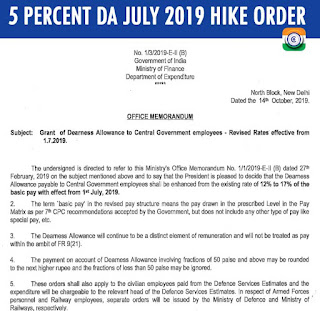
5 Percent DA July 2019 Hike Order - Grant of Dearness Allowance to Central Government employees

Grant of Dearness Allowance to Central Government employees 5 Percent DA July 2019 Hike Order  No. 1/3/2019-E- II (B) Government of...

Blog Archive

About The Author