A complete reference blog for Indian Government Employees

Tuesday, 5 July 2016

What to do with 7th pay commission ‘non-bonanza’

What to do with 7th pay commission ‘non-bonanza’
By Dhirendra Kumar CEO, Value Research

Eight years ago, I wrote a newspaper column advising government employees (or should I say public servants) on what to do with the arrears that they would get with the implementation of the sixth pay commission.

On the face of it, one could just repeat that advice now. However, the situation then was very different. One, the acceptance of that pay commission report came with a huge delay of 30 months, leading to large accumulated arrears. Most employees got eight months to a year’s extra salary as arrears. Two, that was the height of the global financial crisis. Many people were exhorting government employees to go forth and spend their bonanza to boost the economy, which was clearly not a wise thing to do from the individual’s point of view.

The 30-month delay meant that many were receiving an amount that would otherwise have taken them seven to ten years to save and it was important to point out that the best course would be to take this forced saving and convert it into a long-term investment. This time around, things are different. The government has acted much faster and the arrears are just six months. A smaller hike and a much shorter delay mean that most government employees will get an amount equivalent to barely one month’s extra salary so there isn’t any great excitement about extra savings.

In any case, government employees’ savings imperatives are very different from those who don’t have lifelong infla tion-adjusted pensions that also keep getting hiked by pay commissions. Realistically, government employees’ salaries and pensions are now so good that someone who does not save at all for retirement will also get by fine. This is especially true because free lifelong healthcare is part of the package.

A long retirement with inflation-ravaged savings does not bother government employees because their burden will also be carried by the rest of us. The rest of the country will work hard and pay their taxes so that government employees are guaranteed a comfortable income and pension. Little wonder that even the most menial, lowest-level government jobs attract thousands of highly qualified applicants.

However, this is true only of the older ge neration of government employees, that is, those who joined before 2004.The biggest change that has come about since 2004 is that a large proportion of government employees are on the National Pension System. Younger employees have retirement savings enforced instead of having pensions guaranteed from the public purse.While the final impact on their post-retirement finances is hard to predict at this juncture, it does mean that they will have to learn a little more about savings and investments than the older generation of government employees had to.

The little bit of arrears don’t amount to much, but the higher income should be directed to long-term savings instead of any kind of consumption expenditure. The theory behind the Pay Commission is that its awards are a response, not just to the rising cost of living, but also to the general rise in private sector’s salaries and an attempt to narrow the gap thus created. I can hear the sniggers from private sector employees but like I said, that’s the theory. In this sense, arrears are money that is already spent. Given the way most people’s finances are structured nowadays, I think the first priority should be to lighten or eliminate any debt load that one has.

Beyond debt-reduction, the arrears, as well as the higher income is best added to whatever savings medium the saver is most comfortable with as long as one doesn’t make the mistake of relying on fixed income savings for the long term.

For those who want to invest for the long-term (at least five to seven years), the best course of action could be to shift this money gradually to a good balanced fund. As the past has decisively shown, despite higher volatility, equitybacked investments have long-term returns that are far superior to any other kind of asset. A type of mutual fund that gets you most of the gains of equity while saving you from some of the volatility is probably the best choice.

Share:

7th Pay Commission: central government employees not to go on strike over pay disparity from July 11

7th Pay Commission: central government employees not to go on strike over pay disparity from July 11

Southern-Railway-Mazdoor-Union-General-Secretary-N-Kanniah

NJCA convener (South Zone) N Kanniah informed the indefinite strike scheduled from July 11 has been temporarily postponed.

New Delhi: An indefinite central government employees’ strike will not begin on July 11 in protest at the “government inaction” on fulfilling their demands, including hike in minimum pay to Rs 26,000 from Rs 18,000 which was recommended by the 7th Pay Commission and was approved by the cabinet on Wednesday.

No central government office will be closed at any part of the country and the trains will also be running on July 11 and ahead as National Joint Council Action (NJCA), a confederation of 3.3 million government employees, has temporarily postponed the indefinite strike scheduled from July 11 after PM Modi formed a committee of Ministers to negotiate with union leaders on their demands.

“Since the Prime Minister has intervened and initiated the process of negotiation, we have decided to temporarily postpone the indefinite strike. The NJCA will make sure that the genuine demands of the employees are met with,” NJCA convener (South Zone) N Kanniah told The Hindu.

However, the claim that the government was giving a 14.28 per cent hike in pay was false since the calculations revealed an increase of only 11.31 per cent, which would further decline to 4.51 per cent after deductions towards provident fund and pension scheme contributions, he added.

TST
Share:

Change of date of holiday on account of Id-ul-Fitr during 2016 for all Central Government Offices

Change of date of holiday on account of Id-ul-Fitr during 2016 for all Central Government Offices

F.No.12/10/20 16-JCA2
Government of India
Ministry of Personnel Public Grievances and Pensions
Department of Personnel and Training
North Block, New Delhi
Dated the 05 July, 2016
OFFICE MEMORANDUM

Sub: Change of date of holiday on account of Id-ul-Fitr during 2016 for all Central Government administrative offices located at Delhi / New Delhi.

As per list of holidays circulated vide this Ministry’s 0.M.No.12/7/2015-JCA-2 dated the 11th June, 2015, the holiday on account of Id-ul-Fitr falls on Wednesday the 6th July, 2016. It has been brought to notice of this Ministry that in Delhi Id-ul-Fitr will be celebrated on 7th July, 2016. Accordingly, it has been decided to shift the Id-ul-Fitr holiday to 7th July, 2016 in place of 6th July, 2016 as notified earlier, for all Central Government administrative offices at Delhi / New Delhi.

2. For Offices outside Delhi / New Delhi the Employees Coordination Committee or Head of Offices (Where such committees are not functioning) can decide the date depending upon the decision of the concerned State Government.
Hindi version will follow.
sd/-
(DEBABRATA DAS)
Under Secretary
Authority: www.persmin.gov.in
Click to view the order
Share:

COMPARISON OF PAY between 6th Pay Commission & 7th Pay Commission

COMPARISON OF PAY between 6th Pay Commission & 7th Pay Commission

COMPARISON OF PAY AS ON 31.12.2015 AND AS ON 01.01.2016
PAY ON 31.12.2015 PAY ON 01.01.2016
01 Pay in Pay Band  5200.00 7000.00  
18000.00
Grade Pay – GP 1800.00
Total Basic Pay- BP
02 DA @ 125% as on 01.01.2016 8750.00 0
03 Total Pay 15750.00 18000.00
DEDUCTION
04 Income Tax 0.00 0.00
05 CGEIS 30.00 30.00
06 CHSS @ 1% of BP 70.00 180.00
07 Professional Tax 175.00 225.00
08 GPF @ 8.33% of BP 583.00 1499.00
09 License Fee 135.00 135.00
10 Total deduction 993.00 2069.00
11 Take Home Salary: 14757.00 15931.00
12 Increase in Salary = 18000 – 15750 2250.00
13 % of Increase in Salary 14.28%
14 Increase in Take Home Salary = 15931 – 14757 1174.00
15 % of Increase in Take Home Salary 7.9%
COMPARISON OF PAY AS ON 31.12.2015 AND AS ON 01.01.2016
PAY ON 31.12.2015 PAY ON 01.01.2016
01 Pay in Pay Band  5200.00  
7730.00
 
19900.00
Grade Pay – GP 1900.00
Total Basic Pay- BP
02 DA @ 125% as on 01.01.2016 9125.00 0
03 Total Pay 16855.00 19900.00
DEDUCTION
04 Income Tax 0.00 0.00
05 CGEIS 30.00 30.00
06 CHSS @ 1% of BP 77.00 199.00
07 Professional Tax 175.00 225.00
08 GPF @ 8.33% of BP 644.00 1658.00
09 License Fee 135.00 135.00
10 Total deduction 1061.00 2125.00
11 Take Home Salary: 15794.00 17775.00
12 Increase in Salary = 19900 – 16855 3045.00
13 % of Increase in Salary 18.06%
14 Increase in Take Home Salary = 17775 – 15794 1981.00
15 % of Increase in Take Home Salary 12.54%
COMPARISON OF PAY AS ON 31.12.2015 AND AS ON 01.01.2016
PAY ON 31.12.2015 PAY ON 01.01.2016
01 Pay in Pay Band  5200.00  
8460.00
 
21700.00
Grade Pay – GP 2000.00
Total Basic Pay- BP
02 DA @ 125% as on 01.01.2016 10575.00 0
03 Total Pay 19035.00 21700.00
DEDUCTION
04 Income Tax 0.00 0.00
05 CGEIS 30.00 30.00
06 CHSS @ 1% of BP 85.00 217.00
07 Professional Tax 175.00 225.00
08 GPF @ 8.33% of BP 707.00 1808.00
09 License Fee 135.00 135.00
10 Total deduction 1132.00 2415.00
11 Take Home Salary: 17903.00 19285.00
12 Increase in Salary = 21700 – 19035 2665.00
13 % of Increase in Salary 14%
14 Increase in Take Home Salary = 19285 – 17903 1382.00
15 % of Increase in Take Home Salary 7.72%
COMPARISON OF PAY AS ON 31.12.2015 AND AS ON 01.01.2016
PAY ON 31.12.2015 PAY ON 01.01.2016
01 Pay in Pay Band  5200.00  
9910.00
 
25500.00
Grade Pay – GP 2400.00
Total Basic Pay- BP
02 DA @ 125% as on 01.01.2016 12388.00 0
03 Total Pay 22298.00 25500.00
DEDUCTION
04 Income Tax 0.00 0.00
05 CGEIS 30.00 30.00
06 CHSS @ 1% of BP 99.00 255.00
07 Professional Tax 175.00 225.00
08 GPF @ 8.33% of BP 826.00 2124.00
09 License Fee 310.00 310.00
10 Total deduction 1440.00 2944.00
11 Take Home Salary: 20858.00 22556.00
12 Increase in Salary = 25500 – 22298 3202.00
13 % of Increase in Salary 14.36%
14 Increase in Take Home Salary = 22556 – 20858 1698.00
15 % of Increase in Take Home Salary 8.14%
COMPARISON OF PAY AS ON 31.12.2015 AND AS ON 01.01.2016
PAY ON 31.12.2015 PAY ON 01.01.2016
01 Pay in Pay Band  5200.00  
11360.00
 
29200.00
Grade Pay – GP 2800.00
Total Basic Pay- BP
02 DA @ 125% as on 01.01.2016 14200.00 0
03 Total Pay 25565.00 29200.00
DEDUCTION
04 Income Tax 473.00 836.00
05 CGEIS 30.00 30.00
06 CHSS @ 1% of BP 114.00 292.00
07 Professional Tax 225.00 225.00
08 GPF @ 8.33% of BP 946.00 2432.00
09 License Fee 310.00 310.00
10 Total deduction 2098.00 4125.00
11 Take Home Salary: 23467.00 25075.00
12 Increase in Salary = 29200 – 25565 3635.00
13 % of Increase in Salary 14.22%
14 Increase in Take Home Salary = 25075 – 23467 1608.00
15 % of Increase in Take Home Salary 6.8%
COMPARISON OF PAY AS ON 31.12.2015 AND AS ON 01.01.2016
PAY ON 31.12.2015 PAY ON 01.01.2016
01 Pay in Pay Band  9300.00 13500.00  
35400.00
Grade Pay – GP 4200.00
Total Basic Pay- BP
02 DA @ 125% as on 01.01.2016 16875.00 0
03 Total Pay 30375.00 35400.00
DEDUCTION
04 Income Tax 954.00 1416.00
05 CGEIS 60.00 60.00
06 CHSS @ 1% of BP 135.00 354.00
07 Professional Tax 225.00 225.00
08 GPF @ 8.33% of BP 1125.00 2948.00
09 License Fee 370.00 370.00
10 Total deduction 2869.00 5373.00
11 Take Home Salary: 27506.00 30027.00
12 Increase in Salary = 35400 – 30375 5025.00
13 % of Increase in Salary 16.54%
14 Increase in Take Home Salary = 30027 – 27506 2521.00
15 % of Increase in Take Home Salary 9.16%
COMPARISON OF PAY AS ON 31.12.2015 AND AS ON 01.01.2016
PAY ON 31.12.2015 PAY ON 01.01.2016
01 Pay in Pay Band  9300.00  
17140.00
 
44900.00
Grade Pay – GP 4600.00
Total Basic Pay- BP
02 DA @ 125% as on 01.01.2016 21425.00 0
03 Total Pay 38565.00 44900.00
DEDUCTION
04 Income Tax 1773.00 2730.00
05 CGEIS 60.00 60.00
06 CHSS @ 1% of BP 171.00 449.00
07 Professional Tax 225.00 225.00
08 GPF @ 8.33% of BP 1428.00 3740.00
09 License Fee 370.00 370.00
10 Total deduction 4027.00 7574.00
11 Take Home Salary: 34538.00 37326.00
12 Increase in Salary = 44900- 38565 6335.00
13 % of Increase in Salary 16.4%
14 Increase in Take Home Salary = 17788 – 15403 2788.00
15 % of Increase in Take Home Salary 8.07%
COMPARISON OF PAY AS ON 31.12.2015 AND AS ON 01.01.2016
PAY ON 31.12.2015 PAY ON 01.01.2016
01 Pay in Pay Band  9300.00  
18150.00
 
47600.00
Grade Pay – GP 4800.00
Total Basic Pay- BP
02 DA @ 125% as on 01.01.2016 22688.00 0
03 Total Pay 40838.00 47600.00
DEDUCTION
04 Income Tax 2000.00 3270.00
05 CGEIS 60.00 60.00
06 CHSS @ 1% of BP 182.00 476.00
07 Professional Tax 225.00 225.00
08 GPF @ 8.33% of BP 1512.00 3965.00
09 License Fee 370.00 370.00
10 Total deduction 4349.00 8366.00
11 Take Home Salary: 36489.00 39234.00
12 Increase in Salary =  47600 – 40838 6762.00
13 % of Increase in Salary 16.56%
14 Increase in Take Home Salary = 17788 – 15403 2745.00
15 % of Increase in Take Home Salary 7.52%
COMPARISON OF PAY AS ON 31.12.2015 AND AS ON 01.01.2016
PAY ON 31.12.2015 PAY ON 01.01.2016
01 Pay in Pay Band  15600.00  
22100.00
 
56100.00
Grade Pay – GP 5400.00
Total Basic Pay- BP
02 DA @ 125% as on 01.01.2016 27625.00 0
03 Total Pay 49725.00 56100.00
DEDUCTION
04 Income Tax 3695.00 4970.00
05 CGEIS 120.00 120.00
06 CHSS @ 1% of BP 221.00 561.00
07 Professional Tax 225.00 225.00
08 GPF @ 8.33% of BP 1841.00 4673.00
09 License Fee 500.00 500.00
10 Total deduction 6602.00 11049.00
11 Take Home Salary: 43123.00 45051.00
12 Increase in Salary = 56100 – 49725 6375.00
13 % of Increase in Salary 12.82%
14 Increase in Take Home Salary = 45051 – 43123 1928.00
15 % of Increase in Take Home Salary 4.47%
COMPARISON OF PAY AS ON 31.12.2015 AND AS ON 01.01.2016
PAY ON 31.12.2015 PAY ON 01.01.2016
01 Pay in Pay Band  15600.00  
25350.00
 
67700.00
Grade Pay – GP 6600.00
Total Basic Pay- BP
02 DA @ 125% as on 01.01.2016 31688.00 0
03 Total Pay 57038.00 67700.00
DEDUCTION
04 Income Tax 5158.00 7290.00
05 CGEIS 120.00 120.00
06 CHSS @ 1% of BP 254.00 677.00
07 Professional Tax 225.00 225.00
08 GPF @ 8.33% of BP 2112.00 5639.00
09 License Fee 500.00 500.00
10 Total deduction 8369.00 14451.00
11 Take Home Salary: 48669.00 53249.00
12 Increase in Salary =  67700- 57038 10662.00
13 % of Increase in Salary 18.69%
14 Increase in Take Home Salary = 17788 – 15403 4580.00
15 % of Increase in Take Home Salary 9.41%

Source : http://nfaeehq.blogspot.in/
Share:

Monday, 4 July 2016

New faces to be inducted in Union Cabinet tomorrow

New faces to be inducted in Union Cabinet tomorrow

New Delhi: Several new faces, including some from dalit community, are likely to be included in the expansion and reshuffle of the Union Council of Ministers tomorrow, an exercise being done with an eye on the Assembly elections in Uttar Pradesh and a few other states next year.

In the expansion, the second since Prime Minister Narendra Modi took over in May, 2014 new faces like Anupriya Patel, an OBC Lok Sabha member of ally Apna Dal in Uttar Pradesh, besides BJP MPs S S Ahluwalia (West Bengal) and Purushottam Rupala, a Rajya Sabha member from Gujarat, may be inducted.

Krishna Raj, a dalit woman MP from Uttar Pradesh, Mahendra Nath Pandey, a Brahmin face in the state, Ajay Tamta, a dalit MP from Uttarakhand, which also goes to polls next year, also figure in the list of probables.

Arjun Ram Meghwal, a dalit BJP MP from Rajasthan, Ramdas Athawale, another dalit leader and RPI MP from Maharashtra, can get ministerial berths besides Subhash Ramrao Bhamre, who is also from Maharashtra, and Mansukhbhai Mandaviya, a Rajya Sabha member from Gujarat.

The names of Rajya Sabha MPs Vijay Goel, M J Akbar, Anil Madhav Dave, Bhupender Yadav and P P Chaudhary, Lok Sabha member from Pali in Rajasthan, have also been doing the rounds as possible inductions.

Many of these leaders today met party chief Amit Shah, who is also likely to announce the party’s organisational team soon.

Some ministers can also be dropped, party sources said, while a few state ministers can be promoted and portfolios of some others may witness changes.

Frank Noronha, Principal spokesperson of the government, tweeted today that the cabinet expansion will take place tomorrow at 11 AM.

There is also a vacancy in the Council of Ministers after Sports Minister Sarbananda Sonowal became the Chief Minister of Assam.

The first expansion had occurred in November 2014.

There are currently 64 Union ministers, including the Prime Minister, and there can be a maximum of 82 of them under a constitutional bar.

PTI
Share:

7th CPC – BPS appeals to the Prime Minister for acceptance of option 1 for pension revision

7th CPC – BPS appeals to the Prime Minister for acceptance of option 1 for pension revision

No.SG/BPS/PC/FM/02

dt. 4.7.2016

Sh. Narendra Modi ji
Hon’ble Prime Minister Govt. of India

Sub: Parity in Pension – Revision of Pension based on first option recommended by VIICPC (Para 10.1.67(1) and accepted Conditionally by the Govt.

RespectedSir,

May I on behalf of ‘Bharat Pensioners Samaj beseech a few minutes of your highly precious time for the favour of considering following submission on behalf of Civil Pensioners of the Country:

1. Sir. there is no need of any committee to study feasbility of implementation of option l recommended by 7th CPC for the revision of pension of pre 01.01.016 pensioners& accepted conditionalty by the Govt. It can be smoothly implementedas all the requied records are available. Service records are of permanent nature & their non-availability. if true. is a case of a gross irregularity worthy of being taken serious note of.

2. Departments professing non- availability of records are misguiding the govt to avoid their own accountability as you are insisting on fast compliance. Option 1 contained in Para 10.1.67 (i) of the Pay Commission relates to the Scale of pay/pay band+grade pay in which a pensioner had retired and the stage of pay in that scale which is fuly captured in PPOs issued at the time of retirement. On the recommendations of the V Central Pay Commission full parity in pension was granted to all the pre-1986 retirees and their pension was revised by notional fixation of their pay as on 1.1.1986 & bringing them to the level of 4″ CPC Scales. Modified Parity had been granted to Pre-1996 & Pre-2006 Pensioners as per recommendation of the Filth and Sixth Pay Commissions respectively and the revision of Pension was done accordingly. All this could be done as records were available.

3. The issue of non-availability of Service Records was never raised before at any stage either before or after the Fifth or Sixth Pay Commission nor was it mentioned before the Seventh Pay Commission by any of the Govt. Department. Also it was never mentioned by UOI in any of the legal proceedings so far.

4. In rare cases where service records may not be available, the same can be generated from the information available in PPOs as also with various departments and the pensioners themselves as they hold sufficient authentic information rather than passing over a key recommendation of 7th CPC impacting all pensioners very adversely.

5. Bharat Pensioners Samaj appeal to your goodself to kindly approve the first option of parity in pension without further delay and bestow succour to pensioners in the twilight of their lives.

Thanking you and with Warm regards

Yours faithfully,

sd/-
S.C.Maheshwari
Secy. Genl. Bharat Pensioners Samaj

Source : http://scm-bps.blogspot.in/
Share:

Inadequate Fitment Benefit recommended by 7th CPC and accepted by the Govt

Inadequate Fitment Benefit recommended by 7th CPC and accepted by the Govt

7th CPC – BPS appeals to the Finance Minister Sh. Arun Jaitlely for revision of minimum salary & fitment factor of 2.57


No. SG/BPS/PC/FM/02

Dt: 4.7.2016

Sh. Arun Jaitley ji,

Honbfe Minister of Finance Govt. of India

Sub: Inadequate Fitment Benefit recommended by 7th CPC and accepted by the Govt.

Respected Sir.

   1.The 2.57 fitment factor recommended by the 7th CPC and accepted by the Govt. is essentially a multiple factor which is the ratio of the new minimum pay arrived at by the 7th Pay Commission (18,000) and the existing minimum pay (7,000). { Para 5.2.7 of 7th CPC report} This provides only 14 29% rise in Salary as well as in Pension which is the historically lowest raise given by any Govt. in the past seventy years. This has happened because of incorrect calculation of minimum revised salary resulted not only by adopting lower prices of commodities but also due to adoption of Aykroyd formula without updating it.

   2. It is surprising as to how a gender biased formula of Dr Aykroyd adopted by ILC in 1957 is applied, without updating, in digital India of 2016. In today’s scenario how can Indian civil society accept a formula for Minimum requirement including just 2700 food calories for a family of four with moderate physical activities which treat the lady of the house as 0.8 compared to the adult male of the house, Further more so this formula does not at all take into consideration the minimum requirement of todays digital India i.e. a smart mobile phone with an internet connection.

    3. Considering wife to be .80 unit is nothing but gender bias indicating a colonial mindset of Dr Aykroyd. In the present scenario a wife too puts in the same amount rather more of physical and intellectual work as compared to the husband. She needs more nutrients & healthcare to keep herself fit to be a mother and as an educationist for her school going children. She needs more better clothing than 1957. A lady whether she is a wife of a labourer or of a Secretary to Govt. of India, has a basic right to keep herself reasonably presentable for which she needs some minimum add-ons. As such treating her to be less than a unit is gross injustice, gender bias and unconstitutional. Similarly growing children of less than 14 years need more of proteins, fats& carbohydrates, need to take sufficient exercise & field activities for healthy growth. Today they need much better and more clothing, better education & healthcare compared to 50s. The Nation needs healthy & stout young citizens. It is against the National interest to restrict their need based minimum requirement to .6 unit.

   4. Sir, in view of the facts enumerated in lore going pares, minimum Salary & consequently the fitment factor for both Pensioners & employees need upwards revision. ‘Bharat Pensioners Samaj’ therefore, appeal to you to revisit the issue to take a favourable decision.

Thanking you in anticipation.

Yours faithfully,
S.C.Maheshwari
Secy. Genl. Bharat Pensioners Samaj

Source: http://scm-bps.blogspot.in/
Share:

Featured post

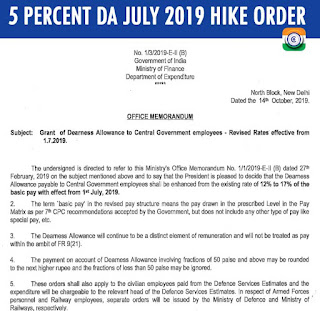
5 Percent DA July 2019 Hike Order - Grant of Dearness Allowance to Central Government employees

Grant of Dearness Allowance to Central Government employees 5 Percent DA July 2019 Hike Order  No. 1/3/2019-E- II (B) Government of...

Blog Archive

About The Author