A complete reference blog for Indian Government Employees

Tuesday, 24 October 2017

Transport Allowance (TPTA) : Report of the Committee on Allowances


Transport Allowance (TPTA) : Report of the Committee on Allowances

Transport Allowance (TPTA) (Para 8.15.53)

Existing Provisions: Granted to cover the expenditure involved in commuting between place of residence and place of duty. The existing rates are as under:


Officers drawing GP 10000 and higher, who are entitled to the use of official car, have the option to avail of the existing facility or to draw TPTA @ Rs.7000 + DA.

Differently abled employees are granted TPTA at double rates subject to a minimum of Rs.1000+DA.

Recommendations of 7th CPC: Transport Allowance is already fully DA indexed. Therefore, following rates of Transport Allowance are recommended:

Officers in Pay Level 14 and higher, who are entitled to the use of official car, will have the option to avail themselves of the existing facility or to draw the TPTA at the rate of Rs.15,750+DA pm.
Differently abled employees will continue to be paid at double rate, subject to a minimum of Rs.2,250 plus DA.

Demands:
I. National Council (Staff Side), JCM:

i. There should be only two levels for Transport Allowance, as under:
Level 9 and above
Rs.7500+DA (Higher TPTA Cities)
Rs.3750 + DA (Other Places
Below Level 9
Rs.3750+DA (Higher TPTA Cities)
Rs.1875 + DA (Other Places)

ii. Income Tax exemption, which was available for Transport Allowance, may be reintroduced.

II. Ministry of Health and Family Welfare: SAG Doctors should be paid Transport Allowance at the rates admissible to Joint Secretary in lieu of Staff Car.

Analysis and Recommendations of the Committee: The Committee notes that the Transport Allowance is fully indexed to Dearness Allowance and the rates have accordingly been revised by the 7th CPC. As the demands do not relate to any changes recommended by the 7th CPC, the recommendations of the 7th CPC on Transport Allowance may be accepted without any change.

When this allowance was introduced by 5th CPC, the entire amount was exempted from Income Tax. However, the Committee is not making any recommendations relating to raising of Income Tax ceiling on Transport Allowance as it is not within the purview of the Committee. The matter may be taken up separately with Department of Revenue.

Authority: www.doe.gov.in
Click to view the Report
Share:

House Rent Allowance (HRA) : Report of the Committee on Allowances

House Rent Allowance (HRA) : Report of the Committee on Allowances

House Rent Allowance (HRA) (Para 8.7.3-16)

Existing Provisions: HRA is paid @30, 20 and 10 percent for X class (50 Lakh & above), Y class (5 to 50 lakh) and Z class (below 5 lakh) cities respectively.

At present, in the case of those drawing either NPA or MSP or both, HRA is being paid as a percentage of BP+NPA or BP+MSP or BP+NPA+MSP respectively.

Recommendations of 7th CPC: It has been retained and rationalized. After applying a multiplication factor of 0.8, the rates have been revised downwards to 24 percent, 16 percent and 8 percent of the Basic Pay for X, Y and Z class cities, respectively.

The rate of HRA will be revised to 27 percent, 18 percent and 9 percent when DA crosses 50 percent, and further revised to 30 percent, 20 percent and 10 percent when DA crosses 100 percent. Add-ons like NPA, MSP, etc. should not be included while working out HRA.

Demands:
I. National Council (Staff Side), JCM: HRA may be retained @30%, 20% and 10% for X, Y and Z cities respectively as the Commission has taken unreliable statistics to determine HRA, which has been reduced by a multiplication factor of 0.8 to 24%, 16% and 8% for X, Y and Z cities respectively.

II. CAG, Civil Aviation, M/o Health & FW, M/o HRD - D/o of Higher Education, MEA, Coal, DAE, DRDO, Dep. Of Space, CVC: Retain the allowance at the existing rates.

III. M/o of Law & Justice- D/o Justice: Cities having population of more than 1 crore may be granted HRA @ 30%.

Analysis and Recommendations of the Committee: The Committee has the following observations on the recommendations of the 7th CPC on HRA:
(I) HRA rates have been revised downwards by applying the multiplication factor of 0.8 applied by the 7th CPC on all percentage- based allowances. This was done to neutralise the significant increase in the Basic Pay. All fixed allowances have only been given an inflation indexed increase by the 7th CPC. While the 7th CPC has not explicitly stated how the multiplication factor of 0.8 has been arrived at anywhere in the Report, it may be seen that factoring in the expected Dearness Allowance of 125% on 01.01. 2016 would have yielded a multiplication factor of 0.875 which may have been rounded off to 0.8.

(II) On the 7th CPC recommendation that the rate of HRA will be revised to 27%, 18% and 9% when DA crosses 50 percent and further revised to 30%, 20% & 10% when DA crosses 100%, the Committee is of the view that given the inflation rates since January 2016 and the RBI policy on inflation, the DA rates might not go beyond 50% in the next 10 years.

(III) While the rents for residential accommodation have not gone up significantly in the recent past and might also have fallen in some areas, the HRA at the rates recommended by the 7th CPC at the lower levels might not continue to be adequate as per the prevailing market rent.

In view of these observations, the Committee has deliberated upon the following three options which separately, or in combination, can be suggested by way of modifications to the 7th CPC recommendations:

Option (i): Having regard to submissions made before it stating that towards the later part of the ten year period, HRA compensation falls considerably short of requirement, the 7th CPC has recommended that the rate of HRA will be revised to 27 percent, 18 percent and 9 percent when DA crosses 50 percent, and further revised to 30 percent, 20 percent and 10 percent when DA crosses 100 percent. However, considering the present inflation rate, the rate of increase of the Dearness Allowance and future inflation projections, it appears unlikely that DA rates will reach 100 % in the ten year period. Taking this into consideration, the Committee considered that the timing of the upward revisions in HRA rates proposed by the 7th CPC may be advanced as under:

report-on-allowances-hra


This would have no immediate financial implication and the 1st revision, as per the current trend of increase in DA, is expected to occur in July, 2018. Accordingly, additional annual financial implication in July, 2018 will be approximately Rs.1850 crore. The additional financial implication in the second, third and fourth revision will also be
approximately Rs.1850 crore per annum.

Option (ii): Instead of advancing the full restoration of HRA rates, the Committee considered splitting the revisions proposed by 7th CPC as under:

7th-CPC-report-on-allowances-hra


The financial implication would be similar as in Option (i) except that the timing of the revision would undergo a change.

Option (iii): It has been pointed out that at the recommended rates, HRA at the minimum level might not be sufficient. The minimum HRA calculated at the entry level of Level 1for X, Y and Z category cities at the rates recommended by the 7th CPC will be Rs.4320, Rs.2880 and Rs.1440 respectively. The Committee considered recommending that the HRA at the rates recommended by the 7th CPC may be subject to a floor which may be fixed at Rs.5400, Rs.3600 and Rs.1800 per month, calculated at 30%, 20% and 10% of the minimum pay for X, Y and Z category cities respectively. This will benefit employees in Levels 1, 2 and 3.

The additional financial implication is estimated to be Rs. 385.00 crore and around 7.70 lakh employees shall be benefited. After a detailed consideration of the above options, the Committee recommended that either only option (iii) or option (iii) in combination with option 
(ii) be accepted. A final decision in this regard may be taken by E-CoS.

Authority: www.doe.gov.in
Click to view the Report

Share:

Monday, 23 October 2017

Complete List of CGHS Covered Cities and their Website Links

Complete List of CGHS Covered Cities and their Website Links

Eligibility for joining CGHS and Facilities available under CGHS

Eligibility for joining CGHS

All Central Govt. employees drawing their salary from Central Civil Estimates and their dependant family members residing in CGHS covered areas.

Central Govt. Pensioners/family pensioners receiving pension from central civil estimates and their eligible dependent family members.

Facilities available under CGHS

OPD Treatment including issue of medicines.

Specialist Consultation at Polyclinic/Govt. Hospitals.

Indoor Treatment at Government and Empanelled Hospitals.

Investigations at Government and Empanelled Diagnostic centers.

Cashless facility available for treatment in empanelled hospitals and diagnostic centers for Pensioners and other identified beneficiaries.

Reimbursement of expenses for treatment availed in Govt. /Private Hospitals under emergency.
Reimbursement of expenses incurred for purchase of hearing aids, artificial limbs, appliances etc. as specified.

Family Welfare, Maternity and Child Health Services.

Medical consultation and dispensing of medicines in Ayurveda, Homeopathy, Unani and Siddha system of medicines (AYUSH)

No.City Name
Website Link
1.AHMADABAD
Click Here
2.ALLAHABAD
3.BENGALURU
4.BHOPAL
Click Here
5.BHUBANESHWAR
6.CHANDIGARH
Click Here
7.CHENNAI
8.DEHRADUN
Click Here
9.DELHI & NCR
10.GUWAHATI
Click Here
11.HYDERABAD
12.INDORE
Click Here
13.JABALPUR
Click Here
14.JAIPUR
15.JAMMU
Click Here
16.KANPUR
17.KOLKATA
18.LUCKNOW
Click Here
19.MEERUT
20.MUMBAI
21.NAGPUR
Click Here
22.PATNA
Click Here
23.PUNE
Click Here
24.RANCHI
Click Here
25.SHIMLA
Click Here
26.SHILLONG
Click Here
27.THIRUVANATHAPURAM
Share:

GRAMIN DAK SEVAK ISSUE IN LOK SABHA : 22-03-2017


GRAMIN DAK SEVAK ISSUE IN LOK SABHA : 22-03-2017

GOVERNMENT OF INDIA
MINISTRY OF COMMUNICATIONS
DEPARTMENT OF POSTS
LOK SABHA
UNSTARRED QUESTION NO.3450
TO BE ANSWERED ON 22ND MARCH, 2017
GRAMEEN DAK SEVAKS
3450. SHRI RAHUL KASWAN:
SHRI RAMESH BIDHURI:
SHRI BALABHADRA MAJHI:
SHRI TAMRADHWAJ SAHU:

Will the Minister of COMMUNICATIONS be pleased to state:
(a) the total number of postal circles in the country and the number of GPOs, SPOs and EDBOs functioning under these circles alongwith number of these post offices located in rural and urban regions separately;
(b) the number of post offices manned by Grameen Dak Sevaks (GDSs) State/UT-wise alongwith the details about the monthly salary of the GDS;
(c) whether Grameen Dak Sevaks (GDSs) are eligible for pension like other Government employees and if not, the reasons therefor;
(d) whether Government is contemplating to constitute any Committee to look into the salary structure and other service matters of Grameen Dak Sevaks and if so, the details thereof;
(e) whether the said committee has submitted its said report and if so, the salient features of the said report; and
(f) the time by which it is likely to be implemented?

ANSWER

THE MINISTER OF STATE (IC) OF THE MINISTRY OF COMMUNICATIONS & MINISTER OF STATE IN THE MINISTRY OF RAILWAYS (SHRI MANOJ SINHA)
(a) Madam, the total number of Postal Circles in the country is 23. The total number of GPOs is 24, the total number of Sub Post Offices (SPOs) is 24753, the total number of Extra Departmental Branch Offices (EDBOs) is 129346. The details of these post offices rural and urban regions wise is enclosed at Annexure-I.

(b) The number of post offices which are manned by Gramin Dak Sewaks (GDS) is given in the Annexure-II. Details of the monthly wages admissible to various categories of Gramin Dak Sewaks are given in the Annexure-III.

(c) No, Madam. The legal status of the Gramin Dak Sevaks as held in 1977 by Apex Court is that they are holders of the civil posts outside the regular civil service. Being a distinct and separate category, CCS (Pension) Rules, 1972 are not applicable in the case of Gramin Dak Sevaks (GDS).

(d) Yes, Madam. To examine the system of Branch Post Offices, engagement conditions, existing structure of allowances and all other welfare issues pertaining to Gramin Dak Sevaks, a one-man Committee under the Chairmanship of Shri Kamlesh Chandra, Retired Member Postal Services Board was set up.

(e) Yes, Madam. The committee has submitted its report. The salient feature of the report is given in the Annexure-IV.

(f) The recommendations of the committee are being examined by the Department of Posts. No timeline is specified to implement the recommendations of the Committee.
Annexure-I : Distribution of Rural and Urban Post Offices as on 31.03.2016
Annexure-II : State wise list of number of post offices manned by Gramin Dak Sewaks
Annexure-III : Details of the monthly wages admissible to various categories of Gramin Dak Sevaks
Annexure-IV : Salient features of the GDS Report

Source: Confederation
Share:

Sunday, 22 October 2017

Clarification regarding pay fixation under 7th CPC for the post of 'Trainee' appointed on compassionate grounds


Clarification regarding pay fixation under 7th CPC for the post of 'Trainee' appointed on compassionate grounds

CGDA, Ulan Batar Road, Palam, DelhiCantt-110010
No.AN/XIV/14164/7th CPC/corrsp/Vol-II
Dated: 11/10/2017
To
All PCsDA/CsDA/PCof A(Fys) Kolkata

Subject: Clarification regarding pay fixation under 7th CPC for the post of 'Trainee' appointed on compassionate grounds.

Reference: This HQrs Circular of even no dated 01/02/2016.
With reference to the above cited circular, Ministry of Finance Dept. of Expenditure to whom the matter was referred has since clarified as under:

"Level -1 of the Pay Matrix introduced on implementation of the 7th CPC Report be the replacement for the pre-revised -IS scale. The pay of those governed by the IS scale may be revised by using the fitment factor of 2.57 for placement in Level -1 in conformity with the Rule 7 of the CCS(RP)Rules 2016. All pre-revised pay stages lower than pre-revised pay of Rs 7000 in the pre-revised -IS scale shall not be considered for determining the benefit of bunching, on the same lines as has been clarified by MoF(DoE)'s OM dated 3.08.2017 on application of the benefit on account of bunching".

2.This is for your information and necessary action please. All pay fixation cases may be regulated accordingly.
S/d,
(Kavita Garg)
Sr.Dy.CGDA(AN)
Source: CGDA
Share:

Saturday, 21 October 2017

Long Term Training programmes at LSE and LKY under DFFT during 2018-19

Long Term Training programmes at LSE and LKY under DFFT during 2018-19

No.12037/4112017-FTC
Government of India
Deptt. Of Personnel & Training
Training Division
Block-4, Old JNU Campus
New Delhi, 20.10.2017
1. Secretaries of all Ministries/Department in Govt. of India
2. Chief Secretaries of all States/UTs

Subject: Long Term Training programmes at LSE and LKY under DFFT during 2018-19

Dear Sir,
The Training Division, DoPT, conducts long term and short term training programmes in institutes/universities abroad under the scheme of Domestic Funding of Foreign Training (DFFT). While the policy for DFFT training programmes for 2018-19 is currently under finalization and circular in this regard will be issued separately, it is brought to the notice of officers willing to apply for long term programmes that the timeline of admission for long term programmes at LKY school of public policy, Singapore and LSE, London for 2018-19 shall be as under:

InstituteCourseLast date of admission
LKY school of

public policy
Master in Public Management31.12.2017
Master in Public Administration
LSE, LondonM.sc in Public policy and administrationRolling admission
(for further details, kindly refer to the website of respective universities)

The proposed eligibility for the above courses is as under:

Service eligibility

  • The officers belonging to IAS, and group 'A' officers of CSS/CSCS/SCS, irrespective of their place of posting.
  • Other AIS (IPS & IFoS) and organized group 'A' central services who are on deputation under Central Staffing Scheme of DoPT
Minimum Length of Service (as on 01.07.2018):
  • AIS and organized group 'A'central services officers: 7 years
  • SCS officers who have completed 9 years of service as Deputy Collectors
  • CSS officers who have completed 5 years service as Under Secretaries and CSSS officers who have completed 5 years as Group A
(c) Upper age limit: 48 years
(The above eligibility conditions are proposed for 2018-19 and therefore subject to approval of the competent authority)

Since the timeline for finalization of slotting under DFFT is likely to exceed the admission timeline of the above institutes, the interested officers are requested to apply for the courses through online portal of the institutes. While applying, the officers should ensure that they fulfill the conditions stipulated by the institutes for the particular course. The officers are also required to make online application against the DFFT circular which will be issued in due course. After finalization of slotting of  officers under DFFT, the successful officers shall be provided funding under DFFT. Priority will be given to those applicants who have also applied online to the universities. These courses were shortlisted for the year 2017-18 and are likely to be continued. Their continuation is, however, subject to approval of the competent authority.
Yours faithfully,
(P K Pattnaik)
Under Secretary to the Govt.of India
Source: DoPT
Share:

Sovereign Gold Bond Scheme 2017-18 Issue Price for the next subscription period i.e. October 23-25, 2017 would be Rs. 2,971 per gram with Settlement on October 30, 2017


Sovereign Gold Bond Scheme 2017-18 Issue Price for the next subscription period i.e. October 23-25, 2017 would be Rs. 2,971 per gram with Settlement on October 30, 2017

The Government of India, in consultation with the Reserve Bank of India (RBI), had floated Series III of Sovereign Gold Bonds 2017-18, for the period from October 09, 2017 to December 27, 2017 (with subscription period Monday to Wednesday every week). The Bonds will be issued on the succeeding Monday after each subscription period.

For the next subscription period i.e. October 23-25, 2017, the issue price shall be Rs. 2,971/ (Rupees Two thousand Nine hundred Seventy One only) - per gram with Settlement on October 30, 2017, as also published by RBI in their Press Release dated Oct.20, 2017.

The Government of India in consultation with the Reserve Bank of India, has decided to allow discount of Rs.50 (Rupees Fifty) per gram from the issue price to those investors who apply online and the payment is made through digital mode.

PIB
Share:

Featured post

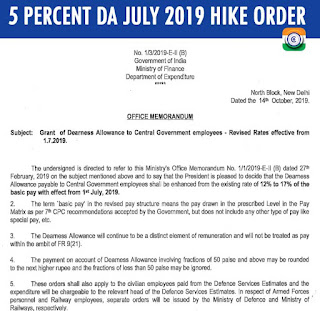
5 Percent DA July 2019 Hike Order - Grant of Dearness Allowance to Central Government employees

Grant of Dearness Allowance to Central Government employees 5 Percent DA July 2019 Hike Order  No. 1/3/2019-E- II (B) Government of...

Blog Archive

About The Author