A complete reference blog for Indian Government Employees

Thursday, 10 March 2016

Paternity Leave to Bank Employees

Shri Jayant Sinha, Minister of State in the Ministry of Finance in written reply to a question in Lok Sabha has confirmed that 15 days of Paternity Leave would be available to bank employees as accepted under the 10th Wage Negotiation Settlement signed between Indian Banks’ Association (IBA) and the Unions/Associations of employees

Male Bank Employees eligible for 15 days Paternity leave as accepted under the 10th Bank Wage Negotiation Settlement – Minister of Finance confirms in Lok Sabha.

Shri Jayant Sinha, Minister of State in the Ministry of Finance in written reply to a question in Lok Sabha has confirmed Grant of 15 days Paternity Leave to bank employees

Paternity Leave to Bank Employees
Grant of Paternity Leave to bank employees has been accepted under the 10th Wage Negotiation Settlement signed between Indian Banks’ Association (IBA) and the Unions/Associations of employees.

Male employees with less than two surviving children shall be eligible for 15 days paternity leave during his wife’s confinement and may be availed upto 15 days before or upto 6 months from the date of delivery of the child.

This was stated by Shri Jayant Sinha, Minister of State in the Ministry of Finance in written reply to a question in Lok Sabha today.

PIB
Share:

Productivity linked Bonus all Railway Employees: Amendment to payment of Bonus Act, 1965

Government has recently passed the bill for revision of Bonus calculation from Rs. 3500/- to Rs.7000/- and the eligibility ceiling to Rs. 21,000 with effect from 01.04.2014 – As Railway Employees are entitled to Productivity linked Bonus all Railway Unions are pressing the Govt for grant of arrears of bonus for the financial year 2014-15

Revision of wage calculation limit from Rs. 3500/- p.m. to Rs. 7000/- p.m. with effect from 01/04/2014 – Amendment to payment of Bonus Act, 1965

National Federation of Indian Railwaymen writes to Minister of Railways on amendment of Bonus Act 1965.

NFIR
National Federation of Indian Railwaymen
3, CHELMSFORD ROAD, NEW DELHI – 110 055
Affiliated to :
Indian National Trade Union Congress (INTUC)
International Transport Workers’ Federation (ITF)
No. 1/10/Part IV
Dated: 07/03/2016
Shri Suresh Prabhu,
Hon’ble Minister for Railways, Rail Mantralaya,
New Delhi

Respected Sir,
Sub: Amendment to payment of Bonus Act, 1965-Revision of wage calculation limit from Rs. 3500/- p.m. to Rs. 7000/- p.m. with effect from 01/04/2014- payment of P.L. Bonus to Railway employees at revised rate of Rs. 7000/- p.m.-reg.
Ref: Railway Board’s reply vide No. E(P&A)II-2014/PLB-8 dated 16/02/2016 to GS/NFIR.

***********
While thanking the Railway Ministry for its prompt reply to NFIR under reference No. E(P&A)II-2014/PLB-8 dated 16/02/2016, the Federation re-iterates the following facts for taking appropriate steps by the Government.
(i) The chronological developments since decades need to be taken into account for processing the case for payment of PL Bonus to the Railway employees at the revised wage calculation ceiling limit i.e. Rs. 7000/- p.m. w.e.f. 01/04/2014.
(ii) When the Bonus Act was amended, raising the wage calculation ceiling from Rs. 750 to 1600, the Railway employees were paid PL Bonus at the revised wage calculation ceiling limit. Subsequently, when the Bonus Act was amended, revising the wage calculation limit from Rs. 1600/- to Rs. 2500/-, the said rate was adopted by the Railway Ministry and PL Bonus paid to the Railway employees at the revised rates.
(iii) When the wage calculation ceiling was again revised to Rs. 3500/- w.e.f. 1st April 2006, the Federation took up the issue and explained the merits of the case for adopting the rate of Rs. 3500/- w.e.f. 01/04/2006 for ensuring payment of PL Bonus. The Railway Ministry had processed the case and obtained Union Cabinet’s approval and issued orders vide letter No. E(P&A)II-2008/PLB-10 dated 03/10/2008, duly revising the wage calculation ceiling to Rs. 3500/- with retrospective effect i.e, from 01/04/2006, consequently, PLB arrears for the year 2006-07 were paid to the Railway employees in October 2008.
From the above facts, it could be seen that the payment of P.L. Bonus has been ensured commensurating with the revision of wage calculation ceiling limit made through amendments to Bonus Act, 1965 without any deviation. Similarly when the wage calculation ceiling limit has been raised to Rs. 7000/- p.m., the Railway Employees are entitled for payment of P.L. Bonus at revised rates for the year 2014-15.

NFIR, therefore, requests the Hon’ble Railway Minister to kindly arrange to process the case on top priority for obtaining the approval of the Union Cabinet for making payment of PL Bonus arrears pertaining to the year 2014-15 to the Railway employees at the earliest.
Yours sincerely,
(Dr. M. Raghavaiah)
General Secretary
Click to view NFIR letter No.1/10/Part IV dated 07.03.2016
Share:

7th CPC recommendations and Charter of Demands — Reg

7th CPC recommendations and Charter of Demands — Reg

NJCA
National Joint Council of Action

4, State Entry Road, New Delhi — 110055
No.NJC/2016/7th CPC
March 7, 2016
To
Cabinet Secretary,
Government of India & Chairman,
National Council/JCM

Subject:- 7th CPC recommendations and Charter of Demands — Reg.

Dear Sir

Kindly refer to the NJCA letter dated 10th December 2015 conveying you the decision of the National Joint Council of Action to go on indefinite strike in pursuance of the Charter of demands submitted there-with, if no settlement through bilateral discussions is brought about.

I am also to invite your kind attention to the discussion the Empowered Committee of Secretaries chaired by you with Standing Committee of NC of JCM on 15t March 2016 where-in while summing up the discussions on the charter of demands you assured that a fair consideration would be given on all demands raised by the Staff Side. It was also stated by you that reasonable time should be given to the Government since the issues concern inter=departmental consultations.

The NJCA in its meeting held on 7th March 2016 considered the request made by you. To give space for negotiated settlement on the charter of demands raised by the Staff Side it has been decided to defer the commencement of the indefinite strike to 11th July 2016 and to serve the strike notice on 9th June 2016, if the desired settlement through bilateral discussions is not brought about.

It is requested that in the intervening period the Government may hold meaningful negotiation with the Staff Side, JCM so that a settlement could be reached on the Charter of demands raised by the staff side, in the interest of industrial harmony.

Thanking you,
Yours faithfully,
(Shiva Gopal Mishra)
Source-http://ncjcmstaffside.com/
Share:

EPF Tax Withdrawn – How the Controversy Rendered NPS more Attractive

Under NPS, only 60 per cent of the corpus can be withdrawn as lump sum. Now, there is no tax on the 40 per cent. And if the person decides to invest the remaining 20 per cent also in annuity, there would be no tax on withdrawal.

EPF Tax Withdrawn – How the Controversy Rendered NPS more Attractive – Finance minister Arun Jaitley on Tuesday withdrew the controversial tax on employees provident fund after the middle class outrage threatened to synge the government badly.

Finance minister Arun Jaitley on Tuesday withdrew the controversial tax on employees provident fund after the middle class outrage threatened to synge the government badly. He, however, said the changes proposed for the National Pension Scheme (NPS) would be tabled in Parliament as they are. If his proposals are accepted, the NPS will become an attractive avenue for retirement savings than it was earlier.

“Employees should have the choice of where to invest. Theoretically such freedom is desirable, but it is important the government to achieve policy objective by instrumentality of taxation. In the present form, the policy objective is not to get more revenue but to encourage people to join the pension scheme,” Jaitley said explaining the rationale for the taxation proposal.


Until the current financial year, the NPS did not have many voluntary takers despite the government providing an  additional deduction of Rs 50,000 under Section 80CCD (1B) of the Income Tax Act. That’s because the entire corpus was taxable at the time of withdrawal.

Tapati Ghose, partner with Deloitte Haskins & Sells, explains: “According to the structure of the scheme, it is mandatory for an investor to buy an annuity plan with at least 40 per cent of the corpus. One could withdraw the balance amount after paying tax on it.” Many investors felt that to save tax, they would be forced to buy annuity with the entire money on retirement.

The Budget has rationalised the tax on NPS. While the structure of the scheme remains the same, a person can now withdraw up to 40 per cent of the corpus without paying any tax on it. And, if a person chooses to withdraw 60 per cent as a lump sum, he will need to pay tax only on 20 per cent of the total corpus. “This is a bonanza for NPS investors,” says Ghose.

Let us examine the following case. A person invests Rs 50,000 every year into NPS to benefit from tax deductions for the next 25 years. Assume that the person opted for Asset E, wherein 50 per cent of the contribution is allocated to equities, and earns an average annual return of 12 per cent. On retirement, the person will have a kitty of around Rs 75 lakh.

According to the existing provisions, the person will need to buy an annuity with 40 per cent of the corpus, which will be Rs 30 lakh. If he withdraws the balance amount of Rs 45 lakh, there will be 30 per cent tax, which works out to Rs 13.5 lakh. The person, then, ends up with a corpus of Rs 31.5 lakh in hand.

If one makes changes to these calculations based on the recommendations in the Budget, the individual will end up with Rs 40.5 lakh in hand. That is a significant difference of Rs 9 lakh or a saving of 12 per cent, as compared to the existing norms.

Here’s how it works out to be so. The person buys the mandatory annuity plans with Rs 30 lakh (40 per cent of Rs 75 lakh corpus). Of the remaining money, there will be no tax on Rs 30 lakh (40 per cent of the corpus) on withdrawal. On the remaining amount of Rs 15 lakh (20 per cent of corpus) the investor will need to pay 30 per cent tax, which will work out to Rs 4.5 lakh. The total money in hand of the individual thus be Rs 40.5 lakh.

If you are an employee, whose organisation has moved to NPS you will end up with similar savings on your total corpus at the time of retirement. The returns may or may not be as high as the EPF (depending, among other factors, on the amount you allocate to equities in NPS) but the proposed changes in the Budget will definitely put more money in your hands at the time of retirement.

Source: Business Standard
Share:

Wednesday, 9 March 2016

NPS Exit and purchase of Annuity - PFRDA

NPS Exit and purchase of Annuity – Clarification issued by PFRDA in respect of interim arrangement for the purpose of buying annuity from the NPS maturity amount

In the case of pre-mature exit by NPS Subscriber, any annuity scheme provided by Annutiy Service provider that covers the spouse of NPS subscriber can be purchased

PENSION FUND REGULATORY
AND DEVELOPMENT AUTHORITY
B-14/A, Chhatrapati Shivaji Bhawan
Qutab Institutional Area,
Katwaria Sarai, New Delhi-110016

Circular
PFRDA/2016/5/Exits/01

03.03.2016

Subject: Clarifications on Settlement of Claims Relating To Exits, Involving Purchase of Annuities.

1. Whereas the Authority has notified the PFRDA (Exits and Withdrawals from National Pension System) Regulations, 2015 on 11th May, 2015 and is in force.

2. Number of claims have been received post the notification of the regulations covering pre-mature exits and also pertaining to claims arising out of the death of the subscriber under NPS. It has been brought to the notice of the Authority that as default annuity schemes mentioned under Regulation 3 of the PFRDA (Exits and Withdrawals from National Pension System) Regulations, 2015 have not been made available by the Annuity Service Providers yet, these claims could not be settled and thus there exists a difficulty in settling claims in accordance with the aforesaid Regulations.

3. The Authority having considered and upon being satisfied that the claims of the subscribers are not being able to be processed and settled in accordance with Regulation 3 of the PFRDA (Exits and Withdrawals from National Pension System) Regulations, 2015 and to ensure that the interest of the
subscribers are protected in this regard, has decided that till the time the default annuity schemes as mentioned under aforementioned Regulation 3, are made available to the subscribers, the claims both present and future shall be settled in the following manner:

Existing ProvisionsRemoval of difficulty
1.Regulation 3 (b) applicable in case of pre-mature exit (to extract proviso from regulations)In place of default annuity scheme
Any annuity scheme provided by the Annuity Service Provider such that scheme shall mandatorily cover the spouse of the subscriber.
2.Regulation 3 (c) applicable in case of death (to extract proviso from regulations)The entire accumulated pension wealth (100%) would be paid to the nominee/legal heir of the subscriber and there would not be any purchase of annuity/monthly pension.

  4. The above provisions for removal of difficulty shall be in force till the default annuity schemes are devised by the Annuity Service Providers and made available to the subscribers, and shall cease on a date notified by the Authority, whereafter settlement of claims shall be in accordance with the applicable provisions of the regulations. All other provisions of settlement including settlement of lump sum pension wealth shall be continued to be governed by the applicable provisions of the regulations.

    5. This clarification for removal of difficulty is issued by the Authority in exercise of its powers under Section 14 of the Pension Fund Regulatory and Development Authority Act, 2013 read with Regulation 39 of the PFRDA (Exits and Withdrawals from National Pension System) Regulations, 2015.
    
Yours faithfully,
    sd/-
    (Subroto Das)
    Chief General Manager
Share:

Healthcare, Education Facilities for NPPS Employees

Healthcare, Education Facilities for NPPS Employees

Facilities for NPPS employees

In respect of employees at the Nuclear Power Plant sites, healthcare facilities are provided to all the employees and their family members through Contributory Health Service Scheme (CHSS) of Department of Atomic Energy (DAE) through hospitals established by NPCIL/DAE at the Nuclear Power Plant sites and/or hospitals empanelled for the purpose. The wards of employees are provided education facility upto 12th standard through Atomic Energy Central Schools (AECS) managed by Atomic Energy Education Society (AEES), an autonomous grant-in-aid institution of DAE.

With regard to people living in the vicinity of Nuclear Power Plants, NPCIL has been contributing in the areas of education, healthcare and infrastructure & skill development through its Corporate Social Responsibility (CSR) and Neighborhood Development Programme (NDP). NPCIL is running primary health centers through NGOs and providing Out Patient (OPD) services. It also runs Mobile Medical Vans and conducts free medical camps. It has also upgraded several primary health centers and provided medical equipment, ambulances, prosthetic aids etc. A multi-specialty hospital is being set up at Kudankulam, Tamil Nadu under the Neighborhood Development Programme. In respect of education, school buildings have been constructed, improvements made in existing buildings, provisions for drinking water and toilet blocks made, educational aids including books, computers, bags & uniforms distributed and scholarships provided for meritorious students in neighborhoods of nuclear power plants.

NPCIL extends support for infrastructure around nuclear power plants like construction of roads, bridges, school buildings, drinking water schemes, water tanks, bore wells, community centres, crematoria, multi-purpose halls solar street lights etc. In the last two years and the current year, infrastructure projects totaling to about Rs. 67 crore have been planned.

This information was provided by the Union Minister of State (Independent Charge) Development of North-Eastern Region (DoNER), MoS PMO, Personnel, Public Grievances & Pensions, Atomic Energy and Space, Dr Jitendra Singh in a reply to an unstarred question in Lok Sabha today.

Source: PIB News
Share:

Reviewing Pay and Allowances of Armed Forces Personnel

Reviewing Pay and Allowances of Armed Forces Personnel

The Government entrusted the task to a Pay Commission in 1973, at the time of setting up of 3rd Central Pay Commission. The Government had set up a Post War Pay Committee in 1947, a departmental pay committee (Raghuramiah Committee) during 1959-60 and another Departmental Committee in 1967 for review of pay and allowances of Defence Forces Personnel. There was general discontentment amongst the Services with respect to the recommendations of these Committees. Thereafter, the Government decided to entrust the examination of structure of emoluments, including benefits in cash and kind and death cum retirement benefits of the Armed Forces to the 3rd Central Pay Commission.

The terms of reference with respect to the Armed Forces personnel were different to the extent that the 3rd Central Pay Commission was not required to make recommendations on the conditions of service of the Armed Forces personnel. Though, the matters related to pension of Defence Service personnel was referred to 3rd Pay Commission, there has been no clubbing with civilians. The Commission felt that by and large, the principles followed by Armed Forces Pension Revision Committee (AFPRC) continue to be valid. The 3rd Pay Commission had considered the peculiar conditions of service and hierarchical set up of the Services, age of retirement, period of qualifying service pension etc. in respect of Armed Forces personnel. As such there has been no mistake in entrusting the matter to 3rd Central Pay Commission.

This information was given by Defence Minister Shri Manohar Parrikar in a written reply to Shri Mahendra Singh Mahra in Rajya Sabha today.

PIB
Share:

Featured post

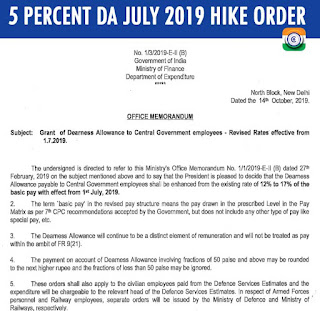
5 Percent DA July 2019 Hike Order - Grant of Dearness Allowance to Central Government employees

Grant of Dearness Allowance to Central Government employees 5 Percent DA July 2019 Hike Order  No. 1/3/2019-E- II (B) Government of...

Blog Archive

About The Author