A complete reference blog for Indian Government Employees

Tuesday, 26 March 2019

Central Civil Services FAQ on Pension - Pension Policy


Central Civil Services FAQ on Pension - Pension Policy

Frequently Asked Questions (FAQs)
(Central Civil Services)

1. PENSION POLICY

(1.1) Which rules govern pension and gratuity to the employees retiring from Central Government Civil Departments.
Pension and gratuity of the employees retiring from Central Government Departments is regulated by the Central Civil Services (Pension) Rules, 1972. There are separate rules regarding pension and gratuity of Railway employees and Defence personnel.

(1.2) Is the date of voluntary retirement treated as duty?
Yes, the date of voluntary retirement is treated as duty (Rule 5).

(1.3) Who is eligible for pension?
A Govt. servant appointed in a pensionable establishment on or before 31.12.2003 and retires from Government service with a qualifying service of 10 years or more is eligible for
pension (Rule 2, 49).

(1.4) How is pension calculated?
W.e.f. 1.1.2006, pension is calculated @ 50% of emoluments (last pay) or average emoluments (for last 10 months), whichever is more beneficial to the retiring Govt. servant. (Rule 49).

(1.5) What happens to the departmental proceedings instituted against a Govt. servant during service and pending at the time of retirement? Can pension/gratuity be paid to a retiring, Govt. servant if Departmental/Judicial proceeding are pending against him at the time of retirement?
Department proceedings pending at the time of retirement are deemed to be the proceedings under Rule 9 and shall be continued and concluded by the same disciplinary authority and in the same manner. Thereafter, authority will submit a report recording its finding to the President. In such cases, only provisional pension is paid and gratuity is withheld till the conclusion of departmental proceedings and issue of final orders thereon
by the competent authority.

(1.6) Can Departmental proceedings be instituted after retirement?
Departmental proceeding can be instituted after retirement subject to following conditions:-
(a) Sanction of the President shall be obtained before instituting such proceedings;
(b) The proceedings shall not be in respect of any event which took place more than 4 years such institution;
(c) Proceedings shall be conducted by such authority and in such place or the President may direct and in accordance with rules applicable to departmental proceedings in which an order of dismissal from service could be made in relation to the Govt. servant during his service.

(1.7 ) When is departmental or judicial proceeding deemed to be instituted?
(a) Departmental proceedings shall be deemed to be instituted on the date on which the statement of charges is issued to the Government servant or pensioner, or is the Government servant has been placed under suspension from an earlier dated, on such date;
(b) Judicial proceedings shall be deemed to be instituted-
(i) In the case of criminal proceedings, on the date on which the complaint or report of a Police Officer, of which the Magistrate takes contingence, is made, and
(ii) In the case of civil proceedings, on the date the plaint is presented in the
court.

(1.8) Can the pension/gratuity be withheld on conclusion of departmental/judicial proceedings?
The President reserves to himself the right of withholding a pension or gratuity, or both, either in full or in part, or withdrawing a pension in full or in part, whether permanently or for a specified period, and of ordering recovery from a pension or gratuity of the whole or part of any pecuniary loss caused to the Government, if, in any departmental or judicial proceedings, the pensioner is found guilty of grave misconduct or negligence during the period of service, including service rendered upon re-employment after retirement. Power to withhold/withdraw pension/gratuity is with President and UPSC is required to the consulted before any final orders are passed.

(1.9) Which pay is reckoned as emoluments for pension and gratuity?
The basic pay as defined in FR 9 (21) (a) (i) is reckoned as emoluments for pension. However, Non- Practicing Allowance granted to Medical Officers is also included in emoluments. For the purpose of Retirement/ Death gratuity, Dearness Allowance admissible on the date of retirement/death is also treated as emoluments.

(1.10) Which pay is reckoned as emoluments for pension if the Government servant is on leave, suspension or deputation at the time of retirement?
(a) If a Government servant immediately before his retirement or death while in service had been absent from duty on leave for which leave salary is payable or having been suspended had been reinstated without forfeiture of service, the emoluments which he would have drawn had he not been absent from duty or suspended shall be the emoluments for the purposes of this rule. However, increase in pay (other than the increment) which is not actually drawn shall not form part of his emoluments.
(b) If a Government servant immediately before his retirement or death while in service had been absent from duty on extraordinary leave or had been under suspension, the period whereof does not count as service, the emoluments which he drew immediately before proceeding on such leave or being placed under suspension shall be the emoluments for the purposes of this rule.
(c) If a Government servant immediately before his retirement of death while in service, was on earned leave, and earned an increment which was not withheld, such increment, though not actually drawn, shall form part of his emoluments. However, such increment should have been earned during the currency of the earned leave not exceeding one hundred and twenty days, or during the first one hundred and twenty days of earned leave where such leave was for more than one hundred and twenty days.
(d) Pay drawn by a Government servant while on foreign service shall not be treated as emoluments, but the pay which he would have drawn under the Government had he not been on foreign service shall alone be treated as emoluments.

(1.11) Can a pension be withheld/withdrawn on grounds of misconduct after retirement?
Future good conduct is the implied condition for grant/continuance of pension. The appointing authority may, by order in writing, withhold or withdraw a pension or a part thereof, whether permanently or for a specified period, if the pensioner is convicted of a serious crime or is found guilty of grave misconduct.

(1.12) Can a pension, once authorized, be revised to the disadvantage of pensioner on grounds other than misconduct under Rule 8 and 9.
Except under Rule 8 and 9, pension once authorized after final assessment shall not be revised to the disadvantage of the Government servant, unless such revision becomes necessary on account of detection of a clerical error subsequently. No revision of pension to the disadvantage of the pensioner shall be ordered by the Head of Office without the concurrence of the Department of Pension and Pensioners’ Welfare if the clerical error is detected after a period of two years from the date of authorization of pension. The question whether it is a case of clerical error or not would be decided by the administrative Ministry.

(1.13) What is the formula for revision of pension of pre-2006 pensioner/family pensioner?
In terms of para 4.1 of OM No.38/37/08-P&PW(A) dated 1.9.2008, the pension/family pension will be consolidated w.e.f. 1.1.2006 by adding together (i) The existing pension/family pension,(ii) Dearness Pension, where applicable, (iii)Dearness Relief @24% of basic Pension/Basic Family Pension plus dearness pension as admissible vide OM No.42/2/2006-P&PW(G) dated 5.4.2006 and (iv) Fitment weightage @40% of the existing pension/family pension. Where the existing pension at (i) includes the effect of merger of 50% of DR w.e.f. 1.4.2004, the existing pension for the purpose of fitment weightage will be re-calculated after excluding the merged DR of 50% from the pension. The amount so arrived at will be regarded as consolidated pension/family pension w.e.f. 1.1.2006. The fixation of pension will be subject to the provision that the revised pension, in no case shall be lower than 50% of the minimum of the pay in the pay band plus the grade pay corresponding to the pre-revised pay scale from which the Govt. servant retired. The minimum of pay is the pay band/pay scale is to be reckoned in accordance with DoPPW OM No. 38/37/08-P&PW dated 30.07.2015.

(1.14) Whether all pre-2006 pensioners/family pensioners would get benefit under Department of Pension and Pensioners’ Welfare O.M. NO.38/37/08- P&PW (A) dated 28.1.2013 (now OM dated 30.07.2015)?
There will be no change in the pension of those pre-2006 pensioners whose pension (as revised with effect from 1.1.2006) is already equal to or more than this minimum limit mentioned in the OM dated 28.01.2013 and 30.07.2015. In the case of family pensioner also the minimum family pension as mentioned in Col.10 of the Annexure to the OM dated 28.1.2013 shall be payable if the amount of family pension (w.e.f. 01.01.2006) is equal to or more than this minimum family pension, the same family pension shall continue to be paid.

(1.15) What are the provisions regarding revision of pension of pre-2016 pensioners after 7th CPC?
Orders were issued vide OM No. 38/37/2016-P&PW(A) dated 04.08.2016 for revision of pension of pre-2016 pensioners by multiplying the pre-revised pension by a facor of 2.57. This was to be done by the Pension Disbursing Authorities/ Banks. Further orders were issued vide OM No. 38/37/2016- P&PW(A) dated 12.05.2017. As per this OM, the revised pension/family pension w.e.f 01.01.2016 of all Central Civil Pensioners/ family pensioners, including CAPF’s, who retired/died prior to 01.01.2016, shall be revised by notionally fixing their pay in the pay matrix recommended by the 7th CPC in the level corresponding to the pay in the pay scale/ pay band and grade pay at which they retired/ died. This will be done by notional pay fixation under each intervening Pay Commission based on the Formula for revision of pay. While fixing pay on notional basis, the pay fixation formulate approved by the Government and other relevant instructions on the subject in force at the relevant time shall be strictly followed. 50% of the notional pay as on 01.01.2016 shall be the revised pension and 30% of this notional pay shall be the revised family pension w.e.f. 01.01.2016 as per the first Formulation. In this case of family pensioners who were entitled to family pension at enhanced rate, the revised family pension shall be 50% of the notional pay as on 01.01.2016 and shall be payable till the period up to which family pension at enhanced rate is admissible as per rules. The amount of revised pension/family pension so arrived at shall be rounded off to next higher rupee. The pension/ family pension already revised in accordance with this Department’s OM No. 38/37/2016-P&PW(A) (ii) dated 04.08.2016 or the revised pension/ family pension as worked out in accordance with OM dated 12.05.2017 shall be granted to pre-2016 central civil pensioners as revised pension/ family pension w.e.f. 01.01.2016. In cases where pension/ family pension being paid w.e.f. 01.01.2016 in accordance with this Department’s OM No. 38/37/2016-P&PW(A) (ii) dated 04.08.2016 happens to be more than pension/ family pension as worked out in accordance with para 4 above, the pension/ family pension already paid shall be treated as revised pension/ family pension w.e.f. 01.01.2016.

(1.16) Is any ready reckoner available for revision of pension of pre-2016 pensioners by notional pay fixation method?
A Concordance Table for fixation of notional pay of pension/ family pension of employee who retired/ died in various grades of Vth/ VIth CPC period has been prepared and circulated on 06.07.2017. These Concordance Tables are available on the website of this Department, i.e. http://doppw.gov.in/ and http://pensionersportal.gov.in

(1.17) Is there any online calculator available for fixation/ revision of pension?
A calculator for calculation/ revision of pension/ gratuity is available on the website of this Department, i.e. http://doppw.gov.in/ and http://pensionersportal.gov.in/

(1.18) What is the amount of minimum and maximum pension after Seventh CPC?
The pension shall not be less than Rs.9000/- (excluding the element of additional pension to old pensioners) and shall not be more than 50% of the highest pay in Government i.e Rs 1,25,000/- w.e.f. 01.01.2016.

(1.19) From where can we download the pension /nomination Forms ?
All forms are available at the website of Department of Pension & Pensioners Welfare.

(1.20) When can a Government servant apply for voluntary retirement?
Under Rule 48, a Government servant can apply for voluntary retirement after completion of 30 years of qualifying service. Under Rule 48-A, he can apply for voluntary retirement after completion of qualifying service of 20 years. Under FR 56 (k) he can apply for voluntary retirement an attaining the age of 50 years (for Gr. A & B) and 55 years (in other cases).

(1.21) Whether older pensioners will get higher rate of pension?
Yes, from 1.1.2006, the quantum of pension/family pension available to old
pensioners/family pensioners has been increased as follows:-
O.M.No. 38/37/08- P&PW(A) dated 2.9.2008 .
Age of pensioner/ family pensionerAdditional quantum of pension
From 80 years to less than 85 years20% of revised basic pension/ family pension
From 85 years to less than 90 years30% of revised basic pension/ family pension
From 90 years to less than 95 years40% of revised basic pension/ family pension
From 95 years to less than 100 years50% of revised basic pension/ family pension
100 years or more100% of revised basic pension/ family pension

(1.22) Is additional pension admissible to old family pensioners also?
Yes, the rates related to additional pension as applicable in the case of old pensioners hold good for family pensioners, as well.

(1.23) Whether the provision of added years in qualifying service for computation of pension is still in force?
The benefit of added years of qualifying service for computation of pension/related benefits has been withdrawn w.e.f. 01.01.2006.

(1.24) Whether the provision of added years in qualifying service has been withdrawn for calculating gratuity also?
Yes, w.e.f. 01.01.2006.

(1.25) Whether the additional pension/family pension available to old pensioners would be payable from the date of attaining age of 80 years or above or from the first day of the month in which the date of birth falls?
The additional quantum of pension/family pension, on attaining the age of 80 years and above, would be admissible from the 1st day of month in which his date of birth falls. For example, if a pensioner/family pensioner completes age of 80 years in the month of August, 2008, he will be entitled to additional pension/family pension w.e.f. 1.8.2008. Those pensioners/family pensioners whose date of birth is 1st August, will also be entitled to additional pension/family pension w.e.f. 1.8.2008 on attaining the age of 80 years and above.
Share:

NPS to OPS: Abolition of National Pension System and for restoration of Old Pension Scheme

NPS to OPS: Abolition of National Pension System and for restoration of Old Pension Scheme
Annexure-I
F.No-20/07/2017-PR
18.03.2019
To
Shri C. Srikumar, General Secretary,
All India Defence Employees' Federation,
S.M. Joshi BhavanI, Survey No. 81 ,
Dr. Babasaheb Ambedkar Road,
Khadki, Pune - 411 003.

Subject: Representation received for abolition of National Pension System and for restoration of Old Pension Scheme - reg.

Sir,
Kindly refer, to your representation dated 03.11.2018 on the subject cited above.

In this connection, it is started that the introduction of National Pension System (NPS) was a policy decision of the Government of India in view of the Increasing pension liability on the economy.
Your concerns In this regard have been noted. It Is informed that based on the feedback received from time to time from the subscribers covered under NPS and other stakeholders, the Government of India, based on the Committee of Secretaries recommendations, has recently approved the following proposals for streamlining NPS for Central Government employees.
  • Enhancement of the Government's contribution from the existing 10% to 14% of the employee's pay + DA While keeping the employee's contribution at the existing 10%
  • Providing freedom of choice for selection of Pension Funds and pattern of investment to subscribers
  • Payment of compensation for non-deposit or delayed deposit of NPS contributions during 2004-2012
  • Providing tax deduction to the contribution made under Tier-II of NPS under Section 80 C for deduction up to Rs. 1.50 Iakh provided that there is a lock in period of 3 years
  • Increase In the tax exemption limit for lump sum withdrawal on exit from the existing 40% to 60% making the entire withdrawal exempt from Income tax.
It Is further assured that keeping in view the concerns of NPS subscribers, the Government will continue to do its best to ensure that the Interests of the subscribers are protected to the best extent.

Yours faithfully,
(Abhay Garg)
Under Secretary to the Government of India

NPS-OPS-Abolition-National-Pension-System

Share:

DoPT: Updation of web-based data of PS Grade of CSSS in CSCMS

DoPT: Updation of web-based data of PS Grade of CSSS in CSCMS
IMMEDIATE
File No.4/1/2019-CS-II(A)
Government of India
Ministry of Personnel, Public Grievances & Pensions
Department of Personnel & Training
3rd Floor, Lok Nayak Bhawan,
Khan Market, New Delhi-110003.
Dated: 25th March, 2019
OFFICE MEMORANDUM

Subject: Updation of web-based data of PS Grade of CSSS in CSCMS - reg.

The undersigned is directed to say that the information in respect of Private Secretaries of CSSS who are posted in all the Ministries/Departments is essentially required to be updated for several purposes ego filling of Immovable Property Return (IPR), updation of web-based data of PSs and filling up of unfilled vacancies etc. It will also serve other purposes- record maintenance, preparation of CSL etc.
All Ministries/Departments are, therefore, requested to furnish the requisite information of PS Grade as on 15.03.2019 in the proforma attached by 05.04.2019 positively to enable this Department to update the records of PS Grade. The cadre units are also requested to update the information on CSCMS portal of this Department simultaneously.
To
(Chirabrata arkar)
Under Secretary to the Govt. of India
Tel. No. 24623157

To
All Ministries/Departments participating in CSSS cadre.
(Deputy Secretary (Admn./Estt.)

Vacancy position in the grade of Private Secretaries as on 15.03.2019.

Name of the Main Cadre Unit:
GradeSanctioned
Strength
No. of Private Secretaries
In-Position as on 15.03.2019
Regular - Adhoc - Total
Vacancies
on15.03.2019
PS


The following information may also be provided in the table given below:

SI.No.Name of Private Secretaries Regular / AdhocDate of Retirement on attaining the age of superannuation (between 01.01.19 to 30.06.19)


Source: DoPT

Share:

Monday, 25 March 2019

Railways: Emergency Cashless Treatment Scheme (CTSE) Card issue during retirement

Railways: Emergency Cashless Treatment Scheme (CTSE) Card issue during retirement

GOVERNMENT OF INDIA
MINISTRY OF RAILWAYS
RAILWAY BOARD
No. 2018/Trans.Cell/Health/Medical Card
Dated: 20.03.2019
The General Manager, All Indian Railways/PUs, NF(Con), CORE
The DG/RDSO/Lucknow, DG/NAIR/Vadodara
CAOs, DMW/Patiala, WPO/Patna, COFMOW/NDLS, RWP/Bela, CAO/IROAF

Sub: Issue of Cashless Treatment Scheme in Emergency (CTSE) Card at the time of retirement.
Ref:
(1) Railway Board letter no.2018/Trans.Cell/Health/Medical Cards dated 30.07.2018.
(2) GM/SECR’s letter no. G/SECR/70 dated 31.01.2019.

With reference to GM/SECR’s letter at (2), and Board’s letter at (1) above, Board (MS, FC & CRB), have approved the following:

Issue of Cashless Treatment Scheme in Emergency (CTSE) Card to willing and eligible retiring Railway employees and their dependents at the time of retirement or before subject to their deposition of the required fee as per extant rules and the same will be effective from the next day of retirement.
Other extant instructions/guidelines issued from Board on the subject shall remain unchanged or as modified from time to time.

This issues with the concurrence of Associate Finance of Transformation Cell of Railway Board.
Kindly acknowledge the receipt and ensure compliance
(Umesh Balonda)
Executive Director/S&T
Transformation Cell
Dated: 20.03.2019
Share:

National Council (JCM) Dharna on 28th March is delayed

National Council (JCM) Dharna on 28th March is delayed

All the Constituent Organizations of National Council (JCM)

Sub:- Holding of regular meetings of the National Council (JCM), Standing Committee of the National Council (JCM) and the Departmental Council (JCM) as per the JCM Scheme - deferment of the proposed Dharna at Delhi on 28th of March, 2019.

Ref:-DOPT letter F.No.3/1/2019-JCA dated 22/3/2019

Dear Comrades,
Cabinet Secretary already fix the meeting of the National Council (JCM) on 13/4/2019 vide letter referred above (copy enclosed).

In view of above a dharna proposed by JCM Members on 28th March 2019 has been deferred in consultation with the principle Office Bearers of various Federations.
With greetings,
Yours Comradely,
(Shiva Gopal Mishra)
Convener
Source : Confederation
Share:

GDS: Revised eligibility criteria for engagement to Gramin Dak Sevaks posts

DS: Revised eligibility criteria for engagement to Gramin Dak Sevaks posts

Revised_eligibility_criteria_Gramin_Dak_Sevaks_GDS_posts

No.17-02-2018-GDS
Government of India
Ministry of Communications
Department of Post
(GDS Section)
Dak Bhawan, Sansad Marg,
New Delhi-110001
Dated: 22.03.2019
To
All Chief Postmasters General/Postmasters General

Subject: Revised eligibility criteria for engagement to Gramin Dak Sevaks (GDS) posts.

I am directed to invite your kind attention towards DG Posts’ orders of even number dated 08.03.2019 and to inform that the para X of revised eligibility criteria for engagement to GDS post may be substituted with the following para:-

(i) The following Minimum TRCA shall be payable to the different categories of GDS post as mentioned Directorate Order No 17-31/2016- GDS dated 25.06.2018

Minimum TRCA of all categories of GDS as per working hrs/Levels

SI.No.CategoryMinimum TRCA for 4 Hours/ levelMinimum TRCA for 5 Hours/ level 2
1BPMRs.12000/-Rs.14500/-
2ABPM/ Dak SevaksRs.10000/-Rs.12000/-

(ii) However, in respect of the GDSs engaged on or after 01.07.2018, the initial fixation of TRCA will be done on the first stage of Level -1 of the respective category.

The above necessary amendment may be given in the draft notification as well as in revised eligibility criteria.
sd/-
(SB Vyavahare)
Assistant Director General (GDS/PCC)
Tele No. 011-23096629
Email- adggds@indiapost.gov.in
Share:

Saturday, 23 March 2019

Guidelines of Resident Welfare Association: DoP

Guidelines of Resident Welfare Association - Department of posts
Guidelines_Resident_Welfare_Association_DoP
Government of India
Ministry of Communications
Department of posts
(Welfare & Sports Section)
Dak Bhawdn, Sansad Marg,
New Delhi-110001
No.1 - 1 12017 -WL/Sports
To
All Heads of postal Circle

Subject: Guidelines of Resident Welfare Association.

Madam / Sir,
The undersigned is directed to forward herewith the guidelines of Resident welfare Association for information, guidance and compliance.

The Scheme is approved by Member (planning & HRD).

Guidelines for Residential Welfare Associations

1. Objective of establishment of residential colonies:

The Department built residential colonies to provide accommodation to its employees and this accommodation is made available to them in lieu of monthly house rent allowance. The main objective of the Department in arranging housing facility for employees and their family members is to provide for their convenience and a healthy environment, so that employees can work without stress and their performance can be enhanced.

2. Requirement of Residential Welfare Association (RWA):

To handle maintenance and other types of problems in the residential
colonies built by the Department, the need for Residents' Welfare Associations (RWAs) was fell. Ail the employees residing in these colonies should be provided membership of the RWA. There should be a process by which the Governing Council of the RWA is chosen. The main duties of the Governing Council will be to redress the grievances, like electricity , water, sanitation, hygiene, safety, wear & tear, etc., of the residents quickly.

3. Main duties of the RWA:

  • To maintain a non-discriminative, cordial and collaborative atmosphere for all the employees and their families members living in the colony.
  • To ensure that there is adequate security in the colony and the colony is always kept clean. The security and cleanliness of the colony should be reviewed regularly
  • To organise community programmes for the employees residing in the colony.
  • To ensure participation of maximum number of residents of the colony in the celebrations on the occasion of National Festivals like Republic Day, Independence Day & Gandhi Jayanti and also on the occasion of the celebration of the anniversaries of eminent persons with a National stature.
  • To facilitate various extra-curricular activities for the employees and their family members.
  • To organise medical camps regularly in the colony for the residents of the colony.
  • To maintain cordial relations with local elected people's representatives.
  • To reduce the loss of lives and properties during natural disaster such as earthquake, flood, fire, etc. in cooperation and coordination with all the stakeholders and act as a bridee between the administration and the residents of the colony.
  • To be of assistance, without any discrimination & influence, if any family living in the colony faces any problem.
  • To report any unethical activity, being done/carried out in the colony by its residents or external elements, to the local administration and the Department.
  • To prevent wastage of water & electricity in the colony and to make adequate arrangement for saving the resources.
  • To keep the record of the expenses out of the assistance granted by the Department, as well as items provided by employees who reside in the colony and inform the same to the Department from time to time and to the residents during the quarterly meeting of the RWA.
  • To ensure early disposal of the complaints lodged in the complaint book.
  • To follow the rules contained in the Constitution of RWA .
  • The meeting of the Governing Council should be held at least once every quarter to discuss the ways to solve the issues pertaining to colony.
  • Every two year a schedule for the election of the Governing Council of RWA should be issued. An election supervisor should also be appointed from Divisional Office for the above elections to ensure peaceful election process.
  • The Department should be informed regularly about the problems being faced by RWA and the activities being organised by them.
  • To plant more trees/Plants/natural vegetation within the available space in the premises of the colony to develop Park (s) wherever feasible and creating environmental friendly complex.
  • To find solution for any issues in the colony, through mutual discussion and the rules set forth in the Constitution of the RWA.
  • To ensure that the welfare activities in the colony are run smoothly and all kinds of tasks are completed in the fixed time frame.

4. Responsibilities of Divisional Office / Circle Office:

  • Divisional Office/ Divisional Office should meet the Governing Council of RWA at regular intervals and give the status report on old issues.
  • The Divisional should nominate an officer in the Governing Council of
  • RWA, whose responsibility will be to advise the RWA from time to time, to be present as observer during RWA elections and to work as an interface between the RWA and the Department.
  • The concerned Senior Superintendent/Superintendent of Post Offices should conduct quarterly visits of the departmental colony and submit the visit report to the Circle Office.
  • The RWA requires funds from time to time for carrying out various day to day basic activities such as cleaning, security, etc., for which collection of the monthly subscription should be made from each residential quarter. The ' rates of the said subscription and other contributions by the member of RWA are to be decided by the respective governing council of PRWA's. The responsibility for collection of subscription and accounts maintenance will jointly be with the Treasurer and Secretary of the PRWA Governing Council. This provision should also be mentioned in the allotment letter
  • during allotment of a house to the employee.

5. Postal Residential Welfare Association Guidelines

(1) Tenure: The tenure of the RWA will be two years.
(2) Membership: The provisions for the membership of an RWA are as
follows:
  • Governing council (GC) may enhance membership monthly contribution considering the monthly expenditure of colony.
  • Each employee living in the colony in allotted accommodation will be a member of the RWA.
  • The following posts are provided in the Governing Council (GC) of
  • Postal Residential Welfare Association:
President-One Post
Vice-President-One Post
Secretary-One Post
Joint Secretary-One Post
Treasurer Convenor,-One Post
Civic facilities and Health services Convenor,-One Post
Sports and Cultural activities Convenor,-One Post
Environment, consumer rights and Security-One Post
Members-Two Post
(iv) The Composition of the GC may be altered by convening a'GBM while
following other formalities. However, the approval of Divisional Office
is required for such a change.
(v) Under normal circumstances the tenure of every Governing Council will
be two years and election for all the above posts will be held at the , beginning of every financial year at the same time. All elections of RWA
should be completed by the month of May.
(vi) The meeting of the Governing Council should be held at least once in a
quarter and the date of the meeting must be notified at least three days
before the said meeting.
(vii) A copy of the minutes of each meeting of the Council should be sent to
the concerned Divisional Office.
(viii) The quorum of all the meetings of Governing Council, except emergency meetings, is one-third of total members of the Governing Council.
(ix) The Governing Council should take all kinds of administrative as well as financial decisions on the basis of the majority present and voting and
before implementing these decisions it should be brought to the notice
of the Divisional office.
(x) In case two-thirds of the members of RWA including GC members are in
favour of dissolving the current GC, re-elections would be required by
dissolving the current GC. The tenure of new GC will be valid for the
balance of the tenure of the previous GC
(xi) Every GC has to submit the audited statement of accounts of the RWA to
the Circle office annually by 31" Muy. Audited statement of account t
should be formatted as per boPT letter no.7/01/2016-welfare dated 22nd
June, 2016 (Annexure-I).
(xii) A joint account will be opened in the nearest BanVPost Office for the
purpose of PRWA in the name of Secretary and Treasurer of the PRWA
and the subscription collected from those residing in colony will be
deposited in the said account. The account will be operated jointly the
Secretary and Treasurer. The account must be maintained by RWA in
the name of Secretary and treasurer for the purpose of receipt and
expenditure of the funds.
(xiii) An Audit committee will be constituted by the Controlling Office for
auditing the functions and expenses, etc. of the RWA. The Audit
Committee shall audit the accounts of PRWA once in a year and submit
its report to controlling Office/circle Office. The account of RWA will
have to be audited by the Committee constituted by Chief Welfare
Officer ie. CPMG. These audit reports would be submitted to the Circle
Offices annually.

6. Powers and Duties of the Members of GQ:

  • President - He shall preside over the meetings of the General Body/Managing Committee and exercise general supervision over the activities of the Association. He may dispose of such important and urgent ' matter which for want of time cannot be put up to the Governing Council and report the same in the next meeting of the Governing council. He may also authorize expenditure up to Rs.350/- expenditure and the expenditure so incurred should be got approved by the governing council at its next meeting. He would be treated as 'head' of the association. In the event of resignation by any office bearer/member, the President shall arrange to convene a meeting of the Governing council within a week of receipt of resignation in which the nominated representative of the Divisional Office will be present.
  • Vice-President - He will discharge all responsibilities assigned to him by the President from time to time. During the absence of the President, Vice President will act as President and will also bear all the powers and responsibilities of the post.
  • Secretary - He shall (i) maintain a register containing the names and addresses of the members of the association, (ii) issue notice of the meeting is consultation with the Presidents and record the minutes of the meetings,(iii) be responsible to the Governing council for all activities of the Association and will conduct corespondence on behalf of the association, have authority to incur expenditure not exceeding Rs.150/- in anticipation of formal sanction, such expenditure being reported to the governing Council for approval at its next meeting (v) submit a report on the working of Association for the preceding year at the annual general Meeting and (vi) execute contracts on behalf of the Association as and when authorized to do so by the governing council, (vii) keep all the records (excluding cash and accounts) of the corespondence with him.
  • Joint Secretary - He will discharge all responsibility assigned to him by the President and Secretary from time to time. During the absence of the Secretary, the Joint Secretary will act as Secretary and will exercise all the powers and responsibilities of the post.
  • Treasurer -He shall (i) be responsible for making all collections and receive cash and give receipts thereon on behalf of the Association and be responsible for the proper maintenance of Association accounts, (ii) keep regular accounts of money received and disbursed and be responsible for the pt6p.r maintenance of the accounts book and other registers of the Association and for this pu{pose, he shall post all the receipts of income and expenditure regularly in the cash book and put it up for information of the Governing Council in its next meeting, (iii) work as Financial Advisor to the President/Secretary of the Association, (iv) keep cash in hand up to Rs.350/- only and to deposit excess funds, if any, in the Bank, (v) prepare annual statement of accounts at the end of the financial year and after approval of the Governing council submit it to the annual General Body Meeting duly audited (along with the auditor's report and replies thereto, if any).
  • Convenor - Convenor would carry out their related responsibilities under the supervision of RWA President and Secretary.

7. General Body:

  • It should be consist of all members of the RWA.
  • The meeting of GB are to be conducted within a period of time which the members of the RWA think fit.
  • A GB can be a called by a written notice of at least 14 days. The quorum for the said meeting shall be ll4th of the total numbers of members.
  • Removal of officer bearers etc. can be done by the General Body of RWA, following due formalities, with prior intimation to, and approval of
  • Divisional Office.

Election Process:

  • There is a provision for general election for all the posts of GC. All member of the General Body are eligible to vote. Retired persons retaining their accommodation of the permissible period can also vote.
  • In normal circumstances the election process must be completed by 31st May every two years and election to all the posts of GC will be held in a single phase.
  • Disposal of all election-related disputes would under the jurisdiction of the concerned Divisional Office. The person nominated by the Divisional Office will act as the interface between RWA and the Department and he
  • shall be present as an Observer for Election process.
Download
Guidelines of Resident Welfare Association - Department of posts
Government of India
Ministry of Communications
Department of posts
(Welfare & Sports Section)
Dak Bhawdn, Sansad Marg,
New Delhi-110001
No.1 - 1 12017 -WL/Sports
To
All Heads of postal Circle

Subject: Guidelines of Resident Welfare Association.

Madam / Sir,
The undersigned is directed to forward herewith the guidelines of Resident welfare Association for information, guidance and compliance.

The Scheme is approved by Member (planning & HRD).

Guidelines for Residential Welfare Associations

1. Objective of establishment of residential colonies:

The Department built residential colonies to provide accommodation to its employees and this accommodation is made available to them in lieu of monthly house rent allowance. The main objective of the Department in arranging housing facility for employees and their family members is to provide for their convenience and a healthy environment, so that employees can work without stress and their performance can be enhanced.

2. Requirement of Residential Welfare Association (RWA):

To handle maintenance and other types of problems in the residential
colonies built by the Department, the need for Residents' Welfare Associations (RWAs) was fell. Ail the employees residing in these colonies should be provided membership of the RWA. There should be a process by which the Governing Council of the RWA is chosen. The main duties of the Governing Council will be to redress the grievances, like electricity , water, sanitation, hygiene, safety, wear & tear, etc., of the residents quickly.

3. Main duties of the RWA:

  • To maintain a non-discriminative, cordial and collaborative atmosphere for all the employees and their families members living in the colony.
  • To ensure that there is adequate security in the colony and the colony is always kept clean. The security and cleanliness of the colony should be reviewed regularly
  • To organise community programmes for the employees residing in the colony.
  • To ensure participation of maximum number of residents of the colony in the celebrations on the occasion of National Festivals like Republic Day, Independence Day & Gandhi Jayanti and also on the occasion of the celebration of the anniversaries of eminent persons with a National stature.
  • To facilitate various extra-curricular activities for the employees and their family members.
  • To organise medical camps regularly in the colony for the residents of the colony.
  • To maintain cordial relations with local elected people's representatives.
  • To reduce the loss of lives and properties during natural disaster such as earthquake, flood, fire, etc. in cooperation and coordination with all the stakeholders and act as a bridee between the administration and the residents of the colony.
  • To be of assistance, without any discrimination & influence, if any family living in the colony faces any problem.
  • To report any unethical activity, being done/carried out in the colony by its residents or external elements, to the local administration and the Department.
  • To prevent wastage of water & electricity in the colony and to make adequate arrangement for saving the resources.
  • To keep the record of the expenses out of the assistance granted by the Department, as well as items provided by employees who reside in the colony and inform the same to the Department from time to time and to the residents during the quarterly meeting of the RWA.
  • To ensure early disposal of the complaints lodged in the complaint book.
  • To follow the rules contained in the Constitution of RWA .
  • The meeting of the Governing Council should be held at least once every quarter to discuss the ways to solve the issues pertaining to colony.
  • Every two year a schedule for the election of the Governing Council of RWA should be issued. An election supervisor should also be appointed from Divisional Office for the above elections to ensure peaceful election process.
  • The Department should be informed regularly about the problems being faced by RWA and the activities being organised by them.
  • To plant more trees/Plants/natural vegetation within the available space in the premises of the colony to develop Park (s) wherever feasible and creating environmental friendly complex.
  • To find solution for any issues in the colony, through mutual discussion and the rules set forth in the Constitution of the RWA.
  • To ensure that the welfare activities in the colony are run smoothly and all kinds of tasks are completed in the fixed time frame.

4. Responsibilities of Divisional Office / Circle Office:

  • Divisional Office/ Divisional Office should meet the Governing Council of RWA at regular intervals and give the status report on old issues.
  • The Divisional should nominate an officer in the Governing Council of
  • RWA, whose responsibility will be to advise the RWA from time to time, to be present as observer during RWA elections and to work as an interface between the RWA and the Department.
  • The concerned Senior Superintendent/Superintendent of Post Offices should conduct quarterly visits of the departmental colony and submit the visit report to the Circle Office.
  • The RWA requires funds from time to time for carrying out various day to day basic activities such as cleaning, security, etc., for which collection of the monthly subscription should be made from each residential quarter. The ' rates of the said subscription and other contributions by the member of RWA are to be decided by the respective governing council of PRWA's. The responsibility for collection of subscription and accounts maintenance will jointly be with the Treasurer and Secretary of the PRWA Governing Council. This provision should also be mentioned in the allotment letter
  • during allotment of a house to the employee.

5. Postal Residential Welfare Association Guidelines

(1) Tenure: The tenure of the RWA will be two years.
(2) Membership: The provisions for the membership of an RWA are as
follows:
  • Governing council (GC) may enhance membership monthly contribution considering the monthly expenditure of colony.
  • Each employee living in the colony in allotted accommodation will be a member of the RWA.
  • The following posts are provided in the Governing Council (GC) of
  • Postal Residential Welfare Association:
President-One Post
Vice-President-One Post
Secretary-One Post
Joint Secretary-One Post
Treasurer Convenor,-One Post
Civic facilities and Health services Convenor,-One Post
Sports and Cultural activities Convenor,-One Post
Environment, consumer rights and Security-One Post
Members-Two Post
(iv) The Composition of the GC may be altered by convening a'GBM while
following other formalities. However, the approval of Divisional Office
is required for such a change.
(v) Under normal circumstances the tenure of every Governing Council will
be two years and election for all the above posts will be held at the , beginning of every financial year at the same time. All elections of RWA
should be completed by the month of May.
(vi) The meeting of the Governing Council should be held at least once in a
quarter and the date of the meeting must be notified at least three days
before the said meeting.
(vii) A copy of the minutes of each meeting of the Council should be sent to
the concerned Divisional Office.
(viii) The quorum of all the meetings of Governing Council, except emergency meetings, is one-third of total members of the Governing Council.
(ix) The Governing Council should take all kinds of administrative as well as financial decisions on the basis of the majority present and voting and
before implementing these decisions it should be brought to the notice
of the Divisional office.
(x) In case two-thirds of the members of RWA including GC members are in
favour of dissolving the current GC, re-elections would be required by
dissolving the current GC. The tenure of new GC will be valid for the
balance of the tenure of the previous GC
(xi) Every GC has to submit the audited statement of accounts of the RWA to
the Circle office annually by 31" Muy. Audited statement of account t
should be formatted as per boPT letter no.7/01/2016-welfare dated 22nd
June, 2016 (Annexure-I).
(xii) A joint account will be opened in the nearest BanVPost Office for the
purpose of PRWA in the name of Secretary and Treasurer of the PRWA
and the subscription collected from those residing in colony will be
deposited in the said account. The account will be operated jointly the
Secretary and Treasurer. The account must be maintained by RWA in
the name of Secretary and treasurer for the purpose of receipt and
expenditure of the funds.
(xiii) An Audit committee will be constituted by the Controlling Office for
auditing the functions and expenses, etc. of the RWA. The Audit
Committee shall audit the accounts of PRWA once in a year and submit
its report to controlling Office/circle Office. The account of RWA will
have to be audited by the Committee constituted by Chief Welfare
Officer ie. CPMG. These audit reports would be submitted to the Circle
Offices annually.

6. Powers and Duties of the Members of GQ:

  • President - He shall preside over the meetings of the General Body/Managing Committee and exercise general supervision over the activities of the Association. He may dispose of such important and urgent ' matter which for want of time cannot be put up to the Governing Council and report the same in the next meeting of the Governing council. He may also authorize expenditure up to Rs.350/- expenditure and the expenditure so incurred should be got approved by the governing council at its next meeting. He would be treated as 'head' of the association. In the event of resignation by any office bearer/member, the President shall arrange to convene a meeting of the Governing council within a week of receipt of resignation in which the nominated representative of the Divisional Office will be present.
  • Vice-President - He will discharge all responsibilities assigned to him by the President from time to time. During the absence of the President, Vice President will act as President and will also bear all the powers and responsibilities of the post.
  • Secretary - He shall (i) maintain a register containing the names and addresses of the members of the association, (ii) issue notice of the meeting is consultation with the Presidents and record the minutes of the meetings,(iii) be responsible to the Governing council for all activities of the Association and will conduct corespondence on behalf of the association, have authority to incur expenditure not exceeding Rs.150/- in anticipation of formal sanction, such expenditure being reported to the governing Council for approval at its next meeting (v) submit a report on the working of Association for the preceding year at the annual general Meeting and (vi) execute contracts on behalf of the Association as and when authorized to do so by the governing council, (vii) keep all the records (excluding cash and accounts) of the corespondence with him.
  • Joint Secretary - He will discharge all responsibility assigned to him by the President and Secretary from time to time. During the absence of the Secretary, the Joint Secretary will act as Secretary and will exercise all the powers and responsibilities of the post.
  • Treasurer -He shall (i) be responsible for making all collections and receive cash and give receipts thereon on behalf of the Association and be responsible for the proper maintenance of Association accounts, (ii) keep regular accounts of money received and disbursed and be responsible for the pt6p.r maintenance of the accounts book and other registers of the Association and for this pu{pose, he shall post all the receipts of income and expenditure regularly in the cash book and put it up for information of the Governing Council in its next meeting, (iii) work as Financial Advisor to the President/Secretary of the Association, (iv) keep cash in hand up to Rs.350/- only and to deposit excess funds, if any, in the Bank, (v) prepare annual statement of accounts at the end of the financial year and after approval of the Governing council submit it to the annual General Body Meeting duly audited (along with the auditor's report and replies thereto, if any).
  • Convenor - Convenor would carry out their related responsibilities under the supervision of RWA President and Secretary.

7. General Body:

  • It should be consist of all members of the RWA.
  • The meeting of GB are to be conducted within a period of time which the members of the RWA think fit.
  • A GB can be a called by a written notice of at least 14 days. The quorum for the said meeting shall be ll4th of the total numbers of members.
  • Removal of officer bearers etc. can be done by the General Body of RWA, following due formalities, with prior intimation to, and approval of
  • Divisional Office.

Election Process:

  • There is a provision for general election for all the posts of GC. All member of the General Body are eligible to vote. Retired persons retaining their accommodation of the permissible period can also vote.
  • In normal circumstances the election process must be completed by 31st May every two years and election to all the posts of GC will be held in a single phase.
  • Disposal of all election-related disputes would under the jurisdiction of the concerned Divisional Office. The person nominated by the Divisional Office will act as the interface between RWA and the Department and he
  • shall be present as an Observer for Election process.
Download
Share:

Featured post

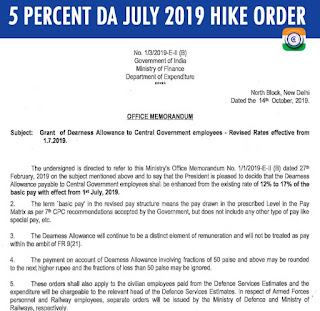
5 Percent DA July 2019 Hike Order - Grant of Dearness Allowance to Central Government employees

Grant of Dearness Allowance to Central Government employees 5 Percent DA July 2019 Hike Order  No. 1/3/2019-E- II (B) Government of...

Blog Archive

About The Author