A complete reference blog for Indian Government Employees

Thursday, 19 June 2014

No Six Days Week Proposal Under Consideration with the govt at present: NC JCM Press Release & Media News

No Six Days Week Proposal Under Consideration with the govt at present: NC JCM Press Release & Media News
Press Release about Government’s plan to make six days a week working in the administrative offices of Central Government.
Shiva Gopal Mishra
Secretary

National Council (Staff Side)
Joint Consultative Machinery
Central Government Employees
13-C, Ferozshah Road, New Delhi – 110001
E Mail : nc.jcm.np@gmail.com


PRESS RELEASE

 NEW DELHI: 14 JUNE, 2014

 Present whispering about reverting back to six days a week in place of the prevalent five days week working in the Administrative Office of the Central Government.

In this connection, the issue was discussed by Shri Shiva Gopal Mishra, Secretary Staff Side, National Council(JCM) and General Secretary, All India Railwaymen’s Federation, with the Cabinet Secretary on 13th June, 2014, and it was brought to his notice that five days a week working was introduced, way back in the year 1985 after prolonged deliberations at the National Council(JCM) level. Various aspects, including energy saving in the form of electricity and also Statutory Provision regarding working hours were kept in view.

After discussion, Cabinet Secretary assured to Secretary Staff Side NC/JCM, Shri Shiva Gopal Mishra, that no such proposal is under consideration with the Government at present.


For Secretary(Staff Side)
National Council(JCM)
Source: http://ncjcmstaffside.com/wp-content/uploads/2014/06/Press_release.pdf


News by The Hindu Business Line:-

No 6-day week for Govt staff: Cabinet Secretary assures unions


The Hindu Business Line New Delhi, June 14:


The Government is not considering any proposal to increase the number of working days to six from five a week in administrative offices of the Central Government, according to Shiva Gopal Mishra, Secretary – staff side, National Council, Joint Consultative Machinery (JCM), which is a joint group of various staff unions of Central Government employees.

Mishra stated this on the basis of assurances received from the Cabinet Secretary on Friday. The assurance came through in a meeting of the JCM with Cabinet Secretary on Friday, according to a release.

“After discussion, Cabinet Secretary assured to Secretary, Staff Side National Council – JCM, Shiva Gopal Mishra, that no such proposal is under consideration with the Government at present,” it said.

Mishra also holds the post of General Secretary, All India Railwaymen’s Federation (AIRF).

“Five days a week working was introduced, way back in the year 1985 after prolonged deliberations at the National Council(JCM) level. Various aspects, including energy saving in the form of electricity and also Statutory Provision regarding working hours were kept in view,” stated the release.

The Unions also reiterated their view to increase the salaries by merging 50 per cent of Dearness Allowance with the basic pay, Mishra told Business Line.

Source: http://www.thehindubusinessline.com/news/no-6day-week-for-govt-staff-cabinet-secretary-assures-unions/article6114964.ece
Share:

Tuesday, 10 June 2014

List of holidays for central govt employees 2015 - Dopt Orders

List of holidays for central govt employees 2015 - Dopt Orders
Holidays to be observed in Central Government Offices during the year 2015
Most Immediate
F.No.12/5/2014-JCA-2
Government of India
Ministry of Personnel, Public Grievances and Pensions
(Department of Personnel and Training)
North Block, New Delhi 
Dated the 6th June, 2014
Office Memorandum
Subject: Holidays to be observed in Central Government Offices during the year 2015.
It has been decided that the holidays as specified in the Annexure -I to this O.M. will be observed in all the Administrative Offices of the Central Government located at Delhi/New Delhi during the year 2015. In addition, each employee will also be allowed to avail himself/herself of any two holidays to be chosen by him/her out of the list of Restricted Holidays in Annexure - II

2. Central Government Administrative Offices located outside Delhi / New Delhi shall observe the following holidays compulsorily in addition to three holidays as per para 3.1 below:
1. REPUBLIC DAY
2. INDEPENDENCE DAY
3. MAHATMA GANDHI'S BIRTHDAY
4. BUDDHA PURNIMA
5. CHRISTMAS DAY
6. DUSSEHRA (VIJAY DASHMI)
7. DIWALI (DEEPAVALI)
8. GOOD FRIDAY
9. GURU NANAK'S BIRTHDAY
10. IDU'L FITR
11. IDU'L ZUHA
12. MAHAVIR JAYANTI
13. MUHARRAM
14. PROPHET MOHAMMAD'S BIRTHDAY (ID-E-MILAD)
3.1. In addition to the above 14 Compulsory holidays mentioned in para 2, three holidays shall be decided from the list indicated below by the Central Government Employees Welfare Coordination Committee in the State Capitals, if necessary, in consultation with Coordination Committees at other places in the State. The final list applicable uniformly to all Central Government offices within the concerned State shall be notified accordingly and no change can be carried out thereafter. It is also clarified that no change is permissible in regard to festivals and dates as indicated.
1. AN ADDITIONAL DAY FOR DUSSEHRA
2. HOLI
3. JANAMASHTAMI (VAISHNAVI)
4. RAM NAVAMI
5. MAHA SHIVRATRI
6. GANESH CHATURTHI / VINAYAK CHATURTHI
7. MAKAR SANKARANTI
8. RATH YATRA
9. ONAM
10. PONGAL
11. SRI PANCHAMI / BASANT PANCHAMI
12. VISHU/ VAISAIKHI / VAISAKHADI / BAHAG BIHU / MASHADI UGADI / CHAITRA SUKLADI / CHETI CHAND / GUDI PADAVA 1st NAVRATRA / NAUROZ/ CHHATH POOJA/ KARVA CHAUTH.
3.2 No substitute holiday should be allowed if any of the festival holidays initially declared subsequently happens to fall on a weekly off or any other non¬working day or in the event of more than one festivals falling on the same day.
4. The list of Restricted Holidays appended to this O.M. is meant for Central Government Offices located in Delhi / New Delhi. The Coordination Committees at the State Capitals may draw up separate list of Restricted Holidays keeping in view the occasions of local importance but the 9 occasions left over, after choosing the 3 variable holidays in para 3.1 above, are to be included in the list of restricted holidays.
5.1 For offices in Delhi / New Delhi, any change in the date of holidays in respect of Idu'l Fitr, Idu'l Zuha, Muharram and Id-e-Milad, if necessary, depending upon sighting of the Moon, would be declared by the Ministry of Personnel, Public Grievances and Pensions after ascertaining the position from the Govt. of NCT of Delhi (DCP, Special Branch, Delhi Police).
5.2 For offices outside Delhi / New Delhi, the Central Government Employees Welfare Coordination Committees at the State Capitals are authorised to change the date of holiday, if necessary, based on the decision of the concerned State Governments / Union Territories, in respect of Fitr, Zuha, Muharram and Id-e-Milad.
5.3 It may happen that the change of date of the above occasions has to be declared at a very short notice. In such a situation, announcement could be made through P.I.B. /T.V. / A.I.R. / Newspapers and the Heads of Departments/ Offices of the Central Government may take action according to such an announcement without waiting for a formal order about the change of date.
6. During 2015, Diwali (Deepavali) falls on Wednesday, November 11, 2015 (Kartika 01). In certain States, the practice is to celebrate the occasion a day in advance, i.e., on "Narakachaturdasi Day". In view of this, there is no objection if holiday on account of Deepavali is observed on "Naraka Chaturdasi Day (in place of Deepavali Day) for the Central Government Offices in a State if in that State, that day alone is declared as a compulsory holiday for Diwali for the offices of the State Government.
7. Central Government Organisations which include industrial, commercial and trading establishments would observe up to 16 holidays in a year including three national holidays viz. Republic Day, Independence Day and Mahatma Gandhi's birthday, as compulsory holidays. The remaining holidays / occasions may be determined by such establishments / organisations themselves for the year 2015, subject to para 3.2 above.
8. Union Territory Administrations shall decide the list of holidays in terms of instructions issued in this regard by the Ministry of Home Affairs.
9. In respect of Indian Missions abroad, the number of holidays may be notified in accordance with the instructions contained in this Department's O.M. No.12/5/2002-JCA dated 17th December, 2002. In other words, they will have the option to select 9(Nine) holidays of their own only after including in the list, three National Holidays and Milad-Un-Nabi or Id-E-Milad, Rama Navami, Id-ul-Fitr, Janamashtami and Muharram included in the list of compulsory holidays and falling on day of weekly off.
10. In respect of Banks, the holidays shall be regulated in terms of the extant instructions issued by the Department of Financial Services, Ministry of Finance.
11. Hindi version will follow.
sd/-
(Ashok Kumar) 
Deputy Secretary (JCA)
Source: www.persmin.gov.in
[http://ccis.nic.in/WriteReadData/CircularPortal/D2/D02est/12_5_2014_JCA_2-06062014.pdf]
Share:

Thursday, 5 June 2014

Central Government Officers may have to work 6 days a week

News: 6 Days a week workdays in central government offices
Central Government Officers may have to work 6 days a week
Deccan Chronical | June 03, 2014

New Delhi: Speculation is rife in various union ministries that the new government under Narendra Modi may revert back to the six-days a week workdays in central government offices after about three decades.

Although there is no move yet by the government in this regard the issue is subject of much discussion among the bureaucrats. It was former PM Rajiv Gandhi who, in the mid-1980s, had decided to go in for the five-day week.

The aim at that time was to promote efficiency since it gave the bureaucrats much-needed rest over the weekend on the assumption that the work-culture would improve during week-days.

The closure of Government offices on Saturdays also resulted in saving of electricity and other expenses of the Centre. But despite the current five-day week, some of the ministers even in the previous UPA-2 government were known to attend office on Saturdays and attend to files and other important work.


Source: http://www.deccanchronicle.com/140603/nation-current-affairs/article/central-government-officers-may-have-work-6-days-week
Share:

AICPIN Points on the Ascent Again!

Expected DA from July 2014 – AICPIN for April 2014
 
AICPIN Points on the Ascent Again!
 
Previously, it was announced that the AICPIN points for the month of April will be released on the 30th. But the Labour Bureau and PIB didn’t release the statistics of AICPIN on that day. Instead of releasing the detailed information transparently in their official websites, the departments chose to unveil the number with an air of secrecy. We had managed to find the number and had published them. Countless people had benefitted from it (Press Release given below).
 
The Consumer Price Index (IW), which was on a huge decline in the months of November and December 2013. The number stood at 239 in December 2013, but fell two points to 237 in January 2014. In the following days, it rose steadily by a point each month. This time, the AICPIN number rose by 3 points to now stand at 242. As a result there is a high probability that the next Additional Dearness Allowance could be a substantial one.
 
Like we said before, we believe there are chances that it could change from 6% to 7% this time. But, a concrete answer depends on the AICPIN numbers for the next two months.
 
 The below table is clearly indicate the movement of AICPIN with increasing additional Dearness allowance month wise…
 
AICPIN for the month of April 2014 begged at 242
 
Month/
Year
AICPIN (IW)
Base Year
2001=100
Increased/
Decreased
Points in
AICPIN
Total Points
Increased
Total of
12 Months
12 Months
Average
% Increase
over 115.763
Approximate
DA
Total DA % DA% Increase
Month wise
Jan-14 237 -2
2802 233.5 117.74 101.71 101 1
Feb-14 238 1
2817 234.75 118.99 102.79 102 2
Mar-14 239 1
2832 236 120.24 103.86 103 3
Apr-14 242 3 3 2848 237.33 121.57 105.02 105 5

Source: 90paisa.blogspot.in
[http://90paisa.blogspot.in/2014/06/aicpin-points-on-ascent-again.html]
Share:

Child Care Leave (CCL) in respect of Central Government Employees as a result of Sixth Central Pay Commission recommendations – Clarification – regarding.

No.13018/6/2013-Estt.(L)
Government of India
Ministry of Personnel, Public Grievances and Pension
[Department of Personnel & Training]
New Delhi, the 5th June, 2014
OFFICE MEMORANDUM

        Subject: Child Care Leave (CCL) in respect of Central Government Employees as a result of Sixth Central Pay Commission recommendations – Clarification – regarding.

The undersigned is directed to refer to this Department’s O.M. No.13018/2/2008-Estt.(L) dated 11/09/2008 regarding introduction of Child Care Leave(CCL) in respect of Central Government employees.

Subsequently, clarifications have been issued vide OMs dated 29.9.2008, 18.11.2008, 02.12.2008 and dated 07.09.2010. Child Care Leave at present is allowed for a minimum period of 15 days. References have been received from various quarters seeking a review of this stipulation.

2. The matter has been considered in consultation with Department of Expenditure, and it has been decided to remove the requirement of minimum period of 15 days’ CCL. There is no change as regards other conditions of this leave.

3. These orders take effect from the date of issue of this Office Memorandum.

4. Hindi version will follow.
sd/-
S.G. Mulchandaney)
Under Secretary to the Government of India
Source: DoPT
[http://ccis.nic.in/WriteReadData/CircularPortal/D2/D02est/13018_6_2013-Estt.L-05062014.pdf
Share:

National Council Writes to Finance Minister to Consider Merger of DA with Pay

National Council Writes to Finance Minister to Consider Merger of DA with Pay

National Council (Staff Side)
Shiva Gopal Mishra
General Secretary
Joint Consultative Machinery
for Central Government Employees
13-C, Ferozshah Road, New Delhi – 110001

I personally and on behalf of the Staff Side of the National Council(JCM) and on behalf of All India Railwaymen’s Federation congratulate on your taking over as Union Finance Minister.

I hope that, under your able leadership, the financial health of our country will achieve greater heights.

As you may be kindly aware, Joint Consultative Machinery (JCM) Scheme is in operation in Government of India with the object of promoting harmonious relations and of securing the greatest measure of cooperation between the Central Government, in its capacity as employer and the general body of its employees in matters of common concern, and with the object, further, of increasing the efficiency of the public services. The Joint Consultative Machinery (JCM) consists of the Official Side and the Staff Side.

We, as Staff Side, have raised a number of issues with the government, concerning the employees of the Government of India. Two of these issues are agitating the minds of the Government employees and need urgent resolution. These relate to Merger of Dearness Allowance with Pay and removal of the issue relating to Senior Promotee employees drawing less pay than the Junior Direct Recruit employee. Since these issues need decision at the level of Ministry of Finance, I am enclosing brief notes on the same for your kind perusal.

We are hopeful that, you will be kind enough to have them examined in a positive-manner

I would also be grateful, if you could spare some time from your busy schedule between 10th and 12th ” June, 2014, so that I may call on you to meet you in person.

With regards!
Yours sincerely,
Shiv Gopal Mishra
To
Shri Arun Jaitley,
Hon’ble Minister of Finance,
(Government of India),
North Block,
New Delhi
End: As above
Copy to: All Constituent Organizations of the NC/JCM(Staff Side) — for information


MERGER OF DA WITH PAY

The wage revision of the Central Government employees is carried out through the Central Pay Commissions which, considering the magnitude of employees is a time consuming process. The 7 Central Pay Commission (CPC) set up by the Government will require a reasonable time frame to go into the matter judiciously especially because the implementation of 6m CPC recommendations have given rise to large number of issues and cadre related grievances.

During the past, the methodology adopted for compensating the erosion in the real value of wages due to price rise as reflected in high rate of DA to Government employees before the date of the submission of Pay Commission Report and its acceptance by the Government, had always been though the mechanism of merger of a portion of DA with Pay. The merger of DA to partially compensate the erosion in the real wages was first done in pursuance of the Gadgil Committee in the post 2nd Pay Commission period. The 3 CPC had recommended such merger of the DA when it crossed 36%, The Government agreed to merge 60% and later the whole of the DA before the 4°’ CPC was set up. The 501 CPC merged 98% of DA with pay. The 51h CPC had also recommended that the DA must be merged with pay and treated as pay for computing all allowances as and when the percentage of Dearness compensation exceeds 50%. Accordingly even before the setting up of the 6°’ CPC the DA to the extent of 50% was merged with pay.

Presently, the factual position is that as on 1.1.2014, the Dearness compensation is 100% and will exceed the same with effect from 1.7.2014. Since the 7°’ CPC has been set up and one of the issues to be dealt with by the CPC would relate to revision in the existing reference base of price index, it becomes all the more necessary that the Government takes steps to merge at least 50% of DA with pay to compensate the erosion of the real value of wages immediately.

ISSUE RELATING TO SENIOR PROMOTEE EMPLOYEES DRAWING LESS PAY THAN THE JUNIOR DIRECT RECRUIT EMPLOYEES

The main issue in this case is that the 6th CPC for the first time recommended specific entry level pay for Direct Recruits (DRs). This resulted in employees who were appointed in service prior to the DRs and also got promoted earlier get less pay as compared to their counterparts recruited directly and who joined after 1.1.2006. It has always been the case that on promotion, the pay of a promoted employee is never fixed at less than the entry level of pay of that post as admissible to a direct recruit.

Consequent upon implementation of the recommendations of the 6th CPC, in respect of pay scales of various categories of staff, there are certain situations where the senior who were promoted before 01.01.2006 are getting lesser pay than their juniors promoted after 01.01.2006, on fixation of their pay w.e.f. 01.01.2006. This, being a serious anomaly, has been raised by us in the National Anomalies Committee for redressal thereof.

The consensus decision in the National Anomaly Committee was that the Staff Side as well as the Official Side agreed that wherever there is a provision of direct recruitment in the Recruitment Rules, pay on promotion would be fixed at the prescribed minimum of the Entry Pay as provided for the Direct Entrants in the Revised Pay Rules, irrespective of the fact whether direct recruitment has actually taken place or not. However to our distress it was later on learnt that the Government went back on this mutually agreed solemn resolution and did not issue any Order in this regard. This being a serious issue has resulted in discontentment prevailing among the seniors who are drawing less pay than is legitimately due to them.

A very simple solution to this issue is that orders may be issued to the effect that the pay on promotion w.e.f. 01.01.2006 would not be fixed less than at the prescribed minimum of the Entry Pay as provided for the Direct Entrants in the Revised Pay Rules, to eliminate this unfairness.
Share:

Memorandum to 7th CPC on merger of DA with Pay and Interim Relief

Memorandum to VII CPC on merger of DA with Pay and Interim Relief

National Council (Staff Side)
Joint Consultative Machinery
for Central Government Employees
13-C, Ferozshah Road, New Delhi – 110001
Shiva Gopal Mishra
General Secretary
No.NC4JCM/2O14/VII CPC
Dated: June 3, 2014
Justice Shri Ashok Kumar Mathur,
Chairman,
Seventh Central Pay Commission,
New Delhi

Dear Sir
Sub: Memorandum to VII CPC on merger of DA with Pay and Interim Relief

As was decided in the Preliminary Discussion Meeting, held on 28”‘ May, 2014, with the VII CPC, we submit herewith Memorandum on Merger of Dearness Allowance with Pay and Interim Relief, on behalf of Staff Side, National Council(JCM).
Yours faithfully,
sd/-
(Shiva Gopal Mishra)

Copy to: Ms Meena Agarwal, Secretary, Seventh Central Pay Commission (Government of India), New Delhi, along with a copy of above cited memorandum.
Encl: As above
Copy to: All Constituent Organizations of the NC/JCM(Staff Side), along with a copy of above cited memorandum.
Encl: As above

MEMORANDUM  ON MERGER OF DA WITH PAY AND INTERIM RELIEF.

We solicit the kind reference of the 7th Central Pay Commission to the discussion during the informal interaction the staff side of the National Council had with the Commission on 28.5.2014, when we inter alia raised the issue of merger of Dearness allowance and Interim Relief.

2. Before we dwell upon the issues, it may not be out of place to refer to the evolution of the JCM which later became the negotiating platform for the entirety of Central Government employees and workers It was conceived to bring about a conflict free industrial climate in Civil Service in the wake of the tumultuous experience of an industrial strike action in 1960. The National Council, the apex forum under the three tier system headed by the Cabinet Secretary was empowered to deliberate upon the common issues of the Central Government employees. The Staff Side, National Council, thus became the united voice of the entirety of the Central Government employees on fundamental issues like Wages, Pay Scales, Rate of increment, Dearness compensation and other general allowances.

3. However, over the years, JCM became an ineffective instrument to address the basic issues and demands of the employees. We shall detail the requirements to empower and streamline the functioning of the JCM as a negotiating forum in our Main Memorandum to the Commission.

4. The twin issues viz. Merger of DA and Interim relief had been the subject matter of discussion with the Government when the Staff side was called upon to present their views in the matter of finalization of the terms of reference for the 7th CPC by the Secretary, Personnel, (Department of Personnel and Training) in his capacity as Chairman, Standing Committee, National Council JCM. Though we pleaded for the specific reference of the above two issues, to the 7th CPC, the final 1 version of the terms of reference approved by the Government did not find a place for our views. We have, therefore, been constrained to take recourse to clause 5 in the terms of reference, which enables the Commission to send interim report to the Government.

MERGER OF DA WITH PAY:

5. Dearness allowance is considered as a device to protect, to a greater or lesser extent, the real income of wage earners and salaried employees from the effects of rise in prices. As per the vagaries of price fluctuation in the market, the allowances are bound to go up and down. Constant rise in the price level, might bring about a situation whereby the quantum of allowance shall go up. Such a phenomenon of constant increase of prices of commodities gave rise to the demand for merger of Dearness allowances with pay so as to make it pay, rather than an allowance, with all concomitant benefits. A committee to advice the Govt. on the portion of such DA to be treated as pay was appointed on 15th July, 1952 (Resolution No. F6(6)E-II/52). The terms of reference of the Committee was :

“Taking in to consideration the rates of dearness allowance that have been sanctioned to date for Central Govt. servents, and the level at which cost of living index are likely to stabilize in the foreseable future, to recommend the percentage of dearness allowance now given to the Central Govt. servents which should be allowed to be treated as pay for all purposes in future, provided that by doing so the present total pay and dearness allowance is not enhanced:”

6. The said committee was headed by Shri N.V. Gadgil, Member of Parliament. The Committee in its report concluded that
“We have recorded the various reasons which we have taken into account in arriving at the conclusion that the appropriate level below which the All India cost of living index is not likely to fall, should be taken as 265-284. We find that for the index figure of 265, the Central Pay Commission formula allows Govt. Employees in the lowest pay group a dearness allowance of Rs.20/- and this amount remain unchanged until the cost of living index go above the index of the next level i.e. 285. We, therefore, consider that the employees in this pay group, a sum of Rs. 20/- which represents 50% of the present dearness allowance of Rs. 40 per month should be treated as pay (page 22 chapter V Report of the Dearness allowance Committee).”

7. The Committee also enumerated in their report the purposes for which the DA shall be treated as pay as under:-
Retirement Benefits
Travelling allowance
Compensatory allowance
House rent allowance
Compensation of Leave Salary etc.

8. The 3rd CPC, whose recommendations were implemented with effect from 1.1.1973 had no reference from the Govt. on the question of merger of DA. Still while dealing with the issue of Dearness allowance (vol.IV – Page 1 Ch.55) the Commission noted that “no other country in the world (except Ceylon and Pakistan) seems to be following the practice of paying dearness allowance or cost of living allowance as a separate element of wage. In most of the countries compensation to Govt. employees for the increase in the price level is given by way of periodical salary revisions Prior to the setting up of the 3rd CPC, pursuant to the discussion in the National Council, JCM, the entire dearness allowance as on 1.8.1966 was treated as Dearness pay and the consequent increase in allowance was granted by the Government with effect from 1.12.1968. In para 16, the Commission recommended that should the price level rise above twelve monthly index of 272 ( 1960=100) the Government should review the position and decide whether the Dearness allowance Scheme should be extended further or the pay scale themselves should be revised. ( Page 4 Chapter 55. Vol. 4 3 rd CPC report). On crossing the index point of 272, the Government conceded the demand for merger of 36% of DA with pay. Later, based on an agreement reached at the National Council JCM the DA granted upto the index level of 320 points i.e. 60% of the Basic Pay was merged through executive instructions for purpose of allowances and pension. Before the 4th CPC was set up in 1983, the issue of further merger of DA with Pay was raised by the employees. Conceding the demand the Government decided that DA entitled to be drawn upto the index average of 568 points be treated as pay for all purposes.

9. Since the Pay Scales were to be constructed with reference to the consumer price index as on the date of revision, every Commission had to perforce merge the entire DA when the actual revision was made. The DA on such revised pay is to be computed on the basis of annual average rise of index after every six months interval. Therefore, the question of merger of DA again rose at the time of negotiation with the Government for setting up the 5th CPC. An agreement was reached on merger of certain percentage of DA and interim relief. (Rs. 100/-) in September, 1993. In April, 1994, the Government issued notification setting up the 5 th CPC (resolution No. 5(12)E-III/93 dated 9.4.1994).

10. The Staff Side placed before the 5th CPC the necessity to merge DA with Pay at an index level below which prices were not likely to move downwards. Pointing out that in the last two decades i.e. 1980s and 1990s there had been not a single occasion when the annual average index had fallen consequent upon which the DA rates were to be reduced, they requested the Commission to merge the entire DA which had been at 97% of the Basic pay as on 1.7. 1993. (The AICPI index being 1201.66). The Commission after deliberations on the memorandum and discussion with the staff Side, recommended that 97% of Basic Pay as DA admissible from. 1.7. 1993 be treated as Pay for all purposes. However, they suggested that the said merger might be given effect only from 1.4. 1995.

11.The 5th CPC submitted its final report to the Government on 19th January, 1997. Before the Commission, the Staff side had demanded that as and when the consumer price index exceeds 25% of the base index at which the pay is fixed that proportion of Dearness allowance should be treated as Pay for all purposes and the decision on this must not be left at the discretion of the Government. The Commission considering this demand observed that:

“From the past trend of CPI given in annexure 11’8.1 it is observed that 50% increase in prices generally takes around five years to materialise. A mid-term quinquennial revision of salaries of the Government employees is not something the Government should grudge. In view of the above, we recommend that DA should be converted into Dearness Pay each time the CPI increases by 50% over the base index used by the last Pay Commission. Such DA should be termed as Dearness Pay and be counted for all purposes including retirement benefits. (Chapter 105 page 157)”. The 5th CPC thus regularised the periodical merger of DA into a well thought 11. out scheme. They also established that wage revision is needed either when the DA exceeds 50% over the base index or after five years .

12. The Government, however, did not act upon this recommendation, when the percentage of DA exceeded 50( 52%) as on 1.7.2002, though it had accepted the recommendation in 1997. With the persistent persuasion, ultimately, the Government issued orders treating 50% DA as Dearness Pay for all purposes with effect from.1.4.2004.

13. Even though the 5th CPC had brought about a finality on the approach to the question of merger of DA with pay, the 6th CPC reopened the issue afresh. The Commission made the following observation-

“This conversion (merger of DA with Pay) is however not necessary in the revised structure being recommended where increments are payable as a percentage of Pay in the Pay Band and Grade Pay thereon and provision has been made for all allowances/benefits to be revised periodically, linked to the increase in the price index. The Commission is, therefore, not recommending merger of DA with Basic pay at any stage.”

14. The 3rd, 4th and 5th Central Pay Commissions had approvingly endorsed the recommendations made by Gadgil Committee in 1952. The practice of periodical merger had been followed as a device to protect the erosion in the real value of wages (including allowances) especially at the lowest level of employees. This erosion becomes unbearable when DA crosses over 50%. To say that the increment rate which is presently 3% of pay would take care of the erosion is to say the least, atrocious. Increment is granted as a legitimate reward for the service rendered by an employee for a year. It has nothing to do with the erosion in the real value of wages. No doubt, the 6th CPC has recommended that a few allowances should be revised by 25% as and when the DA crosses over the stipulated 50%. Such allowances are very in number. Moreover, 25% rise as a compensation when the DA itself rises to 50% is arbitrary and conceived to compensate the worker with lesser amount than what he is entitled to.

15. We, therefore, strongly plead before the Commission, for the reasons enumerated in the foregoing paras, that the Dearness allowance as on 1.1.2014 which stood at 100% may be recommended to be merged and treated as Dearness Pay for grant of all benefits, allowances, pension and other retirement entitlements.

16. We further submit that Merger of D.A. as on 1.1.2014 may also be recommended in respect of pensioners and Gramin Dak Sewaks of Postal Departments.

INTERIM RELIEF.

Barring the 6th Central Pay Commission, all other Commissions had recommended grant of Interim Relief to the Central Government Employees. As per the 5thCPC, Interim relief represented a provisional arrangement during the period between setting up of a Pay Commission and submission of a report by the Commission and its acceptance by the Government. Most of the earlier Commissions with the exception of Ist and 6th Central Pay Commission had taken 2-3 years and sometimes more to finalise their recommendations. Despite the specific reference made to the 6th CPC, by the Government to consider grant of Interim Relief the Commission took the position that having decided to submit its recommendation within the stipulated period of eighteen months and having arrived at a view that its recommendations must be effective from 1.1.2006, it shall not waste time on the question of interim relief. What the 6th CPC failed to appreciate was the erosion in the real value of wages that had taken place over the years due to inflation and rise in prices of essential commodities and the inability especially of the employees at the lower level to make the both ends meet with the available wages. No doubt, the employees had been to some extent benefitted by the decision of the Government to merge 50% Dearness allowance and treat it as pay for all purposes including DA thereon.

2. Every Pay Commission which had recommended Interim Relief had made it amply clear that it was intended to provide some relief to the employees pending a comprehensive determination of their salary structure and other benefits. The relief granted was treated as sui generis (one of its own kind, unique) and it was not taken into account for determining any allowance or benefit.

3. We give below briefly the course of negotiation and approach of various earlier Pay Commissions on the question of grant of interim relief.

4. The Second Pay Commission gave a report within a month’s time and recommended an Interim Relief of Rs. 5/-. The third pay Commission gave three instalments of Interim Relief on varying rates. After appoint of the 4th CPC in July, 1983, Government sanctioned (Vide Department of Expenditure O.M.No. 7(39)-E III/83 dated 2nd August, 1983) on their own initiative Interim Relief at varying rates of Rs. 50 and Rs. 100 per month. In March, 1985, 4th CPC submitted a report and granted a further interim relief at 10% of Basic pay subject to a minimum of Rs. 50 per month. Again before the setting up of the 5th CPC, the Government sanctioned Rs. 100 as interim Relief. As it was not considered adequate, the staff side of the National Council, JCM submitted a memorandum to the 5th CPC demanding additional interim relief. The Govt. vide their Department of Expenditure, Resolution No. 5(12)EIII/93 dated 12.01.1995 amended the terms of reference to enable the Commission to decide upon the additional interim relief. The 5th Central Pay Commission in their interim report submitted on 2 nd May, 1995, recommended Interim Relief equal to 10% of Basic Pay subject to a minimum of Rs. 100/-. The terms of reference of 6th CPC on the issue of Interim Relief was as under:-

“2.g. To examine desirability and need to sanction any interim relief till the time the recommendations of the Commission are made and accepted by the Government”

5. It has to be recalled that the Government did not initially refer the question of Interim Relief to the 5th CPC but when the Staff Side submitted their memorandum to the Commission on I.R., the Government had to amend the terms of reference and refer the issue to the Commission for their decision.

6. These go to establish the need for a relief in view of the erosion in the real value of wages, the need to fill the widening gap in wages when compared to outside rates and the fact that final recommendations of the 7 th Pay Commission are bound to revise the wage structure and above all the need to provide some relief to the employees who would retire before the Commission’s recommendations are finally submitted to the Government and accepted by them.

7. We give hereunder a table indicating the retail prices of the commodities which goes into the computation of minimum wage as per Dr.Ackroyd formula as on 1.1.2006 (quoted by the 6th CPC in their report. Page 53. Table 2.1`.1 Chapter 2.2.) and the actual retail price of those very commodities as on 1.1.2011. The percentage increase in the prices of each commodity is also given in the table. The average rise in prices was of the order of 174%, whehreas the Dearness allowance entitlement was only 51%.. The table clearly indicate the erosion in the real value of the wages.

Sl.No Name of articles Price as on 1.1.2006     As on date      %increase
1  Rice   18 38 120
2 Dhall 4 varieties average   40 87 120
3 Raw vegetables 10  40  400
4 Green veg . 10 56 560
5 Other veg 10  40  400
6 Fruits 30 100  330
7 milk 24 32 40
8 Sugarjiggery Average 24 43 95
9 Edibleoil.3varieties.average 50 95 95
10 Fish 120 300 150
11 meat 120 240 100
12 egg 2 3 50
13 Detergents/soap 200 350 75
14 Cloth 80 120 50

Average increase : 174

8. The need based minimum wage computed on the basis of Dr Ackroyd formula as on 1.1.2014 will be around Rs. 26,000 bringing about a gap of almost 12,000 at the level of an MTS. We shall submit the details thereof in our main memorandum.

9. The only Public Sector undertaking in which the wage agreement has been reached in 2013 is the Coal India Limited. As per the said agreement, the minimum wage at the lowest level of the worker as on 1.12014 is:
Basic Pay ——————————–Rs. 15, 712
Dearness allowance: ——-29.6%
Special allowance: ——— 4.0%
Special DA: ——————1.795%
Attendance bonus: ——-10%
Total: 49.395%————————– Rs. 7132.46
Total salary: —————————–Rs.22844.46
At the MTS level 22.844.46 x 130% —- Rs.29697.


10. As per the formula adopted by the 5th CPC, the minimum wage will work out to Rs. 22,857 as under:

A. Per Capita NNP at constant price for 2004-05 – Rs. 24,143
B. Per capita NNP at constant price for 2011-12 – Rs. 38,037
C. The increase registered over 8 years. – Rs. 13,894.
D. Percentage increase over 2004-05 – 57.54877.
E. Emoluments of an MTS as on 1.1.2014 – Rs. 14,000
F. 57.55% of Rs. 14,000. – Rs. 8,857.
G. Wage to be fixed in thecase of MTS as on1.1.14. – Rs. 22857.

From the above it is seen that Central Government employees presently have a very depressed salary structure. The final outcome of the deliberations of the 7 th CPC will become available only by 2016. It is, therefore, needed that the employees have to be compensated in the form of Interim Relief. In our opinion the Commission may, as has been done by the various earlier Pay Commissions, recommend atleast 25% of Pay in Pay Band plus Grade Pay as Interim Relief subject to a minimum of Rs. 4000/-. Incidentally we may point out that the grant of interim relief will enable the Government to spread out the financial outlay on account of wage revision over a period of more than three years.

We further urge that the Commission may kindly recommended Interim Relief at the above rate subject to minimum of Rs.2000/- to as pensioners and Gramin Dak Sevaks of Postal Department.

SHIVA GOPAL MISHRA
Secretary, Staff Side, National Council JCM.

Source: http://ncjcmstaffside.com/wp-content/uploads/2014/06/Memorandum-for-IR-and-DA-merger_03.06.2014.pdf
Share:

Featured post

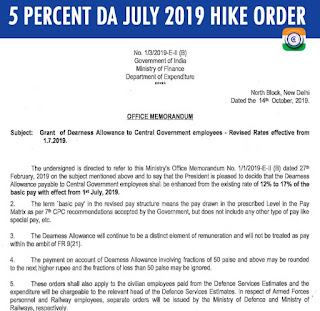
5 Percent DA July 2019 Hike Order - Grant of Dearness Allowance to Central Government employees

Grant of Dearness Allowance to Central Government employees 5 Percent DA July 2019 Hike Order  No. 1/3/2019-E- II (B) Government of...

Blog Archive

About The Author