A complete reference blog for Indian Government Employees

Showing posts with label military. Show all posts

Saturday, 14 January 2017

Defence panel raises retirement age of soldiers by TWO years to cut new recruitment cost


Defence panel raises retirement age of soldiers by TWO years to cut new recruitment cost

Recommendations of the Lt Gen Shekatkar Committee were submitted to defence minister Manohar Parrikar

The report also touches upon the creation of the post of Chief of Defence Staff

In order to enhance their combat capabilities, a key defence ministry panel has made several recommendations including increasing the retirement age of jawans by two years, doing away with manpower in non-combat arms and shutting down military farms.

The recommendations of the Lt Gen Shekatkar Committee were submitted to defence minister Manohar Parrikar almost three weeks ago.

The report also touches upon the creation of the post of Chief of Defence Staff - who would be the single point contact for the military with the government.

The main aim of the committee was to suggest means to cut down on useless expenditure and use the savings to acquire and enhance fighting capabilities of the army.

One of the most important recommendations of the committee was to increase the retirement age of jawans by two years, which will help the army save a significant amount on pensions and training of personnel.

Army jawans retire after serving a minimum of 17 years and depending upon their promotion while in service.

'If the recommendations are accepted, jawans and junior commissioned officers till the rank of subedar major will get two more years of service,' ministry sources told Mail Today.

'This will reduce the cost of training new jawans along with the problem of providing them reemployment. Of the one million jawans in the army, almost 60,000 retire every year.

'For two years, the forces can also save on recruiting new manpower,' they said.

The Shekatkar committee has also suggested ‘optimising’ non-combat support arms in the army such as supply corps, ordnance and electrical and mechanical engineers who service cars and heavy vehicles.

'Even in remote areas of Arunachal Pradesh and Rajasthan, one can get private agencies close to the border to service and repair army vehicles,' the sources said.

Same applies for certain functions of the supply and ordnance corps like supplying rations and clothes to the forces.

Their roles can be limited to during war and other critical assignments.

The committee has also recommended abolishing military and dairy farms, where several thousand army personnel and a considerable number of officers are involved in mundane tasks like cattle rearing and growing vegetables.

The committee has also called for downsizing the remount veterinary corps, which looks after horses and mules for ceremonial as well as operations in the higher Himalayan regions of J&K and Arunachal Pradesh.

'With helicopters and road networks allowing vehicles to reach the last points of border areas and mountains, there is no need to maintain such a large force of mules,' the sources said.

The NCC is also on the radar of the Shekatkar committee as a large number of officers from the Army are sent there.

'The committee feels that retiring personnel can be trained and sent there as re-employment. This will save the army the regular personnel for operational duties,' the sources said.

Source : dailymail.co.uk
Share:

Friday, 25 November 2016

Pay Parity between Military and Civilian Personnel


Press Information Bureau
Government of India

25-11-2016
Pay Parity between Military and Civilian Personnel

The 7th Central Pay Commission (CPC), an expert body constituted by the Government, gave its  recommendations on emolument structure of government employees, including personnel belonging
to Defence Forces, after due consultation with various stakeholders and thorough examination of various aspects involved. The Commission recommended separate Pay Matrix for Defence Forces
after considering: (i)principles and philosophy adopted in devising the Pay Matrix for civilian employees; and (ii)some of the aspects in the rank structure unique to Defence Forces. The Government accepted the Commission’s recommendations on Minimum Pay, Fitment Factor, Index of Rationalization, Pay Matrices and general recommendations on pay with certain exceptions in Defence Pay Matrix, namely, (i)revision of Index of Rationalization of Level 13A (Brigadier) from 2.57 to 2.67; and (ii)addition of three stages in Level 12A (Lt Colonel), three stages in Level 13 (Colonel), and two stages in Level 13A (Brigadier).

As and when issues regarding anomalies in the pay of defence personnel are brought to notice, the same are examined by the Government, on case to case basis.

This information was given by Minister of State for Defence Dr. Subhash Bhamre in a written reply to Shri Sultan Ahmed and others in Lok Sabha today.
Share:

Wednesday, 14 September 2016

7th Pay Commission: Parrikar orders military chiefs immediate implementation


7th Pay Commission: Parrikar orders military chiefs immediate implementation

New Delhi: Defence Minister Manohar Parrikar on Monday ordered the military chiefs to immediately enforce the recommendations of the 7th pay commission.

Last week, the three services , Army, Navy and the Air Force, had issued an open signal to servicemen informing them the implementation of the 7th Pay Commission is being kept in abeyance till anomalies are addressed.

Air Chief Marshal Arup Raha, chairman of the Chiefs of Staff Committee and Admiral Sunil Lanba, the Navy chief met Parrikar on Monday to reiterate the need to address the anomalies before the 7th Pay Commission could be rolled out for forces.

Sources said that Parrikar ordered the chiefs to immediately enforce the recommendations of the 7th pay commission and anomalies will be addressed shortly by the government.

Resentment has been brewing in the defence services over not allowing non- functional upgrade (NFU) in the services. NFU allows bureaucrats who have been passed over to get a higher pay as soon as their batch mates make it to the next rank.

The government has formed a national anomalies committee to look to into these type of issues.

Parrikar’s order to the forces comes at a time when a large section of the government feels that pay and allowances of military is better than most other government services.

The military gets pension from government exchequer when no other service gets pension from government exchequer because the civil employees covered under National Pension System (NPS), besides it, the military has been given One Rank One Pension (OROP), which is not available any civil service, sources said.

With inputs from agencies
Share:

Wednesday, 6 July 2016

7th Pay Commission and the military

7th Pay Commission and the military

Since 29 June, the day when the Central government announced the acceptance of the 7th Pay Commission report, there have been quite a few voices of concern, anguish and plain anger have been emanating from military veterans over the issue of continuing degradation of the military’s status in the overall government hierarchy. Most of the anger is justified but some of the contentions are not, simply because they are not based on facts as they obtain at the moment.

Take the case of allowances and the case of non-functional financial upgrade have NOT been accepted by the government and remain on table for discussions and their eventual resolution. Unfortunately, in absence of the actual notification, the old issue about disparity in allowances to be given to a civil service officer posted in the north-east vis-a-vis a soldier posted in Siachen continues to be cited as fact when in reality, the government has refused to accept this anomalous recommendation. However, many write-ups, discussions, WhatsApp and Facebook messages continue to harp on this single point, creating confusion in the minds of majority of serving and retired personnel.

The need right now is to have patience and not hasty conclusions, past experience notwithstanding. The 7th Pay Commission had made some completely absurd recommendations which, the government, after proper analysis aided by the three service headquarters, has NOT accepted. Contrary to several emails and WhatApp messages going around, rations to the military personnel have NOT been discontinued. Neither has the disability pension been reduced. But many of seem to ignore this. Yes, several anomalies carried over from the 6th Pay Commission continue to remain unresolved; yes the Central Armed ​Police ​Forces (CAP​Fs) are becoming increasingly vocal demanding parity or even higher status from that of the military; yes, the bureaucrats will try their best to degrade the military. But, like their predecessors, the current military leadership is doing its best to fight the onslaught. Some battles will be won; some others will result in stalemate and a few will be lost. The trick is to lend full support to those who are leading the battle and not ridicule them.

But I am sorry to say many seniors are—wittingly or unwittingly—running down the current leadership across the three services without full knowledge of what they are trying. The best course forthe moment, in my view, is to hold the horses and wait for the notification to be available in writing before rushing to pronounce judgement.

I write this even as I get an earful every week from my 84-year old father—who retired as Subedar Major in 1982, for those who don’t know—for not being able to find out why his bank account does not show any enhanced pension more than six months after the announcement of the One Rank One Pension award! Despite my so-called reach and contacts, I am still waiting for a satisfactory answer from the department of Ex-servicemen (non) Welfare. That personal frustration notwithstanding, I feel the need is to wait a little more before deciding on the next course of action and not forward half-baked posts and ill-informed opinions without application of mind.

If considered judgement is not applied, the military community will once again look foolish as it did in forwarding—on a large scale– a fictitious interview with former IAS officer Vivek Rae (who was member of the 7th CPC), which ostensibly displayed his total contempt for the uniform. That is just one instance. As someone who has had the privilege of reporting on the government and especially on the MoD for over three decades, all that I can say is: don’t play into the hands of those inimical to the services. By making rash comments, sweeping generalisations and fictional charges, the military community is only aiding those who wish to see a servile, subservient and demoralised military.

This post is sure to anger many seniors and the perpetually ‘on the boil’ veterans but please view this issue in a broader perspective and introspect whether hasty conclusions are in the best interest of the organisation all of you had the privilege of serving.

Source: abplive.in
Share:

Monday, 13 April 2015

LACK OF VESTED RIGHT OF EFFECTIVE JUDICIAL REVIEW FROM ORDERS OF THE ARMED FORCES TRIBUNAL (AFT)

Lack of vested right to effective judicial review from orders of the Armed Forces Tributnal (AFT): 
IESM letter to PM/RM/LAW MINISTER/COAS/CNS/CAS
Dated: 11 April 2015
Shri Narendra Modi
Hon’ble Prime Minister of India
Prime Minister’s Office (PMO)
New Delhi – 110 001

Shri Manohar Parrikar
Hon’ble Raksha Mantri
104, South Block,
New Delhi

Shri. D.V. Sadananda Gowda
Hon’ble Minister for Law & Justice
Room No. 401, A Wing,
4th Floor, Shastri Bhavan,
New Delhi – 110001
LACK OF VESTED RIGHT OF EFFECTIVE JUDICIAL REVIEW FROM ORDERS OF THE ARMED FORCES TRIBUNAL (AFT)
The Hon’ble Supreme Court on 11 March 2015 pronounced a decision in a case wherein it was held that orders passed by the Armed Forces Tribunal (AFT) would not be challenged by litigants in Hon’ble High Courts but only in the Supreme Court. The judgement was passed on an appeal filed by the Ministry of Defence (and perhaps also the Army HQ) during the time of the last Government. We also have reasonable information to believe that one of the grounds raised by the MoD/Army in the appeal for denying the right of judicial remedy like other citizens of India was that Fundamental Rights can be restricted/abrogated under Article 33 of the Constitution for defence personnel and hence a judicial remedy under writ jurisdiction of High Court would not be available. If it is true that this argument was raised by the MoD/Army, then it is the most unfortunate that the system itself is pleading for placing defence personnel on a lower pedestal than other citizens and pleading before the Hon’ble SC that the military community does not deserve the enjoyment of fundamental rights like others. It is a well known fact that Article 33 only operates during performance of duties to maintain discipline and has no connection with right to access of justice. It is also well known that the majority of cases in the AFT pertain to retired personnel, military widows and their families and hence Article 33 even otherwise has no applicability. This is also against the spirit of Article 39A of the Constitution which underlines equal justice for all citizens.

While in the beginning, there was an attempt to convince us that the decision will lead to ‘quicker’ justice to defence personnel, on closer and deeper examination of the issue, the following real facts and fallouts emerge:

1. There is actually no right of appeal to the Supreme Court from AFT orders as per AFT Act since an appeal only lies in exceptional cases involving ‘point of law of general public importance’ vide Section 31 of AFT Act, hence what has been pleaded before the SC is that AFT should become the court of first instance as well as the court of last instance, leaving defence personnel, veterans and widows remediless since it is well known that 99.9% of cases can never involve ‘public importance’ questions. The decision will not lead to ‘quicker’ justice but in reality remove all chances and channels of challenge/appeal against AFT decisions. Can this bogey of ‘quicker’ justice be raised at the price of fundamental rights of accessible justice and remedy to citizens?

2. It is well known that almost all such litigants cannot afford litigation in SC due to its prohibitive cost and the aura itself of being the highest court of the country. It is not understood how the defence ministry expects poor litigants including disabled soldiers and widows from all over the country to travel to Delhi and engage lawyers in SC to fight their cases. Most of the cases in the AFT involve issues such as disability benefits, pension, minor allowances, pay fixation, ACRs etc and litigants would now be expected to suffer in silence if they feel that they have not got justice from AFT.

3. Defence personnel, veterans, widows and families have been deprived of their basic right of access to justice due to the plea raised by the MoD/Army wherein while all citizens of the country would have access to multiple tiers of justice, not even one tier would be available to us. Even civil govt employees aggrieved by orders of Central Administrative Tribunal (CAT) can approach the HC if they are dissatisfied and then further the SC, whereas similar access has been denied to us and after an order of the AFT even the SC cannot be approached as a matter of vested right unless there is involvement of a point of general public importance.

4. We hereby express our dismay on the attempt of the official system to convey to the SC that fundamental rights of the military community should be restricted or abrogated. We are disappointed that the system itself by raising the plea of Article 33 is attempting to prove that defence personnel, ex-servicemen and their families are lower than the ordinary person on the street. This will have disastrous consequences in the years to come. If the MoD/Army makes such averments pleading for taking away the fundamental rights of their own members and former members and their families, then it is extremely unfortunate.

5. It is well known that the AFT functions under the control of the MoD and even Members of AFT are appointed by the MoD and selected by a selection committee which has the Defence Secretary as its member. AFT has also not been given civil contempt powers to ensure compliance of its orders. In other words, an ineffectual body has been created which functions under the MoD and then now on the plea of the MoD it has been assured that there is no effective appeal making it an all supreme body.

In light of the above, while expressing dissatisfaction at the stand and damaging stance of the MoD and the Army in the said case which has led to such a situation, we request you to kindly abrogate Sections 30 and 31 of the AFT Act so that AFT orders can be challenged on the lines of the Central Administrative Tribunal (CAT) thereby making justice accessible and practical for defence personnel, ex-servicemen, widows and their families.
With regards,
Maj Gen Satbir Singh, SM (Retd)
Chairman IESM
Source: http://ex-servicemenwelfare.blogspot.in/2015/04/iesm-letter-to-pmrmlaw.html
Share:

Featured post

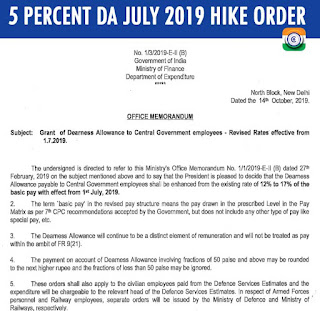
5 Percent DA July 2019 Hike Order - Grant of Dearness Allowance to Central Government employees

Grant of Dearness Allowance to Central Government employees 5 Percent DA July 2019 Hike Order  No. 1/3/2019-E- II (B) Government of...

Blog Archive

About The Author