A complete reference blog for Indian Government Employees

Showing posts with label Seventh Pay Commission Recommendation. Show all posts

Thursday, 17 March 2016

7th Pay Commission Recommendation will be issued after the completion of State Assembly Election 2016

7th Pay Commission Recommendation will be issued after the completion of State Assembly Election 2016

7th-Pay-Commission-Recommendation-7CPC


The notification to put into effect the 7th pay commission recommendation will be issued after the completion of states assemblies’ poll process as the model code of conduct is currently in place, sources of Finance Ministry said on Wednesday.

The assemblies’ election of Tamil Nadu, West Bengal, Assam, Kerala and Puducherry states, which will be held from April 4 to May 16 and the counting of votes in the states will take place on May 19 but the model code of conduct will remain in place till May 21.

So, it is believed that the government will announce 7th pay commission award after the end of model code of conduct of states assemblies election.

The government doesn’t want to give any chance to the Opposition to deter its image in the polls and hence, sources, said that the announcement of the dates of the the model code of conduct of states polls seems to be the cut-off point for notification of the 7th pay commission award.

The 7th pay commission recommendations will benefit 48 lakh central government employees and 52 lakh pensioners including dependents.

“The BJP led central government decided execution time of the pay commission’s proposals in April but the Empowered Committee of Secretaries headed by cabinet Secretary can’t sort out some anomalies of 7th pay commission recommendations like scrapping of advances, allowances and minimum pay before declaration of states Assemblies polls,” sources said.

Sources also said the Implementation cell of the Empowered Committee of Secretaries for the 7th pay commission recommendation in Finance Ministry works hard to send a summary of the pay commission implementation to PMO for its nod. After PMO’s nod, it would be placed before the cabinet for its nod through cabinet secretary.

Sources said the 7th Pay Commission recommendations implementation notification will be issued in June, after cabinet nod.

The 7th Pay Commission was set up by the UPA government in February 2014, The Commission headed by Justice A K Mathur submitted its 900-page final report to Finance Minister Arun Jaitley on February 19, recommending 23.55 per cent hike in salaries and allowances of Central government employees and pensioners.

The panel recommended a 14.27 per cent increase in basic pay, the lowest in 70 years. The previous 6th Pay Commission had recommended a 20 per cent hike, which the government doubled while implementing it in 2008.

The 7th pay commission recommended fixing the highest basic salary at Rs 250,000 and the lowest at Rs 18,000and its increased the pay gap between the minimum and maximum from existing 1:12 to 1: 13.8
The government constitutes the Pay Commission almost every 10 years to revise the pay scale of its employees and pensioners, often these are adopted by states after some modifications. However, the 7th Pay Commission suggested to discontinue the practice of appointing pay commissions in future.

Via Central Government News
Share:

Monday, 21 December 2015

7th Pay Commission recommendation: A big challenge facing government

7th Pay Commission recommendation: A big challenge facing government

7th-Pay-Commission-recommendation-big-challenge-facing-government


New Delhi: Seventh Pay Commission recommendation is a big challenge facing the central government to accept its.

All central government employees, officers, Unions and association protested against the Seventh Pay Commission recommendations and they demanded a re-look at the Seventh Pay Commission report.
The Confederation of Civil Service Associations (COSCA), representing thousands of officers of 20 civil services, including Indian Police Service (IPS), met finance minister Arun Jaitley early this month.

The purpose of that meeting was to press their demand that the group of secretaries of revision pay panel report headed by cabinet secretary, which will examine the report before the Cabinet nod, must not be dominated by one service, read IAS.

What they want is the removal of the edge that the IAS enjoys so far, something that was fiercely opposed by one member in the Pay Commission, thereby making it difficult for the government to draw a conclusion.
“The government can’t make the pill more bitter than it is. We expect the government instead to sweeten the Commission’s recommendations further,” says IRS officer Jayant Misra, who is also the convenor of COSCA.

“We have also appealed to the finance minister and cabinet secretary that the the group of secretaries of revision pay panel report must not have more than 25 per cent members from one particular service so that the report can be examined objectively and impartially.”

The Central Secretariat Service which is considered the backbone of the Central government ministries and the one that comprises over 12,000 employees, is planning a massive agitation in the coming week near North Block. They will protest against what they call an unfair treatment meted out by the Pay Commission because “some officers with vested interests” misled the Commission.

The Trade unions also protested the Seventh Pay Commission recommendations and said the proposed hike was lowest in many decades and were not in sync with inflation.

If the government decides to accept the Pay Commission recommendation as it is. The government will take a hit of Rs 39,100 crore on account of salary hikes and another Rs 29,300 crore from allowances. Of the allowances, a whopping Rs 17,200 crore will be on account of only one allowance — house rent.

If the government delays implementing the Pay Commission report, it can save some allowances amount.
While the pay hike per se will be retrospective, with government servants getting arrears with effect from January 1, 2016 if the government accepts it as the effective date, the payment on account of allowances is prospective in nature.

Money is, however, not the only challenge that the government has to cope with at this juncture.

The bigger challenge is how to arrest the growing discontent among various layers of civil servants who are at loggerheads with each other. Whereas IPS, IRS, IIS among others want parity with IAS in terms of rank and pay, the next layer, the Central Secretariat Service, has its angst against their immediate superiors in the civil services hierarchy.

“We are not in a tussle with the IAS. But many Group “A” services officers don’t want us to move up the ladder. We have taken the agitation path, as the Pay Commission did not even hear us out because of some officials with vested interests,” says Rakesh Kumar, general secretary of the Central Secretariat Service Forum.

However, the Finance Ministry has set up a cell in the Expenditure Department headed by joint secretary R K Chaturvedi for a period of one year with effect from November 20, 2015 to implement the recommendations of the Seventh Pay Commission.

The cell will give all the inputs to the group of secretaries of revision pay panel report headed by cabinet secretary for examining the report before cabinet nod.
Inputs With ET
Share:

Featured post

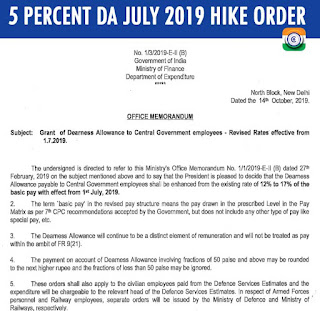
5 Percent DA July 2019 Hike Order - Grant of Dearness Allowance to Central Government employees

Grant of Dearness Allowance to Central Government employees 5 Percent DA July 2019 Hike Order  No. 1/3/2019-E- II (B) Government of...

Blog Archive

About The Author