A complete reference blog for Indian Government Employees

Showing posts with label Railways Act. Show all posts

Tuesday, 27 March 2018

Booking to Tatkal Tickets & Measures to Avoid Misuse of Tatkal Scheme


Ministry of Railways
Booking to Tatkal Tickets & Measures to Avoid Misuse of Tatkal Scheme
27 MAR 2018
On Indian Railways, reserved accommodation including Tatkal accommodation can be booked through computerised Passenger Reservation System (PRS) on first come first served basis. During peak rush periods/days when demand outstrips  the availability, reserved accommodation especially in higher classes and on popular routes gets exhausted within short duration of opening of reservation.  However,   during lean periods, on non-popular and lower classes, the accommodation remains available for longer duration.  The phenomenon is more relevant for Tatkal where limited accommodation is earmarked. This happens as the available limited accommodation is accessed simultaneously through more than 10,300 counters at 3465 computerised Passenger Reservation Centers as well as through internet.

To avoid misuse of Tatkal Scheme, there are some inbuilt features in Tatkal scheme which includes provision of not granting refund on cancellation of confirmed Tatkal tickets except in case of certain special circumstances indicated in the scheme, not allowing any modification of Tatkal ticket, etc. Some additional steps have also been taken to facilitate the passengers and to avoid the misuse, some of which are:-
  • Staggering of the timings of reservation under Tatkal scheme.
  • Captcha implementation in Registration, Login and Booking page to check fraudulent booking through automation software.
  • Imposition of minimum time limit before proceeding for payment gateway as well as after making payment while booking tickets through internet.
  • Making OTP(one time password) compulsory for all net Banking Payment options.
  • Disabling authorised agents to book Tatkal tickets during first half an hour of opening of reservation.
To keep a check on the activities of touts, preventive as well as regular checks are conducted jointly/individually by Vigilance, Security and Commercial Departments, and the action against the culprits is taken as per provisions of Section 143 of Railways Act, 1989.

This information was made available in reply to a question in Rajya Sabha.

PIB
Share:

Saturday, 10 March 2018

Loco running staff as on April 2017 is 87196


Loco running staff as on April 2017 is 87196

Loco running staff

As on 01.04.2017, over Zonal Railways, total number of employed staff in loco running category is 87196.

As per the provision of the Railways Act, 1989 and the Railway Servants (Hours of Work & Period of Rest) Rules, 2005, Loco running staff on the Railways are classified as 'Continuous' and as such, their rostered hours of work is 54 hours a week on an average in a two-weekly period of 14 days.
After the Seventh CPC (Central Pay Commission) recommendations, the basic pay of the non-running staff has been increased by a multiplication factor of 2.57 with effect from 01.01.2016 and then fixed in the appropriate cell of the relevant Level in the Seventh CPC pay matrix, while for the running staff the multiplication factor of 2.945 was used. Further, the actual raise in the pay of the running staff has been ensured at a minimum of 14.29 percent with the Ministry of Finance (MoF) concurrence. This has resulted in an effective multiplication factor of around 3.01 for Running Staff. The running staff also get allowances like Dearness Allowance and House Rent Allowance on the basic pay enhanced by 30%.

This was stated by the Minister of State for Railways Shri Rajen Gohain in a written reply to a question in the Parliament on 9.2.2018.
Share:

Tuesday, 27 December 2016

Railways Act: Railways hikes relief from Rs 4 lakh to Rs 8 lakh in case of death

Railways Act: Railways hikes relief from Rs 4 lakh to Rs 8 lakh in case of death

New Delhi: Enhancing the financial aid in train accident, the government has amended the rules under the Railways Act of 1989 to double up the amount in case of death or physical disability like loss of limbs.

Under the Railway Accidents and Untoward Incidents (Compensation) Amendment Rules, 2016, the compensation amount of Rs four lakh has been increased to Rs 8 lakh in case of death or loss of hand and foot caused in train accident, an official notification said.

The relief amount will be given by the Railways Claim Tribunal to the kith and kin of the person who dies in the accident. In case the person is seriously injured like loss of hand and foot, then he would also get the same amount of Rs eight lakh as compensation after completion of inquiry process, said a senior Railway Ministry official.

According to the notification, if a person loses his eye sight or becomes absolute deaf due to the train accident, then he would be entitled for Rs eight lakh in compensation.

A person is also eligible for getting the same amount (Rs eight lakh) if he suffers from severe facial disfigurement due to the mishap, the official added.

The notification will come into effect from January, sources said.

PTI
Share:

Saturday, 10 December 2016

Insurance Scheme For Railway Passengers

Insurance Scheme For Railway Passengers

An Optional Travel Insurance Scheme on a pilot basis for one year has been launched w.e.f 01.09.2016 for the Railway passengers who book e-ticket through official website of Indian Railway Catering & Tourism Corporation (IRCTC) at the premium of Rs. 0.92 per passenger.

This insurance scheme provides financial support to the family/legal heir in case of death/injury of reserved passengers due to train accident/untoward incidents as defined under section 123 read with Sections 124 and 124A of the Railways Act, 1989, subject to the qualification that the coverage will be valid from the actual departure of train from the originating station to actual arrival of train at the destination station including 'process of entraining' and 'process of detraining' the train.
The Sums Insured to be given to passengers are as follows: (i) In case of Death- Rs. 10 lakh, (ii) Permanent Total Disability - Rs. 10 Lakh, (iii) Permanent Partial Disability upto- Rs. 7.5 Lakh, (iv) Hospitalization Expenses for Injury -Rs. 2 Lakh, (v) Transportation of mortal remains - Rs. 10 Thousand.

IRCTC which is a wholly owned undertaking of Ministry of Railways has entered into an agreement with three Insurance Companies through Limited Tender, namely (i) Shriram General Insurance Company Ltd., (ii) ICICI Lombard General Insurance Company Ltd., and (iii) Royal Sundaram General Insurance Co. Ltd.

(a) Ex-gratia is paid to the victims of train accidents and untoward incidents at the following scales:
Train Accident
(Sec.124)
Untoward Incident
(Sec. 124- A)
In case of deathRs. 50,000/-Rs. 15000/-
In case of grievous injuryRs. 25,000/- lump sum for hospitalisation upto 30 days.
Rs. 300 per day at the end of every 10 day period or discharge,
whichever is earlier.
Rs.5000/- lump sum for hospitalisation upto 30 days.Rs. 1000/- per week or part thereof the period for indoor treatment
upto further six months of hospitalisation.
Rs. 500/- per week or part thereof the period for indoor treatment
upto further five months of hospitalisation.
The maximum period for which ex-gratia is payable to the
grievously injured passenger will be 12 months.
In case of simple injuryRs
5000/-
Rs. 500/-

The insurance scheme is available on optional basis to passengers of all reserved classes (SL, 1AC, 2AC, 3AC etc.) of all trains except passenger trains and sub-urban trains for tickets booked online on the IRCTC websites.

This Press Release is based on the information given by the Minister of State for Railways Shri Rajen Gohain in a written reply to a question in Rajya Sabha on 09.12.2016 (Friday).

PIB
Share:

Featured post

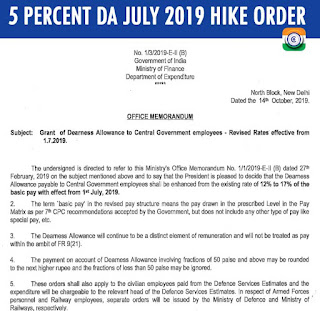
5 Percent DA July 2019 Hike Order - Grant of Dearness Allowance to Central Government employees

Grant of Dearness Allowance to Central Government employees 5 Percent DA July 2019 Hike Order  No. 1/3/2019-E- II (B) Government of...

Blog Archive

About The Author