A complete reference blog for Indian Government Employees

Showing posts with label RTI Act. Show all posts

Thursday, 5 March 2020

Implementation of RTI Act - PIB


Ministry of Personnel, Public Grievances & Pensions
Implementation of RTI Act

04 MAR 2020

The Central Government is fully committed to implement the Right to Information (RTI) Act in respect of public authorities under it. Each State Government is responsible for implementation of the Right to Information Act in respect of the public authorities in the State concerned.

In respect of the Central Information Commissions, the appointment process has been conducted duly as and when vacancies were required to be filled up and has not been at preliminary stage.

Also check: DoPT - Notification regarding RTI Rules 2019

The Hon’ble Supreme Court vide its Order dated 16.12.2019 in M.A. No. 1979 of 2019 in WP (C) No. 436 of 2018: Ms Anjali Bhardwaj & Others Vs. Union of India and Others pertaining to fill up the vacancies in Central Information Commissions, has inter-alia directed that the Government complete the process of appointment in 3 months.

The process has reached an advanced stage for appointment of the Chief Information Commissioner and one Information Commission in Central Information Commission.

This information was provided by the Union Minister of State (Independent Charge) Development of North- Eastern Region (DoNER), MoS PMO, Personnel, Public Grievances & Pensions, Atomic Energy and Space, Dr Jitendra Singh in written reply to a question in Lok Sabha today.

MACP ON PROMOTIONAL HIERARCHY - MACP Supreme Court Order – Heard & Reserved - Order dated 23 Jan 2020

PIB
Share:

Tuesday, 21 November 2017

Aadhaar Data is Never Breached or Leaked: UIDAI


Aadhaar Data is Never Breached or Leaked: UIDAI

The Unique Identification Authority of India (UIDAI) responding to a news report, appeared in certain section of media on "210 Government sites made Aadhaar info public" as if Aadhaar data is leaked or breached, has said that such report is a skewed presentation of the facts and poses as if the Aadhaar data is breached or leaked which is not the true presentation. UIDAI said in a statement here that the Aadhaar data is fully safe and secure and there has been no data leak or breach at UIDAI.

UIDAI said that this said data on these websites was placed in public domain as a measure of proactive disclosure under RTI Act by these government and institutional websites which included beneficiaries’ name, address, bank account, and other details including Aadhaar number and was collected from the third party/users for various welfare schemes. It was this collected info which had been displayed in the public domain under RTI Act. There was no breach or leakage of Aadhaar data from UIDAI database or server as has been aired by the said report.

UIDAI said that acting promptly on this, UIDAI and Ministry of Electronics & IT had directed the concerned Government departments/ministries to immediately remove it from their websites and ensure that such violation do not occur in future. Certain other measures were also taken at various levels to ensure that such incidents of display of Aadhaar numbers do not take place. Following UIDAI’s action such data were removed from these websites immediately. However, the news presented the facts in a skewed manner and misleads readers as if Aadhaar data has been leaked or breached at 210 websites posing Aadhaar security is vulnerable.

UIDAI reiterated that Aadhaar security systems are best of the international standards and Aadhaar data is fully secure. There has been no breach or leakage of Aadhaar data at UIDAI. Also, the Aadhaar numbers which were made public on the said websites do not pose any real threat to the people as biometric information is never shared and is fully secure with highest encryption at UIDAI and mere display of demographic information cannot be misused without biometrics.

UIDAI clarified that Aadhaar number is not a secret number. It is to be shared with authorized agencies when an Aadhaar holder wishes to avail a certain service or benefit of government welfare scheme/s or other services. But that does not mean that the proper use of Aadhaar number poses a security or financial threat. Also, mere availability of Aadhaar number will not be a security threat or will not lead to financial/other fraud, as for a successful authentication fingerprint or iris of individual is also required. Further all authentications happen in presence of personnel of respective service provider which further add to the security of the system.

Furthermore, UIDAI security system has people's participatory security system like Biometric Lock facility available at UIDAI portal which any Aadhaar holder can use to put his/her own lock on one’s biometric by visiting UIDAI's official website www.uidai.gov.in.

PIB
Share:

Wednesday, 22 March 2017

Information under RTI Act


Information under RTI Act
No data is centrally maintained either by Government or Central Information Commission (CIC) in respect of cases wherein the information under RTI Act has not been provided to the applicants.

CIC adjudicates the second appeals and complaints received in the Commission. The Right to Information Act, 2005 provides for imposition of penalty by CIC against the Central Public Information Officer (CPIO), in pursuance of section 20 of the RTI Act. As per the information furnished by CIC, the amount of penalty imposed on such CPIOs for the last three years is as under:

YearPenalty Imposed
2013-1419,25,000
2014-157,39,000
2015-1610,52,500

Right to Information (RTI) Act 2005 mandates timely response to citizen's request for information in order to promote transparency and accountability in the working of every public authority.

Review of the implementation of the provisions of RTI Act is an ongoing process. There have been constant efforts on part of the Government to streamline and strengthen the existing mechanisms for successful and effective implementation of the RTI Act.

Government has taken several steps to strengthen the regime of RTI Act, which inter-alia include the following:
i. RTI Online Portal (https://rtionline.gov.in) was launched in August, 2013 by D/o Personnel and Training. As on 17.03.2017, 1840 Central Public Authorities have been aligned to it making it convenient for citizens to file RTI requests and First Appeals through on-line.
ii. The Government has conducted training and capacity building programs for Public Information Officers and First Appellate Authorities through State Government Training Institutes for effective implementation of the RTI Act.
iii. Ministries/Departments and other Public Authorities are proactively working towards suo-motu disclosure and more information is put on their websites so as to reduce the need for filing RTI applications.
This was stated by the Minister of State in the Ministry of Personnel, Public Grievances and Pensions and Minister of State in the Prime Minister's Office Dr. Jitendra Singh in a written reply to a question by Shri Raju Shetty in the Lok Sabha today.

PIB
Share:

Saturday, 11 February 2017

Centrally Sponsored Scheme on Improving Transparency and Accountability in Government through Effective Implementation of RTI Act Release of funds to YASHADA, Pune


Centrally Sponsored Scheme on Improving Transparency and Accountability in Government through Effective Implementation of RTI Act Release of funds to YASHADA, Pune

F.No.14/13/2016-IR
Government of India
Ministry of Personnel, Public Grievance & Pension
Department of Personnel & Training
North Block, New Delhi
Dated the 06th February, 2017
To
The Pay & Accounts Officer
Pay & Accounts Office
Ministry of Personnel, PG & Pension
Department of Personnel & Training
Lok Nayak Bhavan,
Khan Market, New Delhi

Subject: Centrally Sponsored Scheme on Improving Transparency and Accountability in Government through Effective Implementation of RTI Act Release of funds to YASHADA, Pune.

Sir,
I am directed to convey the sanction of the President to make a total payment of Rs.3,62,050/-
(Rupees Three lakhs sixty two thousand fifty only) to Yashwantrao Chavan Academy of  Development Administration, Pune towards Setting up of Help Line on RTI.

2. The details of sum, being released, alongwith the conditions attached thereto are furnished in the Annexure.

3. The expenditure of Rs.3,62,050/- will be met from the Major Head 2070 - Other Administrative Services, 41.01-Propagation of Right to Information Act, 41.01.31 - Grants-in-Aid under Demand No.64 for the year 2016-17.

4. The amount of Rs.3,62,050/- may be released electronically through RTGS as per the Bank details mentioned below. IDBI BANK, Account No. 062104000065663, IBC Code: IBKL0000062

5. This issues with the concurrence of Integrated Finance Division vide their CF No. 3126672 dated the 03.02.2017.
Yours faithfully,
(M.M Maurya)
Under Secretary to Government of India
Tel: 23040401

Annexure to Sanction Order No.14/13/2016-IR
Dated 06th February, 2017
The fund of Rs.3,62,050/- is subject to the following terms and conditions:
(i) This grant is released for the Setting up of Help Line on RTI;

RTI Activities Amount (Rs.)
I. Awareness Generation for RTI Setting up of Help Line I. Computer System
II. Sony PS3 Wireless and noise cancelling headsets
III. Broadband Telephone Line
IV. Stationery
V. Furniture
VI. Manpower (Honorarium Rs.165000/ month )(Dec, 2016-
March, 2017)
VII. Software
VIII. Database and Storage
IX. Miscellaneous Expenditure
X. Administrative Charges @15% (on sub-total from point I
to IX)
75,99013,446
30,000
12,000
15,000
33,000
90,000
20,000
25,390
47,224
Total 3,62,050
(ii) The General Financial Rules, 2005 should be followed while incurring the expenditure.

(iii) Yashwantrao Chavan Academy of Development Administration, Pune should furnish to this
Department for record and audit, Utilization Certificate in GFR 19-A Form duly countersigned
by the Head of the Institute along with Achievement-cum-Performance Report as required
under Rule 212 of General Financial Rules, 2005.

(iv) The unutilized amount of grant, if any, may be surrendered to this Department by a Demand
Draft drawn in favour of "Under Secretary (Cash), DOPT payable at New Delhi.

(v) There should not be any overlap of activities under any other Scheme.
(M.M. Maurya)
Under Secretary to Government of India
Source: ccis.nic.in
Share:

Wednesday, 21 September 2016

2000 central government organisations to accept online RTI applications


2000 central government organisations to accept online RTI applications

New Delhi: Around 2,000 Central government organisations will soon be accepting applications under the Right to Information (RTI) Act through online medium.

The move is based on the suggestion given by a group of secretaries before Prime Minister Narendra Modi.

The Department of Personnel and Training (DoPT) has started a massive exercise to train nodal officers of all such public authorities who have not yet started accepting the RTI pleas online.

In a stern directive, it has asked all the government departments to attend a workshop being organised by the DoPT in this regard  without fail. In case, the officers concerned fail to attend the workshop, a username will be created suo-motu and all these public authorities will be made live on the RTI portal.

As many as 690 public authorities have been aligned so far on the especially designed website www.rtionline.Gov.in  to enable online filing of the RTI applications.

The DoPT had during June and July this year conducted a workshop for 330 public authorities. Of these, 51 nodal officers did not attend the workshop.

Since all the public authorities (around 2,000) will have to be aligned in a time bound manner ( a target/timeline fixed and monitored at the highest level), DoPT is organising yet another training workshop as a special drive for those defaulted public authorities and nodal officers who did not attend the workshop

It requested that all nodal officers under 51 public authorities attend the workshop without fail on Tuesday, the DoPT said in the order.

It may be noted by all concerned that no further opportunity would be given to the nodal officers after this workshop, the order said.

In case the concerned nodal officer is unable to attend this training, the username will be created suo motu and the concerned public authority will be made live on the RTI online portal with effect from September 30, by DoPT, it said.

The RTI Act, 2005, enables a citizen to seek tome-bound reply on governance related matters. People can also make payment of RTI fee online.

On the occasion of completion of more than 10 years of implementation of the RTI Act, the Central Information Commission is going to hold annual convention in October, the DoPT said.

PTI
Share:

Tuesday, 28 June 2016

Centrally Sponsored Scheme on Improving Transparency and Accountability in Government through Effective Implementation of RTI Act – Release of Grants

Centrally Sponsored Scheme on Improving Transparency and Accountability in Government through Effective Implementation of RTI Act – Release of Grants

F.No.14/6/2016-IR
Government of India
Ministry of Personnel, Public Grievance & Pension
Department of Personnel & Training
North Block, New Delhi
Dated the 17th June, 2016
To
The Pay & Accounts Officer
Pay & Accounts Office
Ministry of Personnel, PG & Pension
Department of Personnel & Training
Lok Nayak Bhavan,
Khan Market, New Delhi

Subject:- Centrally Sponsored Scheme on ‘Improving Transparency and Accountability in Government through Effective Implementation of RTI Act’ — Release of Grants to Manipur IC.

Sir,
I am directed to convey the sanction of the President to release a grant of Rs.3,00,000/- (Rupees Three Lakhs only) to Manipur Information Commission, Imphal towards Celebration of RTI Week during 5th _ 12th October, 2016.

2. The details of grant, being released, alongwith the conditions attached thereto are furnished in the Annexure.

3. The expenditure of Rs.3,00,000/- will be met from the Major Head 2070 — Other Administrative Services, 41.01-Propagation of Right to Information Act, 41.01.31 — Grants-in-Aid under Demand No.64 for the year 2016-17.

4. The grant of Rs.3,00,000/- may be released electronically through RTGS as per the Bank details mentioned below.

State Bank of India, Account No. 30951775224, IFSC Code: SBIN0004562

5. This issues with the concurrence of Integrated Finance Division vide their Dy. No. 3123586/Dir(F/P)/2016 dated the 09.06.2016.
Yours faithfully,
(M.M. Maurya)
Under Secretary to Government of India
Tel: 23040401
Annexure to Sanction Order No.14/6/2016-IR
Dated 17th June, 2016

The grant of Rs.3,00,000/- is subject to the following terms and conditions:

(I) This grant is released towards Celebration of RTI Week during 5th-12th October, 2016;

RTI Activities
I. Awareness Generation for RTI RTI Week Celebration:
(i) One State Level Workshop on RTI for SPIOs/RTI Activists/Media Persons/ Resource Persons etc. – Amount (Rs.) 1,20,000
(ii) State Level Seminar cum Workshop on RTI for SPI0s/RTI
Activists/ Persons/ Students etc. – Amount (Rs.) 80,000
(i) Press Meet, Essay Writing/Quiz competition for college students
on RTI related matter – Amount (Rs.) 1,00,000

Total Amount (Rs.) 3,00,000

(ii) The General Financial Rules, 2005 should be followed while incurring the expenditure.

(iii) Manipur Information Commission, Imphal should furnish to this Department for record and audit, Utilization Certificate in GFR 19-A Form duly countersigned by the Head of the Commission along
with Achievement-cum-Performance Report as required under Rule 212 of General Financial Rules, 2005.

(iv) The unutilized amount of grant, if any, may be surrendered to this Department by a Demand Draft drawn in favour of “Under Secretary (Cash), DOPT payable at New Delhi.

(v) There should not be any overlap of activities under any other scheme.

(vi) Expenses on lunch should not exceed Rs.150/- per head.

(vii) TA/DA to non-official, wherever applicable, should be paid after establishing their equivalence with government officials.
(M.M. Maurya)
Under Secretary to Government of India
Share:

Wednesday, 23 March 2016

Personal information under RTI Act

Personal information under RTI Act

The Department of Personnel and Training have been impressing upon the public authorities to disclose maximum information proactively, so that public at large need not file RTI applications to seek information held by the public authorities.

In this regard, it was brought to the notice of the public authorities from time to time that they may not disclose personal information of an individual as it does not serve any public interest.
Some of the stakeholders have objected to disclosure of personal information as it would put the lives of the information seekers at risk.

Based on directions from High Court of Kolkata in the matter of Shri Avishek Goenka Vs UOI and in the interest of stakeholders, the DOPT is inviting comments from the stakeholders on draft OM within 15 days. These comments may be sent to Shri R.K. Girdhar, US (RTI) through e-mail only at usrti-dopt@nic.in.

Click here for Draft OM
Share:

Friday, 9 October 2015

Dopt issued guidelines for giving information to the applicants under RTI Act

Dopt issued guidelines for giving information to the applicants under RTI Act

Format for giving information to the applicants under RTI Act- issue of guidelines regarding.

G.I., Dept. of Per. & Trg., O.M.No.10/1/2013-IR, dated 6.10.2015
Subject: Format for giving information to the applicants under RTI Act- issue of guidelines regarding.

It has been observed that different public authorities provide information to RTI applicants in different formats. Though there cannot be a standard format for providing information, the reply should however essentially contain the following information:
(i) RTI application number, date and date of its receipt in the public authority.

(ii) The name, designation, official telephone number and email ID of the CPIO.

(iii) In case the information requested for is denied, detailed reasons for denial quoting the relevant sections of the RTI Act should be clearly mentioned.

(iv) In case the information pertains to other public authority and the application is transferred under section 6(3) of the RTI Act, details of the public authority to whom the application is transferred should be given.

(v) In the concluding para of the reply, it should be clearly mentioned that the First Appeal, if any, against the reply of the CPIO may be made to the First Appellate Authority within 30 days of receipt of reply of CPIO.

(vi) The name, designation, address, official telephone number and e-mail ID of the First Appellate Authority should also be clearly mentioned.
2. In addition, wherever the applicant has requested for ‘certified copies’ of the documents or records, the CPIO should endorse on the document “True copy of the document/record supplied under RTI Act”, sign the document with .date, above a seal containing name of the officer, CPIO and name of public authority; as enumerated below:
True copy of the document/record supplied under RTI Act.
Sd/-
Date
(Name of the Officer)
CPIO
(Name of the Public Authority)
Further in case the documents to be certified and supplied is large in number, information on RTI application should be supplied by a designated PIO but the certification of the documents, if need be, could be done by an other junior gazetted officer.

3. This may be brought to the notice of all concerned.

Source: www.persmin.gov.in
Click to view the order
Share:

Monday, 11 May 2015

DoPT withholds info on CIC selection

DoPT withholds info on CIC selection

New Delhi: Department for Personnel and Training (DoPT), which is the nodal authority for handling RTI matters, has refused to furnish records related to appointment process of the Central Information Commission without citing any exemption clause for the same, which is mandatory as per CIC orders.
While refusing to furnish information, a Central Public Information Officer must cite either of the 10 sub clauses given in the section 8 of the RTI Act along with proper reasons justifying how the section is attracted.
The case related to an Odisha based RTI applicant Deba Prasad Sahoo who sought to know the information related to appointment of Chief Information Commissioner, a post which has been lying vacant since August 22, 2014 after the retirement of then incumbent Rajiv Mathur.

“The appointment of IC/CIC is under challenge in the High Court of Delhi and therefore, the document sought for cannot be provided at this stage,” R K Girdhar, the Central Public Information Officer for DoPT said.

Under Section 8 (1) (b) only that information can be withheld by a CPIO which has been expressly forbidden to be published by any court of law or tribunal or the disclosure of which may constitute contempt of court.

In a recent order, Information Commissioner Basant Seth had clarified “The mere pendency of arbitration proceedings is not sufficient justification by itself for withholding the information. The RTI Act provides no exemption from disclosure requirement for sub-judice matters”.

“The only exemption in sub-judice matters is regarding what has been expressly forbidden by a court or a tribunal and what may constitute contempt of court,” Seth said.

In his response dated May 5, 2015, Girdhar said the CPIO claimed that appointment of Chief Information Commissioner is being handled in file number 4/7/2014-IR.

On March 25, 2015 reply to a separate RTI activist Commodore (Retd) Lokesh Batra, Girdhar had claimed that the process for shortlisting of candidates, for the current phase of appointment to the post of Chief Information Commissioner/ Information Commissioners is not available in file numbers… 4/7/2014-IR.

PTI
Share:

Sunday, 22 February 2015

Guidelines for Public Information Officers/First Appellate Authorities for supply of information and disposal of first appeal respectively

Guidelines for Public Information Officers/First Appellate Authorities for supply of information and disposal of first appeal respectively - reiteration of : DoP&T Order

F.No. 1/32/2013-IR
Government of India
Ministry of Personnel, Public Grievances & Pensions
Department of Personnel & Training
 North Block, New Delhi
Dated: the 17th February, 2015

OFFICE MEMORANDUM

Subject: Guidelines for Public Information Officers/First Appellate Authorities for supply of information and disposal of first appeal respectively - reiteration of 


Section 26 of the RTI Act requires the Government to compile a guide containing such information, in an easily comprehensible form and manner, as may reasonably be required by a person who wishes to exercise any right specified in the Act. Further, it requires the Government to update the guide at regular intervals. Accordingly a Guide on the Act was published online on 28.11.2013 to help all the stake-holders viz. information seekers in getting information, public information officers in dealing with the RTI applications, first appellate authorities in taking cogent decisions on appeals and the public authorities in implementing various provisions of the Act in right earnest.
2. The Public information Officers/First Appellate Authorities should keep in mind the salient features of the guidelines in supply of information to the information seeker and disposal of first appeal respectively, so that information seekers may not resort to filing of second appeals before the information Commissions. The relevant salient features of the guidelines are reiterated below for consideration of the Public information Officers and First Appellate Authorities:
Supply of Information by the Public Information Officer
1) The answering Public Information Officer should check whether the information sought or a part thereof is exempt from disclosure under Section 8 or Section 9 of the Act. Request in respect of the part of the application which is so exempt may be rejected and rest of the information should be provided immediately or after receipt of additional fees, as the case may be. 

2) Where a request for information is rejected, the Public Information Officer should communicate to the person making the request-

(i) the reasons for such rejection;
(ii) the period within which an appeal against such rejection may be preferred; and
(iii) the particulars of the authority to whom an appeal can be made.

3) If additional fee is required to be paid by the applicant as provided in the Fee and Cost Rules, the Public Information Officer should inform the applicant:
(i) the details of further fees required to be paid;
(ii) the calculations made to arrive at the amount of fees asked for:
(iii) the fact that the applicant has a right to make appeal about the amount of fees so demanded;
(iv) the particulars of the authority to whom such an appeal can be made; and
(v) the time limit within which the appeal can be made.

4) Though there is no hard and fast rule as to when exactly intimation about additional fees is to be given to the applicant, such intimation should be given soon after receipt of RTI application.
Disposal of Appeal by the First Appellate Authority
1) While disposing off first appeals, the first Appellate Authorities should act in a fair and judicious manner. it is very important that the order passed by the first appellate authority should be a detailed and speaking order, giving justification for the decision arrived at.

2) If an appellate authority while deciding on appeal comes to a conclusion that the appellant should be supplied information in addition to what has been supplied by the Public Information Officer, he may either (i) pass an order directing the Public Information Officer to give such information to the appellant: or (ii) he himself may give information to the appellant. In the first case the appellate authority should ensure that the information ordered by him to be supplied is supplied to the appellant immediately. It would, however, be better if the appellate authority chooses the second course of action and he himself furnishes the information alongwith the order passed by him in the matter.

sd/-
(Sandeep Jain)
Director

Source: www.persmin.nic.in
[http://ccis.nic.in/WriteReadData/CircularPortal/D2/D02rti/GuidelinesforPIOsAAs.pdf]
Share:

Thursday, 15 January 2015

Introduction of postal stamps as RTI fee/cost – seeking comments from public regarding

Introduction of postal stamps as RTI fee/cost – seeking comments from public regarding

No.1/3/2014-IR
Government of India
Ministry of Personnel, Public Grievance and Pensions
Department of Personnel and Training
(IR Division)
North Block, New Delhi
Dated 14th January, 2015
Circular

Subject: Introduction of postal stamps as RTI fee/cost – seeking comments from public regarding

RTI Rules, 2012 prescribe payment of RTI application fee/Cost through four Modes i.e. IPO, Demand Draft, Bankers Cheque and Cash against receipt. Apart from regular modes of payments, Information seekers can use the facility of e-IPO and also use Debit/Credit Card for filing online RTI application.

2. CIC in its full bench decision in the case No. CIC/BS/C/2013/000149/LS dated 27.08.2013 had inter-alia urged DoPT to consider acceptance of RTI stamps as a mode of payment of RTI Fee and Costs. The issue was examined in consultation with Department of Posts and the latter expressed its inability to print exclusive RTI stamps. Subsequently, Department of Posts recommended use of definitive series of postal stamps which are ubiquitously available in the Post Offices across the country in different denominations. It further added that, the RTI applicants would also need to affix the said stamp(s) on the RTI application. The RTI applicant(s) by putting his signature or thumb impression shall cancel the said postage stamp(s) to prevent it from misuse/re-use.

3. It was decided with the approval of the then MoS (PP) that acceptance of postal stamps as mode of payment of RTI fee and cost would require amendment in the RTI Rules notified on 31.7.2012 only, the recommendations of CIC may be noted and considered as and when amendment to RTI Rules are considered.

4. The CIC in its recent decision dated 12.12.2014 in File No.CIC/SA/C/2014/000038 has again recommended to DoPT to adopt the proposal of the Deptt. of Posts of use of ordinary Postal Stamps for payment of RTI fee.

5. Introduction of Stamps as one of modes of payment for RTI application fee would require amendment to the RTI Rules, 2012. In addition, the following issues need to be sorted out before taking any decision.

i. Use of ordinary postal stamps for the purpose of RTI may lead to accounting problem, as it would not be possible to account amount collected for RTI through ordinary stamps. Section 25(3)(e) of the RTI Act lays down that each public authority is required to communicate to CIC/SIC, as the case may be, the amount of charges collected under this Act for incorporation in their Annual Report.

ii. There is apprehension of misuse of ordinary stamps for the purpose of RTI, in the absence of specific procedure for crossing such stamps.

iii. Whether postal stamps may be considered for initial RTI fees only or for payment of additional fee also.

6. A Committee has been formed to look into the above and other related issues. It has been decided to invite views/suggestions from the citizens in the subject matter, for the consideration of the Committee. The views/suggestions, preferably not exceeding more than one page, may be sent latest by 7.2.2015 through email only to Shri R.K. Girdhar, Under Secretary (RTI), North Block at usrti-doptOmic. in.
sd/-
(Sandeep Jain)
Director – IR
Tele. No. 011-23092755
Source Document: www.persmin.gov.in
Share:

Friday, 10 October 2014

RTI course is open for all the citizens and is available free of cost – Dopt

RTI online Certificate Course conducted by the Department of Personnel and Training

F No.111012009-IR
Government of India
Ministry of Personnel, Public Grievances and Pensions
Department of Personnel and Training
North Block, New Delhi-I 10001
Dated: 7.10.2014
Office Memorandum

Subject: RTI online Certificate Course conducted by the Department of Personnel and Training

The Department of Personnel and Training has been conducting an justify to  Information Online Certificate Course in English since the year 2009 and in Hindi and Telugu since the year 2012.

The course is hosted through Centre for Good Governance, Hyderabad on the url rtiocc.cgg.gov.in . The RTI online certificatecourse not only offers the benefit of away from Class room learning, but also provides a platform for reinforcing one’s learning through interacting with experts and fellow candidates.
This course is open for all the citizens and is available free of cost.

2. The CGG hosts two courses on RTI – a short duration course of 7-days and a longer version of 15 days. The 7 days course is introductory in nature and does not  have chat window/moderator facility and does not carry any certificate. However, this is treated as an eligible criterion for getting selection into the longer version 15-days course.

3. The 15-day course is more intensive with practical orientation of applying the RTI Act. This version of the course has the facility of discussion forum and moderation. On successful completion of the course, an e-Certificate will be issued.

4. It is requested that the Public Information Officers and First Appellate Authorities working in your Ministry/Department and public authorities under your administrative control may be encouraged to enroll for the said Online Certificate Course on RTI.
(Archana Varma)
Joint Secretary
Source: Dopt
 #dopt, #DOPT Orders, #RTI, #RTI online Certificate Course, #Department of Personnel and Training, #CGG, #RTI Act, #Indian Government News,
Share:

Thursday, 15 August 2013

PM's address from the ramparts of the Red Fort on the occasion of Independence Day 2013

PM's address from the ramparts of the Red Fort on the occasion of Independence Day 2013

Prime Minister, Dr. Manmohan Singh, addressed the Nation from the ramparts of the Red Fort today on the occasion of Independence Day. Following is the English rendering of the Prime Minister’s address:

“My dear fellow-citizens,

Brothers, sisters and dear children,

I greet you all on this Independence Day.

Today is certainly a day of joy for us. But on this celebration of independence we also feel pain in our hearts that our brothers and sisters in Uttarakhand had to face devastation about two months back. Our deepest sympathies are with all the families that suffered loss of life or property. I want to assure the people of Uttarakhand today that the whole country stands with them in this moment of crisis. Our government is working with all the resources at its command to rehabilitate those whose houses have been destroyed and rebuild damaged infrastructure.

Our army, paramilitary forces and numerous officers and staff of the Central and State governments worked in difficult conditions in partnership with the common people to perform an outstanding task in providing relief to those who were stranded. We especially pay homage to the officers and men of the Air Force, ITBP and NDRF who sacrificed their lives to save others.

We are also deeply pained that we lost the submarine, INS Sindurakshak in an accident yesterday.  Eighteen brave sailors are feared to have lost their lives.  The accident is all the more painful because the Navy had recently achieved two major successes in the form of its first nuclear submarine, INS Arihant and the aircraft carrier, INS Vikrant.

We pay homage to the brave hearts we have lost.  We also congratulate the Navy on its successes.

Brothers and Sisters,

We achieved independence in 1947 under the leadership of Mahatma Gandhi.  If we look at our subsequent journey, we would find that our country has seen major changes every ten years.

In the decade beginning 1950, India took its first steps as a democratic republic under the leadership of Pandit Jawahar Lal Nehru. We established institutions like the Atomic Energy Commission, Planning Commission and Election Commission, which went on to make a major contribution to the processes of nation building in later years. The first general elections were conducted and a beginning was made towards the formulation of the First Five Year Plan for socio-economic development of the country.

In the Sixties, Pandit Nehru set up new industries and factories, implemented new irrigation projects and opened new universities. By laying emphasis on the role of Science and Technology in nation building he started the work of transforming this ancient country into a modern nation.

In the Seventies, Indiraji boosted our confidence as a nation. During this period, we launched our first satellite in space. The Green Revolution enabled us to be self sufficient in food grains for the first time.

In the next decade, Rajiv Gandhi ji set into motion the process of technological and economic modernization. The foundation for the progress we later made in the area of Information Technology was laid during this period. The importance of Panchayati Raj Institutions was emphasized and this later resulted in amendments to our Constitutions for strengthening and empowering these institutions.

In the year 1991, under the leadership of Shri Narsimha Rao, we successfully negotiated a major economic crisis and embraced reforms for strengthening our economy. These reforms were opposed by many political parties at that time. But the reforms were in national interest and were therefore continued by all governments that came to power subsequently. Since then, the reform process has continually moved forward.

I believe that the last decade has also been a decade of major changes in the history of our nation. In no other decade has our economic development increased as much as in this decade. Democratic forces have been strengthened and many sections of our society have joined the mainstream of development for the first time. The common man has been given new rights which have led to his social and economic empowerment.

Brothers and Sisters,

The first UPA government came to power in May 2004. Ever since, we have worked with sincerity and honesty to build a progressive and modern India.

We have envisioned a prosperous India. An India which has got rid of centuries old burden of poverty, hunger and disease. Where the light of education has driven away the darkness of ignorance and superstition.

Where there is social equality and all citizens enjoy equal economic opportunity. Where no section of the society faces injustice and exploitation.

We have dreamt of an India where the youth get employment opportunities that enable them to contribute to the noble endeavour of nation building.

We have strived for India’s voice to be heard loud and clear at the international level. We have strived to build a nation that is looked at with respect and honour by the whole world.

We have taken many measures to realise these dreams.  But the journey is long and a large distance still remains to be travelled.

Brothers and Sisters,

We have recently issued an Ordinance towards  a Food Security law.  The Food Security Bill is now before Parliament and we hope it will be passed shortly.  This law will benefit 75 percent of our rural population and half of our urban population. Under the law, about 81 crore Indians would be entitled to receive rice at 3 Rupees per kg, wheat at 2 Rupees per kg and coarse grains at 1 Rupee per kg. This is the largest effort of its kind in the whole world.

We have been able to implement this law only because of the hard work of our farmers. Our food-grain production reached a record level of 25.9 crore ton in 2011-12.

Without rapid agricultural growth, we cannot achieve our goal of making our villages prosperous. We have constantly endeavoured to increase production and to ensure that farmers get remunerative prices for their produce. In the last 9 years, support prices for various crops have been enhanced as never before. The support prices for wheat and paddy have been more than doubled. Many States which faced shortages of food-grains earlier are now producing more than what they require for themselves.

The average annual rate of agricultural growth in the 11th Plan was 3.6, which is more than both the 9th and 10th Plan levels.

We now see clear indications of enhanced economic prosperity in our rural areas. In the period 2004 to 2011, rural per-capita consumption has increased four times faster than earlier.

Rural wages have also increased much faster in this period. MNREGA provides employment to crores of people in rural areas.

Measuring poverty is a difficult task. There are diverse views about what constitutes poverty. But whatever definition we may adopt, it cannot be denied that the pace of reduction in poverty has increased after 2004.

Many States which had been considered backward for a long time, with some of them being called Bimaru, are now progressing rapidly.

We have enacted the Right to Education Act to provide every child in the country the opportunity for education. Almost all our children are today being imparted education in Primary schools.

The number of young men and women going to college has more than doubled in the last 9 years.

We have implemented new schemes for scholarships on a large scale to enable poor children and those belonging to the weaker sections to access opportunities for education. Today, the Central government provides scholarships to more than 2 crore children.

Many new institutions have been opened in the area of Higher education. For example, 8 new IITs, 7 New IIMs, 16 new Central universities and 10 new NITs.  New institutions have also been opened to boost scientific research. Steps have been taken to attract students to the study of science and encourage Indian scientists working abroad to return to India.

However, much still remains to be done for reforming our education system.  Many of our schools still lack drinking water facilities, toilets and other necessary infrastructure. There is a need to improve the quality of education. To achieve this, it is necessary to lay more emphasis on training of teachers.

About 11 crore children are being provided afternoon meals every day in schools under the Mid-day Meal Scheme. This programme is of immense benefit for both education and nutrition of children. However, it is necessary to improve its implementation. The tragedy that happened in Bihar some days back should not be repeated anywhere in the country.

We had launched the National Rural Health Mission in 2005. The Mission has started showing good results. Both Maternal Maternity and Infant Mortality rates have come down sharply. A much larger proportion of children is now born in hospitals. There has also been a large increase in the proportion of children being inoculated.

No case of polio has been detected in the country in the last two years. We have been able to eradicate a disease which used to cause disability to lakhs of people.

The Rashtriya Swasthya Bima Yojana, which provides free in-patient treatment in hospitals to our poor brothers and sisters, now covers about 3.5 crore families.

We have implemented the Health Mission in urban areas also. This will result in both expansion and improvement of health services in such areas.

For ensuring better safety and security for women, we have strengthened the law dealing with offences against women.

There has been good progress in the last 9 years in the infrastructure sector also, covering areas such as Roads, Railways, Power, Civil Aviation, Ports and Telecommunications. About 2 lakh km of new roads have been constructed for connecting villages under the Pradhan Mantri Gramin Sadak Yojana.  More than 37,000 km of new Highways have been built, facilitating travel and trade. More than 40 airports have been built or upgraded.  In 2004, only 7 percent of the people had telephone connections. Today, 73 percent enjoy this facility. In rural areas, this figure has gone up from 2 to 40. There has been a record addition to our capacity for electricity generation.

Brothers and Sisters,

In the recent months, there has been much discussion on the fact that last year our growth rate came down to 5 percent. This is indeed true and we are trying our best to remedy the situation. However, it is not only our country that is facing economic difficulties. The last year has been difficult for the world economy as a whole. Major European nations are experiencing a slowdown these days. All over the world, there has been a slump in export markets. All developing countries have slowed down.

I believe that this phase of slow growth in India will not last long. In the last 9 years, our economy has grown at an annual average rate of 7.9 percent. This pace of development is the highest in any decade so far.

Brothers and Sisters,

Countries today are more integrated with each other than ever before. We have endeavoured that our foreign policy exploits this fully to India’s benefit. In the last 9 years, there has been a continuous improvement in our relations with the major powers of the world. Our Look East policy in respect of 10 ASEAN countries in East and South-East Asia has borne good results, especially in economic matters. We have also strived for friendship with our neighbouring countries. However, for relations with Pakistan to improve, it is essential that they prevent the use of their territory and territory under their control for any anti-India activity.

There has been improvement in the area of national security also. Despite some worrisome communal incidents in 2012 and this year, the last 9 years have been good for communal harmony. There has been a reduction in terrorist and Naxal violence also. However, the area of national security calls for constant vigil. We have not been successful in preventing Naxal attacks that happen from time to time. The Naxal violence in Chhatisgarh on 25 May was a frontal attack on our democracy. Recently, there was a dastardly attack on our Jawans on the Line of Control with Pakistan. We will take all possible steps to prevent such incidents in the future.

Brothers and Sisters,

We have taken many important measures to make the work of the government responsive, transparent and honest. I would like to mention only two of them here.

Through the RTI Act, the common man now gets more information than ever before about the work of the government. This legislation is being used on a large scale at all levels. The Act frequently brings to light irregularities and corruption and opens the door for improvements. I am sure that the RTI will lead to further improvements in the way the government functions.

We have introduced the Lokpal Bill in Parliament. The Lok Sabha has passed the Bill and it is now before the Rajya Sabha. This legislation will be a major step towards making our political system clean.

Brothers and Sisters,

We have journeyed a large distance in the last decade. But much remains to be done. The process of change that we have initiated will be continued in the coming time.

As I have stated earlier also, rapid economic growth is an imperative for our country. Without it, we cannot possibly achieve targets such as removal of poverty, provision of good quality education and health services and creation of new employment opportunities. The average rate of economic growth that we have attained in the last 9 years shows what we are capable of. However, economic growth has slowed down at present and we are working hard to remedy the situation.

We have recently taken many steps to speed up the process of government clearances for industry, build an environment more conducive to trade and industry and increase investment in the economy. A special Cell has been set up to help big projects with clearances. The Cabinet Committee on Investment is working to remove hindrances in the way of stalled projects.

Inadequate supply of coal had become a major problem affecting our efforts for increasing electricity generation. This has been resolved to a large extent.

We will start work on a number of new infrastructure projects in the coming months. This includes 2 new ports, 8 new airports, new industrial corridors and Rail projects.

To boost Foreign Direct Investment, we have recently enhanced the limit of such investment in many sectors and made its easier procedurally.

In the coming months, we will see visible results of these efforts to increase investment. Our growth will accelerate, new employment opportunities will be generated and there will be improvements in the infrastructure sector.

Brothers and Sisters,

After the enactment of the Food Security legislation, its implementation will be one of our priorities. We have already started working in this direction in partnership with States. Computerization of the Public Distribution System will be speeded up.

The Mid-day Meal scheme will be reformed. The meals being provided to our children should not only be nutritious but also be cooked hygienically. We will take concrete measures to ensure this.

In the area of Skill Development, we could not initially achieve as much progress as we wanted. But now the pace has picked up. We have established the National Skill Development Authority a few months back. We will shortly launch a new scheme under which those who have successfully acquired new skills will be given a grant of about Rupees 10,000.  This scheme will benefit about 10 lakh young men and women in the next 12 months.

The Multi Sectoral Development Programme for minorities has been reformed recently. We will now implement it effectively.

A scheme for offering Minimum Support Prices for minor forest produce has been approved some days back. This will enable our tribal brothers and sisters to get remunerative prices for the minor forest produce they collect. We will implement the scheme expeditiously.

A High Level Committee has been constituted to collect accurate information about the socio-economic, educational and health status of our tribal population. The report of the Committee will help us in designing better schemes for their benefit.

We can solve many of the problems that our country faces by deploying advanced technology. The Aadhaar scheme is a good example. Under the scheme, by the end of this year, about 50 crore people will acquire the means of proving their identity and this will bring them convenience in their daily lives. It will also enable crores of people to avail of banking facilities for the first time.

Brothers and Sisters,

There can be no place for narrow and sectarian ideologies in a modern, progressive and secular country. Such ideologies divide out society and weaken our democracy. We should prevent them from growing. We need to strengthen those traditions of our country which teach us to promote tolerance and respect for thought processes different from ours. I would appeal to all political parties, all sections of our society and the public at large to work in this direction.

Brothers and Sisters,

I had stated a few minutes back that every decade after independence has witnessed major changes in our country. We need to think today what changes we would like to see in the decade ahead.

If in the future we can achieve the same kind of progress as in the last decade, the day is not far off when India will be rid of poverty, hunger, disease and ignorance. Our India will be prosperous and all its citizens will be equal partners in this prosperity, irrespective of their religion, caste, region or language.

We will also need to build an environment of political stability, social cohesion and security for this to happen.

Let us all re-dedicate ourselves to building such an India together.

Dear children, please repeat with me thrice: Jai Hind, Jai Hind, Jai Hind.

***

SC/NK/SH/SKS

(Release ID :98295)
PIB News
Share:

Featured post

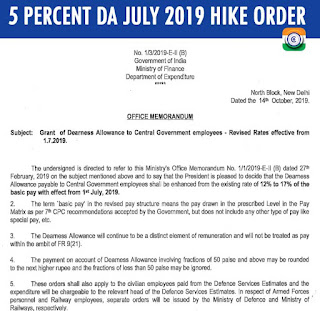
5 Percent DA July 2019 Hike Order - Grant of Dearness Allowance to Central Government employees

Grant of Dearness Allowance to Central Government employees 5 Percent DA July 2019 Hike Order  No. 1/3/2019-E- II (B) Government of...

Blog Archive

About The Author