YEAR END REVIEW 2020 DEPARTMENT OF POSTS
Ministry of Communications
New version of DARPAN-PLI App deployed in Core Integration System (CIS) with facility of processing various financial and non-financial requests of PLI/RPLI insurants at 127115 Branch Post Offices
17,092 villages brought under the coverage of Bima Gram Yojana (BGY) From January, 2020 to November, 2020
Over 7 lakh Passport applications and more than 99 lakh requests for Aadhar enrollments / updations processed from January, 2020 to November, 2020
India Post tied-ups with Indian Drug Manufacturers Association, Director General of Health Services and a number of private firms and online pharmaceutical companies for delivery of medicines from their facilities to hospitals and beneficiaries during COVID-19
31 crore financial transactions enabled through Post Office and IPPB accounts during COVID 19 period
India Post won India Today Healthgiri Award for providing the best logistic services during COVID 19
Posted On: 29 DEC 2020
YEAR END REVIEW 2020 DEPARTMENT OF POSTS
For more than 150 years, the Department of Posts (DoP) has been the backbone of the country’s communication and has played a crucial role in the country’s social economic development. It touches the lives of Indian citizens in many ways: delivering mails, accepting deposits under Small Savings Schemes, providing life insurance cover under Postal Life Insurance (PLI) and Rural Postal Life Insurance (RPLI) and providing retail services like bill collection, sale of forms, etc. The DoP also acts as an agent for Government of India in discharging other services for citizens such as Mahatma Gandhi National Rural Employment Guarantee Scheme (MGNREGS) wage disbursement and old age pension payments. In the year 2020, the Department strengthened its supply chain through capacity upgradation and expanding Road Transport Network. It played important role in countering impact of COVID-19 pandemic by enabling doorstep delivery of financial services and medicines etc. The Year End Review for Department of Posts highlights the achievements, and progress on various initiatives of department in the year 2020.
Supply Chain and e-Commerce: Mail, Express Services and Parcel:
- Capacity upgradation: Parcel handling capacity has increased from 6.0 crore per annum to 7.5 crore per annum.
- Road Transport Network: National level dedicated Road Transport Network rolled out on 56 routes touching 80 cities. Approx. 15000 bags containing 75 tonnes of parcels are being carried daily through the setup network.
- Improvement in Pan – India Average Transit Time for Speed Post: Average Transit time of Speed Post reduced from 105 hrs. in July,2019 to 81 hrs. in Feb,2020.
- Real-Time updation of Delivery: Postman Mobile App implemented in 1.47 Lakh POs including 98,454 post offices in rural areas. Real time delivery status of 14 crore Speed Post and Registered articles done through the Postman Mobile App.
- E-Commerce exports: ‘DakGharNiryat Kendra’ are being established at around 800 Post Offices covering all District headquarters to promote exports of MSMEs.
- International Tracked Packet Service extended to 3 more countries Mongolia, Bhutan and Sri Lanka taking the total from 12 to 15 countries.
Banking Services and Financial Inclusion:
- Digital Financial empowerment of the public at large: DOP serves more than 50 crore POSB customers through 1.56 lakh post offices across length & breadth of the country and have an outstanding balance of Rs. 10,81,293 crore under Post Office Savings Bank (POSB) Schemes. The Post Office CBS system is the largest network in the world with 23,483 Post Offices already on this network. Further 1,29,151 Branch Post Offices have been also enabled to access the network on real time basis. The CBS has enabled the DOP in providing 24×7 services through ATMs, Internet & Mobile Banking.
- Financial Empowerment of Rural Populace: All the 9 Small Savings Schemes of MoF are available in 1.56 lakh Post Offices. 5 Schemes, namely, Monthly Income Scheme, Senior Citizens Savings Scheme, Public Provident Fund, National Savings Certificate & KisanVikas Patra have been introduced in BOs through SB Order 27/2020 dated 23.07.2020. People living in rural India will not be required to come to town & cities to do any Post Office Savings Bank (POSB) transaction. The same will be available at their doorstep through local Branch Post Offices.
- Economic Empowerment of Girl Child: Sukanya Samriddhi Account (SSA) scheme is also known as girl child prosperity scheme and was launched by Prime Minister Shri Narendra Modi Ji on 22nd January, 2015 in Panipat, Haryana. SSA scheme ensures a bright future for girl children. This scheme has facilitated them in proper education, marriage expenses and securing their future. The Sukanya Samriddhi Account can be opened in any post office. A total of 1.83 Crore Sukanya Samriddhi Accounts have been opened with deposits amounting to Rs. 58,822.62 Crore, by the Department of Posts, till November, 2020 since introduction of the scheme.
- Insurance and Pension coverage of masses at reasonable rates: The PM Jan Suraksha Schemes, namely, Pradhan Mantri Suraksha Bima Yojana (PMSBY), Pradhan Mantri Jeewan Jyoti Bima Yojana (PMJJBY) & Atal Pension Yojana (APY) were launched by Hon’ble Prime Minister in May, 2015. The DOP has been playing an active role under these Government of India flagship schemes and had made 3.2 Lakh Atal Pension Yojana (APY), 5.9 Lakh Pradhan Mantri Jeevan Jyoti Bima Yojana (PMJJBY) and 1.17 crore Pradhan Mantri Suraksha Bima Yojana (PMSBY) enrolments so far.
- Simplified processing of deceased claim cases to expedite deceased claim settlement process and help claimants to get the claim amount expeditiously.
- Post Bank of India: More than 1.36 Lakhs Access Points enables for India Post Payments Bank (IPPB) transactions thus creating largest single bank network across the country. More than 2.90 Lakhs Gramin Dak Sewaks (GDS) and Postmen enables to act as Doorstep Banking Service Providers taking Banking services to the doorstep. More than 3.61 crore people benefitted from Aadhar enabled Payment System (AePS) transactions involving an amount of Rs.7,667 crore, majority of them during COVID-19 lockdown.
- Direct Benefit Transfer (DBT): More than 3.99 crores transactions were performed involving an amount of Rs. 4,040 crore for a period from January, 2020 to November, 2020. Disbursed benefits of more than 275 schemes of different Ministries to beneficiaries including those in remote and rural areas.
- Digital Inclusion: 1,29,159 Branch Post offices are using SIM based handheld POS devices. 40 crore digital transactions have been facilitated through promotion of Remotely Managed Franking Machines for a period from January, 2020 to November, 2020.
Postal Life Insurance (PLI)/ Rural Postal Life Insurance (RPLI) :
- Bonus of PLI for the financial years 2016-17, 2017-18, 2018-19, 2019-20 and 2020-21 have been declared in the month of March, 2020. Similarly, Bonus of RPLI for the financial years 2016-17, 2017-18, 2018-19, 2019-20 and 2020-21 have been declared in the month of April, 2020.
- A total of 26,54,652 transactions were done in respect of PLI/ RPLI amounting to Rs. 5,15,14,03,966/- in the month of April, 2020, inspite of nation-wide lockdown and extension of premium payment period to June, 2020.
- Since, April, 2020, there has been 48% increase in monthly PLI/RPLI online transactions.
- Inspite of lockdown and severe restrictions on transportation and staff attendance in offices, more than 90% of Central Processing Centres (CPCs) across the country were functional, more than 70,000 new proposals were processed and more than 40,000 claims were sanctioned in the month of April, 2020.
- Wirecard, the then existing payment gateway has been replaced by PayU for online premia payment, offering multiple channel of payment by customers, namely Debit Card, Credit Card, Net Banking, Wallets and UPI.
- To simplify the process of acceptance of new proposals and facilitate settlement of claims within citizen charter’ norms, approver limits for acceptance of new proposals and settlements of claims have been revised and has been decentralized to Head Post Office/ GPO/ Divisional Level (except for early death claims involving inquiry, for which approving authority is Director). Accordingly, Rules 55, 55(1), 55(2), 58(1) and 59(2) of PLI (Postal Life Insurance) Rules, 2011 were amended.
- The process of settlement of Death Claim, Maturity Claim and handing of Loan requests in PLI/ RPLI has been simplified by prescribing Comprehensive Standard Operating Procedure (SoP) for each.
- To facilitate faster processing of death claim cases, Rule 39 of PLI (Postal Life Insurance) Rules, 2011 has been amended keeping in line with the existing Industry practice.
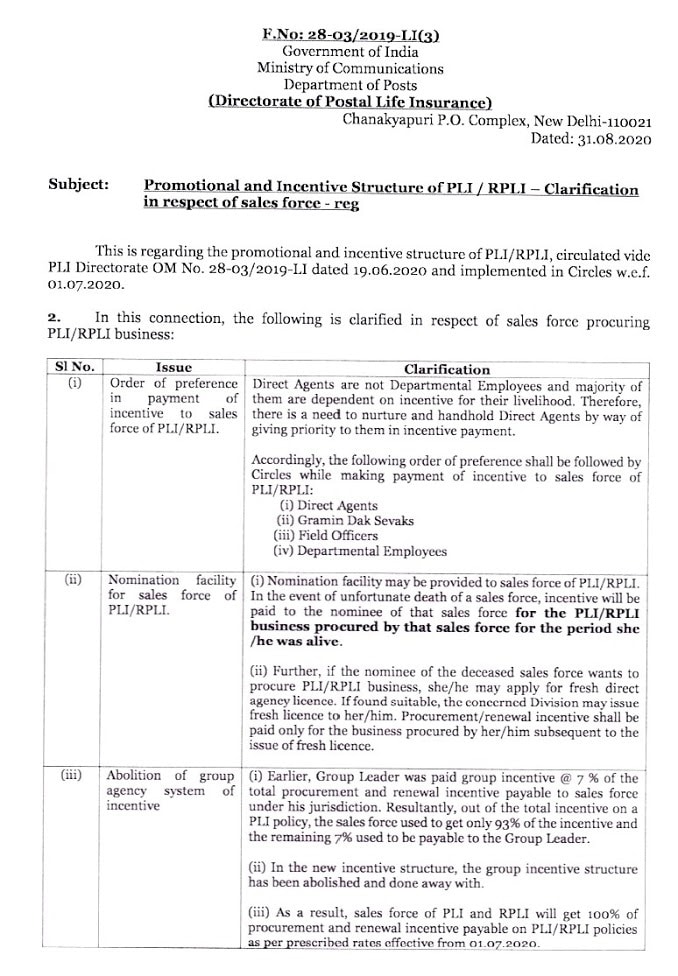
- A new version of DARPAN-PLI App has been deployed in Core Integration System (CIS) with facility of processing various financial and non-financial requests of PLI/RPLI insurants at level of 127115 Branch Post Offices including those in remote and rural areas.
- Department has brought in more transparency in communication with customer by adding more SMSs relating to policy servicing.
- Department has removed 2 revival restrictions during the policy contract. Along with this, provision for revival of policy in instalments has been provisioned in the PLI system.
- Business Performance of PLI and RPLI: As on 30-11-2020, there were a total of 96.79 lakh active PLI and RPLI policies with an aggregate sum assured of Rs. 2.05 lakh crores.
- Investment Functions of PLI / RPLI Fund: The total corpus of PLI / RPLI fund has reached Rs 1.13 lakh crore by 30-11-2020.
- Bima Gram Yojana: From January, 2020 to November, 2020, 17,092 villages brought under the coverage of Bima Gram Yojana (BGY). Each BGY village has at least 100 households covered by one RPLI policy.
Citizen Centric Services:
- Post Office Passport Seva Kendras (PoPSK): With the growing need of its citizens for a passport for various purposes, Ministry of External Affairs and Department of Posts mutually agreed for setting up Post Office Passport Seva Kendras (PoPSKs) in post offices to utilise the post office infrastructure and reach for delivering passport services. 426 PoPSKs have been made operational till date, of which 02 PoPSKs opened in 2020 namely (i) Seoni, Madhya Pradesh and (ii) Port Blair, Andaman & Nicobar Island. 7,27,329 applications have been processed through PoPSKs from January, 2020 to November, 2020.
- Aadhar Enrolment and Updation Centres: The facility has brought convenience to the citizens by way of generating new Aadhaar and updating their Aadhaar cards in case of any change/ mis-match. More than 42,000 Postal Officials/ MTS/ GDS have been trained/ certified to perform Aadhaar operations. The Aadhaar Enrolments are done free of cost. A sum of Rs. 100/- is reimbursed by UIDAI for every successful Aadhaar Enrolment to India Post. Aadhaar Updations are chargeable and a sum of Rs. 50/- is collected from the citizens for every demographic updation and Rs. 100/- is collected from the citizens for every biometric updation.13,352 Post Office Aadhaar Centres have been set up across the country. 99,25,630requests for enrollments / updations have been processed by these Centres from January, 2020 to November, 2020.
- A total no of 3,43,296 Gangajal Bottles have been supplied for the period from January, 2020 to November, 2020.
- Digital Advancement of Rural Post Offices for a New India (DARPAN): Carried out 17.41 crores online Postal and financial transactions involving Rs. 23,251/- crores for a period from January, 2020 to November, 2020 through 1.29 lakh Branch Post Offices in the rural areas of the country. More than 1.5 crores transactions per month are taking place through DARPAN devices.
- PO-CSC (Post Office-Common Service Centres): A convergence of Post Offices and Common Service Centres (Part of CSC e-Governance Services India Limited under Ministry of Electronics & Information Technology) for effective delivery of various citizen centric services is a part of the five-year Vision Document of the Department of Posts. Accordingly,10136 Post Offices are now providing services of Common Service Centres through the Digital Sewa portal of CSC. As on 30.11.2020, 48234 transactions worth Rs. 4.62 Crore were delivered through these Post Offices.
- There are 100+ CSC Services which are offered through these post offices which include Government to Citizen Schemes(G2C) such as Pradhan Manthri Street Vendors’ Athma nirbhar Nidhi Yojana (PMSVANIDHI), Pradhan Manthri Jan Arogya Yojana (Ayushman Bharat), Pradhan ManthriShram Yogi Maan-dhanYojana (PM-SYM), Pradhan Mantri Laghu Vyapari Maan-dhan Yojana (PM-LVM), The Election Card Printing, E-Stamp Service, and Various e-District Services. Some of B2C (Business to Citizens) Services offered includes Bharat Bill Payment System Bills (Electric, Gas, Water bills etc…), Renewal Premium collection for Life Insurance Policies and General Insurance such as Motor Vehicle, Health and Fire Insurance etc, Third party services such as EMI collections for various loans offered by financial institutions and submission of online application forms for loans and Travel services such as Ticket booking service is available for Flight, Train and Bus Tickets.
Opening of new Branch Post Offices (BOs) in 90 identified Left Wing Extremism (LWE) affected districts in the country: In pursuance of the Ministry of Home Affairs (MHA) Note for Cabinet Committee on Security(CCS), a proposal for opening of 4903 new Branch Post Offices (BOs) in 90 identified LWE districts in the country was under taken. In the first Phase, 1789 Branch Post Offices in Panchayats not having post offices opened in LWE districts across the country, of which 16 Branch Post Offices have been opened from January, 2020 to November, 2020.
Public Grievances:
Centralized Public Grievance Redress and Monitoring System (CPGRAMS): Department of Posts processes complaints registered by consumers of postal services in the Centralized Public Grievance Redress and Monitoring System (CPGRAMS). Streamlining of CPGRAMS was done by mapping over 1.55 lakh Post Offices till the level of Branch Post Offices by intuitive navigation of complaints to the line-end offices for faster resolution. This was done in collaboration with Department of Administrative Reforms & Public Grievances (DARPG) and the new version 7.0 was successfully launched in September 2019. Department of Posts is the only Department selected for the pilot study for the revamping by DARPG. The details of the complaints handled in 2020 upto 30.11.2020 are as under:
| S. No. | Year | Complaints received during the period | Complaints settled during the period | % of settlement | Average disposal time (days) |
| 1 | 01.01.2020 to 30.11.2020 | 57604 | 56935 | 98.8% | 16 |
- Social Media Cell: Social media Cell is an independent entity and deals with the Twitter and Facebook accounts of the Department of Posts. The social media cell monitors the complaints sent to all the Circles on daily basis. The average first response time is approximately 4 hours. The details of the complaints handled in 2020 upto 30.11.2020 are as under: –
| S. No. | Year | Complaints received during the period | Complaints settled during the period | % of settlement |
| 1 | 01.01.2020 to 30.11.2020 | 197801 | 195896 | 99% |
- India Post Call Centre (IPCC): ln wake of the initiatives taken up by Prime Minister to bring transparency and accountability in the Government, Department of Posts established 2ndIndia Post Call Centre with 24x7x365 IVRS (Interactive Voice Response System) facility for the citizens in Patna on 01.07.2019. IPCC is working in the four languages namely Hindi, English, Odiya and Bengali for the convenience of the citizens. 36,72,136 calls were received in IPCC from 01.01.2020 to 30.11.2020.
- Implementation of Dynamic Queue Management System (DQMS) in Post Offices: Dynamic Queue Management System (DQMS) has been installed in 57 Head Post Offices in the last one year having six or more than six working counters. Overall DQMS have been installed in 340 Post Offices. The Objectives & scope of DQMS are given below:-
- To reduce waiting time.
- To increase processing capacity.
- To reduce miscommunication among customers.
- To give a comfort level to staff and customers.
- To monitor customer flow.
Initiatives taken by the Department in the COVID-19 situation:
- Postal services were identified as essential services during lockdown. The vast network of post offices had been galvanized to respond to the challenges in coordination with State Governments and local bodies. Control Rooms at India Post HQ and Circle (State) HQs were established to manage, receive and respond for immediate needs.
- Supply Chain: Road Transport Network connecting 56 routes and 75 cities was commenced in April, 2020 utilizing Departmental Mail Vans. The network came handy to delivery essentials, medicines and medical equipment including ventilators, defibrillators, COVID 19 testing kits, masks and PPE kits. Around 36,000 tonnes of material were delivered through postal channels which also include use of Parcel Trains. Supply chain arrangements were also made for farmers to connect their farm produce to markets.
- Financial Inclusion: During lockdown and initial phase of unlocking more than 33.95 crore transactions valuing around Rs. 7.02 lakh crore were made through POSB accounts. Around 78 lakh POSB ATM transactions amounting to Rs. 2389 crore were made.
- Instructions issued during lockdown for the ease of customers:
- Waive off penalty/ revival fee (default fee) in RD/ PPF/ SSA Accounts for the deposits due in FY 2019-20 and April, 2020, till June, 2020.
- Relaxation in guidelines in respect of PPF/ SSA Accounts for a Single Deposit pertaining to FY 2019-20 till June, 2020.
- Extension of the prescribed time limit of one month post retirement for retirees, of Feb 2020 to April 2020, to invest in Senior Citizen Savings Scheme (SCSS) till June, 2020.
- Relaxation in provisions for rebate on RD Advance deposits & default fee for the month of March 2020 to May, 2020 without default/ revival fee, till June, 2020.
- Reduction in TDS rate in POSB Schemes for the period from 14.05.2020 to March, 2021.
- Various relaxation under POSB schemes extended till 30.07.2020 instead of 30.06.2020.
- India Post tied-ups with Indian Drug Manufacturers Association, Director General of Health Services and a number of private firms and online pharmaceutical companies for delivery of medicines from their facilities to hospitals and beneficiaries.
- During COVID period, Rs. 5200 crore disbursed to 2.5 crore beneficiaries through AePS at the doorstep who were not able to access banking facilities.
- 31 crore financial transactions enabled during COVID19 period through Post Office and IPPB accounts.
- Taking initiative in public interest, special features have been added to Post info App for accepting emergent service requests from people. More than 60,000 service requests have been attended by Department of Posts during lockdown.
- Activated Mobile Post Offices across the country to provide basic postal services, food and masks distribution etc.
- Free distribution of around 10 lakhs food and ration packets was made to the needy.
- Launched dedicated Road Transport Network in April, 2020 on 56 long haul routes and connected farm produce of farmers to markets by activating postal supply chain.
- India Post won India Today Health giri Award for providing the best logistic services during COVID19. The selfless service of the employees of India Post did not go unnoticed!
- Special Covers, Post Cards and Special Impressions were issued with messages to create awareness about social distancing and to express gratitude to Corona Warriors.
- A grace period was provided to all the Registered Newspapers from March, 2020 to November, 2020 for printing and posting of their editions as per their convenience.
- Department of Posts has extended the Postal Life Insurance (PLI) / Rural Postal Life Insurance (RPLI) premium payment period due on March, 2020, April, 2020 and May, 2020 upto 30.06.2020 without penalty/default fee due to outbreak of COVID19.Due to outbreak of COVID19, date for revival of lapsed policies, in which premia have not been paid during the last 5 years, was extended in phases.
- CPGRAMS Portal: A separate category for ‘COVID-19’ grievances was created on CPGRAMS to address and monitor grievances of the public with regard to their postal needs in the backdrop of the pandemic. 1235 grievances have been resolved within the prescribed timeline of 3 days since the creation of the category i.e. from 30.03.2020.
- Social Media: Social Media (Twitter handle of India Post) had a mitigating effect in this pandemic by providing immediate relief to the citizens by redressing their concerns in booking and delivering medicines and arranging financial transactions in post offices. 1.54 lakh grievances have been resolved during the period of lockdown.
- Separate category of COVID 19 Grievances provided on the Online portal. IPPC services over 25 Lakh calls during COVID 19 lockdown.
Miscellaneous:
- Human Resource Management: The Department has conducted various training sessions and a total no of 92,824 officers / officials were trained for the period from January, 2020 to November, 2020.
Source: PIB