A complete reference blog for Indian Government Employees

Showing posts with label Employees Provident Fund. Show all posts

Friday, 26 April 2019

EPFO - Finance Ministry has approved 8.65% rate of interest on Employees Provident Fund (EPF) for 2018-19

EPFO - Finance Ministry has approved 8.65% rate of interest on Employees Provident Fund (EPF) for 2018-19

The Finance Ministry has approved 8.65% rate of interest on Employees’ Provident Fund (EPF) for 2018-19 as decided by retirement fund body EPFO, benefitting more than 6 crore formal sector workers.

“The Department of Financial Services (DFS), a wing of Finance Ministry, has given its concurrence to Employees Provident Fund Organisation’s (EPFO) decision to provide 8.65% rate of interest for 2018-19 to its subscribers,” a source privy to the development told PTI.

“The DFS has approved the proposal subject to fulfilment of certain conditions related to efficient management of the retirement fund,” the source said further.

Earlier in February, the EPFO’s apex decision making body Central Board of Trustees headed by labour minister Santosh Gangwar had decided to raise the interest rate on EPF to 8.65% for 2018-19, which was the first increase in the last three years.

The interest rate on EPF was hiked to 8.65% for the last fiscal from 8.55% provided in 2017-18. The EPFO had earlier reduced the interest rate in 2016-17 to 8.65% from 8.8% in 2015-16.

After the Finance Ministry concurrence, the Income Tax Department and the Labour Ministry would notify the rate of interest for 2018-19. Thereafter the EPFO would give directions to its over 120 field offices to credit the rate of interest into subscribers’ account and settle their claims accordingly.
According to the EPFO estimates, there would be a surplus of Rs.151.67 crore after providing 8.65 per cent rate of interest for 2018-19 on EPF. There would have been a deficit of Rs.158 crore on providing 8.7 per cent rate of interest in EPF for last fiscal. That is why the body decided to provide 8.65 per cent rate of interest for 2018-19.

The EPFO had provided a five-year low interest rate of 8.55% to its subscribers for 2017-18.

PTI


Share:

Wednesday, 26 September 2018

Newly Launched Atal Bimit Vyakti Kalyan Yojna to Benefit More Than 3 Crore Insured Persons


Ministry of Labour & Employment
Newly Launched Atal Bimit Vyakti Kalyan Yojna to Benefit More Than 3 Crore Insured Persons
26 SEP 2018

Around 3.2 crore Insured Persons (IPs) will benefit from newly launched scheme of ESIC 'Atal Bimit Vyakti Kalyan Yojna'. The ESI Corporation has approved 'ATAL BIMIT VYAKTI KALYAN YOJNA' for Insured Persons (IP) covered under the Employees’ State Insurance Act, 1948. This scheme is a relief payable in cash directly to the Bank Account in case of unemployment and while they search for new engagement. The cash benefit given to the unemployed persons searching for new employment will be 25 percent of his average earning of 90 days. Shri Gangwar was addressing on the occasion of 7th National Conference on Security and Safety at Workplace and distribution of Safety Systems Excellence Awards in New Delhi today.

Addressing the function, the Minister added that there are around six crores of workers in organized sector who are getting benefits of EPFO, ESIC and Social Security Schemes. The Union Government has taken many steps to enhance their working conditions, safety and social security in order to improve their standard of living. Present government is continuously making efforts to improve life conditions of around 40 crore workers of the unorganized sector also. In last two years nearly one crore workers have been linked with ESIC benefits and more than one crore have been brought in the fold of EPFO. Pradhan Mantri Jeewan Jyoti Beema Yojna and Pradhan Mantri Suraksha Beema Yojna  are totally free for unorganized workers. He further said that nearly 3 crore workers are benefitting from these Social Security Schemes.

The honorarium of 14 Lakh Aanganwadi workers have been increased from Rs. 3,000 per month to Rs. 4,500 per month. Likewise, honorarium of Aanganwadi helpers has also been increased from Rs. 1,500 to Rs. 2,250 per month. The incentive of AASHA workers has also been doubled, he added.

Shri Gangwar further said that the Ministry is making efforts to increase employment opportunities through Pradhan Manrti Rojgar Protsahan Yojana. Twelve per cent of the Employees' Provident Fund (EPF) contribution of new employees is being given by government so that employers may not have to bear this cost. The government has spent Rs. 1,744 crores for this EPF contribution for around 72 Lakh employees of nearly 87,000 organizations in last two years.

The Minister congratulated all the winners of Safety Systems Excellence Awards and expressed hope that all the participants of this conference will gain from the ideas discussed on this forum.

PIB
Share:

Monday, 19 March 2018

EPFO Rate of Interest

EPFO Rate of Interest
The declared rate of interest on Employees Provident Fund (EPF) paid to the subscribers during the last three years is as under:

YearRate of Interest (in per cent.)Date on which Rate of Interest declared
2014-158.7523.01.2015
2015-168.8023.05.2016
2016-178.6524.04.2017
The interest rate on EPF is determined by the Central Government in consultation with the Central Board. The Central Board of Trustees (CBT), Employees Provident Fund (EPF), in its meeting held on 21.02.2018, has recommended 8.55 per cent. rate of interest to EPF subscribers for 2017-18. The proposal has now been sent to the Ministry of Finance for their concurrence to the interest rate of 8.55 per cent to the EPF subscribers for the year 2017-18.

Approximately 19,97,84,374 number of accounts of account holders are likely to be credited with the statutory rate of interest declared for the year 2017-18.

This information was given by the Minister of State for Labour and Employment Shri Santosh Kumar Gangwar in a written reply to a question in Lok Sabha on 19.3.2018.
Share:

Sunday, 2 April 2017

EPF pensioners to get medical benefits: Bandaru Dattatreya


EPF pensioners to get medical benefits: Bandaru Dattatreya

New Delhi: Nearly 58 lakh people Employees Provident Fund pensioners will now get medical benefits, Labour Minister Bandaru Dattatreya said in the Lok Sabha today.

"Regarding the pensioners, we are going to give the pensioners benefit under the ESIC (Employees State Insurance Corporation) to those who are retired pensioners. We will be providing all medical services to the retired pensioners. 58 lakh pensioners will be benefited," he said.

Dattatreya was replying to a debate on a private member's resolution moved by RSP member N K Premachandran on 'Steps To Ensure Welfare of Employees Provident Fund Pensioners'.

A meeting of the EPFO Board yesterday had on its agenda a proposal to provide health insurance scheme to pensioners of the Employees Pension Scheme through Employees State Insurance Corporation (ESIC).

Although the board agreed in principle to approve the proposal but a final call would be taken on this in the next meeting of the CBT.

Earlier, back of the envelop calculations done by ESI had estimated Rs 200 monthly premium per person for providing health cover under its scheme to the EPFO pensioners.

The proposal is aimed at providing health cover to EPFO pensioners, who get very little amount as pension and hence healthcare is out of their reach.

Hukum Narayan Yadav (BJP), while participating in the debate, demanded pension for farmers and agricultural labourers.

Participating in the discussion, Anandrao Adsul (Shiv Sena) said that unclaimed pension fund of around Rs 27,000 crore which has been deposited should be utilised for the people.

Ravindra Kumar Rai (BJP) said that Pandit Deendayal Upadhyay was of view that policies of the country should be according to the country and added the present government under the Chairmanship of Prime Minister Narendra Modi "we are leading the same direction."

Contending that the present government wants to spread the ray of hope for those who are suffering from destitute, Rai said "We are not working for the political intent but with social ethos."

He also suggested that in every district some amount should be kept aside for the needy which should be allocated to them when there is a need.

Pashupati Nath Singh (BJP) said the unclaimed fund of about Rs 27,000 crore lying with EPFO belongs to poor and it should be utilised to provide relief to the poor only.

Poor people due to lack of awareness or information about rules for drawal could not withdraw so it is lying unused with the the EPFO, he said.

Government has taken various steps to make India a pensioned society, he added.

Due to efforts of the government, the shift of PF fund from one organisation to other has become seamless, said Jugal Kishor Sharma (BJP).

PTI
Share:

Tuesday, 15 November 2016

7th Pay Commission - Employees Provident Fund may be raised to Rs 25,000

7th Pay Commission - Employees Provident Fund may be raised to Rs 25,000

7th Pay Commission - Employees Provident Fund


Under the 7th Pay Commission minimum wage ceiling the Employees Provident Fund (EPF) is likely to raise to Rs 25,000 from the existing Rs 15,000.

The proposal drafted by Employees’ Provident Fund Organisation (EPFO) will be sent to the Union Government which is likely to be approved, the report suggests.

The decision has been taken by the members of Sub-committee of the Central Board of Trustees, EPFO - the highest decision-making body - on contract workers held on November 7.

According to reports, the EPFO has proposed a hike in the wage limit of all employees drawing basic salary Rs 25,000 would have to contribute to the provident fund. However, those government employees drawing above that limit will have the option to become a member of the provident fund and can have an option to select or reject if they want to.

The move taken by the EPFO comes in the wake of changes in the wage structure in accordance with the proposal of the 7th Pay Commission. Most of the trade union representatives at the CBT sub-committee meeting noting that the minimum wage of the Central government employees after implementation of the 7th Pay Commission report has been hiked to Rs 18,000, due to which the EPFO’s wage ceiling of Rs 15,000 needs to be altered.

The CBT pointed out that there could be a further increase in minimum wages from Rs 18,000 is likely with the trade unions demanding minimum wage to be increased at least Rs 21,000 to Rs 22,000.

In fact, the Employees’ Deposit Linked Insurance Scheme (EDLI) is directly linked to the minimum wage ceiling. At present, If an employee is earning up to Rs 15,000 he or she can avail of benefits under the Employees Deposit Linked Insurance Scheme (EDLI). The scheme provides life insurance of up to Rs 6 lakhs.

Source: FE
Share:

Sunday, 6 March 2016

Confusion on EPF due to bad phrasing in Budget speech: Union Revenue Secretary Hasmukh Adhia


Confusion on EPF due to bad phrasing in Budget speech: Union Revenue Secretary Hasmukh Adhia

Union Revenue Secretary Hasmukh Adhia today defended the proposal to tax Employee’s Provident Fund withdrawals, saying the intention was only to encourage investment in pension schemes, but the phrasing in the Budget speech caused the confusion.

“The entire thing happened not because of any illogicality in the step but due to the communication gap,” Adhia said at an interaction on Budget at the Ahmedabad Management Association here.

“In the budget we try to concise the speech by minimising the words. If it goes beyond 1 hour and 30 minutes it becomes boring. When we were reducing the number of words and when it came to this paragraph we chopped it off and that is how the problem occurred,” Adhia said.

“If we had paraphrased this paragraph differently then less confusion would have been created.”

The government has in fact continued with the policy of exempting EPF at all three stages (entry, during the scheme and exit), he argued.

“We have not said that we will be taxing remaining 60 per cent (of withdrawn EPF). The first 40 per cent is totally exempt. Regarding remaining 60 per cent the expectation is you should put it in some pension scheme….To encourage people to put their money in pension products we have said if you put the remaining 60 per cent in annuity scheme it will not be taxed….original corpus after your death will go to your heir and that will also be tax exempt,” he said.

“So in a way we have continued exempt, exempt, exempt scheme, but with a time period,” he said.

“We do not wish to get anything out of this, it is not a revenue mobilisation effort,” Adiha said.

“The Finance Minister has already said that he will make the announcement on it in a very short time (in Parliament)”, he noted.

The government could not raise the Income Tax exemption limit as when it was raised the last time from Rs 2 lakh to 2.5 lakh, it lost some 40 lakh tax payers, he said to another question.

PTI
Share:

Friday, 11 December 2015

Employees can withdraw EPF money without employers permission

Now, employees can withdraw EPF money without employers’ permit
Employees can avail the benefit if details such as Aadhaar number and bank account number have been linked to the EPF UAN and their KYC verification has been done by the employer
New Delhi: Employees will no longer need the approval of their employers to withdraw money from their Employees Provident Fund (EPF) corpus.

If details such as Aadhaar unique identity number and bank account number have been linked to the EPF universal account number (UAN) and their know-your-customer (KYC) verification has been done by the employer, then the employees can avail themselves of the benefit of this hassle-free initiative immediately, the Employees Provident Fund Organisation (EPFO) said on Tuesday.

The state-run retirement fund manager also issued an order on Tuesday to all its field offices across India, instructing them to give effect to the order immediately.

In its quest to make EPFO a more subscriber-friendly organization, the retirement fund manager had delinked the employer from the process, central provident fund commissioner K.K. Jalan said.

Currently, employees need the approval of their employers to withdraw their EPF corpus, leading to unwanted delays on occasion.

Many employees have complained to the EPFO that organizations at times use their approval powers as a tool to harass them.

“Employees whose details like Aadhaar number and bank account number have been seeded into their UAN and whose UAN has been activated, may submit claims in Form 19, Form l0C and Form 31 directly to the commissioner without attestation of their employers, in such form and manner as may be specified by the central provident fund commissioner, for fast settlement of claims,” the EPFO order dated 1 December said.
Since October 2014, the government has allowed EPF number portability through UAN.

All active EPF subscribers have been allotted a UAN which needs to be linked to his Aadhaar and bank account numbers.

The employer verifies the details and approves the KYC details through a digital signature.

But in the past one year, not all EPF subscribers have activated their UAN on the EPFO portal, largely due to three key reasons—lack of awareness, pending KYC and lack of digital signature.

Of the over 40 million active subscribers, only 21 million have activated their UAN, as per data available with the labour ministry.

EPFO authorities said the simplified withdrawal process will work as a catalyst to persuade more employers to get their KYC done and activate their UAN.

“As a retirement fund body, we are now focusing on our subscribers. We are turning subscriber-friendly and hope more people can take benefit from it,” said Jalan, adding that as the corpus and the subscriber base grows, EPFO will continue to adopt new practices.

EPFO has a corpus of more than Rs.8 trillion—Rs.6 trillion directly under it and another Rs.2 trillion with exempted trusts and company trusts who manage their own EPF under the direct supervision of the EPFO. The corpus has been growing by 15% every year for the last couple of years.

Sharad Patil, secretary general of Employers Federation of India, said that the move looks “logical”. “If the withdrawal happens through Aadhaar and bank account, it will reduce the settlement period and also cut down the chance of corruption in the EPFO,” Patil said.

Source: Livemint.com
Share:

Wednesday, 10 June 2015

Premature Provident Fund withdrawal – Income tax will be imposed

Premature Provident Fund withdrawal – Income tax will be imposed

Income Tax for Premature Provident Fund withdrawal of more than Rs.30,000

The Government has announced that income tax will be imposed if, at the time of premature withdrawal, the Provident Fund amount is in excess of Rs.30,000.

Finance Minister brought a new provision in his budget that allows for TDS on Provident Fund withdrawal before five years of continuous service. When calculating the period of continuous service of five years, the previous employment can also be included. The intention of this at promoting long-term savings. The amendment will come into force from June 2015.

“Taxes will be imposed if, at the time of closing or transferring the PF account, the amount is in excess of Rs.30,000, and, if the employee has been employed in the current job for less than five years. Tax rebates are applicable. In order to claim tax exemption, the person has to submit a copy of his/her PAN card and Forms 15G and 15H, accompanied by a signed and filled up Form 19.

“Failing to do so will attract maximum taxes of up to 34.61%. If the forms are submitted, only 10% taxes will be deducted. Taxes will not be imposed if an old PF account is being converted to a new PF account. If the employee has served for more than five years, then, at the time of closing his account, no taxes will be imposed.

“The PF amount will also not be taxed if the employee is unwell, if the company has closed down, if the employment contract comes to an end, or if the employee loses employment for reasons that cannot be attributed to him/her.”

Source: CGEN.in
Share:

Thursday, 30 April 2015

Central Government Allows 5% of PF Funds to be Invested in Share Market

Central Government Allows 5% of PF Funds to be Invested in Share Market

The Central Government has allowed investing up to 5% of the Provident Fund capital in the stock market. As a result, Rs.5000 crore is expected to be released for investment this financial year. A circular from the Ministry of Labour has confirmed that 5% of the PF amount has been sanctioned for investing in the stock market.

The money will be invested in stock market based EDFs. Mr. Shankar Agarwal, the Secretary of Departmetn of Labour, said that announcements to this regard were made about two or three days ago. Rs.80,000 Crore was the total amount collected in the EPF in the financial year 2014-15. The amount is expected to cross Rs.1 lakh crore before the end of the current Financial Year. The number of persons qualified for EPF, and the amount raised, have increased after the salary limit was raised from Rs.6500 to Rs.15,000.

Agarwal has said that initially only 1% of the EPF reserve was going to be used for investments. This is going to be raised to 5% before the end of the financial year. The Ministry of Finance has suggested that between 5 to 15% of the funds can be invested in the markets. Agarwal added that since it was the first time, they are going to be very cautious and invest only 1% of the funds.

“The money is the sweat and blood of workers. We don’t want to carelessly invest it in the stock market. Hence, we have planned to invest only 5% of the money in the first stage,” he clarified.

He said that the plans are to invest only in EDFs. He added that no decision has been made about percentage of investment aimed at public sector companies. In the past, EPF, which has about 6 crore members, has been investing only in Central Government bonds.

Source: CG Staff News
Share:

Sunday, 8 March 2015

NPS is more beneficial than EPF

NPS is more beneficial than EPF
 
Is NPS better than EPF?

The NPS is more complicated than EPF, but it may ensure a sufficient retirement kitty

If there’s one investment option that has received generous tax breaks in the Budget, it is the National Pension System (NPS). In a watershed move, the Finance Minister has also announced that employees in the organised sector will now be able to opt out of contributions to the Employees Provident Fund (EPF) and invest in the NPS instead. So, if given this choice, what should you do? Here’s how they compare.
Contributions

EPF contributions are mandatory for employees earning up to ₹15,000 a month in the organized sector. Many employers however insist on EPF contributions for all their employees. The contribution is pegged at 12 per cent of your pay (basic plus dearness allowance). Your statutory EPF contributions are matched by your employer. If you are an employee who usually struggles to save, the EPF is a good option for you as it forces you to save at least 12 per cent of your pay.

Share:

Monday, 2 March 2015

Employees Under the Employees Provident Fund(EPF) to be Provided two Options

Employees Under the Employees Provident Fund(EPF) to be Provided two Options

The Union Finance Minister Shri Arun Jaitley has announced that with respect to Employees Provident Fund (EPF), the employee needs to be provided two options. Firstly, the employee may opt for EPF or the New Pension Scheme (NPS). Secondly, for employees below a certain threshold of monthly income, contribution to EPF should be optional, without affecting or reducing the employer’s contribution. He said, with respect to ESI, the employee should have the option of choosing either ESI or a Health Insurance product, recognized by the Insurance Regulatory Development Authority (IRDA).

The Finance Minister announced that he intends to bring amending legislation in this regard, after stakeholders’ consultation.
Share:

Monday, 16 February 2015

EPFO Pension Scheme: Age Limit May Be Raised

EPFO Pension Scheme: Age Limit May Be Raised

New Delhi: The Employees’ Provident Fund Organisation’s trustees in a meeting on Thursday will consider a proposal to raise the age limit from 58 to 60 years for vesting of pension under the Employees’ Pension Scheme (EPS-95).

At present, a formal sector worker covered under the EPS-95 can make contributions towards the pension scheme till the age of 58 years and can claim pension after that.

The Pension Implementation Committee (PIC) has recommended an increase in the age for vesting pension to 60 years, while suggesting that the actuary should be asked to develop a model to give incentive to those persons who opt for drawing pension at the age of 60 years.

An actuary analyses financial consequences of risk after studying uncertain future events, particularly of concerns to pension and insurance plans.

Raising the age limit would reduce the deficit in pension fund and would increase the pension benefits of members as there would be two additional years of service, as per the agenda listed for the meeting of the Employees’ Provident Fund Organisation’s apex decision making body – Central Board of Trustees (CBT).
According to a report of the valuer on the scheme, increasing the age limit would reduce the shortfall in the pension fund to the extent of Rs 27,067 crore.

The level of deficit is not a matter of concern, though it is recommended that the retirement fund body should look into investment returns more carefully and not increase benefits without consulting the actuary, and do sensitivity analysis more frequently, the valuer has suggested.

As per the the valuer, appointed by EPFO, net liability or deficit is Rs 10,855 crore as of March 31, 2012, Rs 6,712.96 crores as of March 31, 2013 and Rs 7,832.74 crore as of March 31, 2014.

It is also proposed by the committee to increase the short service pension entitlement age from 50 years to 55 years. This measure would reduce the shortfall in pension fund to the extent of Rs 12,028 crore.

At present, members can ask for fixing pension at attaining the age of 50 years provided they have served for at least 10 years.

It is also proposed that the pensionable salary should be determined on the basis of 36 months average wages immediately preceding the date of exit from the scheme in place of existing 60 months.

It may be noted that there is no bar of any kind for contributing towards other social security schemes run by the Employees’ Provident Fund Organisation (EPFO) – Employees’ Provident Fund Scheme 1952 and Employees’ Deposit Linked Insurance Scheme 1976.

Read at: NDTV Profit
Share:

Thursday, 16 October 2014

Dedication of Portability through Universal Account Number (UAN) for Employees Provident Fund

“The minimum pension for employees has been introduced first time so that employees’ pension is not less than Rs. 1000 per month. The wage ceiling has been raised from Rs. 6500 to Rs. 15000 per month to ensure that vulnerable groups are covered under EPF Scheme”.

Under the scheme complete information for approximately 4 crore subscribers of EPF has been centrally compiled and digitized and a UAN has been allotted to all. The UAN is being seeded with Bank account and Aadhar Card and other KYC details for financial inclusion of vulnerable section of society and their unique identification.

Camps are being organized to facilitate opening of bank account and Aadhar card for those subscribers who have no bank account or Aadhar card as on date. This will ensure portability of the Social Security Benefits to the labour of organised sector across the jobs and geographic areas. The EPF account of employee will be now be updated monthly and at the same time he will be informed through sms.

Finally it will ensure that each of the 4 crore or more EPF account holders have direct access to their EPF accounts and will also enable them to consolidate all their previous accounts (approximately Rs 27000 Crore are currently lying with EPFO in inoperative accounts). By 16th October, 2014, approximately 2 crore subscribers will have the benefit of portability through UAN. Subscribers have been informed through sms/email immediately on inauguration.

The minimum pension for employees has been introduced first time so that employees’ pension is not less than Rs. 1000 per month. The wage ceiling has been raised from Rs. 6500 to Rs. 15000 per month to ensure that vulnerable groups are covered under EPF Scheme.

Source: PIB News
#Employees Provident Fund, #Minimum Pension, #Provident Fund, #Indian Government News,  #EPFO
Share:

Sunday, 28 September 2014

Launching of Minimum Pension Scheme (Rs.1000) across 120 locations in India

Labour Minister Shri Tomar announces launch of Minimum Pension Scheme across 120 locations in India

37 Union Ministers to felicitate pensioners on September 30

The Union Minister of Labour & Employment, Steel and Mines, Shri Narendra Singh Tomar announced the launch of a guaranteed minimum pension of Rs 1000 per month under Employees’ Pension Scheme, 1995. Speaking to journalists at a press conference in here today, he said, the Union Government has decided to organize functions in every office of the Employees Provident Fund Organisation spread across 120 locations in the country. It has also been decided that in 37 locations, Union Ministers will preside over the functions and felicitate the pensioners whose pension is getting increased.

Shri Tomar stated that this is being done to interact with the pensioners and to ensure that no eligible person is left out. He expressed confidence that this interaction will help the EPFO to design its pension re-engineering process in a better way. The Secretary, Ministry of Labour and Employment, Smt Gauri Kumar and Central PF Commissioner Shri K.K. Jalan were also present on the occasion.

The Minister said that the long-pending demand for increase in the pension will soon see the light of day. At present, a large number of pensioners are getting only paltry amounts as pension under the scheme. Nearly two-thirds of the pensioners are in receipt of pension of less than 1000 rupees. Thus, this move would benefit approximately 32 lakh out of a total of 49 lakh pensioners who are getting below Rs 1000 as pension, he added.

It is relevant to note that the wage ceiling for coverage under the three schemes of EPFO i.e. Employees Provident Fund Scheme, Employees’ Pension Scheme and Employees’ Deposit Linked Insurance Scheme (EDLI) has also been increased from monthly Rs 6500 to Rs 15000. This increased wage ceiling is expected to bring in an additional 50 lakh employees under the ambit of these social security programmes. The increased wage ceiling will also result into higher benefit under the EDLI from a maximum of Rs.1,30,000 to a maximum of Rs 3,60,000.

In the recent past EPFO has taken a series of measures to bring in greater transparency and efficiency in its functioning. These include the facility for online registration of establishments (OLRE), Online Transfer Claim Portal (OTCP), e-passbook and electronic payment of PF and Pension benefits through NEFT (National Electronic Fund Transfer) and CBS (Core Banking Solution).

PIB
Share:

Featured post

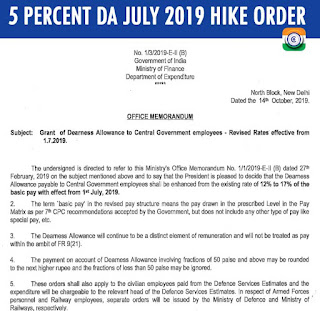
5 Percent DA July 2019 Hike Order - Grant of Dearness Allowance to Central Government employees

Grant of Dearness Allowance to Central Government employees 5 Percent DA July 2019 Hike Order  No. 1/3/2019-E- II (B) Government of...

Blog Archive

About The Author