7th Pay Commission report on DA, CEA, FPA, NPA, OTA and other Allowances
7th Pay Commission report on certain allowances such as Dearness Allowance, Children Education Allowance, Family Planning Allowance, Non-Practising Allowance, Over Time Allowance etc., applicable to Central Government Employees and Defence Personnel
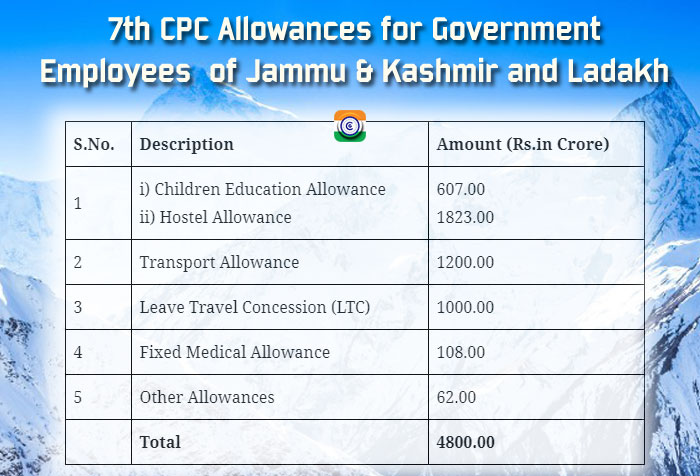
7th Pay Commission has submitted its recommendations to the Central Government on certain allowances which are classified as other allowances
Other Allowances (click the names of allowances below for getting full details of recommendation of 7th Pay Commission)
1. Bhutan Compensatory Allowance -No change
2. Briefcase Allowance – 50% increase and shall increase further by 25% each time DA increases by 50%.
3. Canteen Allowance – Shall increase further by 25% each time DA increases by 50%.
4. Children Education Allowance (CEA) – Increase by 50%
5. Command Allowance – Recommended to be abolished
6. Commercial Allowance – Recommended to be abolished
7. Composite Personal Maintenance Allowance (CPMA) – 50% increase recommended
8. Condiment Allowance – Recommended to be abolished
9. Constant Attendance Allowance – 50% increase recommended
10. Cost of Living Allowance – No change
11. Court Allowance – Recommended for abolition
12. Dearness Allowance– Continuation of existing methodology
13. Desk Allowance – Recommended for abolition
14. Diet Allowance – Recommended for abolition
15. Educational Concession– Recommended for increase and continuous when increase in DA by 50%
16. Electricity Allowance – Recommended for abolition
17. Family Planning Allowance – Existing scheme to continue
18. Fixed Medical Allowance (FMA) – Existing scheme to continue
19. Funeral Allowance – Existing scheme to continue
20. Hair cutting Allowance– Recommended for abolition
21. Hard Area Allowance– should be rationalized by a factor of 0.8 to 20 percent of Basic Pay.
22. Internet Allowance Mobile Phone Allowance, Newspaper Allowance – To be raised by 25 percent and the entire amount should be paid, lump sum, to the eligible employees without the need for production of vouchers.
23. Investigation Allowance – Recommended for abolition
24. Island Special Duty Allowance– Recommended for rationalisation by a factor of 0.8 to 10 percent, 16 percent and 20 percent of Basic Pay respectively.
25. Launch Campaign Allowance and Space Technology Allowance– Recommended for abolition
26. Messing Allowance – Recommended to be increased to Rs.300 per day
27. Night Duty Allowance – Existing scheme to continue with modification in the system.
28. Non-Practicing Allowance (NPA) – Recommended for reduction in NPA to 20% of Basic Pay
29. Nuclear Research Plant Support Allowance – Recommended for 50% hike and further increased by 25% when increase in DA by 50%
30. Nursing Allowance – Existing scheme to continue and further 25% increase each time when DA rises by 50%. Messing allowance is abolished
31. Orderly Allowance – Existing scheme to continue
32. Overtime Allowance – Recommended for abolition except for industrial and operational staff. For others if Government wants to grant OTA for any specific purpose then it has be increased by 50% of the present rates.
33. Parliament Assistant Allowance– Recommended for 50% hike and further increased by 25% when increase in DA by 50%
34. PCO Allowance – Recommended for 6% and 12% for Section Officers and Junior Engineers respectively
35. Ration Money Allowance– Existing Scheme to continue and 7000 ft norm to be lifted in case of CAPF. Abolished for postings at peace areas in respect of officers
36. Soap Toilet Allowance – Recommended for abolition
37. Space Technology Allowance – Recommended for abolition
38. Special Allowance for Child Care for Women with Disabilities– Recommended to double the allowance and further rise by 25% each time DA rises by 50%
39. Special Allowance to Chief Safety Officers/Safety Officers – Recommended to be paid at the rate of 6 percent of Basic Pay.
40. Special Duty Allowance – Recommended to pay 30% and 10% of Basic pay for AIS Officers and Civilian Employees respectively.
41. Special Incident/Investigation/Security Allowance– Recommended for NSG, SPG 40%, IB/CBI/NIA/PDG 20%, CAPF 10% of Basic Pay
42. Special NCRB Pay – Recommended to be stopped
43. Special Scientists’ Pay– Recommended for abolition
44. Specialist Allowance– Recommended for 50% increase and further rise by 25% each time DA rises by 50%
45. Spectacle Allowance – Recommended for abolition
46. Split Duty Allowance– Recommended for 50% increase and further rise by 25% each time DA rises by 50%
47. Study Allowance – Recommended for abolition
48. Subsistence Allowance – Existing scheme to continue
49. Training Stipend – Recommended to Pay Rs.80 p.m
50. Vigilance Allowance – Recommended for abolition
Bhutan Compensatory Allowance
Bhutan Compensatory Allowance is admissible to Defence Forces
personnel posted to IMTRAT (Bhutan) with a depression in the standard
rates promulgated by the Ministry of External Affairs. This was done
because certain service concessions such as mess and canteen facilities
were provided to Defence Forces personnel while in Bhutan. After
September, 2005, the depression in the allowance has been removed but
charges at the rate of 6 percent of the allowance from officers and 4
percent from PBORs are recovered for the free facilities provided. The
existing rates are as follows:
| Grade Pay |
Rs. per month |
| >=10,000 |
1,20,445 |
| 8700 <=GP< 10,000 |
1,15,579 |
| 6600 <=GP< 8700 |
1,10,520 |
| Group `A’ officers with 5400 <=GP< 6600 |
99,065 |
| Group `B’ officers with 4600 <=GP< 6600 |
64,569 |
| Non-Gazetted Staff with 1900 <=GP< 4800 |
55,358 |
| Staff drawing GP< 1900 |
29,255 | |
Demands have been received to the effect that Bhutan postings should
be considered as normal foreign postings and Foreign Allowance as
admissible in other countries be granted.
Analysis and Recommendations
The Commission recognizes this allowance as being singular in nature.
The rates of this allowance are revised periodically–the last revision
being done on 01.04.2013. As such, it is
recommended that status quo should be maintained.
Briefcase Allowance
Certain categories of Central Government employees are entitled to
reimbursement of expenditure incurred on purchase of briefcase/official
bag/ladies’ purse as per the following provisions:
| Pay Band/GP |
Ceiling (Rs.) |
| Apex |
10000 |
| HAG, HAG+ |
8000 |
| GP 10000 |
6500 |
| GP 7600 to GP 8700 |
5000 |
| GP 4800 to GP 6600 |
4000 |
| GP 4200 to GP 4600 |
3500 |
The periodicity of reimbursement is restricted to once in three years. No demands have been received regarding this allowance.
Analysis and Recommendations
The Commission is of the view that the present rates are adequate
However, the ceiling shall further increase by 25 percent each time DA
increases by 50 percent.
Canteen Allowance
This allowance is granted to General Manager and
Manager-cum-Accountant of the Supreme Court Departmental Canteen at the
rates of Rs.350 pm and Rs.300 pm respectively. Canteen allowance is also
granted to certain categories of staff in Central Government ministries
as per the following rates:
( Rs. per month)
| Category of Staff |
Rate of Allowance |
| General Manager |
700 |
| Deputy General Manager |
600 |
| All Managers |
300 |
| All Assistant Manager-cum-Storekeepers |
200 | |
There are demands for a four-fold rise in the allowance.
Analysis and Recommendations
It is
recommended that the rates should be increased by a factor of 1.5. The rates shall further increase by 25 percent each time DA increases by 50 percent.
Children Education Allowance (CEA)
CEA is paid to government employees to take care of schooling and
hostel requirements of their children. The rates of CEA are double for a
differently abled child.
Many demands have been received regarding CEA. It has been requested
that the amount be suitably raised and CEA should be extended for
Graduation/Post Graduation level studies also. The Commission has
received an overwhelming number of requests for simplification of the
procedure for reimbursement.
Analysis and Recommendations
Before VI CPC recommendations, the scheme was known as Children Education Assistance and provided at the following rates:
| Component |
Class I-X
|
Class XI-XII
|
Requirement |
| Reimbursement of Tuition Fee (Rs. pm) |
40 |
50 |
– |
| Reimbursement of Tuition Fee for Disabled and mentally retarded children (Rs. pm) |
100 |
100 |
– |
| Children Education Allowance (Rs. pm) |
100 |
100 |
In case the government employee is compelled to send his child to a school away from the Station of his posting |
| Hostel Subsidy (Rs.pm) |
300 |
300 |
In case the employee is obliged to keep his children in
a hostel away from the Station of his posting and residence on account
of transfer. |
The VI CPC rationalized the structure to the following:
| Component |
Present Rates |
Remarks | |
| CEA |
Rs.1500 pm |
Whenever DA increases by 50% CEA shall increase by 25% |
| Hostel Subsidy |
Rs.4500 pm |
Whenever DA increases by 50% Hostel Subsidy shall increase by 25% |
Effectively a 10-fold rise was given by VI CPC. This has led to high
expectations, and consequently, vast number of demands for increasing
the rates, expansion of scope and simplification for procedure of
reimbursement of this allowance.
The various issues are examined seriatim:
- Has CEA kept pace with time?
Presently CEA goes up by 25 percent each time DA increases by50
percent. Thus, since DA currently stands at 113 percent, CEA has gone up
by 50 percent from its 2008 level. As against this, the movement of the
All India Education Index33 is shown below:
The above chart shows that between 2008 and 2013, the Education Index
has gone up from 134 to 154, i.e., by 14.9 percent, whereas CEA went up
by 25 percent w.e.f. 01.01.2011 (when DA exceeded 50 percent). Thus, it
can be concluded that increase in CEA has kept pace with (and in fact
exceeded) the cost of education.
- What is the adequate level of compensation?
Given the wide range of educational institutions, and the varying fee
structure, the question of adequacy depends upon many factors. On the
one hand we have government institutions like Kendriya Vidyalayas that
charge fees to the tune of Rs.1,000 per month (including Vidyalaya Vikas
Nidhi) and on the other hand there are private institutions where the
monthly fee varies from Rs.5,000 to Rs.25,000 (or even more) per month.
On the whole, the Commission is of the view that quantum of CEA
should be calibrated in such a manner that the main objective is met
without the government entering into the field of subsidizing private
education. Hence, taking into account the various items of expenditure
that are reimbursed as a part of this allowance,
the following is recommended:
| Component |
Recommended rate |
Remarks |
| CEA (Rs. pm) |
1500 x 1.5 = 2250 |
Whenever DA increases by 50%, CEA shall increase by 25% |
| Hostel Subsidy (Rs. pm) |
4500 x 1.5 = 6750 (ceiling) |
Whenever DA increases by 50%, Hostel Subsidy shall increase by 25 |
The allowance will continue to be double for differently abled children.
- What should be the scope of CEA?
Presently CEA is payable up to Class XII. There is a strong demand for
increasing the scope to Graduate and Post Graduate studies. However, due
to the greatly varying nature of studies at the graduate level and
beyond, the extension of scope of the allowance beyond Class XII cannot be accepted.
Source: All India Consumer Price Index (Industrial Workers)
- Simplification of Procedure for Reimbursement. This is a major area
of concern. Many representations have been received by the Commission
wherein employees have stated that due to cumbersome procedures,
reimbursement has been held up for years. Another issue is the kind of
voucher which will be accepted and which kind of voucher will not. The
issue has been examined, and the apprehensions expressed are not without
merit. It is recommended that reimbursement should be done just
once a year, after completion of the financial year (which for most
schools coincides with the Academic year). For CEA, a certificate from
the head of institution where the ward of government employee studies
should be sufficient for this purpose. The certificate should confirm
that the child studied in the school during the previous academic year.
For Hostel Subsidy, a similar certificate from the head of institution
should suffice, with the additional requirement that the certificate
should mention the amount of expenditure incurred by the government
servant towards lodging and boarding in the residential complex. The
amount of expenditure mentioned, or the ceiling as mentioned in the
table above, whichever is lower, shall be paid to the employee.
Command Allowance
This allowance is granted to certain personnel in CAPFs for
shouldering higher responsibilities at the rate of Rs.100 pm. There are
demands to raise this allowance five-fold.
Analysis and Recommendations
Not only is the amount of allowance meagre, there is no valid justification for its continuation. Accordingly, it is
recommended that Command Allowance should be abolished.
Commercial Allowance
Commercial Allowance is granted to Announcers, ECRCs, Commercial
clerks, TCs of Indian Railways for performing certain commercial duties
at the rate of Rs.180 pm. No demands have been received regarding this
allowance.
Analysis and Recommendations
The amount of the allowance is meagre and no valid justification has been provided for its continuation. Hence,
it should be abolished.
Composite Personal Maintenance Allowance (CPMA)
Composite Personal Maintenance Allowance(CPMA)is granted to PBORs of
Defence Forces to take care of their daily needs. The existing rates are
as follows:
( Rs. per month)
| Hair Cutting Allowance |
30 |
| Washing Allowance |
90 |
|
30 |
| Clothing Maintenance Allowance |
30 |
| Rum Allowance |
Peace Areas |
45 |
| Field Areas below 3000 ft |
105 |
| Field Areas 3000 ft–4999 ft |
150 |
| Field Areas 5000 ft–8999 ft |
165 |
| High Altitude Areas |
240 |
There are demands to double the rate of CPMA and for parity among PBORs of all uniformed services.
Analysis and Recommendations
Washing Allowance and Clothing Maintenance Allowance have been subsumed in the Dress Allowance for PBORs.
Other components of CPMA should be increased by 50 percent. The rates of the allowance will further increase by 25 percent each time DA rises by 50 percent.
Entire CPMA will be payable to the PBORs of Defence Forces.
Except Rum Allowance, other components of CPMA will be payable to PBORs
of CAPFs, Indian Coast Guard, RPFand Police forces of Union Territories.
Rum Allowance will be granted to PBORs of CAPFs and Indian Coast Guard
as per the existing guidelines.
Condiment Allowance
Condiment Allowance is paid to those non-gazetted personnel of
Defence forces and CAPFs who dine in the mess, at the rate of Rs.89.78
pm. No demands have been received regarding this allowance.
Analysis and Recommendations
8.17.27 Condiment Allowance is not an allowance in the true sense of
the term, i.e., it is not paid to an individual, but to the Unit for
collective purchase of condiments. As such,
it is proposed to
abolish this allowance, and the expenditure on condiments may be termed
as Condiment expenditure and should be shown as such under the relevant
budget head.
Constant Attendance Allowance
This allowance is sanctioned for 100 percent disablement, if in the
opinion of competent medical authority, the retired employee needs the
services of a Constant Attendant for at least a period of 3 months. This
is subject to acceptance by the pension sanctioning authority and to
the condition that the pensioner actually employs a paid attendant to
look after him. The present rate of this allowance is Rs.4,500 pm. No
demands have been received regarding this allowance.
Analysis and Recommendations
The allowance may be increased by a factor of 1.5, i.e., to Rs.6,750 per month. The allowance shall further increase by 25 percent each time DA rises by 50 percent.
Cost of Living Allowance
This allowance is payable to employees recruited locally by MEA in
foreign countries to compensate for the effect of inflation. No demands
have been received regarding this allowance.
Analysis and Recommendations
This allowance is administered by MEA taking local factors into consideration. Hence,
status quo is recommended.
Court Allowance
Court Allowance is granted to Legal Officers in National
Investigation Agency (NIA) to meet the miscellaneous expenditure
incurred in court. The present rates are Rs.1,500 pm to Public
Prosecutor and Sr.Public Prosecutor, and Rs.2,000 pm to Dy.Legal
Advisor. No demands have been received regarding this allowance.
Analysis and Recommendations
The Commission does not find the allowance justified. Hence, it is
recommended that it should be abolished.
Dearness Allowance
The Dearness Allowance (DA) is paid to Central Government employees
to adjust the cost of living and to protect their Basic Pay from erosion
in the real value on account of inflation. Presently, DA is based on
the All India Consumer Price Index (Industrial Workers).
The JCM-Staff Side has suggested that the existing formula for the calculation of DA may continue.
Analysis and Recommendations
The VICPC had recommended that the National Statistical Commission
may be asked to explore the possibility of a specific survey covering
government employees exclusively, so as to construct a consumption
basked representative of government employees and formulate a separate
index. This has, however, not been done.
Keeping in mind that the present formulation of DA has worked well
over the years, and there are no demands for its alteration, the
Commission recommends continuance of the existing formula and methodology for calculating the Dearness Allowance.
Desk Allowance
Desk Allowance is granted to Desk Officers in CSS and other HQ
services at a rate of Rs.900 pm. No demands have been received regarding
this allowance.
Analysis and Recommendations
This allowance is virtually non-existent since 2010 and there are
very few instances of its payment now. Besides no valid justification
has been provided in support of this allowance. Thus, it is
recommended that Desk Allowance should be abolished.
Diet Allowance
Diet Allowance is granted to deputationists in Bureau of Immigration
as compensation for food, at a rate of Rs.200 pm. No demands have been
received regarding this allowance.
Analysis and Recommendations
The amount of the allowance is meagre and no valid justification has been provided for its continuation. Hence, it is
recommended that the allowance should be abolished.
Educational Concession
Educational Concession is provided to children of Defence personnel
who are missing/ disabled/killed in action. The allowance entails full
reimbursement towards tuition and hostel fees and, in addition,
compensation towards cost of books/stationery, uniform and clothing. The
present rates are as under:
| Tution Fees |
Full Reimbursement |
| Hostel Charges |
Full Reimbursement |
| Cost of books/stationery |
Rs.1000 pa |
| Cost of Uniform |
Rs.1700 pa (First year) |
| Rs.700 pa (Subsequent year) |
| Clothing |
Rs.500 pa (First year) |
| Rs.300 pa (Subsequent year) |
There are demands to increase the amount of concession four-fold and
to extend it to similarly placed personnel of CAPFs and Indian Coast
Guard.
Analysis and Recommendations
The Commission finds merit in the argument that children of similarly
placed personnel in other uniformed forces should not be denied
education opportunities. Accordingly,
it is recommended that the
allowance should be extended to similarly placed personnel of CAPFs,
Indian Coast Guard, RPF and police forces of Union Territories mutatis
mutandis. Since this allowance is not DA indexed, the following rates
are recommended:
| Tuition Fees |
Full Reimbursement |
| Hostel Charges |
Full Reimbursement |
| Cost of books/stationery |
Rs.2000 pa |
| Cost of Uniform |
Rs.2000 pa |
| Clothing |
Rs.700 pa |
The combined amount of Tuition Fees and Hostel Charges shall not exceed Rs.10,000 pm. The allowance shall go up by 25 percent each time DA rises by 50 percent.
Electricity Allowance
Personnel belonging to the Defence Forces are permitted reimbursement
of electricity charges for the first 100 units of electricity. No
demands have been received regarding this allowance.
Analysis and Recommendations
This allowance is petty in nature and with the increase in pay proposed, there is no justification for its continuation. Hence,
it should be abolished.
Family Planning Allowance
Family Planning Allowance (FPA) is granted to Central Government
employees as an encouragement to adhere to small family norms. The
existing rates are as under:
( Rs. per month)
| Grade Pay |
Family Planning Allowance
|
1300-2400
|
210
|
2800
|
250
|
4200
|
400
|
4600
|
450
|
4800
|
500
|
5400
|
550
|
6600
|
650
|
7600
|
750
|
8700
|
800
|
8900
|
900
|
Grade Pay
|
Family Planning Allowance
|
>10,000
|
1000
|
There are demands to make it equal to one increment. Representations
have also been received requesting that the allowance should be double
for those employees who adopt family planning norms after just one
child.
Analysis and Recommendations
The Commission recognizes the fact that most of the benefits related
to children, viz., Children Education Allowance, Maternity Leave, LTC,
etc., are available for two children only. Moreover the level of
awareness regarding appropriate family size has also gone up among the
government servants. Hence, a separate allowance aimed towards
population control is not required now. Accordingly, it is
recommended that Family Planning Allowance should be abolished.
Fixed Medical Allowance
It is granted to pensioners for meeting expenditure on day to day
medical expenses that do not require hospitalization, presently payable
at the rate of Rs.500 pm. Demands have been received to increase the
rate of this allowance to Rs.2,000 pm.
Analysis and Recommendations
The Commission notes that this allowance was enhanced from Rs.300 pm to Rs.500 pm from 19.11.2014. As such,
further enhancement of this allowance is not recommended. Detailed recommendations regarding health care of pensioners have been made in Chapter 9.5 of the Report.
Funeral Allowance
When death of an employee occurs in peace areas, a funeral allowance
of Rs.6,000 is granted and mortuary charges are reimbursed to Defence
personnel. Demands have been received to extend that allowance to all
civilian employees and for a four-fold increase in rates.
Analysis and Recommendations
The Commission is of the view that with the pay raises provided by
successive Pay Commissions, this kind of an allowance has lost its
meaning. Hence, it is
recommended to be abolished.
Hair cutting Allowance
This allowance is granted to PBORs of CISF to compensate for the cost
of hair cutting, at the rate of Rs.5 pm. No demands have been received
regarding this allowance.
Analysis and Recommendations
The Commission took note of the fact that the amount of this
allowance is the lowest among all allowances. This allowance has been
subsumed in Composite Personal Maintenance Allowance and, therefore,
should be abolished as a separate allowance.
Hard Area Allowance
Hard Area Allowance, at the rate of 25 percent of Basic Pay, is
granted to Central Government employees on their posting to the Nicobar
and Lakshadweep groups of Islands. This is paid in addition to ISDA.
There are demands to increase the rate of this allowance.
Analysis and Recommendations
In line with our recommendations on percentage based allowances,
Hard Area Allowance should be rationalized by a factor of 0.8 to 20 percent of Basic Pay.
Internet Allowance, Mobile Phone Allowance, Newspaper Allowance
These allowance are administered differently in ministries as per
their requirements. Some ministries provide Mobile Phones and Internet
connections to their employees, while others compensate their employees
for these services in monetary terms, ranging from Rs.200 pm to Rs.3,000
pm. There are demands to raise these allowances.
Analysis and Recommendations
There is no doubt that these allowances are required in the present
times. However, they should lead to efficiency in administration also.
As such, it is suggested that all ministries should have a comprehensive
database of their employees, including their mobile numbers and email
addresses. This database should be available on the website of the
concerned ministry.
The ministries should continue dealing with these allowances
on their own, subject to the ceilings notified by the Ministry of
Finance from time to time. The present ceilings should, however, be
raised by 25 percent and the entire amount should be paid, lump sum, to
the eligible employees without the need for production of vouchers.
Investigation Allowance
Investigation Allowance is granted in Serious Fraud Investigation
Office, Ministry of Corporate Affairs, to attract talent pool from other
ministries. The existing rates are as under:
( Rs. per month)
| Grade Pay |
Rate
|
8700
|
2000
|
6600
|
1400
|
5400
|
1400
|
4800
|
1400
|
Analysis and Recommendations
There is no justification for continuation of this allowance. Accordingly, it is
recommended that the allowance should be abolished.
Island Special Duty Allowance (ISDA)
ISDA is granted to Central Government employees on their posting to
the Andaman and Nicobar Islands and Lakshadweep. The existing structure
of this allowance is as under:
| Areas around capital towns (Port Blair in A&N islands, Kavaratti and Agatti in Lakshadweep) |
12.5% of Basic Pay |
| Difficult Areas (North and Middle Adaman, South Andaman
excluding Port Blair, entire Lakshadweep except Kavaratii, Agatti and
Minicoy) |
20% of Basic Pay |
| More Difficult Areas (Little Andaman, Nicobar group of Islands, Narcondum Islands, East Islands and Minicoy) |
25% of Basic Pay |
There are demands to increase the rate of ISDA.
Analysis and Recommendations
In line with our recommendations on percentage based allowances,
ISDA should be rationalized by a factor of 0.8 to 10 percent, 16 percent and 20 percent of Basic Pay respectively.
Launch Campaign Allowance and Space Technology Allowance
Space Technology Allowance is granted to supporting scientific and
technical staff in DOS/ISRO in recognition of the need for their
retention and keeping in view the fact that they play a crucial role in
the success of every mission. Considering that all missions/projects of
ISRO are implemented in campaign mode and all categories of employees
have to work with extra vigour, it was decided to give a lumpsum Launch
Campaign Allowance to all administrative staff working in DOS/ISRO to
appreciate and recognize their contribution to ISRO. Both the allowances
are paid at the identical rate of Rs.7,500 per annum. No demands have
been received regarding this allowance.
Analysis and Recommendations
The allowances are in the nature of an appreciation allowance. Since
PRIS has already been implemented in ISRO, there is no justification for
the continuation of these allowances. Hence it is
recommended that both these allowances should be abolished.
Messing Allowance
This allowance is paid to “floating staff” under Fishery Survey of
India, in lieu of free food on board floating vessels, at a rate of
Rs.200 per day. Demands have been received to increase the amount of
allowance to 15 percent of Basic Pay.
Analysis and Recommendations
It is
recommended that the allowance should be increased to Rs.300 per day. The amount will further rise by 25 percent each time DA increases by 50 percent.
Night Duty Allowance
Night Duty Allowance (NDA) is granted to certain specified categories
of employees for performance of duty between 22:00 hrs and 06:00 hrs.
Presently, each hour of night work earns extra ten minutes of day work.
There are demands to grant Night Duty Allowance between 18:00 hrs and
06:00 hrs and for doubling of rates by equating each hour of night work
to extra twenty minutes of day work.
Analysis and Recommendations
This allowance was dealt extensively by Mia Bhoy tribunal in 1969 and
the present dispensation is based on the recommendation of the said
tribunal.
Presently, the allowance is administered as per DoPT’s OM
No.12012/4/86-Estt. (Allowances) of 04.10.1989, wherein every 6 hours of
night work earns 1 weighted hour of day work, or each hour of night
work earns extra 10 minutes of day work.
The Commission examined the various arguments given for the grant of Night Duty Allowance:
- Night Work Convention, 1990 of International Labour Organization, states in Article 8: “Compensation for night workers in the form of working time, pay or similar benefits shall recognise the nature of night work.”
- There are studies to prove the deleterious effects on health of prolonged periods of continuous night duty.
- Sleep is more likely to be interrupted during day time compared to night time.
- Transportation and Entertainment are generally planned keeping day time in mind.
This Commission is, therefore, convinced that the need for compensating night work is widely recognized and should be continued.
However, the practice of arriving at the rates of NDA needs to be
uniform. It is seen that in the Railways the rate of NDA has been
broad-banded and all employees at each level of Grade Pay are given the
same rate of NDA. For achieving this broad-banding, the average of
Minimum and Maximum of the entire Pay Band has been taken to arrive at
the average pay. This appears to be incorrect because running Pay Bands
were intentionally kept wide by the VI CPC to avoid stagnation. Hence to
use the extremities of the Pay Band for arrival at the average rate of
NDA is not appropriate. Moreover, with the computerization of pay rolls,
the amount of Night Duty Allowance can be easily calculated for each
employee.
Taking the above into account,
the following set of recommendations is made with regard to NDA:
- The present formulation of weightage of 10 minutes for every
hour of duty performed between the hours of 22:00 and 06:00 may be
continued;
- The present prescribed hourly rate of NDA equal to (BP+DA)/200 may be continued;
- This amount of NDA should, however, be worked out separately
for each employee. With the computerization of pay rolls, working out
the amount of NDA automatically for each employee every month will not
entail any difficulty. The existing formulation forgiving same rate of
NDA for all employees with a particular GP should be abolished.
- This formulation will extend to all employees across all
ministries/departments who were already in receipt of Night Duty
Allowance.
- A certificate should be given by the supervisor concerned that Night Duty is essential.
Non Practicing Allowance (NPA)
Non Practicing Allowance (NPA), at the rate of 25 percent of Basic
Pay, is paid to medical doctors occupying posts for which minimum
qualification of a medical degree is prescribed. There are demands to
raise this allowance to 40 percent of Basic Pay.
Analysis and Recommendations
The VI CPC had included a detailed rationale for the grant of NPA in
its recommendations. Most of the reasons are still valid and there is no
need to reiterate them here. However, in line with our general approach
of rationalizing the percentage based allowances by a factor of 0.8, we
recommend that NPA should be paid at the rate of 20 percent of Basic
Pay, subject to the condition that Basic Pay + NPA should not exceed the
average of Apex Level and the level of Cabinet Secretary.
Nuclear Research Plant Support Allowance
It is a composite allowance granted exclusively to staff at Research
Unitsin the Bhabha Atomic Research Centre, to compensate for a variety
of factors like round-the-clock shifts, overtime, risk of radiation,
etc. The present rates are as under:
| Pay in the Pay Band |
Rate |
| Up to Rs.5580 |
Rs.480 pm |
| Rs.5581-Rs.16740 |
Rs.660 pm |
There are demands to increase the allowance four-fold.
Analysis and Recommendations
The Commission is of the view that the allowance needs to be
continued. Moreover, since the allowance is already partially indexed to
DA, it is
recommended that the rates of the allowance should be increased by a factor of 1.5 to the following:
| Level of the employee |
Recommended Rate |
| 1-2 |
Rs.720 pm |
| 3 to 5 |
Rs.990 pm |
The rate shall further increase by 25 percent each time DA increases by 50 percent.
Nursing Allowance
Nursing Allowance is the composite term used for four allowances
granted to nursing personnel: Nursing Allowance, Uniform Allowance,
Washing Allowance, and Messing Allowance, presently granted at the
following rates:
( Rs. per month)
| Nursing Allowance |
4800 |
| Uniform Allowance |
750 |
| Washing Allowance |
450 |
| Messing Allowance |
75 |
There are demands to increase the rate to three times its present value.
Analysis and Recommendations
The Commission is of the view that Nursing Allowance is already at an appropriate level. Hence,
no change in the rate of Nursing Allowance is recommended. However, the rate of Nursing Allowance will go up by 25 percent each time DA rises by 50 percent.
Uniform Allowance and Washing Allowance have been subsumed in the
newly recommended Dress Allowance for Nurses and will not be payable
separately.
Messing Allowance is petty in nature. It is recommended that it should be abolished.
Orderly Allowance
Orderly Allowance is paid to Judicial Officers on deputation to
Supreme Court Registry at the same rate that the Judicial Officer was
getting in the parent office. No demands have been received regarding
this allowance.
Analysis and Recommendations
It is
recommended that status quo may be maintained.
Overtime Allowance (OTA)
Overtime Allowance(OTA) is granted to government employees for
performing duties beyond the designated working hours. Presently, OTA is
paid in several ministries/ departments, up to a certain level, at
varying rates.
JCM-Staff Side has demanded that OTA should be paid to all government
employees who are asked to work beyond office hours, on the basis of
actual Pay, DA and Transport Allowance.
Analysis and Recommendations
Out of the total expenditure on OTA in Government of India in
2012-2013, over 90 percent is on account of just two ministries: MoR –
Ministry of Railways and MoD – Ministry of Defence (Civilian employees).
The Commission compared the OTA expenditure in these two ministries
over the period 2006-07 to 2012-13.
In both the ministries, the amount of OTA is showing a rising trend.
The absolute numbers and amounts are as given below:
OTA and Pay (including DA) in MoR and MoD (Civilian Employees)
( Crore of Rs.)
|
2006-07 |
2012-13 |
CAGR of OTA
|
CAGR of Pay
|
| OT A |
P ay |
(A)/(B) |
OT A |
P ay |
(X)/(Y) |
| (A) |
(B) |
(X) |
(Y) |
| MoR |
304.88 |
14563.01 |
2.09% |
791.65 |
30713.98 |
2.58% |
17.24% |
13.24% |
| MoD |
398.15 |
5035.94 |
7.91% |
732.73 |
11211.9 |
6.54% |
10.70% |
14.27% |
There are two noteworthy points here:
a. While OTA as a percentage of Pay is declining in MoD (6.54% in
2012-13 compared to 7.91% in 2006-07), it is on the rise in MoR (2.58%
in 2012-13 compared to 2.09% in 2006-07). (
Source: Brochure on Pay and Allowances published by Pay Research Unit, DoE, Ministry of Finance.)
b. The Compound Annual Growth Rate (CAGR) of OTA (17.24%) in MoR
exceeds even the CAGR of Pay (13.24%), or in other words, OTA is rising
faster than pay.
This clearly shows that while MoD has achieved some success in its
efforts to control OTA, the efforts of MoR have not yielded the desired
results. However, at the same time, it should also be kept in mind that
OTA as a percentage of pay is already much higher in MoD compared to
MoR.
The Commission also took note of the recommendations of the III, IV, V
and VI CPCs that OTA should be abolished except where it is a statutory
requirement. However, it is also a fact that despite these
recommendations, OTA continues to be paid to certain categories of staff
(at rates that are quite old) even when it is not a statutory
requirement.
Hence, while this Commission shares the sentiments of its
predecessors that government offices need to increase productivity and
efficiency,
and recommends that OTA should be abolished (except
for operational staff and industrial employees who are governed by
statutory provisions), at the same time it is also recommended that in
case the government decides to continue with OTA for those categories of
staff for which it is not a statutory requirement, then the rates of
OTA for such staff should be increased by 50 percent from their current
levels.
A stricter control on OTA expenditure is also suggested.
Parliament Assistance Allowance
This allowance is granted in ministries to Assistants and UDCs who
are wholly engaged in Parliament work during Parliament Sessions. The
present rate of the allowance is Rs.1,500 pm for Assistants and Rs.1,200
pm for UDCs. The allowance is admissible at full rates for every
calendar month in which the Parliament is in session for at least 15
days in that month. For months with shorter periods, the allowance is
admissible at half the rates prescribed for the full month. No demands
have been received regarding this allowance.
Analysis and Recommendations
The rate should be increased by a factor of 1.5. The rate shall further increase by 25 percent each time DA increases by 50 percent.
PCO Allowance
This allowance is granted to select staff of Production Control
Organization (PCO) in Workshops and PUs of Indian Railways to compensate
them for the loss in Incentive Bonus. The present rate is 7.5 percent
of Basic Pay for eligible staff in GP 4600 and 15 percent of Basic Pay
for eligible staff up to GP 4200. No demands have been received
regarding this allowance.
Analysis and Recommendations
In line with our general approach of rationalizing the percentage based allowances by a factor of 0.8, the
following rates of PCO allowance are recommended:
| Section Engineers and Sr. Section Engineers in level 7 |
6% of Basic Pay |
| Non-supervisory staff and Jr. Engineers up to level 6 |
12% of Basic Pay |
Ration Money Allowance (RMA)
Ration Money Allowance (RMA) is paid to all personnel of Defence
forces and non-gazetted personnel of CAPFs, Delhi Police, IB, A&N
police and such personnel of Indian Reserve Battalions (IRBn) as are
posted in Andaman and Nicobar Islands and don’t dine in the mess. The
existing rate of this allowance is Rs.95.52 per day for Non-Gazetted
personnel and Rs.79.93 per day for Gazetted personnel.
There are demands to extend RMA to gazetted officers of CAPFs in line
with Defence forces. Demands have also been received from some CAPFs
that RMA should be exempted from the purview of income tax
.
Analysis and Recommendations
Ration Money Allowance is revised periodically by Ministry of Defence
and Ministry of Home for their personnel. Hence, it is proposed that
status quo be maintained regarding the rates of this allowance.
However, regarding the admissibility of RMA,
PBORs of CAPFs
and Indian Coast Guard should be eligible to draw RMA irrespective of
the place of posting (except when in receipt of the Detachment
Allowance). Presently, officers of SSB who are posted in field areas at altitudes of less than 7000 feet are not eligible for RMA.
This restriction of 7000 feet should be removed.
Regarding income tax exemption of RMA, the Commission, as part of its
general approach, has refrained from making recommendations involving
income tax. However, looking into the unique service conditions of
CAPFs, the Commission is of the view that since RMA is granted in lieu
of free rations, it should be exempt from income tax.
It is further
recommended that the provision of free rations
and the grant of Ration Money Allowance to officers of Defence forces
posted in peace areas should be withdrawn.
This allowance is granted to Group `B’ and `C’ combatised personnel
of Assam Rifles at the rate of Rs.90 pm. No demands have been received
regarding this allowance.
Analysis and Recommendations
The allowance is subsumed in Composite Personal Maintenance Allowance. Hence, it is
recommended that this allowance should be abolished.
Special Allowance for Child Care for Women with Disabilities
As the name indicates, this allowance is granted to differently abled
female employees for taking care of their newborn child. The present
rate of this allowance is Rs.1,500 pm.
Analysis and Recommendations
The Commission recognizes the huge responsibility that these women
shoulder while raising their children. Therefore, instead of the factor
of 1.5 that we have mostly used for semi-DA indexed allowances, it is
recommended that this allowance be raised by a factor of 2 to Rs.3,000 pm. The allowance shall further rise by 25 percent each time DA rises by 50 percent.
Special Allowance to Chief Safety Officers/Safety Officers
This allowance is granted to Senior Supervisors of workshop cadre
(whether working in workshop or PCO) in Indian Railways, when they are
deputed as Chief Safety Officers/Safety Officers. The existing rate is
7.5 percent of Basic Pay. No demands have been received regarding this
allowance.
Analysis and Recommendations
In line with our general approach of rationalizing the percentage based allowances by a factor of 0.8, it is
recommended that this allowance should, henceforth, be paid at the rate of 6 percent of Basic Pay.
Special Duty Allowance (SDA)
Special Duty Allowance (SDA) is granted to attract civilian employees
to seek posting in North Eastern and Ladakh regions, in view of the
risk and hardship prevailing in these areas. Currently, the rate of SDA
is 37.5 percent of Basic Pay for AIS officers and 12.5 percent of Basic
Pay for other employees.
There is a vociferous demand from employees (other than AIS officers) posted in these areas for parity with AIS officers.
Analysis and Recommendations
The Commission is of the view that AIS officers are allotted cadres,
irrespective of their choice, and they are required to work in these
cadres for considerable periods of time. As such, a higher rate of SDA
for them is justified.
Accordingly, in line with our general approach of rationalizing the percentage based allowances by a factor of 0.8,
SDA
for AIS officers should be paid at the rate of 30 percent of Basic Pay
and for other civilian employees at the rate of 10 percent of Basic Pay.
Special Incident/Investigation/Security Allowance
This allowance is provided to personnel of special security forces,
both as compensation for risk and hardship as well as an incentive to
attract talent. The present structure of these allowances is as under:
| Granted to personnel of |
Present Rate |
| SPG (Operational Staff) |
50% of (BP+DA) |
| SPG (Non-Operational Staff) |
25% of (BP+DA) |
| NSG |
25% of (BP+DA) |
| NIA (Executive Staff) |
25% of (BP+DA) |
| NIA (Non-Executive Staff) |
15% of (BP+DA) |
| CBI (Officers up to the level of SP) |
25% of BP |
| CBI (Officers of the rank DIG and above) |
15% of BP |
| CBI (Non-Executive Cadres) |
15% of BP |
| IB |
15% of BP |
| RAF of CRPF |
10% of BP |
There are demands to rationalize the entire structure of this
allowance. A proposal for extending this allowance at the rate of 25
percent of Basic+DA to personnel of Parliament Duty Group has also been
forwarded to the Commission by the Ministry of Home Affairs.
Analysis and Recommendations
The Commission notes that these allowances were started at different
points in time. There are varying rates that need to be rationalized.
After due discussions with various stakeholders,
the following structure of Special Security Allowances is recommended:
| Granted to Personnel of |
Recommended Rate |
| NSG |
40% of Basic Pay |
| SPG (Operational Staff) |
| SPG (Non-Operational Staff) |
20% of Basic Pay |
| IB |
| CBI |
| NIA |
| Parliament Duty Group (PDG) |
| RAF (CRPF) |
10% of Basic Pay |
The rationalized structure will be applicable only to those employees
who were already in receipt of the allowance, except in case of PDG
employees.
No new categories of staff in other organizations may
be made eligible for the grant of this allowance based on these
recommendations. No Deputation (Duty) Allowance will be applicable along
with this allowance.
Special NCRB Pay
Special NCRB Pay is granted to Assistant Director in C&S division
and Deputy Superintendent (Finger Print) in Central Finger Print Bureau
of National Crime Records Bureau, on the premise that the feeder posts
of both the above mentioned posts lie in the same GP which is an
anomaly. A proposal to upgrade the post of Assistant Director to GP 7600
and that of Deputy Superintendent (Finger Print) to GP 5400 (PB-3) has
been sent to VII CPC. Until then, the Bureau has itself taken steps to
sort out this “pay anomaly” by providing this allowance of Rs.800 pm.
Analysis and Recommendations
The merger of certain V CPC pay scales by the VI CPC, led to similar
situations in many cadres in which some posts and their feeder posts
came to be in the same GP. The resolution to this has not been in the
form of any such allowance. In fact, in many such cases there has been
no resolution, as we have seen in the memoranda received. In this
context, the presumption by NCRB that this constitutes an “anomaly,” to
be “rectified” through an allowance is incorrect. Hence it is
recommended that this pay should be immediately stopped.
Special Scientists’ Pay
Special Scientists’ Pay, at a rate of Rs.4,000 pm, is granted to
Scientists/Engineers H with GP 10000 because it was felt that the pay
scale accorded to them by the V CPC was not commensurate with their
status and was adversely affecting their morale. No demands have been
received regarding this pay.
Analysis and Recommendations
Since the V CPC recommendations, much time has passed and the pay
scales of all employees have been revised upwards. There is no rationale
for the continuation of this allowance. Hence, it is
recommended that this allowance be abolished.
Specialist Allowance
This allowance is paid to specialist medical officers in Defence
Services when posted to fill vacancies of specialists in the medical
establishment. The present rates are as under:
| Graded Specialist |
Rs.2400 pm |
| Classified Specialist |
Rs.3000 pm |
| Consultant/Advisor/Professor |
Rs.3600 pm |
There are demands to raise the amount of this allowance four-fold.
Analysis and Recommendations
The rate of the allowance should be increased by a factor of 1.5. The rate shall further increase by 25 percent each time DA increases by 50 percent.
Spectacle Allowance
Spectacles are issued free to those Defence Forces personnel in whose
case impairment of vision is either attributable to service or their
sight is so defective that it interferes with their efficiency. When
spectacles are not issued, reimbursement is permitted in the form of
Spectacle Allowance, at the following rates:
| For spectacles with normal lenses |
Rs.130 |
| For spectacles with bifocal lenses |
Rs.250 |
There are demands that the Spectacle Allowance should be abolished
and adequately compensated in Composite Personal Maintenance Allowance.
Analysis and Recommendations
The amount of this allowance is meagre. Hence, it is
recommended that this allowance should be abolished.
Split Duty Allowance
This allowance is payable to Sweepers and Farashes in the Central
Secretariat/allied offices performing split duties where the break in
between the shift is at least two hours and who have not been provided
residential accommodation within 1 Km. of the office premises. The
existing rate is Rs.300 pm. There are demands to raise this allowance to
Rs.2,000 pm
.
Analysis and Recommendations
It is
recommended that the allowance should be increased by a
factor of 1.5 to Rs.450 pm. The rate will further rise by 25 percent
each time DA rises by 50 percent.
Study Allowance
Study Allowance, ranging from 1 to 2.75 Pound (Sterling) per day, is
granted to a government servant who has been granted study leave for
studies outside India, for the period spent in prosecuting a definite
course of study at a recognized institution or in any definite tour of
inspection of any special class of work as well as for the period
covered by the examination at the end of the course of study. This
allowance has been referred by the government to VII CPC for
consideration.
Analysis and Recommendations
The rate of this allowance is meagre and not revised since 1972. Accordingly, it is
recommended that the allowance should be abolished.
Subsistence Allowance
Subsistence Allowance is payable to an employee under suspension or
deemed to have been placed under suspension. No demands have been
received regarding this allowance.
Analysis and Recommendations
Payment of Subsistence Allowance is as per CCS (CCA) rules.
Status Quo is recommended.
Training Stipend
Non Gazetted Officers of Delhi Police, while undergoing training, are entitled for Training Stipend at the rate of Rs.80 pm.
Analysis and Recommendations
The stipend is meagre. Hence, it is
recommended that Training Stipend should be done away with.
Vigilance Allowance
A Vigilance Allowance of Rs.2,500 pm is granted to Vigilance
Inspectors in Indian Railways to attract experienced and talented staff.
Analysis and Recommendations
The Commission took note of two aspects regarding this allowance:
a. This allowance is paid only in Railways while there are posts of Vigilance Inspectors under other ministries as well.
b. No supporting evidence has been submitted by the Ministry of
Railways to show that i. Employees were unwilling to join the vigilance
organization before the
commencement of this allowance, and
ii. The position has improved after this allowance was introduced.
In such a situation, the
Commission recommends abolishing this allowance.
========================
Disability in service, Special benefit on death,benefit in disability in service,central government employee news,family pension,Railway news
Special benefit in cases of death and disability in service – Revision of Disability Pension/Family pension
Railway Board announcement of Revision of Disability Pension/Family pension
RBE No.53/2016
GOVERNMENT OF INDIA (BHARAT SARKAR)
MINISTRY OF RAILWAYS (RAIL MANTRALAYA)
(RAILWAY BOARD)
No. F(E)III/2008/PN1/20
New Delhi, Dated : 24.05.2016.
The GMs/FA&CAOs,
All India Railways/Production Units,
(As per mailing list)
Subject :
Special benefit in cases of death and disability in service-Revision of Disability Pension/Family Pension of Pre-2006 disability pensioners/family pensioners-regarding.
*****
A copy of Department of Pension and Pensioners’ Welfare (DOP&PW)’s O.M. No.45/3/2008-P&PW(F) dated 29th April, 2016 on the above subject is enclosed for information and compliance. These instructions shall apply mutatis mutandis on the Railways also. CCS (Extraordinary Pension) Rules, 1972, corresponds to Railway Services (Extra Ordinary Pension) Rules, 1993. The Ministry of Finance, Department of Expenditure’s O.M.1/1/2008-IC dated 30.08.2008 mentioned in the DOP&PAW’s O.M, dated 29.04.2016 has been adopted on Railways vide this office’s letter No. PC-Vl/2008/1/RSRP/1dated 11.09.2008.
2. A concordance of DOP&PW’s instructions referred to in the enclosed O.M. and Railway Board’s corresponding instructions is given below:
| S.No. |
DOP&PW’s instructions |
Railway Board’s corresponding instructions. |
| 1. |
O.M. No. 38/37/08-P&PW(A) dated 30.07.2015 |
Letter No. F(E)III/2008/PN1/12 dated 31.07.2015 |
| 2. |
O.M. No. 45/3/2008-P&PW(F)
dated 20.11.2014 |
Letter No. F(E)III/2008/PN1/20 dated 10.12.2014 |
| 3. |
O.M. No. 38/37/08-P&PW(A) dated 28:01.2013 |
Letter No. F(E)III/2008/PN1/12 dated 11.02.2013 |
| 4. |
O.M. No. 45/3/2008-P&PW(F)
dated 30.09.2010 |
Letter No. F(E)III/2008/PN1/20 dated 19.10.2010 |
| 5. |
O.M. No. 45/3/2008-(P) dated 18.11.2008 |
Letter No. F(E)III/2008/PN1/20 dated 25.11.2008 |
| 6. |
O.M. No. 38/37/08-P&PW(A) dated 01.09.2008 |
Letter No. F(E)III/2008/PN1/12 dated 08.09.2008 |
| 7. |
O.M. No. 45/22/97-P&PW(C) dated 03.02.2000 |
Letter No. F(E)III/2000/PN1/16 dated 08.03.2000 |
3. Please acknowledge receipt.
(Sanjay Prashar)
Deputy Director, Finance (Estt.)III,
Railway Board.
Source:
Railway Board Circular RBE No.53/2016 No.F(E)III/2008/PN1/20 dated 24.05.2016
=======================================
NFIR Strike notice,charter of Demands,NFIR,central government employee news
National Federation of Indian Railwaymen
NO.II/95/Pt.VIII
Dated: 05/06/2016
The General Secretaries of
Affiliated Unions of NFIR
Brother,
Sub: Service of Strike Notice by NFIR Unions on the GMs of Zonal Railways / Production units-reg
********
Please refer NFIR’s communication of even number dated 31st May, 2016
to the Affiliated Unions (already sent through mail). Also refer NFIR’s
message of even number dated 04/06/2016.
In the NJCA meeting held on 3rd June 2016, after taking stock of the
situation particularly in the context of Government’s failure to hold
formal meetings and discuss on Charter of Demands for reaching a
negotiated settlement, it has been decided that the JCM Constituent
organizations shall seive Strike Notice on the respective
employers/authorities.on 9th June,20l6 duly organizing massive
rallies/demonstrations and proceed ahead for total mobilization of
Central Government Employees/workers for Strike Action from 11th July,
2016.
In this connection, NFIR has already sent to the affiliates, the
proforma of Strike Notice together with Charter of Demands to facilitate
the Affiliated Unions to serve Strike Notice on the respective GMs etc
on 9th June, 2016. It was also conveyed that copy of Strike Notice
should also be sent to different authorities as indicated in NFIR’s
letter of even number dated 31st May, 2016 through e-mail and also
through speed post.
The affiliates of NFIR should mobilize Railway employees in a massive
scale on 9th June, 2016 in the course of serving the Strike Notice.
Media Conference should also be held and the Charter of Demands
vis-ir-vis Government’s non-responsive attitude be highlighted for wider
coverage.
The 11 Point Charter of Demands finalized by NJCA again on 3rd June,
2016 is enclosed. In addition, NFIR’s demands are also listed in the
enclosure as part ‘B’ of the Charter of Demands.
The NJCA in its meeting held on 3’d June, 2016 has also decided as follows.
- The Constituents will plan and execute a massive mobilization
campaign to cover each and every employee/worker in which all the
National and State leaders must take part.
- The Unions/Federations/Associations will suspend immediately all
ongoing negotiations with their departmental heads/authorities and
concentrate on the mobilization campaign.
- On 24th June,2O16,a massive united demonstration under the auspices
of the NJCA will be held before the Parliament. The constituent
organizations will decide upon the quota for each State Unit and
communicate the same so that the State Units can take necessary steps to
ensure that their members reach New Delhi on 24th June,2016 and
participate in the demonstration.
- The NJCA (CHQ) will write to the leaders of all the Political
parties as also the Central Trade Unions seeking their support and
solidarity as also explaining as to why the NJCA had to take the extreme
step of organizing the strike action.
- All the constituent organizations and the State Units shall write
such letters to the Members of Parliament of their respective States and
shall make efforls to meet them in person to seek their support.
- All the State Units of the Constituent organizations either jointly
or independently organize Press Conferences for coverage by Print and
Electronic Media.
- The NJCA (CHQ) will hold such a Press Conference at Delhi on 23rd
June, 2016 i.e. just one day prior to the mammoth demonstration planned
before the Parliament.
- The Constituent organizations will get in touch with the
Associations/Federations of the retired personnel both at the All India
and State levels to seek their support for the strike agtion and enlist
their participation in all demonstrative programmes organized by the
working employees in support of Strike. The Pensioners Organizations may
be informed of the Government decision to reject the recommendations of
the 7th CPC to provide option no.1 to the Pensioners as an alternative
pension fitment formula.
- The constituents will also seek the participation of those
organizations in their respective otganizations/departments who are.not
associated with the NJCA being non-participants in the JCM Scheme.
NFIR therefore appeals to all its affiliates to make all out efforts
to enlist the support of employees of all categories for their total and
successful participation in the Strike Action. It needs to be realized
that the historic decision for launching Strike Action by all Central
Government Employees is an opportunity for every employee/worker to
demonstrate united strength of working class and emerge victorious in
spite of Government’s onslaughts. We should get ready to face any
challenge and establish that our united struggle has not only brought
laurels but also become an unforgettable event, inspiring future
generations of work force.
NFIR also appeals to its affiliates to take necessary initiatives as
indicated above promptly in order to see that message goes all over that
the united struggle of rail workforce is creating greater impact for
the eventual success.
Yours fraternally
(Dr. M. Raghavaiah)
General Secretary/
Charter of Demands
PART A
1. Settle the issues raised by the NJCA on the recommendations of the
7th CPC sent to Cabinet Secretary vide letter dated 10th December 2015.
2. Remove the injustice done in the assignment of pay scales to
technical/safety categories etc., in Railways & Defence, different
categories in other Central Government establishments by the 7th CPC.
3. Scrap the PFRDA Act and NPS and grant Pension/Family Pension to
all CG employees under CCS (Pension) Rules, 1972 & Railways Pension
Rules, 1993.
4. i) No privatization / outsourcing / contractorisation of
governmental functions ii) Treat GDS as Civil Servants and extend
proportional benefit on pension and allowances to the GDS.
5. No FDI in Railways & Defence; No corporatization of Defence Production Units and Postal Department.
6. Fill up all vacant posts in the government departments, lift the
ban on creation of posts; Regularize the casual/contract workers.
7. Remove ceiling on compassionate ground appointments.
8. Extend the benefit of Bonus Act, 1965 amendment on enhancement of
payment ceiling to the adhoc Bonus/PLB of Central Government employees
with the effect from the Financial year 2014-15.
9. Ensure five promotions in the service career of an employee.
10. Do not amend Labour Laws in the name of Labour reforms which will take away the existing benefits to the workers.
11.Revive JCM functioning at all levels.
Charter of Demands
PART B
1. Improve minimum wage of Rs. 18,000/- and multiplying factor. Reject all retrograde recommendations of VII CPC.
2. Scrap New Pension Scheme (NPS) and restore old pension scheme to
he made applicable to those employed on & after 1.1.2004.
3. Settle NFIR”s Charter of Demands submitted to the Government and
Ministry of Railways on 24.12,2013, 28.01.2014, 03.07.2014, 07.07.2014,
11.09.2015 & 10.12.2015 which include removal of anomalies of VI
CPC, implementation agreements reached for merger of Technicians, grant
up-gradation of Apex Group `C’ posts to Group `B’ Gazetted, replacement
of Pay Band & GP of various categories, removal of salary
calculation ceiling for ensuring payment of PLB on actual wages, grant
of parity in case of stenographers with those working in Central
Secretariat Services, reduction of duty hours, improvement in Railway
Quarters, Medical facilities, creation of New Posts for New
Assets/Services without insisting on matching surrender etc., Ensure
career improvement of Safaiwalas/Safaiwalies in Railways SPAD definition
to be reviewed to prevent harassment of victimization of Running &
Safety staff, Absorption of Quasi-Administrative Units/Offices Staff
against GP Rs. 1800/- (PB-1), Setting up of multi-disciplinary training
institute to impart training in rail related electronic technologies to
the wards of Railway employees, Induct Course Completed Act Apprentices
against Safety vacancies etc.
4. Scrap report of Bibek Debroy Committee & implement positive
recommendations of High Power Committee (Running & Safety).
5. Recall FDI notification of Government of India dated 22?d August,
2014 in construction, operation & maintenance of Indian Railways and
scrap all agreements entered into with foreign Companies as well as
National Companies which are detrimental to the interests of Railways
& Nation.
6. Stop anti-worker amendments of labour laws.
7. Injustice done to Railway Employees like Technicians, Technical
Supervisors, Loco and Traffic Running Staff, Operating Staff, Medical
categories etc., in respect of allotment of 7th CPC Pay Matrix levels
and promotional scope should be done away with and justice administered.
8. Ensure parity in pay structure & promotional scope for common
categories with those working in the Central Secretariat/Ministries.
9. Retain existing allowance/advances.
10. (a) Constitute Joint Committees at each Ministry/Departmental
level to resolve the VII CPC anomalies/aberrations/injustices within the
prescribed time frame, empowering them to resolve. (b) Set up National
Joint Committee to discuss and resolve VII CPC
anomalies/aberrations/injustices within the prescribed time frame.
11. Ensure payment of P.L. Bonus at the rate of Rs. 7000/- p.m. for
the year 2014-15 as was done in October, 2008 when the salary
calculation limit was revised from Rs. 2500/- to Rs. 3500/- p.m.
Source:
gconnect.in