A complete reference blog for Indian Government Employees

Showing posts with label Aadhaar Act. Show all posts

Thursday, 16 January 2020

Aadhaar enabled Biometric Attendance System for Railway Employees


Aadhaar enabled Biometric Attendance System for Railway Employees

AIRF

All India Railwaymen’s Federation
No.AIRF /24(C)

Dated: January 10, 2020

The Member Staff,
Railway Board,
New Delhi

Dear Sir,
Sub: Aadhaar enabled Biometric Attendance System for Railway Staff

Aadhaar-enabled Biometric Attendance System (AEBAS) was introduced in the Railways vide Office Order No.08 of 2014 dated 01.12.2014 of the Railway Board.

In the year 2016, Ministry of Law and Justice got Aadhaar Act, 2016, enacted in the Parliament, which was notified on March 26, 2016. Aadhaar Act, 2016 clearly states that identity of an individual through Aadhaar can only be established in case of receipt of subsidy and other benefit of services which are being provided by the Government. Meanwhile Hon’ble Supreme Court in its landmark judgement on Aadhaar Act, 2016, delivered on 26th September, 2018, has categorically struck down Section 57 of Aadhaar Act, 2016, which says that, “Nothing in the Act shall prevent the use of Aadhaar for establishing the identity of an individual for any purpose whether by the state or anybody, corporate or person”. In view of the Aadhaar Act, 2016 and Hon’ble Supreme Court’s judgement, the following points are highlighted:-
  • AEBAS was introduced in the year 2014 in the Indian Railways and the system has not been revised after implementation of Aadhaar Act, 2016 and the judgement of Hon’ble Supreme Court thereafter in September 26, 2018.
  • Section 8(2) of the Aadhaar Act, 2016 made it mandatory to obtain the consent of an individual before collecting his identity information for the purposes of authentication. In this connection, it is to be pointed out that, getting consent of the employee for Biometric Attendance, as per Aadhaar Act, 2016, is totally against the Act, which says that, authentication, as per Aadhaar Act, 2016, is only for welfare scheme.
  • An additional step has been introduced in the Biometric Machines which seeks consent of the Railway Employees and demographic locations before Biometric Attendance is marked, making marking of attendance cumbersome and the employees are made to wait in long queues to mark their attendance on Biometric Machines.
  • Section 57 of the Aadhaar Act, 2016 says that, “Nothing contained in this Act shall prevent the use of Aadhaar number for establishing the identity of an individual for any purpose, whether by the State or anybody Corporate or Person, pursuant to any law for the time, being in force or any contract to this effect. As per Aadhaar Act, this is the only section where anybody, Corporate or Person can use Biometric for authentication, but Section 57 of the Aadhaar Act, 2016 has been declared void and unconstitutional by Hon’ble Supreme Court in its judgement in September 2018.
  • Since Biometric Machines belong to the Third Party, and having software developed and modified by the manufacturer and these machines are connected with the internet, thus make data vulnerable for misuse. Consent of the Railway Employees to use their Aadhaar Number and Biometrics on Third Party’s entity for attendance has put personal data (Biometric and Aadhar Number) of Railway Employees at severe risk in the hands of hackers, who can peep into various Aadhaar linker services of an individual, such as Bank Accounts, Income Tax details and other welfare services linked with the Aadhaar Card.
“Classic example of leakage of Aadhaar linked data has been witnessed in the case of Shri R.S. Sharma (TRAI Chairman and Former Director General of UIDAI (Aadhaar) by the country, in whose case leakage of Aadhar Number made hackers to sneak into 14 services being used by him, that include his Bank Accounts, PAN details and other details, including his family members”.

Also check: Aadhaar Enabled Biometric Attendance System for Railway employees - Railway Board Orders

Taking consent from the Railway Employees before usage of Biometric and Aadhar Number, as per Aadhaar Act, 2016, virtually means that, Railways will not take any responsibility if Aadhar or Biometrics of the Railway Employees are misused or in case of fraudulent transaction happens with Aadhaar linked Bank Accounts.

It is evident that, use of Biometric Attendance System in the Railways, to authenticate an individual for attendance, as per Aadhaar Act, 2016, is totally unconstitutional and violates Aadhaar Act, 2016, against the judgement of Hon’ble Supreme Court and blatant attack on the privacy of the Railway Employees.

AIRF, therefore, is of the considered opinion that the above-mentioned issues be given thorough consideration and remedial action taken urgently.

Yours faithfully,
Sd/-
(Shiva Gopal Mishra)
General Secretary

Copy to: General Secretaries, all affiliated unions - for information.
Railway Employees Aadhaar enabled Biometric Attendance System

Share:

Tuesday, 5 March 2019

CABINET APPROVES PROMULGATION OF AADHAAR AND OTHER LAWS (AMENDMENT) ORDINANCE, 2019

Press Information Bureau
Government of India Cabinet
28-February-2019
CABINET APPROVES PROMULGATION OF AADHAAR AND OTHER LAWS (AMENDMENT) ORDINANCE, 2019

The Union Cabinet, chaired by the Prime Minister Narendra Modi has approved the promulgation of an Ordinance to make amendments to the Aadhaar Act 2016, Prevention of Money Laundering Act 2005 & Indian Telegraph Act 1885. The amendments proposed are the same as those contained in the Bill passed by the Lok Sabha on 4th January 2019.

Impact:-
The amendments would enable UIDAI to have a more robust mechanism to serve the public interest and restrain the misuse of Aadhaar. Subsequent to this amendment, no individual shall be compelled to provide proof of possession of Aadhaar number of undergo authentication for the purpose of establishing his identity unless it is so provided by a law made by Parliament.

Salient Features
The salient features of the amendments are as follows:
  • Provides for voluntary use of Aadhaar number in physical or electronic form by authentication or offline verification with the consent of Aadhaar number holder;
  • Provides for use of twelve-digit Aadhaar number and its alternative virtual identity to conceal the actual Aadhaar number of an individual;
  • Gives an option to children who are Aadhaar number holders to cancel their Aadhaar number on attaining the age of eighteen years;
  • Permits the entities to perform authentication only when they are compliant with the standards of privacy and security specified by the Authority; and the authentication is permitted under any law made by Parliament or is prescribed to be in the interest of State by the Central Government;
  • Allows the use of Aadhaar number for authentication on voluntary basis as acceptable KYC document under the Telegraph Act, 1885 and the Prevention of Money-laundering Act, 2002.
  • Proposes deletion of section 57 of the Aadhaar Act relating to use of Aadhaar by private entities;
  • Prevents denial of services for refusing to, or being unable to, undergo authentication;
  • Provides for establishment of Unique Identification Authority of India Fund;
  • Provides for civil penalties, its adjudication, appeal thereof in regard to violations of Aadhaar Act and provisions by entities in the Aadhaar ecosystem.
Background:
The Supreme Court in its judgement dated 26.9.2018 in W.P (civil) No.494 of 2012 and other tagged petitions held Aadhaar to be constitutionally valid. However, it read down/struck down few sections of the Aadhaar Act and Regulations and gave several other directions in the interest of protecting the fundamental rights to privacy.

Consequently it was proposed to amend the Aadhaar Act, Indian Telegraph Act and the Prevention of Money Laundering Act in line with the Supreme Court directives and the report of Justice B.N.Srikrishna (Retd.) committee on data protection, in order to ensure that personal data of Aadhaar holder remains protected against any misuse and Aadhaar scheme remains in conformity with the Constitution. Towards this, the Aadhaar and Other Laws (Amendment) Bill, 2018 was passed by the Lok Sabha in its sitting held on 4th January, 2019. However, before the same could be considered and passed in the Rajya Sabha, the Rajya Sabha was adjourned sine die.

AKT/SH

PIB
Share:

Monday, 15 January 2018

Leveraging for maximizing Digital Life Certification

PCDA Circular No. 196 : Leveraging for maximizing Digital Life Certification

Office of the Principal Controller of Defence Accounts (Pension), Draupadi
Ghat, Allahabad -211014
Circular No. 196
No. AT/Tech/30-XIX
Dated: 10.01.2018
To,
1. The Chief Accountant, RBI Deptt. of Govt. Bank Accounts, Central office C-7, Second Floor, Bandre- Kurla Complex, P B No. 8143, Bandre East Mumbai-400051
2. The Director of Treasuries of all state …….
3. The Manger CPPC of Public Sector Banks including IDBI
4. The CDA (PD) Meerut……….
5. The CDA-Chennai……….
6. The Nodal Officers (ICICI/ AXIS/HDFC Bank)….
7. The Pay & Accounts Officers…………
8. Military and Air Attache, Indian Embassy Kathmandu, Nepal.
9. The DPDO…………
10 The Post Master…………..
Sub: Leveraging for maximizing Digital Life Certification.

Since, Aadhaar Act has now mandated by Govt. of India and the pensioner is required to furnish Aadhaar was for using the Aadhaar information. Therefore, Pension Disbursing Authorities are advised to obtain the consent of all the defence pensioners/family pensioners drawing their pension/family pension from their offices as per the sample Template for Jeevan Pramaan / Digital Life Certificate enclosed herewith.

Encl: As above.
S/d,
(Shubash Kumar)
DCDA (P)
Sample Consent Template for Jeevan Pramaan/Digital Life Certificate- I < Name of the Aadhaar holder >, the holder of Aadhaar number < < xxxx-xxxx-xxxx > >, hereby give my consent to < (Name and Address of PDA) > to use my Aadhaar Number and Fingerprint/Iris/OTP for annual identification and generation of Digital Life Certificate(DLC). I also give my consent for sharing my Aadhaar number and my DLC with my < (Name of PDA) > for e-KYC and authentication from UIDAI through Meit/NIC/NPCI/other ASA.

< (Name of PDA) >………. has informed me on behalf of Meit/NIC/NPCI/other ASA that during authentication, Meit/NIC/NPCI/other ASA shall submit my information to UIDAI and that my core
biometrics (Fingerprint and/or Iris scans will not be stored/shared). I have also been informed that the information submitted to < (Name of PDA) >………. shall not be used for any purpose other than that mentioned above or as per any requirement of law.

(Signature)
Name:…..……………………………………
Rank/Designation:………………………
Personal No./Regimental No………..
PPO No.:……..……………………………
Share:

Wednesday, 14 June 2017

Atal Pension Yojana (APY) included under Section 7 of the Aadhaar (Targeted Delivery of Financial and Other Subsidies, Benefits and Services) Act 2016


Atal Pension Yojana (APY) included under Section 7 of the Aadhaar (Targeted Delivery of Financial and Other Subsidies, Benefits and Services) Act 2016; 

APY currently has more than 54 lacs subscribers with an asset base of more than Rs. 2,200 crores.

With an objective of bringing in transparency, efficiency and to enable beneficiaries to get their entitlement directly in a convenient and seamless manner, Aadhaar card has been constituted as the primary document in identification of the beneficiary under the Aadhaar Act which came into effect from 12th September 2016.

Atal Pension Yojana (APY) has now been included under the Section 7 of the Aadhaar Act. As per the provisions of the Act, any individual who is eligible to receive benefits under the APY will have to furnish proof of possession of Aadhaar number or undergo enrolment under Aadhaar authentication. A copy of the notification is attached.

Accordingly, an APY subscriber will have to get the Aadhaar number recorded in his or her APY pension account and also in his/ her savings account where the periodic pension contribution instalments are debited and government co-contribution is to be credited. In case a subscriber is not yet having an Aadhaar card, he/ she should immediately get him/ her enrolled for the Aadhaar card for which he or she can visit the nearest Aadhaar enrolment centre. The list of all such centers is available on UIDAI website, www.uidai.gov.in.
PFRDA has identified nearly 12.35 lakh subscribers who are eligible for Government of India co- contribution for an amount upto Rs 1000 for the financial year 2016-17 which will be released to the eligible subscribers’ savings bank accounts which are seeded with Aadhaar. These subscribers are advised to approach their Bank or Postal Branch for seeding their Aadhar Number.

In the recent times, various new initiatives like online viewing of Statement of Transactions (SOT) and online PRAN card under APY have been taken up by PFRDA for facilitating subscribers under the scheme.
Atal Pension Yojana currently has more than 54 lacs subscribers with an asset base of more than Rs. 2,200 crores.

PIB
Share:

Featured post

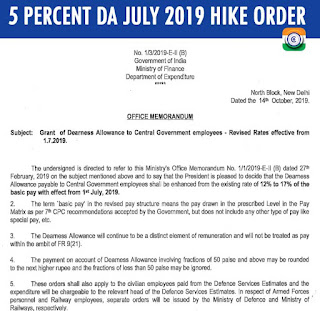
5 Percent DA July 2019 Hike Order - Grant of Dearness Allowance to Central Government employees

Grant of Dearness Allowance to Central Government employees 5 Percent DA July 2019 Hike Order  No. 1/3/2019-E- II (B) Government of...

Blog Archive

About The Author