A complete reference blog for Indian Government Employees

Showing posts with label 7th Pay Commission’s recommendations. Show all posts

Wednesday, 24 July 2019

Revision of Pension of pre 2016 pensioners after implementation of 7th Pay Commissions recommendations – anomaly in determining notional pay

DoPT Orders 2019

Revision of Pension of pre 2016 pensioners after implementation of 7th Pay Commissions recommendations – anomaly in determining notional pay

No.29018/02/2019. AIS-II(Pension)
Government of India,
Ministry of Personnel, P.G. and Pensions
Department of Personnel and Training
AIS-II (Pension)

To,
All Chief Secretaries to the States

Subject: Revision of pension of pre 2016 pensioners after implementation of seventh Central pay Commissions recommendations-anomaly in determining notional pay.

Sir,
I am directed to refer to various communications from State Governments on the above subject and to state that the matter raised in various representations of the pensioners seeking revision of their pension after implementation of 7th CPC recommendations, has been examined in this Department in consultation with Department of Pensions and Pensioner’s Welfare.

The basis for the re-fixation of the pension of pre-2016 pensioners are DoPT OM No.14021/4/2016-AIS-1I dated 19th May, 2017 (mutatis-mutandis based on DoP&PW OM dated 38/37/2018-P&PW(A) dated 12th May,2017) and the Concordance Tables issued by DoP&PW vide OM dated 38/37/2018-P&PW(A) dated 6th July,2017.

Prior to re-fixation of the pension of pre-2016 pensioners / family pensioners etc., following instructions/ pension may be followed:-

   " (a) Para 4 of the OM dated 12th May, 2017 provides inter alia that the “revised pension / family pension w.e.f 01.01.2016 in respect of all Central Civil pensioners retired prior to 01.01.2016, may be revised by notionally fixing their pay in pay matrix recommended by the 7th CPC in the level corresponding to the pay in the pay scale/pay band and grade pay at which they retired. This will be done by notional pay fixation under each intervening Pay Commission based on the Formula for revision of pay. While fixing pay on notional basis, the pay fixation formulas approved by the Government and other relevant instructions on the subject in force at the relevant time shall be strictly followed. Further, para 7 of the OM provides inter alia that in case of those Government servants who retired or died on or after 01.01.1986 but before 1.1.2016, the actual pay and the pay scale from which they retired or died would be taken into consideration for the purpose of calculation of the notional pay as on 01.01.2016 in accordance with para 4 above.

    (b) Accordingly, the pay of pre-2016 pensioners was notionally fixed in relevant cell of pay matrix of 7th CPC as per the formula of pay fixation approved by the Government. The pay of the serving IAS officers (including of Selection Grade officers) is also fixed in relevant cell of Pay Matrix of 7th CPC as per the formula of pay revision from 6th CPC to 7th CPC as approved by the Government. Also, the pay of serving officers who had been promoted on 1.1.2016 in JAG or Selection Grade is first fixed in the relevant cell of Pay Matrix of 7th CPC as per the formula of pay revision approved by the Government. Thereafter, they had to be promoted in next scale and their pay fixed in that level as per IAS Pay Rules 2016, granting them two increment in the promotion level.


    (c) The pay of only those officers who were promoted on or after 1.1.2016 is to be fixed in 3rd cell of level-13. The pay of the officers who were already in selection grade i.e. level-13 as on 1.1.2016 is fixed as per the formula of pay revision from 6th to 7th Central Pay Commission (CPC). The notional pay of the officers who had retired before 01.01.2016 has to be similarly fixed. Therefore, the contention of any pensioner that his/her notional pay cannot be in any case less than the lowest level at which the pay of a serving officer of the Selection Grade of IAS can be fixed, is not tenable. Their pay is to be notionally arrived at by the formula of pay revision from 6th CPC to 7th CPC at par with other serving IAS officers."


Pension of pre-2016 pensioners/ family pensioner may be revised w.e.f 1.1.2016 in accordance with the instructions contained in D/o P&PW OM dated 12.5.2017.

Accordingly, the representations of pre-2016 pensioners may be examined by the State Government and the concerned pensioner(s) may be informed.

This issues is with the approval of the competent authority.

(Sandeep Kumar Sinha)
Under Secretary to the Government of India

Source: DoPT
Share:

Tuesday, 13 September 2016

Anomaly Committee of the National Council (JCM) to settle the anomalies arising out of the implementation of the Seventh Pay Commissions recommendations


Anomaly Committee of the National Council (JCM) to settle the anomalies arising out of the implementation of the Seventh Pay Commissions recommendations

F.No.11/2/2016-JCA-I
Government of India
Ministry of Personnel, Public Grievances and Pensions
Department oaf Personnel & Training
JCA Section
*****************
North Block New Delhi
Dated the 9th September, 2016.
OFFICE MEMORANDUM
Anomaly Committee of the National Council (JCM) to settle the anomalies arising out of the implementation of the Seventh Pay Commission's recommendations

In accordance with the instructions contained in this Department's OM of even number dated 16th August 2016, it has been decided to set up, as indicated below, the Anomaly Committee of the National Council (JCM) consisting of representatives of the Official Side and the Staff Side to settle any anomalies arising out of the implementation of the Seventh Central Pay Commission's recommendations: -

OFFICIAL SIDE
1.Secretary,
........ Chairman
Deptt. of Pers. & Training.
2.Member (Staff),
Railway Board.
3.Secretary,
Department of
Telecommunication.
4.Secretary,
Department of Posts.
5.Financial Adviser, (Ministry
of Defence.
6.Joint Secretary (Pers),
Ministry of Finance.
7.Joint Secretary (Estt.),
Deptt. of Personnel &
Training.
8.Joint Secretary (CPC),
Deptt. of Personnel &
Training
9.Deputy Secretary (JCA),
Deptt. of Personnel &
Training Member- Secretary.
STAFF SIDE
1.Shri Rakhal Das Gupta
2.Shri Shiv Gopal Mishra
3.Shri Ch. Sankara Rao
4.Shri J.R.Bhosle
5.Shri M Raghavaiah
6.Shri Guinan Singh
7.Shri R.P.Bhatnagar
8.Shri K.S. Murty
9.Shri K.K.N.Kutty
10.Shri R.Srin)Visan
11.Shri C.Srikumar
12.Shri M.Krishnan
13.Shri M.S. Raja

2. The working of the Committee would be in terms of the conditions laid down in this Department's OM dated 16th August 2016 mentioned above.
(D.K. Sengupta)
Deputy Secretary to the Government of India
Source: ccis.nic.in
Share:

Monday, 30 November 2015

7th Pay Commission’s Recommendations on Gratuity

7th Pay Commission’s Recommendations on Gratuity

7th CPC recommends for raising Gratuity from the existing Rs.10 lakh to Rs.20 lakh from 01.01.2016. 7th Pay Commission further proposes for DA indexed Gratuity viz., increase by 25 percent whenever DA rises by 50 percent.

Enhancement in the Gratuity Ceiling and its Indexation

A number of representations have been received by the Commission stating that there is a need to revise the existing ceiling of Rs.10.00 lakh with regard to payment of service gratuity.

Analysis and Recommendations

Rule 49 and 50 of the CCS (Pension) Rules provides that a government servant is entitled to get retirement gratuity equal to one-fourth of his emoluments for each completed six monthly period of qualifying service subject to a maximum of 16.5 times of the last emoluments subject to a maximum of Rs.10 lakh.
The Commission sought the views of the government in this regard. The Department of Pension and Pensioners Welfare stated that the VI CPC has increased the amount of gratuity from Rs.3.5 lakh to Rs.10 lakh w.e.f. 01.01.2006. This amount, in the view of the department, is not commensurate with emoluments that are available to senior officers at the time of retirement. The department has suggested to the Commission that a view could be taken to index gratuity with amount of DA admissible at the time of retirement.

The Commission notes that there is merit in the argument advanced to index the ceiling on gratuity so that the benefits of the enhanced ceiling are available to personnel in a manner which is more even over a time frame. The Commission recommends enhancement in the ceiling of gratuity from the existing Rs.10 lakh to Rs.20 lakh from 01.01.2016. The Commission further recommends, as has been done in the case of allowances that are partially indexed to Dearness Allowance, the ceiling on gratuity may increase by 25 percent whenever DA rises by 50 percent.

Rationalisation of Death Gratuity

The Commission has received representations pointing to a need for rationalization of current slabs for death gratuity, especially for the slab of 5 to 20 years of qualifying service in which family pensioners are stated to be placed at a disadvantageous position.

Analysis and Recommendations

As per Rule 50 of Pension Rules, the death gratuity admissible will be as follows, subject to the maximum limit prescribed for the gratuity:

Length of Service Rate of Death Gratuity
Less than one year 2 times of monthly emoluments
One year or more but less than 5 years 6 times of monthly emoluments
5 years or more but less than 20 years 12 times of monthly emoluments
20 years or more Half month of emoluments for every complete six monthly period of qualifying service subject to a maximum of 33 times of monthly emoluments

The Commission sought the views of the government in this regard. Department of Pension and Pensioners Welfare stated that it had received similar demands from pensioners’ association and it feels a need for a review of the existing slabs for death gratuity.

The Commission, after examination of the matter, recommends the following revised rates for payment of death gratuity:

Length of Service Rate of Death Gratuity
Less than one year 2 times of monthly emoluments
One year or more but less than 5 years 6 times of monthly emoluments
5 years or more but less than 11 years 12 times of monthly emoluments
11 years or more but less than 20 years 20 times of monthly emoluments
20 years or more Half month of emoluments for every complete six monthly period of qualifying service subject to a maximum of 33 times of emoluments

Reduction in the time period for Restoration of Basic Pension
The Commission has received a number of representations requesting reduction of restoration period of commuted portion of pension from the existing 15 years.

Source: gconnect.in
Share:

Tuesday, 17 November 2015

Impact of 7th pay commission very different from last one

Impact of 7th pay commission very different from last one

With investments sluggish and unlikely to pick up for another year or two, many are now betting on a recovery in consumption demand to bump up GDP. The feeling is falling interest rates will prompt purchases of homes and cars, and that central government employees could turn out to be big buyers once their bank accounts have been credited with funds following the recommendations of the 7th Pay Commission. Savings to households from lower prices of oil are expected to free up cash for discretionary spends while a higher MSP (minimum support price) for wheat, if that happens, will boost farm incomes.

However, for a variety of reasons, the rise in consumption-demand this time around may not quite match the spurt seen when the 6th Pay Commission’s recommendations were implemented. As Kotak Institutional Equities points out, the economic environment at the time—the report was implemented in 2008 but effective from January 2006—was far less challenging than currently and there were many other factors that contributed to the surge in consumer demand, none of which is present today. Halving of excise duties—from 16% to 8% between February 2008 and 2009—allowed auto firms to drop prices, and a 425 bps cut in the policy rate in a span of just seven months made money significantly cheaper. Both moves were part of a stimulus package meant to revive demand after the global financial meltdown and resulted in a fall in product prices; the cost of a Maruti Swift, for instance, fell from R6.4 lakh to R5.6 lakh or by around 12%. That apart, the rural economy at the time was in far more robust shape than it is today with farm incomes rising sharply over FY05-13 driven by the MNREGA and big hikes in MSPs; the hike in MSPs for both seasons of FY09 was particularly steep given the elections were round the corner. As such, rural India was a lot more prosperous than now with real rural wages barely growing.

Moreover, consumer confidence was reasonably high as private sector investment, which rose steadily after 2004 and peaked in 2008 at 14% of GDP, had created a lot of jobs. Today, private sector investments are at 15-year lows and corporate cash flows are crimped with most companies highly leveraged. Given the far more difficult environment today, it would be unwise to expect an impact of similar magnitude on consumption demand from pay hikes following the 7th Pay Commission’s recommendations. To be sure, the impact would also depend on the quantum of the hike — the last time around, there was a total increase of 120% between FY06 and FY11, translating into a compounded annual increase of 17%, including R44,000 crore of arrears. Even if the pay hikes are as generous, since there will be no great delay in implementation, there will be no major piling up of arrears. Given that the overall environment will not be as conducive as it was at the time of the 6th Pay Commission, it is unlikely the 7th Pay Commission will pull consumer sentiment up enough to give the economy the boost it needs.

Source: PAlegacy
Share:

Featured post

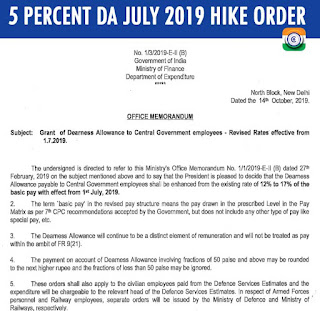
5 Percent DA July 2019 Hike Order - Grant of Dearness Allowance to Central Government employees

Grant of Dearness Allowance to Central Government employees 5 Percent DA July 2019 Hike Order  No. 1/3/2019-E- II (B) Government of...

Blog Archive

About The Author