A complete reference blog for Indian Government Employees

Showing posts with label 7th CPC Recommedations. Show all posts

Monday, 9 November 2015

Expected DA Jan 2016 gets carefully scrutinized by the 7th Pay Commission

“Expected DA Jan 2016” gets carefully scrutinized by the 7th Pay Commission
"This time, it is not just the employees, but the members of the 7th Pay Commission too who are very eager to know about the Dearness Allowance from January 2016. "
'Expected DA January 2016' has the honour of making not just the Central Government employees and pensioners curious; it has even got the 7th Pay Commission on the list of eagerly waiting audience. It is a well-known fact that Central Government employees love to read all kinds of information, analyses, orders, and predictions about the Dearness Allowance. Here are our fact- and trend-based predictions for the additional Dearness Allowance which will be announced from 01.01.2016.
Calculation of DA : The Government of India presently calculates the level of inflation for purposes of grant of dearness allowance to Central Government Employees on the basis of the All India Consumer Price index Number for Industrial Workers (2001=100) (AICPI). The twelve monthly average of the AICPI (2001 base) as on 1st January and 1st July of each year is used for calculating the Dearness Allowance (DA).
Each month, the Central Government’s Labour Bureau releases price-related data called the CPI (IW) on Base Year 2001=100. 78 important cities and towns from all over the country were selected and the fluctuations in prices of essential commodities in all these places are noted. Based on these data, the points, abbreviated as AICPIN, are calculated. The Pay Commission will, in its report, explain in detail how the DA is calculated based on these statistics, known as the ‘DA Determination Formula.’
The Dearness Allowance of not just the Central Government employees, but also the state government employees, is being paid as per the method prescribed by the 6th Pay Commission. The DA calculation method was implemented from January 2006 and will continue to be in effect for ten years, until December 2015. This DA determination method comes to an end now due to the constitution of the 7th Pay Commission.
Implementation of 7th CPC : The 7th Pay Commission is expected to submit its recommendations to the government before December 2015. Its recommendations are expected to be implemented from January 2016 onwards.
Dearness Allowance after 1.1.2016 : After 01.01.2016, Dearness Allowance will be issued based on the prices of essential commodities, as per the method recommended by the 7th Pay Commission. For example, the 6th Pay Commission’s recommendations were implemented from January 2006 onwards. The DA for the months of January 2006 to June 2006 was not paid. DA was issued only from the month of June 2006.
DA Calculation Method of the 7th Pay Commission : Successive Pay Commissions have made changes to the DA formula, suggesting their own methodology for determining the quantum and frequency. The 7th Pay Commission will also expected to recommend a different methodology to determine the DA.
One cannot say for sure that the 7th Pay Commission will follow the method that was recommended by the 6th Pay Commission. It could modify the current CPI(IW) BY 2001-100 statistics index. It could also change the current “Linking Factor 115.76” method. It is difficult to predict how these factors would differ in the recommendations of the 7th Pay Commission report.
Expected DA January 2016 : The Dearness Allowance from January 2016 will be calculated based on the AICPIN points for the six months starting from July 2015. The AICPIN points of only three months have been released as of now. Expected DA for January 2016 can be calculated only after the AICPIN points of October, November and December are released. On a fair guess, assuming that the AICPIN points remain the same for the remaining three months, one can expect Dearness Allowance of 6 percent and the total Dearness Allowance will increase by 125 percent. Unless there is a dramatic change in the AICPIN points, the total Dearness Allowance will very likely be around 125 percent.
The relationship between the 7th Pay Commission and the DA : The quantum of Dearness Allowance mentioned above is an important aspect for 7th Pay Commission. It is based on this number that the much awaited Revised Basic Pay will be calculated. For instance, the amount of total DA percentage will be added to the current Basic Pay and to this, the weightage to be recommended by the 7th Pay Commission will be added and the new Basic Pay will be arrived at.
The AICPIN points for the month of December 2015 will be released only in January 2016. Only then will it be possible to accurately calculate the Dearness Allowance from January 2016.
The 7th Pay Commission is expected to submit its report to the Central Government by December 2015. It remains to be seen how the 7th Pay Commission has calculated the final Dearness Allowance percentage.
Share:

Saturday, 5 October 2013

7th Pay Commission – Expectations and Suggestions

7th Pay Commission – Expectations and Suggestions

 We are all aware about the announcement on forming of 7th Pay Commission during the last week. It is our moral responsibility to convey our gratitude to the Central Government and the Unions which were continuously giving voice to this effect. The main reasons for the announcement regarding the forming of 7th Pay Commission as stated are:

The first reason as considered is being the oncoming election in order to take the efforts to obtain the votes. The second reason is to form pay commission every time and by way of allotment of sizable amount for the sake of the same, the problems like inflation are bound to happen in the country. For that, by way of forming of Pay Commission earlier, as stated by the Government, huge amount are being allotted for the sake of the same  in order to avoid the impact at the later stage caused owing to that.

After forming of the 7th Pay Commission, lots of expectations have been created in the minds of Central Government Staff.  When this Committee will be formed? Who are all the people deputed in this Committee? What will be the tentative date of submission of the report by them to the Government? After that, the dream of each and every Government employee would be what will be the quantum of hike? In that, what are all the concessions would be incorporated? Likewise, various questions and expectations would arise in the minds of each and every person.

We are all aware that the contents of the 6th Pay Commission had contained many deficiencies and fulfillments. After the implementation of the 6th Pay Commission, we would have noticed about the problem as ‘one increment’ through National Anomaly was finalized and we have received arrears of amount based on that. We all know that there were many finalized problems of such nature and unsolved problems.

Meanwhile, eagerness is generated in the minds of all the people as to what would be the outcome by forming of 7th Pay Commission. Last AISPIN value and the procedure for calculation of DA as also based on the present price index are not found appropriate. This has been pointed out by the Confederation on many occasions.

The merger of DA with basic pay as adopted in the 5th Pay Commission has not been made applicable in the 6th Pay Commission. Non-merger of 50% DA has formed regret and dissatisfaction on the minds of all the employees.

Likewise, forming of Pay Commission once in every 10 years is considered to be quite a long period. Due to the present alarming increase of price, in order to overcome the economic problems, it is quite obvious for all to expect the consideration of the present Pay Commission about the aspects like pay revision at least once in 5 years. For this sake, efforts to involve in agitations are being announced by the Union at various levels.

Various dreams and expectations would prevail on all as regards the details that would be covered by the Pay Commission. Likewise, some would be worried about the repetition of the problems those were encountered during the 6th Pay Commission in the 7th Pay Commission also.

Source: www.7thpaycommissionnews.com
[http://www.7thpaycommissionnews.com/2013/10/7th-pay-commission-expectations-and.html]
Share:

Friday, 27 September 2013

7th Pay Commission announced – Focus on 7th CPC

7th Pay Commission announced – Focus on 7th CPC
 
The central government today announced the constitution of Seventh Pay Commission which will benefit about 50 lakhs central government employees and more than 30 lakhs pensioners all over India.
The Finance Minister after getting approved from the Prime Minister announced the decisions. The recommendations of the 7th Pay Commission are likely to be implemented with effect from January 1, 2016.The Central Government constitutes  Pay Commission every ten years to revise the pay scales for its employees and it is implemented with some modifications by some states. This announcement has created a joyous atmosphere among the employees and are eagerly waiting for its details.

50% DA Merge
From now, the longstanding question of merging 50% DA with the Basic Pay stands unanswered and the importance of it is slightly decreased.

Who will be the head of committee
Who will be the head of committee the employees are now awaits the announcement regarding who will head the constitution and its members.

Focus on 7th CPC
In VII CPC the anomaly  committee should rectify all anomalies in quick time rather than taking long years.
The merger of 50% DA which was announced in V CPC was not mentioned in the VI CPC . But in VII CPC, employees are expecting the merger of DA and Pay revision in between 10 years.
Final Words
This announcement may trigger in rise in prices right from the vegetable vendor to all other things.

Source: www.7thcpcnews.blogspot.in
[http://7thcpcnews.blogspot.in/2013/09/7th-pay-commission-announced-focus-on.html]
Share:

Thursday, 26 September 2013

Prime Minister Approves the Constitution of Seventh Central Pay Commission; Recommendations are Likely to be implemented with effect from 1st January, 2016

 Prime Minister Approves the Constitution of Seventh Central Pay Commission; Recommendations are Likely to be implemented with effect from 1st January, 2016


Press Information Bureau
Government of India
Ministry of Finance


25-September-2013 11:50 IST


FM: Prime Minister Approves the Constitution of Seventh Central Pay Commission; Recommendations are Likely to be implemented with effect from 1st January, 2016

The Finance Minister Shri P.Chidambaram in a statement said here today that the Prime Minister has approved the constitution of the Seventh Central Pay Commission.

The fourth, fifth and sixth Central Pay Commissions’ recommendations were implemented as follows:

4th CPC                       1.1.1986
5th CPC                       1.1.1996
6th CPC                       1.1.2006


The average time taken by a Pay Commission to submit its recommendations has been about two years.  Accordingly, allowing about two years for the 7th CPC to submit its report, the recommendations are likely to be implemented with effect from 1.1.2016.

The names of the Chairperson and members as well as the terms of reference (ToR) of the 7th Pay Commission will be finalised and announced shortly after consultation with major stakeholders.

Source: Centralgovernmentnews
http://www.centralgovernmentnews.com/prime-minister-approves-the-constitution-of-seventh-central-pay-commission-recommendations-are-likely-to-be-implemented-with-effect-from-1st-january-2016/

Share:

7th Pay Commission - Central Government approved to constitute 7th CPC to Central Government Employees

7th Pay Commission - Central Government approved to constitute 7th CPC to Central Government Employees...

Government announces Seventh Pay Commission for central employees

NEW DELHI: Ahead of elections, the government on Wednesday announced constitution of the Seventh Pay Commission, which will go into the salaries, allowances and pensions of about 80 lakh of its employees and pensioners.

"Prime Minister Manmohan Singh approved the constitution of the 7th Pay Commission. Its recommendations are likely to be implemented with effect from January 1, 2016", finance minister P Chidambaram said in a statement.

The setting up of the Commission, whose recommendations will benefit about 50 lakh central government employees, including those in defence and railways, and about 30 lakh pensioners, comes ahead of the assembly elections in 5 states in November and the general elections next year.

The government constitutes Pay Commission almost every ten years to revise the pay scales of its employees and often these are adopted by states after some modification.

As the Commission takes about two years to prepare its recommendations, the award of the seventh pay panel is likely to be implemented from January 1, 2016, Chidambaram said.

The Sixth Pay Commission was implemented from January 1, 2006, fifth from January 1, 1996 and fourth from January 1, 1986.

The names of the chairperson and members of the 7th Pay Commission and its terms of reference will be finalized shortly after consultation with major stakeholders, Chidambaram said.

Source: www.timesofindia.indiatimes.com
[http://timesofindia.indiatimes.com/india/Government-announces-Seventh-Pay-Commission-for-central-employees/articleshow/23037562.cms]
Share:

Monday, 17 June 2013

7th CPC NEWS - 7th PAY COMMISSION PROJECTED PAY SCALES.

7th CPC NEWS - 7th PAY COMMISSION PROJECTED PAY SCALES.


VII PAY COMMISSION PROJECTED PAY SCALE : - Its is a imagined pay structure of 7th Central Pay Commission for Central Government Employees, apparently it is a simple calculation, multiple of three times. Let we see 260 - 950 - 3050 - 7000 (still demanding for 10000 as minimum basic pay) and next, it may be at 21000. It is not an authentic source information, it is a prediction only... here we compiled the table of projected pay scale for your information.
 
SIXTH CPC PAY STRUCTURE
PROJECTED PAY STRUCTURE FOR NEXT (VII) PAY COMMISSION
Name of Pay Band/ ScaleCorresponding Pay BandsCorresponding Grade Pay Entry Grade +band pay
Projected entry level pay using uniform multiplying factor` 3’
Band Pay Grade PayEntry Pay
PB-1 5200-20200 1800 7000 15600-60600 5400 21000
PB-1 5200-20200 1900 7730 15600-60600 5700 23190
PB-1 5200-20200 2000 8460 15600-60600 6000 25380
PB-1 5200-20200 2400 9910 15600-60600 7200 29730
PB-1 5200-20200 2800 11360 15600-60600 8400 34080
PB-2 9300-34800 4200 13500 29900-104400 12600 40500
PB-2 9300-34800 4600 17140 29900-104400 13800 51420
PB-2 9300-34800 4800 18150 29900-104400 14400 54450
PB-3 15600-39100 5400 21000 29900-104400 16200 63000
PB-3 15600-39100 6600 25530 46800-117300 19800 76590
PB-3 15600-39100 7600 29500 46800-117300 22800 88500
PB-4 37400-67000 8700 46100 112200-20100 26100 138300
PB-4 37400-67000 8900 49100 112200-20100 26700 147300
PB-4 37400-67000 10000 53000 112200-20100 30000 159000
HAG 67000- (ann increment @ 3%) -79000 Nil


201000
HAG+ Scale 75500- (ann increment @ 3%) -80000 Nil


226500
Apex Scale 80000 (Fixed) Nil


240000
Cab. Sec. 90000 (Fixed) Nil


270000
Share:

Featured post

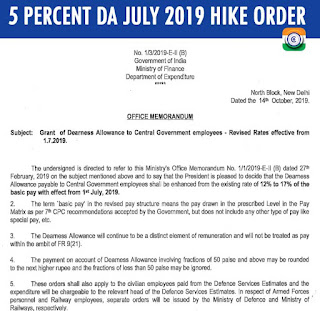
5 Percent DA July 2019 Hike Order - Grant of Dearness Allowance to Central Government employees

Grant of Dearness Allowance to Central Government employees 5 Percent DA July 2019 Hike Order  No. 1/3/2019-E- II (B) Government of...

Blog Archive

About The Author