A complete reference blog for Indian Government Employees

Showing posts with label election. Show all posts

Wednesday, 1 February 2017

Grant of paid holiday to employees on the day of poll - DoPT Orders


Grant of paid holiday to employees on the day of poll - DoPT Orders

General Election to the Legislative Assemblies of Goa, Manipur, Punjab, Uttarakhand and Uttar Pradesh, 2017 - Grant of paid holiday to employees on the day of poll - regarding

F.No.12/3/2016-JCA-2
Government of India
Ministry of Personnel, Public Grievances and Pensions
(Department of Personnel & Training)
Establishment (JCA-2) Section
North Block, New Delhi
Dated 1st February, 2017
OFFICE MEMORANDUM

Subject: General Election to the Legislative Assemblies of Goa, Manipur, Punjab, Uttarakhand and Uttar Pradesh, 2017 - Grant of paid holiday to employees on the day of poll - regarding

The undersigned is directed to say that in connection with the General Elections to the Legislative Assemblies of the States of Goa, Manipur, Punjab, Uttarakhand and Uttar Pradesh, to be held during the months, of February and March, 2017, the guidelines, issued by this Department vide OM No. 12/ 14/99-JCA dated 10.10.2001, may be followed for closing of the Central Government Offices, including Industrial establishments in the above mentioned States the relevant portion of the OM as referred to above are reproduced here.
(i) The relevant organizations shall remain closed in the notified areas where general elections to the State Legislative Assembly are concerned scheduled to be conducted;

(ii)In connection with bye-election to Lok Sabha/ State Assembly, only such of the employees who are bona-fide voters in the relevant constituency should be granted special casual leave on the day of polling. Special Casual leave may also be granted to an employee who is ordinarily a resident of a constituency and registered as a voter but employed in any Central Government Organization/ Industrial Establishment located outside the constituency having a general/ bye-election.
2. The employees detailed on election duty may also be permitted to remain away from their normal duties on polling day(s) as also on the days required for performing journeys which might be undertaken in order to perform such election duty

3. The above instructions may be brought to the notice of all concerned.
sd/-
(D.K.Sengupta)
Deputy Secretary to the Government of India
Click to view the order
Authority: http://dopt.gov.in/
Share:

Monday, 13 April 2015

Payment of Travelling Allowance for Election Duty for a longer period: Clarification by CEO

Payment of Travelling Allowance (from residence to temporary place of duty) to those who were deputed for Election Duty in various cells of District Election Offices or CEO (HQ) for a longer period-admissibility-regarding.

OFFICE OF THE CHIEF ELECTORAL OFFICER
OLD ST. STEPHENS COLLEGE BUILDING,
KASHMERE GATE, DELHI-110006

No. CEO/B&A (109)(50)/2009-LA/24025-24272
Dated: 02-03-2015
CIRCULAR

This office is in receipt of various representations from different departments/ individuals and RTI applications regarding payrnent/admissibility of Travelling Allowance (from residence to temporarily place of duty) to those who were deputed for Election Duty in various cells of District Election Offices or CEO (HQ) for a longer period.

In this regard, this office has received an endorsement from Dte. of Training & Technical Education, Govt. of NCT of Delhi vide which Finance Department, Govt. of NCT of Delhi has clarified that:-

“Travelling Allowance is not admissible for the journey performed by officers/officials from their residence to the temporary duty point. However, they are entitled to Travelling Allowance, provided they performed any local journey in connection with official duty from the temporary duty point, will be regulated as per SR-71”.
Therefore all the Head of Departments/Nodal Officers, Govt. of India, Govt. of NCT of Delhi, all autonomous bodies, District Election Officers/SDM (Elections) are hereby requested to settle the Travelling Allowance Claims for election duty as per Opinion given by the Finance Department, Govt. of NCT of Delhi. The cases already settled may also be reviewed accordingly.
This issues with the prior approval of Chief Electrol Officer, Delhi
(A.K. SRIVASTAVA)
DY. CHIEF ELECTORAL OFFICER
CGDA’s forwarding letter:-
Controller General of Defence Accounts
Ulan Batar Fload, Palam, Delhi Cantt- 110010

No. AN/XIV/19015/Govt. Orders/2015
07.04.2015
All PCsDA/CsDA

Sub: Payment of Travelling Allowance (from residence to temporary place of duty) to those who were deputed for Election Duty in various cells of District Election Offices or CEO (HQ) for a longer period-admissibility-regarding.

A copy of Office of the Chief Electoral Officer, Old St. Stephens College Building, Kashmere Gate, Delhi-06 Circular No. CEO/B&A (109)(50)/2009- LA/24025-24272 dated 02.03.2015 on the above subject is forwarded herewith for your information, guidance and necessary action please.

Source: CGDA PDF
Share:

Monday, 10 November 2014

Updated: Allocation of Portfolios amongst the members of the Council of Ministers

Updated: Allocation of Portfolios amongst the members of the Council of Ministers

Press Information Bureau
Government of India
President's Secretariat
09-November-2014 23:37 IST


    Allocation of Portfolios amongst the members of the Council of Ministers


The President of India, as advised by the Prime Minister, has directed that the allocation of portfolios amongst the members of the Council of Ministers shall be as below:-

Prime Minister Shri Narendra Modi: Personnel, Public Grievances and Pensions; Department of Atomic Energy Department of Space; All important policy issues and all other portfolios not allocated to any Minister

    CABINET MINISTERS

1. Shri Rajnath Singh: Home Affairs

2. Smt. Sushma Swaraj: External Affairs, Overseas Indian Affairs

3. Shri Arun Jaitley: Finance, Corporate Affairs, Information & Broadcasting

4. Shri M. Venkaiah Naidu: Urban Development, Housing and Urban Poverty Alleviation, Parliamentary Affairs

5. Shri Nitin Jairam Gadkari: Road Transport and Highways, Shipping

6. Shri Manohar Parrikar: Defence

7. Shri Suresh Prabhu: Railways

8. Shri D.V. Sadananda Gowda: Law & Justice

9. Sushri Uma Bharati: Water Resources, River Development and Ganga Rejuvenation

10. Dr. Najma A. Heptulla: Minority Affairs

11. Shri Ramvilas Paswan: Consumer Affairs, Food and Public Distribution

12. Shri Kalraj Mishra: Micro, Small and Medium Enterprises

13. Smt. Maneka Sanjay Gandhi: Women and Child Development

14. Shri Ananthkumar: Chemicals and Fertilizers

15. Shri Ravi Shankar Prasad: Communications and Information Technology

16. Shri Jagat Prakash Nadda: Health & Family Welfare

17. Shri Ashok Gajapathi Raju Pusapati: Civil Aviation

18. Shri Anant Geete: Heavy Industries and Public Enterprises

19. Smt. Harsimrat Kaur Badal: Food Processing Industries

20. Shri Narendra Singh Tomar: Mines, Steel

21. Shri Chaudhary Birender Singh: Rural Development, Panchayati Raj, Drinking Water and Sanitation

22. Shri Jual Oram: Tribal Affairs

23. Shri Radha Mohan Singh: Agriculture

24. Shri Thaawar Chand Gehlot: Social Justice and Empowerment

25. Smt. Smriti Zubin Irani: Human Resource Development

26. Dr. Harsh Vardhan: Science and Technology, Earth Sciences


    MINISTERS OF STATE


27. General V.K. Singh: Statistics and Programme Implementation (Independent Charge), External Affairs, Overseas Indian Affairs

28. Shri Inderjit Singh Rao: Planning (Independent Charge), Defence

29. Shri Santosh Kumar Gangwar: Textiles (Independent Charge)

30. Shri Bandaru Dattatreya: Labour and Employment (Independent Charge)

31. Shri Rajiv Pratap Rudy: Skill Development & Entrepreneurship (Independent Charge), Parliamentary Affairs

32. Shri Shripad Yesso Naik: AAYUSH (Independent Charge), Health & Family Welfare

33. Shri Dharmendra Pradhan: Petroleum and Natural Gas (Independent Charge)

34. Shri Sarbananda Sonowal: Youth Affairs and Sports (Independent Charge)

35. Shri Prakash Javadekar: Environment, Forest and Climate Change (Independent Charge)

36. Shri Piyush Goyal: Power (Independent Charge), Coal (Independent Charge), New and Renewable Energy (Independent Charge)

37. Dr. Jitendra Singh: Development of North Eastern Region (Independent Charge), Prime Minister’s Office, Personnel, Public Grievances & Pensions, Department of Atomic Energy, Department of Space

38. Smt. Nirmala Sitharaman: Commerce and Industry (Independent Charge)

39. Dr. Mahesh Sharma: Culture (Independent Charge), Tourism (Independent Charge), Civil Aviation

40. Shri Mukhtar Abbas Naqvi: Minority Affairs, Parliamentary Affairs

41. Shri Ram Kripal Yadav: Drinking Water & Sanitation

42. Shri Haribhai Parthibhai Chaudhary: Home Affairs

43. Shri Sanwar Lal Jat: Water Resources, River Development & Ganga Rejuvenation

44. Shri Mohanbhai Kalyanjibhai Kundariya: Agriculture

45. Shri Giriraj Singh: Micro, Small & Medium Enterprises

46. Shri Hansraj Gangaram Ahir: Chemicals & Fertilizers

47. Shri G.M. Siddeshwara: Heavy Industries & Public Enterprises

48. Shri Manoj Sinha: Railways

49. Shri Nihalchand: Panchayati Raj

50. Shri Upendra Kushwaha: Human Resource Development

51. Shri Radhakrishnan P.: Road Transport & Highways, Shipping

52. Shri Kiren Rijiju: Home Affairs

53. Shri Krishan Pal: Social Justice & Empowerment

54. Dr. Sanjeev Kumar Balyan: Agriculture

55. Shri Manuskhbhai Dhanjibhai Vasava: Tribal Affairs

56. Shri Raosaheb Dadarao Danve: Consumer Affairs, Food and Public Distribution

57. Shri Vishnu Deo Sai: Mines, Steel

58. Shri Sudarshan Bhagat: Rural Development

59. Prof. (Dr.) Ram Shankar Katheria: Human Resource Development

60. Shri Y.S. Chowdary: Science and Technology, Earth Science

61. Shri Jayant Sinha: Finance

62. Col. Rajyavardhan Singh Rathore: Information & Broadcasting

63. Shri Babul Supria (Babul Supriyo) Baral: Urban Development, Housing and Urban Poverty Alleviation

64. Sadhvi Niranjan Jyoti: Food Processing Industries

65. Shri Vijay Sampla: Social Justice & Empowerment

***
(PIB)
[http://pib.nic.in/newsite/PrintRelease.aspx?relid=111200]
Share:

Tuesday, 1 October 2013

As elections loom, government clears 7th Pay Commission

As elections loom, government clears 7th Pay Commission

Pay commission recommendations are likely to be implemented with effect from 1 Jan 2016, says govt

The recommendations of the sixth pay commission headed by justice B.N. Srikrishna were implemented with effect from 1 January 2006

Ahead of the election season, the government approved a proposal to constitute the 7th Central Pay Commission to revise the salary structure of Union government employees from both civil and military services.

In a statement on Wednesday, the finance ministry said the average time taken by a Pay Commission to submit its recommendations is about two years, and accordingly the next set of recommendations is likely to be implemented from 1 January 2016.

The chairperson and members as well as the terms of reference of the Pay Commission will be finalized and announced shortly after consultation with major stakeholders, the ministry said.

N.R. Bhanumurthy, a professor at the National Institute of Public Finance and Policy, said the government might have announced the setting up of the Pay Commission slightly early because of the impending elections in five states and the general election next year. Notifications for assembly elections in Delhi, Rajasthan, Chhattisgarh, Madhya Pradesh and Mizoram are expected to be announced soon. The general election is due in May next year.

Bhanumurthy said states that followed the previous Pay Commission’s recommendations were better placed
in 2008 to increase salaries and allowances of their employees.

“The impact of the 7th Pay Commission on the fiscal situation of the central and state governments will depend on the extent of hike it recommends and also the fiscal devolution package to be announced by the 14th Finance Commission of India,” he added.

The 14th Finance Commission chaired by Y.V. Reddy, constituted in January, is expected to submit its report by October 2014 covering for a period of five years starting April 2015.

The 1st Pay Commission was established in 1956, and since then the Union government usually appoints a Pay Commission once in a decade to revise the wages of Union government employees.

The 6th Pay Commission headed by justice B.N. Srikrishna was constituted on 5 October 2006. It submitted its report on 24 March 2008, but its recommendations were implemented retrospectively from 1 January 2006.

The government accepted most of the recommendations of the 6th Pay Commission with some modification.
But it rejected a few recommendations such as a liberal severance package for employees who want to leave service without pension with 15-20 years of service left, another one that said government employees should have only three holidays in a year, and a suggestion for flexible work hours for women and flexi-weeks for employees with disabilities.

The government also deferred some recommendations to review them separately, such as bonus and overtime allowance, recommendation of lateral shift of defence personnel to central paramilitary forces, corporatization of Indian Railways, and abolition of Indian Telecom Services and Telecom Commission.

Source: Livemint
Share:

Featured post

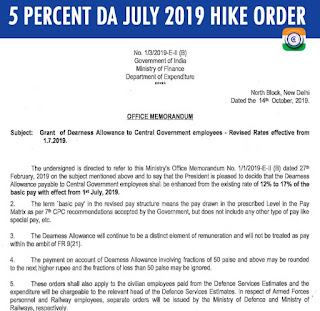
5 Percent DA July 2019 Hike Order - Grant of Dearness Allowance to Central Government employees

Grant of Dearness Allowance to Central Government employees 5 Percent DA July 2019 Hike Order  No. 1/3/2019-E- II (B) Government of...

Blog Archive

About The Author