A complete reference blog for Indian Government Employees

Showing posts with label Post Office Saving Schemes. Show all posts

Friday, 24 May 2019

Amendments to Rule 60(4)(B) and Rule 165(4)(ii) of POSB(CBS) Manual, Rule 87(4) (ii)POSB Manual Volume I and Rule 50(4)


DoP - Post Office Saving Schemes including Certificates - DOP(SB ORDER NO. 05/2019)
SB ORDER NO. 05/2019
F.No.116-12/2016-SB
Government of India
Ministry of Communications & IT
Department of Posts
Dak Bhawan, Sansad Marg,
New Delhi-110001.
Date: 20.05.2019
To,
All Heads of Circles/Regions
Addl. Director General, APS, New Delhi.

Subject:- Amendments to Rule 60(4)(B) and Rule 165(4)(ii) of POSB(CBS) Manual, Rule 87(4) (ii)POSB Manual Volume I and Rule 50(4) (ii) of POSB Manual Volume II regarding change in powers of various authorities to sanction deceased claim cases and their time line in respect of Post Office Savings Schemes, including Certificates, where no nomination is registered and there is no legal evidence available/produced.

Sir / Madam,
The undersigned is directed to say that the competent authority has decided to amend the text of the aforesaid rules with immediate effect.

Revised Text of Rule is as given below.

“The authorities mentioned below are competent to sanction claims without production of legal evidence up to the limit noted against each, after expiry of Six (6) Months from the date of death of the depositor, if no succession certificate or probate of will or letter of administration of the deceased estate is produced during the period or up to the date of sanction.”

Name of Authority
  1. Time Scale Departmental Sub-Postmasters - Limit Rs.5000
  2. Sub Postmasters in Lower Selection Grade/PM Grade-1 - Limit Rs.10,000
  3. Sub-Postmasters/DeputyPostmasters/Postmasters in Higher Selection Grade (all Non Gazetted)/PM Grade -II and III* - Limit Rs.25,000
  4. Deputy Postmasters/Senior Postmasters/Deputy ChiefPostmasters/Superintendent of PostOffices/Deputy
    Superintendent of Post Offices (All Gazetted Group-B) - Limit Rs.1,00,000
    5.Chief Postmasters in GPO/Head Offices, Senior Superintendents of Post Offices (All Gazetted Group-A) - Limit Rs.2,50,000
  5. Director HQ/Regional Directors/ Director (GPO) - Limit Rs.3,75,000
  6. Chief Postmasters General/Postmasters General - Limit Rs.5,00,000
2. It is requested that this SB order may be circulated to all concerned including CBS/non-CBS Post Offices. In case where claims are not yet submitted or claims are already submitted but not yet sanctioned, these revised provisions should be made applicable.

This issues with the approval of competent authority.

Yours faithfully,
( Devendra Sharma )
Assistant Director (SB)
Share:

Monday, 24 December 2018

Income Tax benefits from Post Office Saving Schemes


Income Tax benefits from Post Office Saving Schemes
Interest rates on these post office saving schemes move in line with the government's interest rates on small savings schemes.India Post or Department of Posts, which runs the postal network of the country, offers a number of saving schemes with income tax benefits. Using these saving schemes, investor can claim a deduction up to Rs. 1.5 lakh in a financial year from taxable income under Section 80C of the Income Tax Act. Interest rates on these post office saving schemes move in line with the government's interest rates on small savings schemes, which are revised on a quarterly basis.

Here are post office saving schemes that offer tax benefits:

Post Office Time Deposit (TD) or Fixed Deposit (FD) account
In a post office fixed deposit (FD), one can deposit a lump sum of money for a specific period and avail of features like guaranteed returns and choice of interest payout. Post office time deposit (TD) or Fixed Deposit (FD) account offers interest rates across four maturities: one year, two years, three years, and five years, noted India Post on it's official website- indiapost.gov.in. The investment under 5 years fixed deposit qualifies for the benefit of Section 80C of the Income Tax Act, 1961, mentioned India Post.

Post Office Public Provident Fund (PPF) account
Post office Public Provident Fund (PPF) account offers an investment avenue with decent returns coupled with income tax benefits. For the quarter ending December, PPF accounts fetch an interest rate of 8 per cent per annum. Interests on deposits are compounded on an annual basis, which means that it is added to the principal amount every year, noted India Post. PPF comes under the exempt, exempt, exempt (EEE) category of tax status. This means that returns, maturity amount and interest income are exempt from income tax. Deposits qualify for deduction from income under Section 80C of Income Tax Act.

Post Office Senior Citizen Savings Scheme (SCSS) account
Post Office Senior Citizen Savings Scheme (SCSS) serves as an investment avenue and helps in generating wealth for a successful retirement life. SCSS earns an interest rate of 8.7 per cent per annum, which is payable from the date of deposit on March 31/ September 30/December 31 in the first instance and thereafter, interest are payable on March 31, June 30, September 30 and December 31. Tax Deducted At Source (TDS) is deducted at source on interest if the interest amount is more than Rs. 10,000 per annum. Investment under this scheme qualifies for the benefit of Section 80C of the Income Tax Act, 1961 from April 1, 2007.

Post office National Savings Certificates (NSCs)
Post Office National savings certificates (NSCs) fetch an interest rate of 8 per cent per annum. This interest is compounded annually but payable at maturity. An NSC of Rs. 100 will offer Rs. 146.93 on maturity after five years. NSCs have a lock-in period of five years. Deposits in the National Savings Certificate qualify for deduction under Section 80C of the Income Tax Act.

Source: NDTV
Share:

Featured post

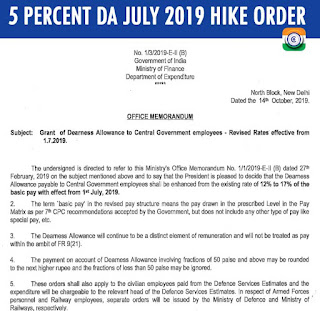
5 Percent DA July 2019 Hike Order - Grant of Dearness Allowance to Central Government employees

Grant of Dearness Allowance to Central Government employees 5 Percent DA July 2019 Hike Order  No. 1/3/2019-E- II (B) Government of...

Blog Archive

About The Author