A complete reference blog for Indian Government Employees

Showing posts with label Pension Funds. Show all posts

Tuesday, 25 June 2019

Pension Funds and Investment Pattern in Tier-I of NPS for Central Government subscribers


Pension Funds and Investment Pattern in Tier-I of NPS for Central Government subscribers

PENSION FUND REGULATORY AND DEVELOPMENT AUTHORITY

CIRCULAR
PFRDA/2019/12/ REG-PF/1
Date: 8th May, 2019

SUBJECT: Introduction of choice of Pension Funds and Investment Pattern in Tier-I of NPS for Central Government subscribers - reg.

Reference is invited to the Gazette Notification F.No.1/3/2016-PR dated 31 st January, 2019 issued by Ministry of Finance, Department of Financial Services, modifying Ministry of Finance's Notification No. 5/7/2003-ECB dated 22nd December, 2003, based on the Government's decision on the recommendations of a Committee set up to suggest measures for streamlining the implementation of National Pension System (NPS).

Accordingly, it has been decided to introduce the following options for Central Government subscribers:

(i) Choice of Pension Fund: As in the case of subscribers in the private sector, the Government subscribers shall also be allowed to choose anyone of the pension funds including Private sector pension funds. They could change their option once in a year. However, the current provision of combination of the Public-Sector Pension Funds will be available as the default option for both existing as well as new Government subscribers.

(ii) Choice of Investment pattern: The following options for investment choices shall be offered to Government employees:

(a) The existing scheme in which funds are allocated by the PFRDA among the three Public Sector Undertaking fund managers based on their past performance in accordance with the guidelines of PFRDA for Government employees shall continue as default scheme for both existing and new subscribers.

(b) Government employees who prefer a fixed return with minimum amount of risk shall be given an option to invest 100% of the funds in Government securities (Scheme G).

(c) Government employees who prefer higher returns shall be given the options of the following two Life Cycle based schemes:
(A) Conservative Life Cycle Fund with maximum exposure to equity capped at 25% - LC-25.
(B) Moderate Life Cycle Fund with maximum exposure to equity capped at 50% - LC-50.
The subscribers may exercise one of the above choices of Investment Pattern twice in a financial year.

(iii) Implementation of choices to the legacy corpus: Transfer of a huge legacy corpus of more than Rs. 1 lakh crore in respect of the Government sector subscribers from the existing Pension Fund Managers is likely to impact the market. It may be practically difficult for the PFRDA to allow Government subscribers to change the Pension Funds or investment pattern in respect of the accumulated corpus, in one go. Therefore, for the present, change in the Pension Funds or investment pattern is allowed in respect of incremental flows only.

(iv) Transfer of legacy corpus in a reasonable time frame: PFRDA shall draw up a scheme in due course for transfer of accumulated corpus as per new choices of Government subscribers in a reasonable time frame of say five years. Once PFRDA draws up this scheme, change in the Pension Funds or investment pattern shall be allowed in respect of the accumulated corpus in accordance with that scheme.
  • For investment option as per para 2 (ii) (a) above, all other terms and conditions as contained in the investment guidelines issued by the Authority dated 03.06.2015 for NPS Schemes (Applicable to Scheme CG, Scheme SG, Corporate CG and NPS Lite Schemes and APY) and subsequent amendments made thereto shall be applicable. Further, for investment options as per para 2 (ii) (b) or 2 (ii) (c) (A) or 2 (ii) (c) (8) above, all other terms and conditions as contained in the investment guidelines issued by the Authority dated 04.05.2017 in respect of NPS Schemes {Other than Govt. Sector (CG & SG), Corporate CG, NPS Lite and APY} and subsequent amendments made thereto shall apply.
  • This circular is issued in exercise of powers of the Authority under sub-clause (b) of sub-section (2) of Section 14 read with Section 23 of the PFRDA Act, 2013 and sub regulation (1) of Regulation 14 of the PFRDA (Pension Fund) Regulations, 2015.
The above arrangements are applicable w.e.f. 1st April, 2019.
(A. G. Das)
Executive Director
Source: PFRDA
Share:

Tuesday, 11 December 2018

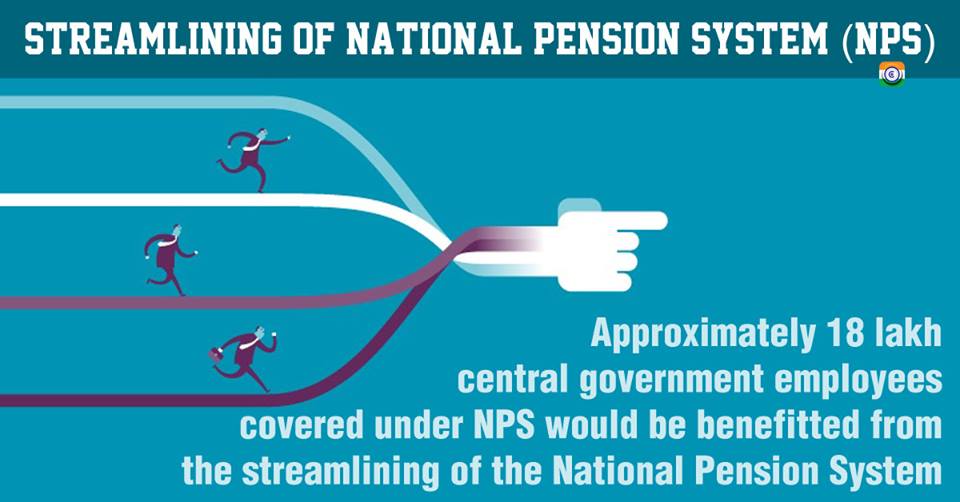
Approximately 18 lakh central government employees covered under NPS would be benefitted from the streamlining of the National Pension System

National Pension System-NPS-Central-Government-Employees
Ministry of Finance

Streamlining of National Pension System (NPS)

Posted On: 10 DEC 2018 3:01PM by PIB Delhi
Decision
The Union Cabinet in its Meeting on 6th December, 2018 has approved the following proposal for streamlining the National Pension System (NPS).
  • Enhancement of the mandatory contribution by the Central Government for its employees covered under NPS Tier-I from the existing 10% to 14%.
  • Providing freedom of choice for selection of Pension Funds and pattern of investment to central government employees.
  • Payment of compensation for non-deposit or delayed deposit of NPS contributions during 2004-2012.
  • Tax exemption limit for lump sum withdrawal on exit has been enhanced to 60%. With this, the entire withdrawal will now be exempt from income tax. (At present, 40% of the total accumulated corpus utilized for purchase of annuity is already tax exempted. Out of 60% of the accumulated corpus withdrawn by the NPS subscriber at the time of retirement, 40% is tax exempt and balance 20% is taxable.)
  • Contribution by the Government employees under Tier-II of NPS will now be covered under Section 80 C for deduction up to Rs. 1.50 lakh for the purpose of income tax at par with the other schemes such as General Provident Fund, Contributory Provident Fund, Employees Provident Fund and Public Provident Fund provided that there is a lock-in period of 3 years.

Background
The new entrants to the central government service on or after 01.01.2004 are covered under the National Pension System (NPS). The Seventh Pay Commission (7th CPC), during its deliberations, examined certain concerns regarding NPS and made recommendations in the year 2015. The 7th CPC recommended for setting up of a Committee of Secretaries in this regard. Accordingly, a Committee of Secretaries was constituted by the Government to suggest measures for streamlining the implementation of NPS in the year 2016. The Committee submitted its report in the year 2018. Accordingly, based on the recommendations of the Committee, draft Cabinet Note was placed before the Cabinet for its approval.

Implementation strategy and targets
The proposed changes to NPS would be made applicable immediately once time critical decisions are taken in consultation with the other concerned Ministries / Departments.

Major impact
  • Increase in the eventual accumulated corpus of all central government employees covered under NPS.
  • Greater pension payouts after retirement without any additional burden on the employee.
  • Freedom of choice for selection of Pension Funds and investment pattern to central government employees.
  • Benefit to approximately 18 lakh central government employees covered under NPS.
  • Augmenting old-age security in a time of rising life expectancy.
  • By making NPS more attractive, government will be facilitated in attracting and retaining the best talent.
Expenditure involved
The impact on the exchequer on this account is estimated to be to the tune of around Rs. 2840 crores for the financial year 2019-20, and will be in the nature of a recurring expenditure. The financial implications on account of provisions regarding payment of compensation for non-deposit or delayed deposit of NPS contributions during 2004-2012, would be in addition to the amount indicated above.

No. of beneficiaries
Approximately 18 lakh central government employees covered under NPS would be benefitted from the streamlining of the National Pension System.
States/districts covered
Pan India.

Details and progress of scheme if already running
Presently, the new entrants to the central government service on or after 01.01.2004 are covered under the NPS. NPS is being implemented and regulated by Pension Fund Regulatory and Development Authority in the country.

PIB
Share:

Thursday, 10 May 2018

PFRDA Common Stewardship Code

PFRDA

PENSION FUND REGULATORY AND DEVELOPMENT AUTHORITY

B-14/A, Chhatrapati Shivaji Bhawan
Qutab Institutional Area,
Katwaria Sarai, New Delhi - 110 016.
Ph: 011-26517501, 26517503, 26133730
Fax:011-26517507
Website: www.pfrda.org.in
CIRCULAR
PFRDA/2018/01/PF/01
Date: 4th May, 2018
Subject: Common Stewardship Code

1.  National Pension System strives to provide old age income security to its subscribers of which NPS Trust is the legal owner of the funds and the Pension Funds undertaking investment of such monies as per the investment guidelines approved by the Authority. Pension Funds are expected to shoulder greater responsibility towards the subscribers/beneficiaries by enhancing monitoring and engagement with the investee companies. Such activities are commonly referred to as 'Stewardship Responsibilities' of the institutional investors and asset managers and are intended to protect the subscribers' pension wealth. Such increased engagement is also seen as an important step towards improved corporate governance in the investee companies and gives a greater fillip to the protection of the interest of subscribers in such companies.

2. In view of the above, in consultation with Securities and Exchange Board of India (SEBI) and Insurance Regulatory and Development Authority of India (IRDAI), a proposal for introducing a Stewardship Code in India was examined by a sub¬committee of the Financial Stability and Development Council (FSDC) and approved.

3. All the Pension Funds under the NPS architecture shall follow the Stewardship Code as placed at Annex including the voting policy dated 20.04.2017, which is already recognized in such principles and is effective.

4. The principles (other than voting policy which is already in effect) enumerated in the Code shall be effective from the date of issuance.

5. This Circular is issued in exercise of the powers conferred under Sections 14 (1) read with 14 (2) (a) & (b) of the Pension Fund Regulatory and Development Authority Act, 2013.

6. This Circular is available at www.pfrda.org.in/ under the link "Regulatory Framework- Circulars".

S/d,
(Venkateswarlu Peri)
Chief General Manager
To
Pension Funds registered with PFRDA
Share:

Saturday, 2 December 2017

PFRDA Workshop benefits of National Pension System & Pension Funds under NPA architecture


PFRDA Workshop benefits of National Pension System & Pension Funds under NPA architecture

PFRDA conducts the Workshop with Corporates to create an awareness about the features, benefits and the process of joining National Pension System (NPS); Also to create awareness about the role of Pension Funds under NPA architecture;

More than 1.80 crore subscribers join under NPS-Private sector

Pension Fund Regulatory Development Agency (PFRDA) in its endeavor to promote NPS among the corporates have embarked upon conducting NPS Workshops at various locations across the country. In continuation of that exercise, a Corporate Meet was held today in Pune in association with FICCI, Maharashtra State Council and Mahratta Chambers of Commerce, Industry and Agriculture.


More than 100 participants from around 55 corporates attended the workshop. PFRDA officials gave a detailed presentation on NPS and informed the participants about the features, benefits and the process of joining NPS to the employees as well as to the employer. The role of the Pension Funds under NPS architecture and the benefits of long term investment and the optimal return being generated by the Pension Fund following the investment guidelines issued by PFRDA was highlighted.

PFRDA officials also clarified the queries regarding joining of NPS, tax benefits, POPs details, timelines, transfer of superannuation fund to NPS, annuity etc. to the participants.

 The recent developments under NPS - Private Sector (All citizen and Corporate) are listed below:
  • Process of Transfer of Superannuation / Recognized Provident Fund to National Pension System.
  •  Allowing option to change the investment choice or asset allocation ratio twice in a financial year
  • Dispensing of requirement of submission of physical application form in case of subscriber opening account online and e-Signing the document.
  • Introduction of Alternative Investment Fund-a separate class of Asset “A”
  • Introduction of two new life cycle funds (LC 75 and LC 25)
  • Under Tier-I account, minimum contribution requirement in a financial year is reduced from Rs 6,000/- to Rs 1,000/-

 As on 25th November 2017, more than 1.84 crores subscribers have joined under NPS- Private sector (Corporate and All Citizen model) . More than 6.58 lacs employees of 4,027 registered Corporates have joined NPS under NPS Corporate Model, and more than 5.46 lacs subscribers have joined NPS under NPS-All Citizen Model. The overall number of NPS and APY subscribers have crossed 1.80 crore with overall Asset under Management (AUM) of more than 2,15,461 crore. PFRDA's endeavour is to significantly scale-up these segments during the ongoing months.

PIB
Share:

Saturday, 13 August 2016

Panel to submit report on one regulator for pension products

Panel to submit report on one regulator for pension products

Mumbai: A panel formed by the government to look into the issue of bringing all pension products under one regulator is likely to submit its report shortly, a top official of pension watchdog PFRDA said today.

At present, pension products are being regulated by multiple financial regulators like PFRDA, Sebi, Irdai and EPFO.

However, Pension Fund Regulatory and Development Authority (PFRDA) has urged the government to bring all such products under it.

“A proposal has been already put to the government to have a single regulator for all kinds of pension products in the country.

“The government has set up a committee to discuss the issue. The committee is likely to give its recommendation shortly,” PFRDA Chairman Hemant Contractor told reporters on the sidelines of a CII event here.

Apart from PFRDA, the panel has members from other regulators like Sebi, Irdai and EPFO.

PFRDA has also asked the Centre to allow private sector fund managers to manage the pension funds for government employees and it is hopeful of getting the government’s nod in a month’s time.

At present, only the three state-owned fund managers are managing such funds, he said.

Moreover, the board of PFRDA has already approved increasing equity exposure in the National Pension System (NPS) to 75 per cent from existing below 50 per cent, Contractor said.

Regarding Atal Pension Yojana (APY), he said rural populace is coming forward and opting for the government-sponsored plan.

“At present, 52 per cent of subscribers under APY comprise rural folks, which was not the case a year ago when the scheme was launched.

“This has become possible only when the regional rural banks and post offices joined the distribution channel for the scheme,” he said.

Total accumulation of funds under APY currently stands at Rs 900 crore, he said.

Except for West Bengal and Tripura, all states have agreed to implement the APY scheme for their employees, Contractor said, adding that PFRDA is in talks with these two states for the same.

PTI
Share:

Tuesday, 27 January 2015

Clarification on Revision of Investment Guidelines for NPS Scheme

Clarification on Revision of Investment Guidelines for NPS Scheme issued on 29.01.2014

CIRCULAR
PFRDA/2015/05/PFM/03
To,
All Pension Funds,
Date: 22nd Jan. 2015

Subject: Clarification on Revision of Investment Guidelines for NPS Scheme issued on 29.01.2014

This is with reference to the Circular No. PFRDA/2014/02/PFM/1 for Revision of Investment Guidelines for NPS Schemes issued by PFRDA on 29.01.2014.

2. Pursuant to above mentioned circular, the Pension Funds were expected to realign their portfolios in accordance with the revised guidelines.

3. However in the interest of the subscribers the following was stipulated in clause 5.
“Pension Funds to ensure that the interest of the subscribers is safeguarded and that they should not incur any loss while exiting the existing investments to comply with the revised guidelines. However, all future investments should be made strictly in compliance with the above guidelines’

4. It is to clarify that the above clause was only intended to protect the subscriber any loss on exiting any existing security merely to comply with revised investment pattern

5. However this does not imply that Pension Funds cannot exit from existing investments at a loss, if it is so required as a measure of portfolio management by the Pension Funds within the parameters of their internal Investment Management/Risk Management/ Stop loss policy and within the overall framework of guidelines issued by PFRDA.

6. A case in the point is when there is downgrade of any security, it is for the Pension Funds to determine the point of exit from it. The guidelines do not bar any such exit even if there is a loss, if the exit is so determined by the policy of Pension Funds within the overall framework of PFRDA guidelines.
sd/-
Sumeet Maur Kapoor
(General Manager)
Source: http://www.pfrda.org.in/MyAuth/Admin/showimg.cshtml?ID=575
Share:

Featured post

5 Percent DA July 2019 Hike Order - Grant of Dearness Allowance to Central Government employees

Grant of Dearness Allowance to Central Government employees 5 Percent DA July 2019 Hike Order  No. 1/3/2019-E- II (B) Government of...

Blog Archive

About The Author