A complete reference blog for Indian Government Employees

Showing posts with label CPI-IW. Show all posts

Monday, 4 January 2016

Expected DA from January 2016 – 2 Point increase in December 2015 may change 7th Pay Commission fitment formula

Expected DA from January 2016 and its impact on 7th Pay Commission Pay fixation formula and Multiplication Factor – If CPI-IW for December reaches 272 then 7th Pay Commission multiplication factor will have to be revised to 2.58

Expected DA from January 2016 – 2 Point increase in December 2015 may change 7th Pay Commission fitment formula

Expected DA from January 2016 – Two Point increase in CPI for Dec 2015 could take it to 126% which is 1% more than what was reckoned for 7th Pay Commission revised Pay fixation.

If DA from January 2016 touches 126%, 7th Pay Commission fitment formula and Multiplication factor of 2.57 may require upward revision

Consumer Price Index (Industrial Workers) for the month of November 2015 has been released recently by Govt. We have one point increase in CPI for November 2015 which has moved from 269 to 270.

Consumer Price Index from January 2015 to November 2015

Month Actual AICPI-IW
Jan-2015 254
Feb-2015 253
Mar-2015 254
Apr-2015 256
May-2015 258
Jun-2015 261
July-2015 263
Aug-2015 264
Sep-2015 266
Oct-2015 269
Nov-2015 270
Dec-2015 Not released

DA from January 2016 – Estimation for 125%:

estimated-DA-expectedDA-dearness-allowance


DA from Jan 2016= [(254+253+254+256+258+261+263+264+266+269+270+258)-115.76]*100/115.76
= 125 % (6% increase in DA from Jan 2016)

Based on actual CPI-IW for 11 months from January 2015 to November 2015 which span from 254 to 270 and estimated index for the month of December 2015, it is almost certain that Dearness Allowance from January 2016 payable to Central Government Employees including Railway Employees and Defence Personnel will not be less than 125% (6% increase).

Even a 12 point fall in CPI-IW from 270 to 258 in December 2015 will not affect the DA from January 2016 clocking 125%.

DA from January 2016 – Estimation for 126%:


Our Proposition discussed in the earlier article on the chances for DA from January 2015 reaching 126% (7% increase) still holds good as two point increase in the CPI-IW in December 2015 would take DA from January 2016 to 126%.


DA from January 2016 126%

DA from Jan 2016= [(254+253+254+256+258+261+263+264+266+269+270+272)-115.76]*100/115.76
= 126 % (7% increase in DA from Jan 2016)

DA from January 2016 – Estimation for 127%:


At the same time possibility of DA from January 2016 reaching 127% or more is remote as CPI-IW has to reach 286 in December 2015 from the present level of 270 for getting DA of 127%.

DA from Jan 2016= [(254+253+254+256+258+261+263+264+266+269+270+286)-115.76]*100/115.76
= 127% (8% increase in DA from Jan 2016)


So, DA from January 2016 will be either 125% (6% increase) or 126% (7% increase). One might think that 1% additional DA from January 2016 is negligible. However, it will be 1% more than what was reckoned for 7th Pay Commission revised Pay fixation.

7th Pay Commission has estimated DA from January 2016 as 125% for the purpose of Revision of Pay and Allowances

Now, if Consumer Price Index (Industrial workers) for the month of December 2015 reaches 172 from the present level of 170, it is certain that DA from January 2016 will be 126%. In that case, 7th Pay Commission pay fitment formula and allowances which are DA indexed will have to be revised accordingly.

For instance, 7th Pay Commission’s uniform multiplication factor of 2.57 includes a factor of 2.25 on account of DA neutralisation, assuming that the rate of Dearness Allowance would be 125 percent at the time of implementation of the new pay. If DA from January 2016 reaches 126% then this multiplication factor will have to revised as 2.58.

Source: gconnect
Share:

Friday, 30 October 2015

Expected DA January 2016 – AICPIN for September 2015

Expected DA January 2016 – AICPIN for September 2015

Expected DA January 2016 – AICPIN for September 2015

No.5/1/2015-CPI
GOVERNMENT OF INDIA
MINISTRY OF LABOUR & EMPLOYMENT
LABOUR BUREAU
CLEREMONT, SHIMLA-171004
DATED : 30th October, 2015
Press Release

Consumer Price Index for Industrial Workers (CPI-IW) – September, 2015
The All-India CPI-IW for September, 2015 increased by 2 points and pegged at 266 (two hundred and sixty six). On 1-month percentage change, it increased by (+) 0.76 per cent between August and September, 2015 which was static between the same two months a year ago.
The maximum upward pressure to the change in current index came from Food group contributing (+) 1.78 percentage points to the total change. At item level, Arhar Dal, Masur Dal, Moong Dal, Urd Dal, Mustard Oil, Onion, Cauliflower, Green Coriander Leaves, Potato, Tea (Readymade), Sugar, Electricity Charges, Private Tuition Fee, Flower/Flower Garlands, etc. are responsible for the increase in index. However, this increase was restricted by Wheat, Fish Fresh, Poultry (Chicken), Eggs (Hen), Apple, Coconut, Tomato, Petrol, Washing Soap, etc., putting downward pressure on the index.
The year-on-year inflation measured by monthly CPI-IW stood at 5.14 per cent for September, 2015 as compared to 4.35 per cent for the previous month and 6.30 per cent during the corresponding month of the previous year. Similarly, the Food inflation stood at 5.71 per cent against 3.55 per cent of the previous month and 6.46 per cent during the corresponding month of the previous year.
At centre level, Chhindwara reported the highest increase of 10 points followed by Varanasi (9 points), Pune, Tripura, Jalpaiguri and Bhilwara (6 points each). Among others, 5 points rise was observed in 5 centres, 4 points in 7 centres, 3 points in 8 centres, 2 points in 16 centres and 1.point in 19 centres. On the contrary, Goa recorded a maximum decrease of 4 points followed by Ernakulam 3 points. Among others, 2 points decrease was observed in 4 centres and 1 point in 2 centres. Rest of the 9 centres’ indices remained stationary.
The indices of 36 centres are above All India Index and other 42 centres’ indices are below national average.
The next issue of CPI-IW for the month of October, 2015 will be released on Monday, 30th November, 2015. The same will also be available on the office website www. labourbureau.gov. in.
(S.S.NEGI)
DEPUTY DIRECTOR GENERAL
Authority: http://labourbureau.nic.in/
Share:

Sunday, 31 May 2015

AICPIN for the month of April 2015

AICPIN for the month of April 2015
No. 5/1/2015- CPI
GOVERNMENT OF INDIA
MINISTRY OF LABOUR & EMPLOYMENT
LABOUR BUREAU
`CLEREMONT’, SHIMLA-171004
DATED : 29th May, 2015
Press Release

Consumer Price Index for Industrial Workers (CPI-IW) – April, 2015

The All-India CPI-IW for April, 2015 increased by 2 points and pegged at 256 (two hundred and fifty six). On 1-month percentage change, it increased by (+) 0.79 per cent between March, 2015 and April, 2015 when compared with the increase of (+) 1.26 per cent between the same two months a year ago.

The maximum upward pressure to the change in current index came from Food group contributing (+) 1.24 percentage points to the total change. At item level, Rice, Arhar Dal, Gram Dal, Urd Dal, Fish Fresh, Goat Meat, Poultry (Chicken), Milk (Buffalo & Cow), Vegetable & Fruit items, Tea (Readymade), Snack (Sweet & Saltish), Country Liquor, Electricity Charges, Doctor’s Fee, Private Tuition Fee, Tailoring Charges, etc. are responsible for the increase in index. However, this increase was restricted by Eggs (Hen), Onion, Chillies Green, Sugar, Petrol, Flower/Flower Garlands, etc., putting downward pressure on the index.

The year-on-year inflation measured by monthly CPI-IW stood at 5.79 per cent for April, 2015 as compared to 6.28 per cent for the previous month and 7.08 per cent during the corresponding month of the previous year. Similarly, the Food inflation stood at 5.68 per cent against 6.98 per cent of the previous month and 7.76 per cent during the corresponding month of the previous year.

At centre level, Srinagar reported the highest increase of 9 points followed by Bhilai (5 points). Among others, 4 points increase was observed in 14 centres, 3 points in 9 centres, 2 points in 14 centres and 1 point in 18 centres. On the contrary, Giridih centre recorded a maximum decrease of 6 points followed by Guntur (3 points) and Ranchi-Hatia and Godavarikhani (2 points each). Among others, 1 point decrease was observed in 8 centres. Rest of the 9 centres’ indices remained stationary.

The indices of 36 centres are above All India Index and other 42 centres’ indices are below national average.

The next index of CPI-IW for the month of May, 2015 will be released on Tuesday, 30th June, 2015. The same will also be available on the office website www.labourbureau.gov.in.
sd/-
(S.S.NEGI)
Director
Source: http://www.labourbureau.gov.in/Press%20Note%20English%20Apr%202015.pdf
Share:

Friday, 6 September 2013

Dearness Allowance linked to Consumer Price Index against inflation

Dearness Allowance linked to Consumer Price Index against inflation

General Secretary of Confederation for Karnataka State Shri P.S.Prasad has written an article on his blog about the Consumer Price Index for the purpose of calculating Dearness allowance to Central Government employees and Pensioners...

The detailed report of article has been reproduced and given below for your information...


DA & CPI UNDER ATTACK

The Consumer Price Index is the main base for calculation of Dearness Allowance for the Central Government and State Government Employees and also the Industrial and Bank Employees.
The Consumer Price Index (CPI) is calculated using following steps:
a) Market prices are collected for 252 items by the Officials of Department of Statics and Department of Posts. These prices of that item & place are sent to Central processing unit from 78 centres all over India ( which are enclosed for your reference).
b) The all India weights given the each category of items such as food 49.71%, housing 9.77 %, fuel 9.49% , footwear O.68%, transportation 7.5%, Medical 5.31%, Personnel care 2.92 % & Miscellaneous 26.31% total 100% . CPI points are determined using this all India weights and prices of the 252 items. (which are enclosed for your reference).
Now from the angle of Employees point of view following changes in all India weights should be brought.
a) Housing should be given as 15% instead of just 9.77 %.
b) Medical should be increased to 15% from 5.31 %.
c) The Miscellaneous items should be reduced to just 5% instead of 26.31 %
The prices have risen by over 200% in last 61/2 years, whereas the CPI has shown an increase from 115 points in Jan 2006 to 235 points in July 2013 that means an increase of 120 points and the actual DA is only 92%. There is fault in the calculation of CPI itself apart from present DA formula , as undue all India weights is given for some items such as miscellaneous items such as 26% whatever increase in prices of the food, fuel, transportation, housing are nullified by these 26% decrease in prices or marginal increase in miscellaneous items.
The Employees are not getting the right DA and thus they are not compensated by the real increase in prices which are used for daily needs.
A new series for the calculation of the Consumer Price Index is under preparation by the Government of India. For this purpose, Government has set up a Standing Tripartite Committee (STC) to advise the Government on issues pertaining to the Consumer Price Index for Industrial Workers (New Series).
There are two aspects in this move we should be doubly carefull.
1) There is vast difference between the real price increase and CPI thus an Employee is deprived of the real DA.
2) The Government of India is thinking that the CPI is bloated or wrong that has made burden on the financial burden on them hence it wants to reduce its expenditure by modifying the CPI as a result of this what DA we used to get 10% half yearly and this year by 20%, this can be avoided by next year, hence it is seriously considering the aspect of revising the All India weights of many items such as food which is at 59% to 30%. By this the whole CPI increase will be limited to just 8 to 9 points in a year rather than 25 points in a year by this we get only 3 to 4 % DA every six months rather than 10% DA which we are used to get due to high inflation and drastic rise in prices.
Now the statements issued by Government of India officials ie Reserve Bank Governor Shri D.Subbarao & Shri Kaushik Basu, Chief Economic Advisor, Ministry of Finance, which is enclosed indicate this stand. Instead of employees friendly CPI they want a Government of India friendly CPI.
The wages of CG employees are determined by principle of need based minimum wages as per table 2.21 of 6th CPC report where in only a few items are chosen rather than 252 items chosen by CPI.
I request one and all to be serious about this issue otherwise the Employees will suffer in a long run regarding wrong calculation of CPI and DA issue.
Comradely yours
(P.S.Prasad)
General Secretary
9480066620.
Please find enclosures ;
Ministry of Labour and Employment, Government of India has decided to prepare a new series of Consumer Price Index for Industrial Workers.
For this purpose, Government has set up a Standing Tripartite Committee (STC) to advise the Government on issues pertaining to the Consumer Price Index for Industrial Workers (New Series).
The STC will go into details of various parameters that are taken into consideration for updation of the base year such as the weighting diagram. consumption basket, selection of centres, sample size of establishments for price collection etc.
Government has no specific information about the skilled/semi-skilled worker outsourced by the Central Government /State Governments through contractors not being paid as per the CPI.
However, the Contract Labour Act, 1970 inter-alia, contains provisions for payment of wages to these category of workers.
The contract workers are also entitled to receive minimum wages as notified by the appropriate Governments from time to time.
This information was given by Minister of State for Labour & Employment Shri Kodikurinil Suresh in the Lok Sabha today in reply to a written question.
MUMBAI: The new series of consumer price index (CPI) is not enough for a robust statistical analysis of prices, Reserve Bank Governor D Suhharao said on Friday.
He also said the new CPI has an excess focus on food prices, which has a 50% weight. House rents, which account for 10%, are also a cause for concern given doubts over the efficacy of the prices, he added.
“The new CPI has only 19 data points which is not sufficient for a statistically robust analysis,” Subbarao, who demits office on September 5, said while speaking at the Statistics Day conference at the RBI headquarters here.
Dearness allowance link brings retail inflation figures under cloud
SMRITI SETH, ET Bureau Jul 19, 2011. 0347am 1ST.
http:/Iarticles.econom ictimes.indiatim es.com/20 11-07-1 9/news129790925_1 _cpi-iwretail-inflation-wpi-ancl-cpi
NEW DELHI There could be a systemic over-estimation of the retail inflation as measured by the consumer price index for industrial workers, or CPI-1W, as it forms the basis for revision in the dearness allowance of central government employees.
This retail measure of inflation has generally shown a wide divergence with the widely followed wholesale price index (WPI) inflation. “Since the people who collect data for the CPI get their salaries indexed by the same index it actually feeds into some tendency to bloat that,” said Kaushik Basu, Chief Economic Advisor, Ministry of Finance. The CPI-IW is compiled by the Labour Bureau and investigators are employed by state governments - directorate of economics and statistics - to collect the prices.
The index is used to decide the dearness allowance of central government employees, which creates the incentive for bloating up the index. ‘We have found a couple of items that occur in both the WPI and CPI collected by different agencies. We are now tracking these two to see it there is any bias in them. But there are no results as yet,” Basu said. “A team at the ministry of finance is looking at various aspects of inflation, this is one thing we are indeed looking at,” he said. The labour bureau has strongly denied any such possibility and insisted there was no form of manipulation whatsoever.
“Our system is fool proof, there are multiple levels of checks. There is no bias in the data collected,” said an official at the Labour Bureau. Even experts are skeptical of the possibility of such widespread coordination between all those involved in the process. “It may be true and there is an incentive to do that (unfairly bloat the CPI-IW), but one can’t say that without empirical prool “. said Arup Mura, labour and employment professor, IEG.
This needs a nexus, because unless all the officials coordinate it won’t be possible,” added Mitra. The CPI-IW and WPI have shown vastly diverging trends through the years. During 2009, when inflation rate as per the CPI-IW was actually rising above 11%, the WPI inflation rate was falling to negative rates.
Since January 1, 2008 the rate of dearness allowance for central government employees has risen from 12% to 51%, an increase of 39 percentage points. According to a Patnaik, professor, NIPFP, the divergence can be explained by the difference in baskets used for both the indices. She dismissed the collectors’ bias theory, saying, “in a study, we found that the prices for a particular commodity reported under CPI is in line with other sources like the NCDEX, ministry of agriculture data. So evidence doesn’t suggest a bias,” said Patnaik.
CPI—AII India weights -2011 See website: http://mospi.nic.in/Mospi_New/upload/brochure_n_cpi18_feb11.pdf
 
See More Detailed News Dearness Allowance
Share:

Featured post

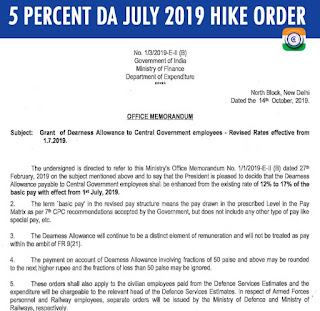
5 Percent DA July 2019 Hike Order - Grant of Dearness Allowance to Central Government employees

Grant of Dearness Allowance to Central Government employees 5 Percent DA July 2019 Hike Order  No. 1/3/2019-E- II (B) Government of...

Blog Archive

About The Author