A complete reference blog for Indian Government Employees

Showing posts with label CCS (CCA) Rules. Show all posts

Tuesday, 13 June 2017

CCS (CCA) Amendment Rules 2017 - Dopt Orders on 2.6.2017

CCS (CCA) Amendment Rules 2017 - Dopt Orders on 2.6.2017

The Central Civil Services (Classification, Control and Appeal) Amendment Rules, 2017

THE GAZETTE OF INDIA : EXTRAORDINARY [PART II-SEC. 3(i)]
MINISTRY OF PERSONNEL, PUBLIC GRIEVANCES AND PENSIONS
(Department of Personnel and Training)
NOTIFICATION
New Delhi, the 2nd June, 2017

G.S.R. 548(E). In exercise of the powers conferred by the proviso to article 309 and clause (5) of article 148 of the Constitution, and after consultation with the Comptroller and Auditor General of India in relation to persons serving in the Indian Audit and Accounts Department, the President hereby makes the following rules further to amend the Central Civil Services (Classification, Control and Appeal) Rules, 1965, namely:-

1. (1) These rules may be called the Central Civil Services (Classification, Control and Appeal) Amendment Rules, 2017.
(2) They shall come into force on the date of their publication in the Official Gazette.

2. In the Central Civil Services (Classification, Control and Appeal) Rules, 1965,-

1. in rule 14,-
(i) for sub-rule (4), the following sub-rule shall be substituted, namely :-
(4) (a) The Disciplinary Authority shall deliver or cause to be delivered to the Government servant a copy of the articles of charge, the statement of the imputations of misconduct or mis behaviour and a list of documents and witnesses by which each article or charges is proposed to be sustained.
(b) On receipt of the articles of charge, the Government servant shall be required to submit his written statement of defence, if he so desires, and also state whether he desires to be heard in person, within a period of fifteen days, which may be further extended for a period not exceeding fifteen days at a time for reasons to be recorded in writing by the Disciplinary Authority or any other Authority authorised by the Disciplinary Authority on his behalf: Provided that under no circumstances, the extension of time for filing written statement of defence shall exceed forty-five days from the date of receipt of articles of charge.

(ii) for sub-rule (13), the following sub-rule shall be substituted, namely:
(13) On receipt of the requisition referred to in sub-rule (12), every authority having the custody or possession of the requisitioned documents shall produce the same or issue a non-availability certificate before the Inquiring Authority within one month of the receipt of such requisition: Provided that if the authority having the custody or possession of the requisitioned documents is satisfied for reasons to be recorded by it in writing that the production of all or any of such documents would be against the public interest or security of the State, it shall inform the Inquiring Authority accordingly and the Inquiring Authority shall, on being so informed, communicate the information to the Government servant and withdraw the requisition made by it for the production or discovery of such document's.

(iii) after sub-rule (23), the following sub-rule shall be inserted, namely:
(24) (a) The Inquiring Authority should conclude the inquiry and submit his report within a period of six months from the date of receipt of order of his appointment as Inquiring Authority.
(b) Where it is not possible to adhere to the time limit specified in clause (a), the Inquiring Authority may record the reasons and seek extension of time from the disciplinary authority in writing, who may allow an additional time not exceeding six months for completion of the Inquiry, at a time.
(c) The extension for a period not exceeding six months at a time may be allowed for any good and sufficient reasons to be recorded in writing by the Disciplinary Authority or any other Authority authorised by the Disciplinary Authority on his behalf;

II. in rule 16,-
(i) in sub-rule (1), in clause (b), for the words, brackets and figure sub-rules (3) to (23) of rule 14, the words, brackets and figure sub-rules (3) to (24) of rule 14”shall be substituted;
(ii) in sub-rule (1-A), for the words, brackets and figure sub-rules (3) to (23) of rule 14, the words, brackets and figure sub-rules (3) to (24) of rule 14 shall be substituted;

III. in rule 19, in the second proviso, after the words against the advice of the Commission, the words within the time limit specified in clause (b) of sub-rule (3) of rule 15, shall be inserted;

IV. in rule 27, in sub-rule (2), in the proviso, in clause (i) after the words against the advice of the Commission, the words "within the time limit specified in clause (b) of sub-rule (3) of rule 15," shall be inserted;

V. in rule 29, in sub-rule (1), in the first proviso, after the words "against the advice of the Commission", the words "within the time limit specified in clause (b) of sub-rule (3) of rule 15," shall be inserted;

VI. in rule 29-A, in the proviso, after the words "against the advice of the Commission", the words "within the time limit specified in clause (b) of sub-rule (3) of rule 15," shall be inserted.
[F. No. 11012/9/2016-Estt.A-111]

GYANENDRA DEV TRIPATHI, Jt. Secy.

Authority: www.dopt.gov.in
Share:

Wednesday, 30 September 2015

Suspension of Government Servant before expiry of 90 days -Review of Suspension

Suspension of Government Servant before expiry of 90 days -Review of Suspension

Controller General of Defence Accounts
Ulan Batar Road, Palam, Delhi Cantt 110010
No.AN/XIII/13006/Vol-XXII
Dated 22.09.2015
To
The PCsDA/CsDA
PCA(Fys)/CFAs(Fys)
PIFAs/IFAs
(Through Website)
Subject : Suspension of Government Servant-Review of Suspension
As per provisions contained in Rule 10 of CCS(CC&A) Rules, 1965 suspension of a Government servant is valid only for 90 days unless it is extended after review before expiry of 90 days. It has been observed by the MoD D(Vigilance) that the suspension order has been struck down on the ground that the same had not been reviewed by the reviewing authority before expiry of 90 days.
 
2. Therefore the Ministry has directed that the provisions of Rule 10(6) and 10(7) of CCS (CC&A) Rules, 1965 which provide for review, modify and extension of the suspension should strictly be observed in all such cases to avoid quashing of orders on technical grounds rather than on merits (copy attached)
3. In this context attention is also invited to DOPT OM No. 11012/4/2003-Estt. (A) dated 07.01.2014 containing review instruction and HQrs letter no. AN/XIII/13007/2A/Vol-IX dated 09.07.2014 regarding constitution of review committee.
 
4. It is requested that all such cases of suspension/review of suspension of Govt. servant may be reviewed on monthly basis in the light of above provisions/guidelines.
 
Please acknowledge receipt.
(V.K. Vijay)
C V O / Jt. CGDA


Most Immediate
Ministry of Defence
D(vigilance)
*******

Subject : Suspension of Government Servants – Review of Suspension order.

Attention is invited to Rule 10 of CCS(CCA) Rules, 1965 relating to Suspension of Govt. Servant by the competent authority on account of disciplinary proceedings pending or contemplated against him, or his engagement in activities prejudicial to the interest of the security of the State, or case pending against him in any criminal offence, or his detention or conviction in a criminal case. The suspension is valid only for 90 days unless it is extended after review for a further period before the expiry of 90 days. Of late the suspension order has been struck down on the ground that the same had not been reviewed by the competent reviewing authority before the expiry of 90 days while it remained in force.
 
2. It is hereby urged that the provisions of Rule 10(6) and Rule 10(7) of CCS(CCA) Rules, 1965 which provide for review, modify and extension of the suspension of the accused should be strictly observed in all such cases to avoid quashing of orders on technical grounds rather than on merits. Such cases may be reviewed on monthly basis by administrative sections of various civilians cadres of Ministry of Defence.

(Atul Kumar Singh)
Director (Vig)
Source: CGDA
[http://cgda.nic.in/adm/circular/suspension24092015.pdf]
Share:

Tuesday, 29 September 2015

Review of Suspension: Suspension of Government Servant before expiry of 90 days

Review of Suspension: Suspension of Government Servant before expiry of 90 days

Controller General of Defence Accounts
Ulan Batar Road, Palam, Delhi Cantt 110010

No.AN/XIII/13006/Vol-XXII
Dated 22.09.2015
To
The PCsDA/CsDA
PCA(Fys)/CFAs(Fys)
PIFAs/IFAs
(Through Website)
Subject : Suspension of Government Servant-Review of Suspension
As per provisions contained in Rule 10 of CCS(CC&A) Rules, 1965 suspension of a Government servant is valid only for 90 days unless it is extended after review before expiry of 90 days. It has been observed by the MoD D(Vigilance) that the suspension order has been struck down on the ground that the same had not been reviewed by the reviewing authority before expiry of 90 days.
2. Therefore the Ministry has directed that the provisions of Rule 10(6) and 10(7) of CCS (CC&A) Rules, 1965 which provide for review, modify and extension of the suspension should strictly be observed in all such cases to avoid quashing of orders on technical grounds rather than on merits (copy attached)
3. In this context attention is also invited to DOPT OM No. 11012/4/2003-Estt. (A) dated 07.01.2014 containing review instruction and HQrs letter no. AN/XIII/13007/2A/Vol-IX dated 09.07.2014 regarding constitution of review committee.
4. It is requested that all such cases of suspension/review of suspension of Govt. servant may be reviewed on monthly basis in the light of above provisions/guidelines.
Please acknowledge receipt.
(V.K. Vijay)
C V O / Jt. CGDA


Most Immediate
Ministry of Defence
D(vigilance)
*******

Subject : Suspension of Government Servants – Review of Suspension order.

Attention is invited to Rule 10 of CCS(CCA) Rules, 1965 relating to Suspension of Govt. Servant by the competent authority on account of disciplinary proceedings pending or contemplated against him, or his engagement in activities prejudicial to the interest of the security of the State, or case pending against him in any criminal offence, or his detention or conviction in a criminal case. The suspension is valid only for 90 days unless it is extended after review for a further period before the expiry of 90 days. Of late the suspension order has been struck down on the ground that the same had not been reviewed by the competent reviewing authority before the expiry of 90 days while it remained in force.
2. It is hereby urged that the provisions of Rule 10(6) and Rule 10(7) of CCS(CCA) Rules, 1965 which provide for review, modify and extension of the suspension of the accused should be strictly observed in all such cases to avoid quashing of orders on technical grounds rather than on merits. Such cases may be reviewed on monthly basis by administrative sections of various civilians cadres of Ministry of Defence.

(Atul Kumar Singh)
Director (Vig)
Source: CGDA
[http://cgda.nic.in/adm/circular/suspension24092015.pdf]
Share:

Tuesday, 23 June 2015

Disciplinary action may be taken against Central Government Employees who are habitual late attendance – Dopt Orders on 22.6.2015

Disciplinary action may be taken against Central Government Employees who are habitual late attendance – Dopt Orders on 22.6.2015

Dopt once again issued orders on the subject of punctuality in Government Offices. The order is directed to take disciplinary action against Central Government employees who are habitual late attendance.

Observance of punctuality in Government Offices – Dopt Orders

G.I., Dept. of Per.& Trg., O.M.No.11013/9/2014-Estt.A-III, dated 22.6.2015

Subject: Observance of punctuality in Government Offices.

Instructions have been issued from time to time with regard to the need to observe punctuality by Government servants. Responsibility for ensuring punctuality in respect of their employees rests within Ministries/ Departments/ Offices.

2. The decision to introduce AADHAR enabled Bio-metric Attendance System (AEBAS) in Central Government offices, including attached/ sub-ordinate offices, to replace the manual system of marking of attendance to ensure punctuality is to be implemented in all Ministries/ Departments. This Department vide O.M. of even no. dated 21.11.2014 and 28.01.2015, while recognizing that the Biometric Attendance System is only an enabling platform had, inter-alia, stated that there was no change in the instructions relating to office hours, late attendance etc.

3. In this connection attention is invited to Rule 3(1)(ii) of CCS (Conduct) Rules, 1964 which stipulates that every Government servant shall at all times maintain devotion to duty. Habitual late attendance is viewed as conduct unbecoming of a Government servant and disciplinary action may be taken against such a Government servant. It is also added that punctuality in attendance is to be observed by Government servants at all levels.

4. It is also requested that the necessary directions may be issued to all employees to mark their attendance in BAS portal on regular basis.

Click to view the original order

Authority: www.persmin.gov.in
Share:

Friday, 21 November 2014

Advice of the UPSC to be communicated to the delinquent Government servant – Amendment

 Central Civil Services (Classification, Control and Appeal) Rules, 1965 – Advice of the Union Public Service Commission (UPSC) to be communicated to the delinquent Government servant – Amendment – regarding


 F. No.11012/8/2011-Estt.(A)
Government of India
Ministry of Personnel, PG & Pensions
Department of Personnel & Training


North Block, New Delhi- 110 001
Dated November 19th, 2014

 
OFFICE MEMORANDUM

Subject: Central Civil Services (Classification, Control and Appeal) Rules, 1965 – Advice of the Union Public Service Commission (UPSC) to be communicated to the delinquent Government servant – Amendment – regarding

The Hon’ble Supreme Court in its judgment on 16.03.2011, while dismissing the Civil Appeal No. 5341 of 2006 in the matter of Union of India & Ors. v/s S. K. Kapoor, had held that it is a settled principle of natural justice that if any material is to be relied upon in departmental proceedings, a copy of the same must be supplied in advance to the charge sheeted employee so that he may have a chance to rebut the same. The Hon’ble Court also observed that there may be a case where the report of the Union Public Service Commission (UPSC) is not relied upon by the disciplinary authority and in that case it is certainly not necessary to supply a copy of the same to the concerned employee. However, if it is relied upon, then a copy of the same must be supplied in advance to the concerned employee, otherwise, there will be violation of the principles of natural justice.

2. The matter was examined in consultation with Department of Legal Affairs and it was decided that in compliance of the above judgement, a copy of the advice of UPSC, if consulted, may be provided to the Charged Officer, before a final decision is taken in disciplinary proceedings. As the UPSC are also consulted in the processes relating to Appeal and Review, it was decided to also extend the benefit of supply of the advice to these cases as well.

3. The rules 15, 16, 17, 19, 27, 29 and 29-A of the Central Civil Service (Classification, Control and Appeal) Rules, 1965, have since been amended vide G.S.R. No. 769(E) dated 31.10.2014. A copy of the Gazette Notification is enclosed. The Notification is also available on the website of this Department at http://persmin.nic.in/DOPT.asp under OM & Orders -> Establishment -> CCS (CCA Rules). There is no change in the procedure upto the stage of consultations with UPSC. The amendment provides that a copy of UPSC advice is to be supplied to the Government servant and his representation, if any, on such advice is to be considered by the Disciplinary/ Appellate/ Revisionary/ Reviewing Authority, as the case may be, before passing the final order.

4. In brief, in the disciplinary cases, where the UPSC are to be consulted, the following procedure should be adopted:

a) The Disciplinary Authority shall forward or cause to be forwarded to UPSC for its advice:

(i) a copy of the report of the Inquiring Authority together with its own tentative reasons for disagreement, if any, with the findings of Inquiring Authority on any article of charge; and

(ii) comments on the representation of the Government servant on the Inquiry report and disagreement note, if any, with all the case records of the inquiry proceedings.

b) On receipt of the UPSC advice, the Disciplinary Authority shall forward or cause to be forwarded a copy of the advice to the Government servant who shall be required to submit, if he so desires, his written representation/ submission to the Disciplinary Authority within fifteen days. The Disciplinary Authority shall consider such representation and take action as prescribed in sub-rules (4), (5) and (6) of Rule 15 of CCS (CCA) Rules, 1965.

5. Similarly, in matters relating to Appeal/ Revision/ Review, a copy of the UPSC advice, if consulted, may be supplied to the Government servant and his representation, if any, thereon may be considered by the Appellate/ Revisionary/ Reviewing Authority before passing final orders.

6. All Ministries/ Departments/Offices are requested to bring the revised guidelines to the notice of all concerned authorities under their control.

7. Hindi version will follow.
sd/-
(J. A. Vaidyanathan)
Director (Establishment)


Source: www.persmin.gov.in
[http://ccis.nic.in/WriteReadData/CircularPortal/D2/D02est/11012_8_2011-Estt.A-19112014.pdf]
Share:

Circumstances for Suspension and Timely review of Suspension: Instructions under CCS(CCA) Rules, 1965

Circumstances for Suspension and Timely review of Suspension: Instructions under CCS(CCA) Rules, 1965

 Central Civil Service (Classification, Control and Appeal) Rules, 1965 — Circumstances under a Government Servant may be placed under suspension and timely review of suspension: DoPT Order


F. No. 11012/17/2013-Estt.A-III
Government of India
Ministry of Personnel, Public Grievances & Pensions
Department of Personnel and Training
Establishment Division


North Block, New Delhi — 110001
Dated November 18th 2014


OFFICE MEMORANDUM


Subject: Central Civil Service (Classification, Control and Appeal) Rules, 1965 — Instruction regarding timely review of suspension.

Rule 10 of the Central Civil Services (Classification, Control and Appeal) Rules, 1965, deals with the provisions of suspension. As per the rule, a Government servant may be placed under suspension, in the following circumstances:

(a) where a disciplinary proceeding against him is contemplated or is pending; or
(b) where, in the opinion of the authority aforesaid, he has engaged himself in activities prejudicial to the interest of the security of the State; or
(c) where a case against him in respect of any criminal offence is under investigation, inquiry or trial:

2. A Disciplinary Authority may also consider it appropriate to place a Government servant under suspension in the following circumstances. These are only intended for guidance and should not be taken as mandatory:-
(i) Cases where continuance in office of the Government servant will prejudice the investigation, trial or any inquiry (e.g. apprehended tampering with witnesses or documents);
(ii) where the continuance in office of the Government servant is likely to seriously subvert discipline in the office in which the public servant is working;
(iii) where the continuance in office of the Government servant will be against the wider public interest [other than those covered by (i) and (ii)] such as there is public scandal and it is necessary to place the Government servant under suspension to demonstrate the policy of the Government to deal strictly with officers involved in such scandals, particularly corruption;
(iv) where allegations have been made against the Government servant and preliminary inquiry has revealed that a prima facie case is made out which would justify his prosecution or is being proceeded against in departmental proceedings, and where the proceedings are likely to end in his conviction and/or dismissal, removal or compulsory retirement from service.


3. In the first three circumstances the Disciplinary Authority may exercise his discretion to place a Government servant under suspension even when the case is under investigation and before a prima facie case has been established. Suspension may be desirable in the circumstances indicated below:-
(i) any offence or conduct involving moral turpitude;
(ii) corruption, embezzlement or misappropriation of Government money, possession of disproportionate assets, misuse of official powers for personal gain;
(iii) serious negligence and dereliction of duty resulting in considerable loss to Government
(iv) desertion of duty;
(v) refusal or deliberate failure to carry out written orders of superior officers In respect of the types of misdemeanor specified in sub-clauses (iii) and
(v) discretion has to be exercised with care.
3. Rules 10(6) and 10(7) of the CCS (CCA) Rules, 1965, deal with review of the suspension cases. The provision for review within ninety day is applicable to all types of suspensions. However, in cases of continued detention, the review becomes a mere formality with no consequences as a Government servant in such a situation has to continue to be under deemed suspension. A review of suspension is not necessary in such cases.

4. It has been brought to the notice of this Department that in cases of prolonged suspension period, the courts have pointed out that the suspension cannot be continued for long and that inspite of the instructions of DoP&T, the Disciplinary Authorities are not finalizing the disciplinary proceedings within the stipulated time. Also, in such cases the Government is unnecessarily paying subsistence allowance without extracting any work and if, on the culmination of the disciplinary proceedings, the charged officer is exonerated from the charges, the Government has to unnecessarily pay the full salary and treat the period of suspension as on duty etc.. It is, therefore, desirable that timely review of suspension is conducted in a just and proper manner and that the disciplinary proceedings are finalized expeditiously.

5. All Ministries/ Departments are requested to bring the existing instructions on timely review of suspension and expeditious completion of disciplinary proceedings to the notice all concerned under their control.


(J.A.Vaidyanathan)
Director(Establishment)


Source: www.persmin.nic.in
[http://ccis.nic.in/WriteReadData/CircularPortal/D2/D02est/11012_17_2013-Estt.A-III-18112014.pdf]
Share:

Wednesday, 12 November 2014

Central Govt employee opts for a surrogate child – What says CCS (Leave) Rules..?

Central Govt employee opts for a surrogate child – What says CCS (Leave) Rules..?

Can Central Govt Female Employees Opting for Surrogate Pregnancy Claim Maternity Leave?

Parenthood is a gift of god. Thanks to the development in medical sciences, childless couples can now opt for surrogate pregnancies. If women employees of Central Government organizations opt for surrogate pregnancies, can they claim maternity leave?

Women employees of Central Government establishments are given Maternity leave for a period of 180 days and male employees are given Paternity Leave for a period of 15 days if they choose to adopt babies. At present, there is no leave entitlements for parents of the surrogate child.

Let’s see what the Indian medical Research Council has to say about couples who choose to have babies through surrogate mothers.


Surrogacy: General Considerations

A child born through surrogacy must be adopted by the genetic (biological) parents unless they can establish through genetic (DNA) fingerprinting (of which the records will be maintained in the clinic) that the child is theirs.Guidelines for ART Clinics in India ICMR/NAMS

Surrogacy by assisted conception should normally be considered only for patients for whom it would be physically or medically impossible/undesirable to carry a baby to term.

Payments to surrogate mothers should cover all genuine expenses associated with the pregnancy. Documentary evidence of the financial arrangement for surrogacy must be available. The ART centre should not be involved in this monetary aspect.

Advertisements regarding surrogacy should not be made by the ART clinic. The responsibility of finding a surrogate mother, through advertisement or otherwise, should rest with the couple, or a semen bank.

A surrogate mother should not be over 45 years of age. Before accepting a woman as a possible surrogate for a particular couple’s child, the ART clinic must ensure (and put on record) that the woman satisfies all the testable criteria to go through a successful full-term pregnancy.

A relative, a known person, as well as a person unknown to the couple may act as a surrogate mother for the couple. In the case of a relative acting as a surrogate, the relative should belong to the same generation as the women desiring the surrogate.

A prospective surrogate mother must be tested for HIV and shown to be seronegative for this virus just before embryo transfer. She must also provide a written certificate that (a) she has not had a drug intravenously administered into her through a shared syringe, (b) she has not undergone blood transfusion; and (c) she and her husband (to the best of her/his knowledge) has had no extramarital relationship in the last six months.

(This is to ensure that the person would not come up with symptoms of HIV infection during the period of surrogacy.) The prospective surrogate mother must also declare that she will not use drugs intravenously, and not undergo blood transfusion excepting of blood obtained through a certified blood bank.

No woman may act as a surrogate more then thrice in her lifetime

Share:

Central Civil Services (Classification, Control and Appeal) (Second Amendment) Rules, 2014

Central Civil Services (Classification, Control and Appeal) (Second Amendment) Rules, 2014

THE GAZETTE OF INDIA EXTRAORDINARY
[PART II—Sec 3(i)]
MINISTRY OF PERSONNEL, PUBLIC GRIEVANCES AND PENSIONS
(Department of Personnel and Training)

NOTIFICATION
New Delhi, the 31st October, 2014

G.S.R. 769(E).- In exercise of the powers conferred by the proviso co article 309 and clause (5) of article 148 of the Constitution, and after consultation with the Comptroller und Auditor General of India in relation to persons serving in the Indian Audit and Accounts Department, the President hereby makes the following rules further to amend the Central Civil Services (Classification, Control and Appel) rules 1965 namely—

1. (I) These rules may be called the Central Civil Services (Classification, Control and Appeal) (SecondAmendment) Rules, 2014.

(2) They shall come into force on the date of their publication in the Official Gazette.
2. In the Central Civil Services (Classification. Control and Appeal) Rules, 1965 (hereinafter referred to as the said rules)
(a) In rule I5, for sub-rules 2A, 3 and 4, the following sub-rules shall be substituted, namely: —

3) (a) In every case where it ta necessary to consult the Commission, the Disciplinary Authority shall forward or cause to be forwarded to the Commission for its advice:
(i) a copy of the report of the Inquiring Authority together with its own tentative reasons for disagreement, if any, with the findings of Inquiring Authority on any article of charge; and
(ii) comments of Disciplinary Authority on the representation of the Government servant on the Inquiry report and disagreement note, if any and all the cue records of the inquiry proceedings
(b) The Disciplinary Authority shah forward or cause to be forwarded a copy of the advice of the Commission received under clause (a) to the Government savant, who shall be required to submit, if he so desires, his written representation or submission to the Disciplinary Authority within fifteen days, on the advice of the Commission

(4) The Disciplinary Authority shall consider the representation under sub-rule (2) and/ or clause (b) of sub-rule (3), if any, submitted by the Government servant and record its findings before proceeding further in the matter as specified in sub-rules (5) and (6).

(5) If the Disciplinary Authority having regard to its findings on all or any of the articles of charge is of the opinion the any of the penalties specified in clauses (I) to (iv) of rule 11 should be imposed on the Government servant, it shall, notwithstanding anything contained in rule 16, make an order imposing such penalty.

(6) If the Disciplinary Authority having regard to its findings on ail or any of the articles of charge and on the basis of the evidence adduced during the inquiry Is of the opinion that any of the penalties specified in clauses (V) to (ix) of rule 11 should be imposed on the Government servant, it shall make an order imposing such penalty and it shall not be necessary to give the Government savant any opportunity of making representation on the penalty proponed to be imposed.”;
(b) In rule 16,—
(i) in sub-rule (I),-
(A) for the words, brackets and figure “sub-rule (3)”, the words, brackets and figure ‘sub-rule (5)” shall be substituted;
(B) for clauses (d) and (e), the following clauses shah be substituted; namely: —
“(d) Consulting the Commission where such consultation is necessary. The Disciplinary Authority shall forward or cause to be forwarded a copy of the advice of the Commission to the Government servant, who shall be required to submit, if he so desires, his written representation or submission on the advice of the Commission, to the Disciplinary Authority within fifteen days; and
(e) recording a finding on each imputation or misconduct or misbehavior.”
(ii) in sub-rule (2) for clauses (vi) and (vii), the following clauses shall be substituted,
“(vi) representation, if any, of the Government servant on the advice of the Commission:
(vii) the findings on each imputation of misconduct or misbehavior; and
(viii) the orders on the case together with the reasons therefor.;
(C) In rule 17, the words “and also a copy of the advice, if any, given by the Commission,” shall be deleted;

(d) In rule 19, in the second proviso, after the words “where such consultation ta necessary”, the words “and the Government servant has been given an opportunity of representing against the advice of the Commission.” shall be added;.

(e) In rule 27, in sub-rule (2), in the proviso, in clause (i) alter the words “where such consultation is necessary” the words “and the government servant has been given an opportunity of representing against the advice of the Commission,” shall be added:

(f) In rule 29, in sub-ruIe (1) in the first proviso, after the words “where such consultation is necessary”. the words“ and the Government servant has been given an opportunity of representing against the advice of the Commission shall be added:

(g) In rule 29-A, in the proviso, after the words “where such consultation is necessary”, the words “and the Government servant has been given an opportunity of representing against the advice of the Commission.” shall be added;

(h) In rule 32 shall be omitted.
[F. No. 11012/8/2011-Estt.(A)]
MAMTA KUNDRA, Jt. Secy.
Source: www.persmin.gov.in
Share:

Featured post

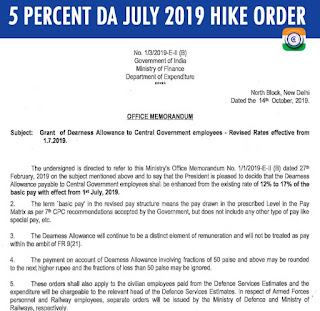
5 Percent DA July 2019 Hike Order - Grant of Dearness Allowance to Central Government employees

Grant of Dearness Allowance to Central Government employees 5 Percent DA July 2019 Hike Order  No. 1/3/2019-E- II (B) Government of...

Blog Archive

About The Author