A complete reference blog for Indian Government Employees

Friday, 15 March 2019

7th Central Pay Commission regulating Casualty Pensionary Award for Defence Forces pensioners/family pensioners - PCDA Circular 618


7th Central Pay Commission regulating Casualty Pensionary Award for Defence Forces pensioners/family pensioners - PCDA Circular 618

7th Central Pay Commission regulating Casualty Pensionary Award for Defence Forces pensioners


Office of the Principal CDA(Pensions)
Draupadi Ghat, fillafia6ad- 211014
Circular No. 618
Dated: 13/03/2019
To,
  1. The Chief Accountant, RBI, Deptt. Of Govt. Bank Accounts, Central office C-7, Second Floor, Bandre- Kuria Complex, P B No. 8143, Bandre East Mumbai- 400051
  2. All CMDs, Public Sector Banks including IDBI Bank
  3. Nodal Officers, ICICl/ HDFC/ AXIS/ IDBI Banks
  4. Managers, All CPPCs
  5. Military and Air Attache, Indian Embassy, Kathmandu, Nepal
  6. The PCDA (WC), Chandigarh
  7. The CDA (PD), Meerut
  8. The CDA, Chennai
  9. The Director of Treasuries, All States
  10. The Pay and Accounts Officer, Delhi Administration, RK Puram and Tis Hazari, New Delhi
  11. The Pay and Accounts Office, Govt of Maharashtra, Mumbai
  12. The Post Master Kathua (J&K)
  13. The Post Master Camp Bell Bay
  14. The Pr. Pay and Accounts Officer, Andaman and Nicobar Administration, Port Blair
Subject: Implementation of Government decision on the recommendations of the Seventh Central Pay Commission- Provisions regulating Casualty Pensionary Award for Defence Forces pensioners/family pensioners-regarding.

Reference: This office Circular No. 570 dated 31.10.2016, Circular No. 582 dated 5.09.2017, Circular No. 585 dated 21.09.2017 and Circular No. 584 dated 07.09.2017.
Copy of GUI, MoD letter No. 16(3)/2017/D(Pen/Policy) dated 29th January 2019 on the above subject, which is self-explanatory, is forwarded herewith as annexure to this circular for further necessary action at your end.

2. As per ibid Govt. letter, it has been decided that following minimum ceiling shall be applied to the under mentioned casualty pensionary awards:
  • The Disability/Liberalized Disability/War Injury pension (i.e. total of service element plus disability/liberalized disability/war injury element as the case may be), shall be subject to minimum of Rs.18,000/- per month irrespective of degree of disability of the personnel.
  • The amount of special family pension,admissible to the families of Armed Forces personnel, shall be subject to a minimum of Rs.18,000/- per month.
  • The amount of liberalized family pension, admissible to the Child/Children of Armed Forces Personnel, shall be subject to a minimum of Rs.18,000/- per month.
3. All other provisions stipulated in above mentioned circulars which are not affected by the provisions of this letter, shall remain unchanged.

4. the provisions of this letter shall take effect from 01.01.2016

5. This circular has been uploaded on this office website www.pcdapension.nic.in for dissemination to all along with Defence pensioners and pension Disbursing Agencies.
sd/-
(Sandeep Thakur)
Addl CDA (P)
Share:

PCDA Circular 619: Deletion of note of conditional sanction printed in PPOs of Pre-01.01.2006 retirees Havildar granted Hony Rank of Naib Subedar

PCDA Circular 619: Deletion of note of conditional sanction printed in PPOs of Pre-01.01.2006 retirees Havildar granted Hony Rank of Naib Subedar

Office of the Prinapar CDA(Pensions)
Draupadi Ghat, fillafia6ad- 211014
Circular No. 619
Dated: 14/03/2019
Subject: Regarding deletion of note of conditional sanction printed in PPOs of Pre-01.01.2006 retirees Havildar granted Hony Rank of Naib Subedar in compliance of Honbie High Courts and AFTs orders.

In compliance of various court orders, conditional sanctions were being issued by AG/P5-4 (Pen/Legal), IHQ (Mob), New beihi in respect of Pre-01.01.2006 retiree Havildars granted Hony rank of Naib Subedar for implementing Gol, Mob letter dated 12.06,2009 in their cases. Accordingly, corrigendum PPOs were/are being issued notifying their pension w.e.f. 01.01.2006 @ Rs. 8450/- for Group “X” and ( Rs. 7750/- for Group .Y and “Z as per the provisions of ibid Mob letter by this office. These Corrigendum PPOs have a Note containing that condition as “The sanction will, however, be subject to the final outcome of appeal, if any filed before the Hon’ble Supreme Court of India. In the event, the appeal is decided in favour of liaI, the petitioners shall be liable to refund the entire amount paid to him under the ibid sanction”.
  1. Of late, it has been observed that large number of such cases of pre 01.01.2006 retiree Hcivildar granted Hony rank of Naib Subedar for grant of pension in terms of Gol, Mob letter dated 12.06.2009 were decided by the various Courts/AFTS. Now, AG/PS- 4 (Pen/Legal), IHQ of Mob, New beihi has started converting conditional sanction into absolute sanction by deleting the ibid contents as printed in Note of Corrigendum PPO of these cases. Large number of such type of sanctions for deleting conditional sanction are being received in this office from Record Offices concerned for issuing Corr. PPO for deleting that Note of conditional sanction in respect of pre-01.01.2006 retiree Havildar granted Hony rank of Naib Subedar.
  2. As large number of Corr. PPOs are to be issued in such cases without any financial bearing or other changes, as such, it has been decided by the competent authority that the note The sanction will, however, be subject to the final outcome of appeal, if any filed before the Hon’ble Supreme Court of India. In the event, the appeal is decided in favour of UoI, the petitioners shall be liable to refund the entire amount paid to him under the ibid sanction” as printed in the respective PPO of those pre-01.01.2000 retirees Havildars granted Hony rank of Naib Subedar issued in compliance of the Court/AFT orders. may be treated as deleted.
  3. It is further reiterated that deletion of ibid note will be applicable only where Service Pension w.e.f. 01.01.2006 @ Rs. 8450/- for Group X and @ Rs. 7750/- for Group and Group Z were notified in compliance of various Courts/AFTS orders in respect of Pre-01.01.2006 retiree Havildar granted Hony rank of Naib Subedar and not in other cases.
  4. This circular has been uploaded on this office website www.pcdapension.n
sd/-
(Sandeep Thakur)
Addl CbA (P)
Share:

Proposal to include in the election manifesto of your party with regard to the scrapping of the National Pension System

Suggestion to include the right of Central Government employees in your party's election manifesto regarding the scrapping of the National Pension System

Proposal to include in the election manifesto of your party with regard to the scrapping of the National Pension System

"If you will be able to indicate your intention to replace the present new contributory scheme with the old Statutory Pension structure, in your manifesto, it might help immensely to elicit the support of the Central Government employees and their family members to your party candidates in the ensuing general election."
Proposal to include in the election manifesto of your party with regard to the scrapping of the National Pension System


 NJCA
National Joint Council of Action
4, State Entry Road, New Delhi - 110055
No.NC-JCM-2019/NPS
March 8, 2019
To
The Chief Executive,
All Recognised National and State level Political Parties

Sub:- Proposal to include in the election manifesto of your party with regard to the scrapping of the National Pension System which has taken away the pension right of Central Government Employees

Dear Sir /Madam,

We write this on behalf of the organisations of the Central Government employees participating in the Joint Consultative Machinery, set up by the Government of India in 1960s as a negotiating forum to settle various demands and grievances of the employees through discussions. In the meeting that was held on 8th February, 2019, of the Standing committee of the National Council, Staff Side, it was unanimously decided that I in my capacity as the Secretary, Staff side National Council, must write to you to draw your kind attention to one of the most significant demands of the Central Government employees i.e. to replace the newly introduced contributory pension scheme with the old statutory defined Pension system and also to restore the GPF Scheme which was withdrawn by the Government. I have been asked to seek your support to this vital demand of the employees especially of the young workers who have entered government service after 1.1 .2004 and obtain an assurance from you that you will accede to the demand for the withdrawal of the New contributory scheme to replace it with the old Statutory pension system if elected to power in the ensuing general elections to constitute the Lok Sabha. Before going into the difficulties being faced by the employees governed under the New Contributory Pension Scheme which is at present christened as “National Pension System (NPS)”, I would like to invite your attention to the historical judgment delivered by the Hon’ble Supreme Court by a 5 Member Bench consisting of Hon’ ble Chief Justice Y.B.Chandrachud. The Hon’ble Supreme Coutt in this case has analyzed in detail the entire issue of Pension. The most impotant portion of the above historical judgment is reproduced below for your kind consideration please.

“From the discussions 3 things emerge
 (i) that pension is neither a bounty nor a matter of grace depending upon the sweeting of the employer and that it creates a vested rights subject to 1972 Rules which are statutory in character, because they are enacted in exercise of powers conferred by the proviso to Article 309 and Clause (5) of article 148 of the constitution,
(ii) that Pension is not an ex-gratia payment but it is a payment for the past service rendered and
(iii) it is a social welfare measure rendering socio economic justice to those who in the heyday of their life ceaselessly toiled for the employer on an assurance that in their old age they would not be left in the lurch.”

As you are aware Sir/Madam, that the new contributory pension scheme was introduced by the then NDA Government in 2004 initially through an executive fiat. Later, rather much later, a bill was introduced in the Parliament to enact the Pension Fund Regulatory and Development Authority. After the promulgation of the Notification in 2004, many State Governments adopted the scheme to cover their employees, the only exception being the State of West Bengal presently. The ostentatious reason adduced at the time of promulgation of the Notification and thereafter at the time of the introduction of the PFRDA bill, was the ever increasing financial outflow on pension account, which makes fiscal deficit management difficult. Prima facie the said reason appeared to be true as the quantum of outflow on account of Pension had been on increase. But the fact that it had always been on rise was concealed as also the one that as a percentage to the GDP, the pension payment had been continuously dwindling over the years.

The employees organisations had been pointing out to the Government that the desired objective of containing pension outflow would not come about for the next four decades. When the probable drastic reduction in pension under the new scheme was raised by the Staff Side in the National Council, the Government stated that under the new dispensation, employees will become entitled more annuity than the then existing entitlement of Pension, this assurance was given in writing by Government in the Standing Committee Meeting of the National Council (JCM) held under the Chairmanship of Secretary (Personnel) on 14th December, 2007 and went on to assure the Government’s intervention if things turns out otherwise. It is also pertinent to mention here that the Government has exempted the Armed Force Personnel from the NPS and they continue to be in the old Pension Scheme. If the NPS is so attractive then why the Government has exempted them from NPS. This is a clear proof that the NPS is vety much detrimental when compare to the old Pension Scheme.

The scheme is presently in vogue for the last 15 years. A few employees who were originally recruited as casual workers but got regularised later (retired before completion of the 33 or 35 years of service.) They were given a paltry amount as pension amounting to less than Rs, 2000. Had they been covered under the old Pension scheme, they would have certainly got more than 20,000 as pension. The new scheme has thus become “NO pension scheme’. The new scheme has thus created consternation of a very high order amongst the employees as they rightly feel that their hard earned savings are in effect compulsorily channelled to benefit the corporate entities. Since the Govt. will have to contribute equal amount or more (now 14%)the same would act in future as a real drain on the resources of the Government and will cause hardship in the form of increased tax liability. The anger and discontent of the employees have manifested itself in huge demonstrations and such other programmes and some of them have even resorted to strike action.

We are proud to mention that our principled opposition to the scheme right from the beginning, when it was introduced by the then NDA Government, has now been vindicated as it neither benefits the subscriber nor the Nation. Incidentally we may point out that in the wake of the 6th CPC, Government agreed to set up an expert committee under the chairmanship of Dr.Gayatri, at the Indian institute of social sciences to look into all aspects of the New Pension scheme. The committee has clearly indicated that the new scheme will draw more funds from the exchequer in the coming 40 years, before any reduction in the outflow could be brought about.

We fervently feel that the new contributory scheme must be replaced by the old Pension Scheme under the CCS (Pension) Rules, 1972. If you will be able to indicate your intention to replace the present new contributory scheme with the old Statutory Pension structure, in your manifesto, it might help immensely to elicit the support of the Central Government employees and their family members to your party candidates in the ensuing general election.

We shall also be grateful for favour of a word in response to this communication from your end.
With kindest regards,
Yours sincerely,
(Shiva Gopal Mishra)
Convener
Source: ncjcmstaffside.com

Share:

Thursday, 14 March 2019

Clarification on applicability of "Very Good" benchmark for financial upgradation under MACPS and consideration of "Good" benchmark for the previous years before 25.07.2016

Clarification on applicability of "Very Good" benchmark for financial upgradation under MACPS - DOP

MACP

No.7-8/2016-PCC (Pt.)
Government of India
Ministry of Communications
Department of Posts
Dak Bhawan, Sansad Marg
New Delhi - 110001
Dated: 13.03.2019
To
All Chief Postmasters General/Postmasters General.

Sub : Clarification on applicability of "Very Good" benchmark for financial upgradation under MACPS and consideration of "Good" benchmark for the previous years before 25.07.2016.

This office is in receipt of large number of references consequent upon the clarification issued vide DG Posts' letter of even number dated 02.07.2018 on the above mentioned subject, regarding allowing opportunity of making representation against 'good' benchmark and relaxation of benchmark for MACPS.

2. In this context, it is reiterated that opportunity of making representation against the APAR which are post 2009 cannot be given as it is already disclosed to the employees in APAR process.

3. Further, the benchmark for the purpose of financial upgradation under MACP was enhanced from 'good' to 'very good' w.e.f. 25.07.2016 i.e prior to 25.07.2016 the benchmark was ‘good’ for MACPS. As such, the 'good' grading of APAPRs for the period prior to 25.07.2016 may be considered for financial upgradation under MACPS. However, the "very good" benchmark applicable w.e.f. 25.07.2016 cannot be relaxed for MACPS.

4. All concerned may be informed accordingly.
(S.B.Vyavahare)
Assistant Director General (GDS/PCC)
Tel. No. 011-23096629
Email-adggds@indiapost.gov.in
Share:

Election Commission: Schedule for bye-elections to fill casual vacancies from 64 - Dhrangadhra AC and 85 - Manavadar AC in the State Legislative Assembly of Gujarat


Election Commission
Schedule for bye-elections to fill casual vacancies from 64 - Dhrangadhra AC and 85 - Manavadar AC in the State Legislative Assembly of Gujarat
14 MAR 2019
The Election Commission of India has decided to hold bye-elections to fill casual vacancies from 64 - Dhrangadhra AC and 85 - Manavadar AC in the State Legislative. Assembly of Gujarat.

After taking into consideration various factors like, festivals, electoral rolls, etc., the Commission has decided to hold the bye-elections to these 2 Assembly Constituencies following the same schedule as for the relevant Parliamentary Constituency as per the programme mentioned as under:

Sl No.EventDate
1Issue of Notification28.03.2019
2Last date of making Nominations04.04.2019
3Scrutiny of Nominations05.04.2019
4Last date for withdrawal of Candidatures08.04.2019
5Date of Poll23.04.2019
6Counting of Votes23.05.2019
7Date before which election shall be completed27.05.2019

ELECTORAL ROLL
The electoral rolls of the Assembly Constituencies where bye-elections are being held have been revised with reference to 01.01.2019 as the qualifying date.

ELECTRONIC VOTING MACHINES (EVMs) & VVPATs
The Commission has decided to use EVMs & VVPATs in the bye-elections in all the polling stations. Adequate numbers of EVMs have been made available and all steps have been taken to ensure that the polls are conducted smoothly with the help of these machines.

IDENTIFICATION OF VOTERS
In consonance with the past practice, the Commission has decided that the voter’s identification shall be mandatory in the aforementioned bye- elections at the time of poll. Electoral Photo Identity Cards (EPIC) shall be the main document of identification of a voter. However, in order to ensure that no voter is deprived of his/her franchise, if his/her name figures in the Electoral Rolls, separate instructions will be issued to allow additional documents for identification of voters at the time of poll in the said bye-elections.

MODEL CODE OF CONDUCT
The Model Code of Conduct shall come into force with immediate effect in the district(s) in which the whole or any part of the Assembly Constituencies going for bye-elections is included, subject to partial modification as issued vide Commission’s instruction No. 437/6/INST/2016/CCS, dated 29th June, 2017 (available on the Commission’s website). The Model Code of Conduct shall be applicable to all candidates, political parties and the State Government concerned. The Model Code of Conduct shall also be applicable to the Union Government for the State concerned.

PIB
Share:

DA to Armed Forces Officers and PBOR from Jan 2019

Payment of Dearness Allowance to Armed Forces Officers and Personnel Below Officer Rank including NCs(E) - Revised rates effective from 01.01.2019

DA to Armed Forces Officers and PBOR from Jan 2019

No. 1(2)/2004/D(Pay/Services)
Government of India
Ministry of Defence
New Delhi, the 11th March, 2019
To
The Chief of the Army Staff
The Chief of the Air Staff
The Chief of Naval Staff

Subject : Payment of Dearness Allowance to Armed Forces Officers and Personnel Below Officer Rank including NCs(E) - Revised rates effective from 01.01.2019.

Sir,

I am directed to refer to this Ministry's letter No. 1(2)/2004-D(Pay/Services) dated 18th September 2018, on the subject cited above and to say that the President is pleased to decide that the Dearness Allowance payable to Armed Forces Officers and Personnel Below Officer Rank, including Non-Combatants (Enrolled), shall be enhanced from the existing rate of 9% to 12% with effect from 01.01.2019.

2. The term 'basic pay' in the revised pay structure means the pay drawn in the prescribed Level in the Pay Matrix as per 7th CPC recommendations accepted by the Government, but does not include any other type of pay like special pay, etc.

3. The Dearness Allowance will continue to be a distinct element of remuneration and will not be treated as pay within the ambit of Pay rules of Defence Force Personnel.

4. The payment on account of Dearness Allowance involving fractions of 50 paise and above may be rounded to the next higher rupee and the fractions of less than 50 paise may be ignored.

5. The payment of arrears of Dearness Allowance shall not be made before the date of disbursement of salary of March, 2019.

6. This letter issues with the concurrence of Finance Division of this Ministry vide their Dy. No. 63-PA dated 07.03.2019 based on Ministry of Finance (Department of Expenditure) O.M. No. 1/1/2019-E-II(B), dated 27th February 2019.
Your faithfully,
(Arun Kumar)
Under Secretary to the Government of India

Share:

DoPT: Master Circular on Probation/ Confirmation in Central Services

DoPT: Master Circular on Probation/ Confirmation in Central Services

No.28020/3/2018-Estt.(C)
Government of India
Ministry of Personnel, PG Pensions
Department of Personnel & Training
North Block, New Delhi
Dated: 11th March, 2019
OFFICE MEMORANDUM

Subject: Master Circular on Probation/ Confirmation in Central Services- reg.

The undersigned is directed to refer to this Department’s O.M.No.28020/1/2010-Estt.(C) dated 21.07.2014 wherin consolidated instructions on Probation/Confirmation were Issued.
It has been decided to further consolidate/ modify the instructions/ guidelines in relation to probation and confirmation as a Master Circular to provide clarity and ease of reference. The Master Circular issued vide O.M. dated 21.07.2014 has been suitably updated as on date and the same is enclosed. The list of O.M.s which have been referred for consolidation of instructions for this Master Circular is at Appendix.
sd/-
Umesh Kumar Bhatia)
Deputy Secretary to the Government of India

MASTER CIRCULAR ON PROBATION AND CONFIRMATION IN CENTRAL SERVICES

PROBATION

  1. A person is appointed on probation in order to assess his suitability for absorption in the service to which he has been appointed. Probation should not, therefore, be treated as a mere formality No formal declaration shall be necessary in respect of appointment on probation. The appointing authority may declare successful completion or extend the period of probation or terminate the services of a temporary employee on probation, on the basis of evaluation or performance.
  2. Probation is prescribed when there is direct recruitment, promotion from One Group to another or for officers re-employed before the age of superannuation. The probation shall stand successfully completed upon issue of orders in writing. It is, however, not desirable that a Government servant should be kept on probation for long periods.
  3. Instead Of treating probation as a formality, the existing powers to discharge probationers should be systematically and vigorously used so that the necessity of dispensing with the services of employees at later stages may arise only rarely.
  4. Concentration of attention on the probationer’s ability to pass the probationary or the departmental examination, if applicabh2, should be an essential part of the qualification for confirmation but there should be a very careful assessment of the outlook, character and aptitude for the kind of work that has to be done in the service before a probationer is confirmed.
  5. A probationer be given an opportunity to Work under more than one officer during this period and reports of his work may be obtained from each one of those officers. The probation reports for the whole period may then be considered by a Board of senior officers for determining whether the probationer concerned is fit to be confirmed in service- For this purpose, separate forms of report should be used, which are distinct. from the usual Annual Performance Appraisal Report (APAR) forms. The probation period reports, unlike APAR, are written to help the supervising officer to concentrate on the special needs Of probation end to decide whether the work and conduct of the officer during the period of probation or the extended period of probation are satisfactory enough to warrant his further retention in service or post- The probation period reports thus do not serve the purpose for which the APARs are written and vice versa. Therefore, m the case of all probationers or officers on probation, separate probation period reports should be written in addition to the usual APARS for the period of probation.
  6. Save for exceptional reasons, probation should not be extended for more than a year and in no circumstance an employee should be kept on probation for more than double the normal period.
  7. A probationer, who is not making satisfactory progress, should be informed of his shortcomings before the expiry of the original probationary period so that he can make special efforts at self-improvement. This can be done by giving a written warning to the effect that his genera] performance has not been such as to justify his confirmation and that, unless he shows substantial improvement within a specified period, the question of discharging him would have to be considered. Even though this is not required by the rules, discharge from the service being a severe, final and irrevocable step, the probationer should be given an opportunity before taking the drastic step of discharge.
  8. During the period of probation, or any extension thereof, candidates may be required by the Government to undergo such courses of training and instructions and to pass examinations, and tests (including examination in Hindi) as the Government may deem fit, as a condition for the satisfactory completion of probation.

MANDATORY INDUCTION TRAINING

9. In all cases of direct recruitment there should be a mandatory induction training of at least two weeks duration. Successful completion of the training may be made a pre-requisite, for completion of probation. The syllabus for the training may be prescribed by the Cadre authorities in consultation with the Training Division of DOPT. The recruitment rules for all posts, wherever such a provision does not already exist, may be amended to provide for such mandatory training. Till such time as the Recruitment Rules are amended, a clause on the above lines may be included in the offer of appointment.

PERIOD OF PROBATION

10. The period of probation is prescribed for Government on the following lines:
S.No.Method of appointment Period of Probation
PROMOTION
1.Promotion from one grade to another but within the same group of posts e.g from Group 'C' to Group 'C'No Probation
2.Promotion from one Group to another e.g. Group 'B' to Group 'A 'The Period of Probation prescribed for the direct recruitment to the higher post. If no period is prescribed then it should be 2 years.
DIRECT RECRUITMENT
3.(i) For direct recruitment to posts except clause (ii) below(ii) For direct recruitment to posts carrying a Grade Pay of Rs. 7600 or above or to the posts to which the maximum age limit is 35 years or above and where no training is involved Note: Training includes 'on the job' or 'Institution training'2 years 1 year
4.Officers re-employed before the age of superannuation2 Years
5.Appointment on contract basis, tenure basis, re -employment after superannuation and absorptionNo Probation.

(A) DIRECT RECRUITMENT TO ANOTHER POST IN SAME OR DIFFERENT DEPARTMENT
If a Government servant is appointed to another post by direct recruitment either in the same department or a different department, it may be necessary to consider him for confirmation in the new post in which he has been appointed by direct recruitment irrespective of the fact that the officer was holding the earlier post on a substantive basis. Further confirmation in the new entry grade becomes necessary because the new post may not be in the same line or discipline as the old post in which he has been confirmed and the fact that he was considered suitable for continuance in the old post (which was the basis for his confirmation in that post) would not automatically make him suitable for continuance or confirmation in the new post, , the job requirements of which may be quire different from those of the old post.

(B) PROMOTION

(i) Persons who are inducted into a new service through promotion shall also be placed on probation. There shall be no probation on promotion from one grade to another but within the same group of posts, except when the promotion Involves a change in the Group of posts in the same service, e.g., promotion from Group 'B' 10 Group ‘N in which case the probation would be for the prescribed period.

(ii) Consequent upon the decision of delinking confirmation from the availability of permanent posts it was also decided that if the recruitment rules do not prescribe any probation, an officer appointed/promoted on regular basis (after following the prescribed DPC procedure, etc.) have all the benefits that a person confirmed in that grade would have.

LEAVE TO PROBATIONER, A PERSON ON PROBATION

11. A probationer shall be entitled to leave under the provisions of the Rule 33 of the CCS (Leave} Rules, 1972. If, for any reason, it is proposed to terminate the services of a probationer, any leave which be granted to him shall not extend;
  • beyond the date on which the probationary period as already sanctioned or extended, expires, or
  • beyond any earlier date on which his services are terminated by the orders of an authority competent to appoint him.
12. A person appointed to a post on probation shall be entitled to leave under these rules as a temporary or a permanent Government servant according as his appointment is against a temporary or a permanent post; Provided that where such person already holds a lien on a permanent post before such appointment, he shall be entitled to leave under these rules as a permanent Government servant.

13. As far as the matter of Child Care Leave to probationers is concerned, CCL should not ordinarily be granted during the probation period except in case of certain extreme situations where the leave sanctioning authority is fully satisfied regarding the need of Child Care Leave to the probationer. It may also be ensured that the period for which this leave is sanctioned during probation is minimal. Further the other provisions contained in Rule 43-C of the CCS (Leave) Rules, 1972 will also apply.

14. Joining Time is granted to Government servants on transfer in public interest. The period of joining time availed by a probationer on return from leave should be counted towards the prescribed period of probation if but for the leave, he would have continued to officiate in the post to which he was appointed.

EXTENSION OF PROBATION PERIOD

15. If during the period of probation, a probationer has not undergone the requisite training course or passed the requisite departmental examinations prescribed (proficiency in Hindi, etc.), if any, the period of probation may be extended by such period or periods as may be necessary, subject to the condition that the total period of probation does not exceed double the prescribed period oi probation.

16. If the Appointing Authority thinks it fit, they may extend the period of probation of a Government servant by a specified period but the total period of probation should not exceed double the normal period. In such cases, periodic reviews should be done and extension should not be done for a long period at a time.

17. Where a probationer who has completed the period of probation to the satisfaction of the Central Government is required 10 be confirmed, he shall be confirmed in the Service/ Post at the end of his period Of probation, having completed the probation satisfactorily.
18. Some employees are not a to complete the probation on account of availing leave for long duration during probation period. In such cases if an employee doc not complete 75% of the total duration prescribed for probation on account or availing any kind of leave as permissible to a probationer under the Rules, his/ her probation period may be extended by the length of the leave availed, but not exceeding double the prescribed period oi probation.

TERMINATION OF PROBATION

19. The decision whether an employee should be confirmed or his probation be extended should be taken soon after the expiry of the initial probationary period that is within six to eight weeks, and communicated in writing to the employee together with reasons, in case of extension. A probationer who is not making satisfactory progress or who shows himself to be inadequate for the service in any way should be informed of his shortcomings well before the expiry of the original probationary period so that he can make special efforts at self-improvement.

20. On the expiry or the period of probation, steps should be taken to obtain the assessment reports on the probationer so as to:
  • Confirm the probationer/ issue Orders regarding satisfactory termination of probation, as the case may be, if the probation has been completed to the satisfaction of the competent authority; or
  • Extend the period of probation or discharge the probationer or terminate the services of the probationer as the case may be, in accordance with the relevant rules and orders, if the probationer has not completed the period of probation satisfactorily.
21. In order to ensure that delays do not occur In confirmation, timely action must be initiated in advance so that the time limit is adhered to.

22. If it appears to the Appointing Authority. at any time, during or at the end of the period of probation that a Government servant has not made sufficient use of his opportunities or is not making satisfactory progress, the Appointing Authority may revert him to the post held substantively by him Immediately preceding his appointment, provided he holds a lien thereon or in other cases may discharge or terminate him from service.

23. A Probationer reverted or discharged from service during or at the end of the period of probation shall not be entitled to any compensation.

CONFIRMATION

24. Confirmation is de- linked from the availability of permanent vacancy in the grade. In other words, an officer who has successfully completed the probation, as prescribed under relevant rules, may be considered for confirmation. Consequent upon the above decision of delinking confirmation from the availability of permanent posts, it emerges that confirmation will be done only once in the service oi an officer which be in the entry grade post/service/cadre provided further confirmation shall be necessary when there is fresh entry subsequently in any other post/service/cadre by way of direct recruitment or otherwise. A specific order of confirmation should be issued when the case is cleared from all angles.

25. If, during the. period of probation or any extension thereof, as the case may be, the Government is of the opinion that an officer is not fit for permanent appointment, the Government may either discharge or revert the officer to the post held by him prior to his appointment in the service, as the case may be.

26. Where probation on promotion is prescribed, the appointing authority will on completion of the prescribed period of probation assess the work and conduct or the officer himself and in case the conclusion is that the officer is fit hold the higher grade, he will pass an order declaring that the person concerned has successfully completed the probation. If the appointing authority considers that the work of the officer has not been satisfactory or needs to be watched (or some more time he may revert him to the post/ service/cadre from which he was promoted, or extend the period of probation, as the case may be. There should be no hesitation to revert a person to the post or grade from which he was promoted if the work of the officer during probation has not been satisfactory.

27. The date from which confirmation should be given effect is the date following the date of satisfactory completion of the prescribed period of probation or the extended period of probation, as the Case may be. The decision to confirm the probationer or to extend the period of probation es the case may be should be communicated to the probationer normally within 6 to 8 weeks, Probation should not be extended for more than a year and, in no circumstance, an employee should be kept on probation for more than double the normal prescribed period of probation. The officer will be deemed to have successfully completed the probation period if no order confirming, discharging or reverting the officer is issued within eight weeks after expiry of double the normal period of prescribed probation,

28. A Government servant appointed by transfer would duly have been confirmed in the earlier post. In such a case further confirmation in the new post would not be necessary and he could be treated as permanent in the new post. However, where a Government servant who has not already been confirmed in the old post is appointed by transfer, it would be necessary to confirm him in the new post. in such cases, he may be considered for confirmation after watching him for two years. During that period of two years, the officer would earn two reports in the new grade and the DPC may consider his case for Confirmation On the basis of these APARS.

Source: DoPT
Share:

Featured post

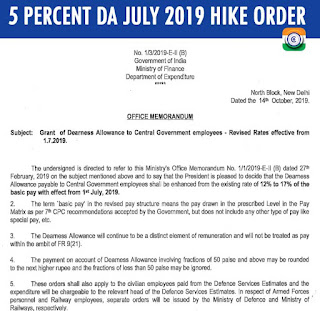
5 Percent DA July 2019 Hike Order - Grant of Dearness Allowance to Central Government employees

Grant of Dearness Allowance to Central Government employees 5 Percent DA July 2019 Hike Order  No. 1/3/2019-E- II (B) Government of...

Blog Archive

About The Author