A complete reference blog for Indian Government Employees

Wednesday, 10 January 2018

Turnover of Canteen Store Department (CSD)

Turnover of Canteen Store Department (CSD)

Details of turnover made by the Army’s Canteen Store Department (CSD) canteen during the last three years

Turnover of CSD

Turnover of Canteen Stores Department (CSD) for the past 3 years is as under:

Year
Turnover in Crores
2014-15
Rs.13709.32
2015-16
Rs.15781.73
2016-17
Rs.17156.26

No restriction has been put on entitlement of the beneficiary. However, instructions have been issued to Unit Run Canteens (URCs) for local restrictions on bulk purchases to prevent pilferage.

Share:

Cabinet approves Cadre review of Group 'A' Executive Cadre of Central Industrial Security Force

Cabinet approves Cadre review of Group 'A' Executive Cadre of Central Industrial Security Force

The Union Cabinet chaired by Prime Minister Shri Narendra Modi has approved the Cadre review of Group 'A' Executive Cadre of Central Industrial Security Force (CISF).  It provides for creation of 25 posts of various ranks from Assistant Commandant to Additional Director General ranks to enhance the supervisory staff in Senior Duty posts of CISF.

The restructuring of the CISF Cadre will result in increase of Group 'A' posts from 1252 to 1277 with increase of 2 posts of Additional Director General, 7 posts of Inspector General, 8 posts of Deputy Inspector General and 8 posts of Commandant.

Impact:

After creation of these Group 'A' posts in CISF, the supervisory efficiency and capacity building of the Force would be enhanced. Timely creation of proposed posts in the Cadre Review of Group 'A' posts in the Force will enhance its supervisory as well as administrative capabilities.

Background:

The CISF came into existence through the CISF Act 1968 amended in 1983 declaring the Force as Armed Force of the Union. The original charter of CISF was to provide protection and security to the property of Public Sector Undertakings. The Act was further amended in 1989, 1999 and 2009 to enlarge the charter of duties and security cover to Private Sector Units and other duties that may be entrusted by the Central Government.

The CISF came into existence in 1969 with a sanctioned strength of only three Battalions. The CISF does not have a Battalion pattern like other CAPFs, except 12 Reserve Battalions and HQRs. Currently, the Force is providing security cover to 336 Industrial Undertaking (including 59 Airports) spread all over the country.  The Force, which had made a beginning with a sanctioned strength of 3192 in 1969, has grown to a strength of 1,49,088 as on 30.06.2017. The CISF has its Headquarters at Delhi. The Organization is headed by the DG which is an Ex-cadre post.
Share:

Cabinet approves amendments in FDI policy

FDI policy further liberalized in key sectors

Cabinet approves amendments in FDI policy


100% FDI under automatic route for Single Brand Retail Trading

    100% FDI under automatic route in Construction Development
    Foreign airlines allowed to invest up to 49% under approval route in Air India
    FIIs/FPIs allowed to invest in Power Exchanges through primary market
    Definition of ‘medical devices’ amended in the FDI Policy


The Union Cabinet chaired by the Prime Minister Shri Narendra Modi, has given its approval to a number of amendments in the FDI Policy. These are intended to liberalise and simplify the FDI policy so as to provide ease of doing business in the country. In turn, it will lead to larger FDI inflows contributing to growth of investment, income and employment.

Foreign Direct Investment (FDI) is a major driver of economic growth and a source of non-debt finance for the economic development of the country. Government has put in place an investor friendly policy on FDI, under which FDI up to 100%, is permitted on the automatic route in most sectors/ activities. In the recent past, the Government has brought FDI policy reforms in a number of sectors viz. Defence, Construction Development, Insurance, Pension, Other Financial Services, Asset reconstruction Companies, Broadcasting, Civil Aviation, Pharmaceuticals, Trading etc.

Measures undertaken by the Government have resulted in increased FDI inflows in to the country. During the year 2014-15, total FDI inflows received were US $ 45.15 billion as against US $ 36.05 billion in 2013-14. During 2015-16, country received total FDI of US $ 55.46 billion. In the financial year 2016-17, total FDI of US $ 60.08 billion has been received, which is an all-time high.

It has been felt that the country has potential to attract far more foreign investment which can be achieved by further liberalizing and simplifying the FDI regime. Accordingly, the Government has decided to introduce a number of amendments in the FDI Policy.

Details:

Government approval no longer required for FDI in Single Brand Retail Trading (SBRT)

    Extant FDI policy on SBRT allows 49% FDI under automatic route, and FDI beyond 49% and up to 100% through Government approval route. It has now been decided to permit 100% FDI under automatic route for SBRT.

    It has been decided to permit single brand retail trading entity to set off its incremental sourcing of goods from India for global operations during initial 5 years, beginning 1st April of the year of the opening of first store against the mandatory sourcing requirement of 30% of purchases from India. For this purpose, incremental sourcing will mean the increase in terms of value of such global sourcing from India for that single brand (in INR terms) in a particular financial year over the preceding financial year, by the non-resident entities undertaking single brand retail trading entity, either directly or through their group companies. After completion of this 5 year period, the SBRT entity shall be required to meet the 30% sourcing norms directly towards its India’s operation, on an annual basis.

    A non-resident entity or entities, whether owner of the brand or otherwise, is permitted to undertake ‘single brand’ product retail trading in the country for the specific brand, either directly by the brand owner or through a legally tenable agreement executed between the Indian entity undertaking single brand retail trading and the brand owner.

Civil Aviation

As per the extant policy, foreign airlines are allowed to invest under Government approval route in the capital of Indian companies operating scheduled and non-scheduled air transport services, up to the limit of 49% of their paid-up capital. However, this provision was presently not applicable to Air India, thereby implying that foreign airlines could not invest in Air India. It has now been decided to do away with this restriction and allow foreign airlines to invest up to 49% under approval route in Air India subject to the conditions that:

    Foreign investment(s) in Air India including that of foreign Airline(s) shall not exceed 49% either directly or indirectly

    Substantial ownership and effective control of Air India shall continue to be vested in Indian National.

Construction Development: Townships, Housing, Built-up Infrastructure and Real Estate Broking Services

It has been decided to clarify that real-estate broking service does not amount to real estate business and is therefore, eligible for 100% FDI under automatic route.

Power Exchanges

Extant policy provides for 49% FDI under automatic route in Power Exchanges registered under the Central Electricity Regulatory Commission (Power Market) Regulations, 2010. However, FII/FPI purchases were restricted to secondary market only. It has now been decided to do away with this provision, thereby allowing FIIs/FPIs to invest in Power Exchanges through primary market as well.

Other Approval Requirements under FDI Policy:

    As per the extant FDI policy, issue of equity shares against non-cash considerations like pre-incorporation expenses, import of machinery etc. is permitted under Government approval route. It has now been decided that issue of shares against non-cash considerations like pre-incorporation expenses, import of machinery etc. shall be permitted under automatic route in case of sectors under automatic route.

    Foreign investment into an Indian company, engaged only in the activity of investing in the capital of other Indian company/ies/ LLP and in the Core Investing Companies is presently allowed upto 100% with prior Government approval. It has now been decided to align FDI policy on these sectors with FDI policy provisions on Other Financial Services. Thus, if the above activities are regulated by any financial sector regulator, then foreign investment upto 100% under automatic route shall be allowed; and, if they are not regulated by any Financial Sector Regulator or where only part is regulated or where there is doubt regarding the regulatory oversight, foreign investment up to 100% will be allowed under Government approval route, subject to conditions including minimum capitalization requirement, as may be decided by the Government.

Competent Authority for examining FDI proposals from countries of concern

As per the existing procedures, FDI applications involving investments from Countries of Concern, requiring security clearance as per the extant FEMA 20, FDI Policy and security guidelines, amended from time to time, are to be processed by the Ministry of Home Affairs (MHA) for investments falling under automatic route sectors/activities, while cases pertaining to government approval route sectors/activities requiring security clearance are to be processed by the respective Administrative Ministries/Departments, as the case may be. It has now been decided that for investments in automatic route sectors, requiring approval only on the matter of investment being from country of concern, FDI applications would be processed by Department of Industrial Policy & Promotion (DIPP) for Government approval. Cases under the government approval route, also requiring security clearance with respect to countries of concern, will continue to be processed by concerned Administrative Department/Ministry.

Pharmaceuticals:

FDI policy on Pharmaceuticals sector inter-alia provides that definition of medical device as contained in the FDI Policy would be subject to amendment in the Drugs and Cosmetics Act. As the definition as contained in the policy is complete in itself, it has been decided to drop the reference to Drugs and Cosmetics Act from FDI policy. Further, it has also been decided to amend the definition of ‘medical devices’ as contained in the FDI Policy.

Prohibition of restrictive conditions regarding audit firms:

The extant FDI policy does not have any provisions in respect of specification of auditors that can be appointed by the Indian investee companies receiving foreign investments. It has been decided to provide in the FDI policy that wherever the foreign investor wishes to specify a particular auditor/audit firm having international network for the Indian investee company, then audit of such investee companies should be carried out as joint audit wherein one of the auditors should not be part of the same network.
Share:

DA @ 3.4% wef 01.01.2018 to Board level and below Board level posts including non-unionised supervisors in CPSEs - Revision of scales of pay w.e.f. 01.01.2017

DA @ 3.4% wef 01.01.2018 to Board level and below Board level posts including non-unionised supervisors in CPSEs - Revision of scales of pay w.e.f. 01.01.2017

No. W-02/0039/2017-DPE (WC)-GL-IV/18
Government of India
Ministry of Heavy Industries & Public Enterprises
Department of Public Enterprises
Public Enterprises Bhawan
Block 14, CGO Complex,
Lodi Road, New Delhi-110003
Dated: 3rd January, 2018
OFFICE MEMORANDUM

Subject:- Board level and below Board level posts including non-unionised supervisors in Central Public Sector Enterprises (CPSEs)- Revision of scales of pay w.e.f. 01.01.2017 - Payment of IDA at revised rates-regarding.

The undersigned is directed to refer to the Para 7 and Annexure-III (B) of DPE’s OM dated 03.08.2017 wherein the rates of DA payable to the Board level and below Board level executives and non-unionized supervisors of CPSEs have been indicated. The next installment for revision of rates of DA is due from 01.10.2017. Accordingly. the rate of DA payable to the executives and non-unionized supervisors of CPSEs is as follows:.

(a) Date from which payable: 01.01.2018

(b) Average AICPI (2001=100) for the quarter Sept. 2017 - Nov. 2017

    Sept. 2017 - 285
    Oct... 2017 - 287
    Nov, 2017 - 288
    Average of the quarter - 286.67

(c) Link Point: 277.33 (as on 01 .01.201 7)

(d) Increase over link point: 9.34 (286.67 minus 277.33)

(e) DA Rate w.e.f. 01.01.2018: 3.4% [09.34 +277.33) x 100]

2. The above rate of DA i.e. 3.4% would be applicable in the case of IDA employees who have been allowed revised pay scales (2017) as per DPE O.M. dated 03.08.2017, 04.08.2017 and 07.09.2017.

3. All administrative Ministries/ Departments of the Government of India are requested to bring the foregoing to the notice of the CPSEs under their administrative control for necessary action at their end.

(Samsul Haque)
Under Secretary

Share:

DA from Jan- 2018 @ 283.1% Board level posts and below Board level posts including Non-unionised supervisors in CPSE - Scales of Pay 01.01.1997


DA from Jan- 2018 @ 283.1% Board level posts and below Board level posts including Non-unionised supervisors in CPSE - Scales of  Pay  01.01.1997

F. No. W-02/0004/2014-DPE (WC)-GL-II/l 8
Government of India
Ministry of Heavy Industries & Public Enterprises
Department of Public Enterprises

Public Enterprises Bhawan
Block 14. CGO Complex
Lodi Road, New Delhi-110003
Dated: 3rd January, 2018
OFFICE MEMORANDUM

Subject - Board level posts and below Board level posts including Non-unionised supervisors in Central Public Sector Enterprises (CPSEs)- Revision of scales of pay w.e.f. 01.01.1997 - Payment of IDA at revised rates regarding

In modification of this Department’s O.M. of even No. dated 05.10.2017, the rate of DA payable to the executives of CPSEs (1997 pay revision) is as follows:

a) Date from which payable: 01.01.2018

b) Average AICPI (1960=100) for the quarter Sept. ’2017 - Nov.’ 2017

    Sep,2017 - 6508
    Oct, 20 l 7 - 6552
    Nov, 2017 - 6572
    Average of the quarter - 6544

c) Link Point : 1708 (as on 01.01.1997)

d) Increase over link point: 4836 (6544-1708)

e) Revised DA Rate w.e.f. 01.01.2018: 283.l% [(4836+1708) x 100]


2. These rates are applicable in the case of IDA employees, whose pay have been revised with effect from 01.01.1997 as per DPE O.M. dated 25.06.1999.

3. All Administrative Ministries/Departments of the Government of India are requested to bring the foregoing to the notice of the CPSEs under their administrative control for necessary action at their end.
(Samsul Haque)
Under Secretary
Share:

Tuesday, 9 January 2018

DA from Jan-18 to Board level/below Board level executives and non-unionized supervisors of IDA scales in CPSE on 1987 and 1992 basis

DA from Jan-18 to Board level/below Board level executives and non-unionized supervisors of IDA scales in CPSE on 1987 and 1992 basis

F.No. W- 02/0003/2014-DPE (WC)-GL.-I/18
Government of India
Ministry of Heavy Industries & Public Enterprises
Department of Public Enterprises
Public Enterprises Bhawan
Block 14, CGO Complex,
Lodi Road, New Delhi- 110003
Dated 3rd - January, 2018
OFFICE MEMORANDUM

Subject - Payment of DA to Board level/below Board level executives and non-unionized supervisors following IDA scales of pay in Central Public Sector Enterprises (CPSEs) on 1987 and 1992 basis.
 
The undersigned is directed to refer to para No.3 of this Department's OM. No. 2(50)/86-DPE (WC) dated 19.07.1995 wherein the rates of DA payable to the executives holding Board level post have been indicated. In accordance with the DA scheme spelt out in Annexure-II of the said OM, the installments of DA become payable from 1st January, 1st April, 1st July, 1st October, every year based on the price increase above quarterly Index average of 1099 (1960 = 100)

2. ln continuation of this Department's OM. of even No. dated 06.10.2017, the rates of DA payable to the executives of CPSEs holding Board level post, below Board level post and Non-Unionized Supervisors following 1DA pattern of 1992 pay scales may be modified as follows:-

(a) Date from which payable: 01.01.2018

(b) AICPI (Linked to 1960=100) for the quarter Sept.2017 - Nov. 2017

    Sept,2017 = 6508
    Oct., 2017 = 6552
    Nov, 2017 = 6572
    Average of the quarter = 6544

(c) Increase over link point : 5445 (6468-1099)

(d) % increase over link point: 495.4% (5445/1099*100)

DA Rates for various Pay Ranges
Basic Pay Per /Month DA Rates
  • Upto Rs. 3500 - 495.4% of pay subject to minimum of Rs. 10890/-
  • Above Rs. 3500 and Upto Rs. 6500 - 371.5% of Pay subject to minimum Rs. 17339/-
  • Above Rs. 6500 - and Upto Rs. 9500 - 297.2% of pay subject to minimum Rs. 24148/-
  •  Above Rs. 9500 - 247.7% of pay subject to minimum of Rs. 28234/-
3. The payment on account of dearness allowance involving fractions of 50 paise and above may be rounded off to the next higher rupee and the fractions of less than 50 paise may be ignored.

4. The quantum of lDA payabIe from 01.01.2018 at the old system of neutralization @ Rs. 2.00 per point shift for increase of 76 points, may be Rs. lS2/- and at AICPIN, Rs. 6544 DA payable may be Rs. 1 1677.75 to the executives holding Board level post, below Board level post and non- unionised supervisors following IDA pattern in the CPSEs of 1987 pay scales.

5. All administrative Ministries/Department of Government of India are requested to bring the foregoing to the notice of the CPSES under their administrative control for necessary action at their end.

(Samsul Haque)
Under Secretary

Share:

Government is planning to abolish the system of formation of Pay Commission in future? Lok Sabha

Government is planning to abolish the system of formation of Pay Commission in future? Lok Sabha

Government of India
Ministry of Finance
Department of Expenditure 

LOK SABHA
UNSTARRED QUESTION NO. 3164

TO BE ANSWERED ON FRIDAY, THE JANUARY 05, 2018
PAUSHA 15, 1939 (SAKA)

NATIONAL ANOMALY COMMITTEE
QUESTION

3164. SHRI CH. MALLA REDDY:

Will the Minister of FINANCE be pleased to state:

(a) whether the National Anomaly Committee (NAC) under the 7th Central Pay Commission has submitted its interim report, if so, the details thereof;

(b) whether the Government is planning to abolish the system of formation of Pay Commission in future, if so, the details thereof and the reasons therefor;

(c) whether the Government is considering to adjust the salaries of its employees and pensioners Deafness Allowance (DA) that crosses the 50 per cent mark, if so, the details thereof and if not, the reasons therefor; and

(d) whether the Department of Expenditure planning to take the responsibility to regularly monitor salaries and allowances of central government employees and recommend the changes if needed, if so, the details thereof and the reasons therefor?

ANSWER
MINISTER OF STATE IN THE MINISTRY OF FINANCE
(SHRI P. RADHAKRISHNAN)
(a): The National Anomaly Committee set up by the Department of Personnel Training in August, 2016 following the decision of the Government on the recommendations of the 7th Central Pay Commission has not yet met.

(b) to (d): No such proposals are at present under consideration.

Click to view on  (http://loksabha.nic.in) in Hindi / English

Share:

Featured post

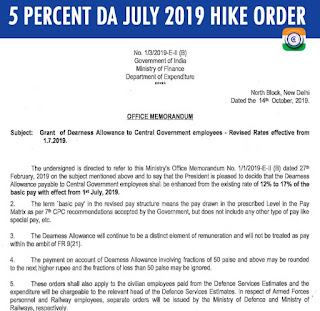
5 Percent DA July 2019 Hike Order - Grant of Dearness Allowance to Central Government employees

Grant of Dearness Allowance to Central Government employees 5 Percent DA July 2019 Hike Order  No. 1/3/2019-E- II (B) Government of...

Blog Archive

About The Author