A complete reference blog for Indian Government Employees

Thursday, 25 February 2016

Central Government Employees Demand Minimum Salary of Rs 26,000

Central Government Employees Demand Minimum Salary of Rs 26,000

Government employees have demanded a minimum salary of Rs 26,000 as against Rs 18,000 recommended by the 7th Central Pay Commission while threatening to go on strike if demands not met.

“Minimum Pay needs to be revised to Rs 26,000 per month and the minimum pay of Rs 18,000 as recommended by 7th CPC is not acceptable,” said Minutes of the meeting of Joint Secretary (IC) with the members of the Staff-side of the Standing Committee (National Council-JCM).

Secretary, Staff-side, Standing Committee (National Council-Joint Consultative Machinery) said Staff-side is “not at all happy” with the recommendations of the CPC and, in fact, “no section of the employees is satisfied”, as the Commission has recommended a minimal pay increase as compared to the previous Pay Commissions.

The Secretary further stated that an amicable and mutually negotiated settlement of these demands is necessary as “non-acceptance would further cause resentment in the employees”.

The Secretary “informed that Staff-Side has already made their stand clear to go on strike from April 11, 2016 if their demands are not considered and no amicable settlement happens”, the Minutes said.

The meeting was held to discuss the issues raised by the National Joint Council of Action (NJCA) in their letter addressed to the Cabinet Secretary, regarding their Charter of Demands on the recommendations of the Pay Commission.

The Staff-side also said the central government employees need to be excluded from the National Pension Scheme (NPS), a long pending demand

The fixed monthly medical allowance for pensioners who are not covered by CGHS and REHS needs to be increased from Rs 500 to Rs 2,000 is another major demand.

The Joint Secretary (Implementation Cell) assured the Staff-Side that the concerns and demands made by them would be placed before the Empowered Committee of Secretaries for consideration after examining the same in the light of the recommendations of the Commission.

The scheme of Joint Consultative Machinery (JCM) is a platform for constructive dialogue between the representatives of the staff side and the official side for peaceful resolution of all disputes between the Government as employer and the employees.

Demands are submitted to the Implementation Cell, created in the Finance Ministry, to work as Secretariat for the Empowered Committee of Secretaries headed by Cabinet Secretary P K Sinha.

The Pay Commission recommendations when implemented would have bearing on remuneration of 47 lakh central government employees and 52 lakh pensioners. Subject to acceptance by the government, the recommendations will take effect from January 1, 2016.

Source: The Economic Times
Share:

Highlights of the Railway Budget 2016-17 – An Official Report

Highlights of the Railway Budget 2016-17 – An Official Report

Highlights of the Railway Budget 2016-17

Theme of the Budget : Overcoming challenges – Reorganize, Restructure Rejuvenate Indian Railways: ‘Chalo, Milkar Kuch Naya Karen’

Three pillars of the strategy i.e. Nav Arjan – New revenues, Nav Manak – New norms, Nav Sanrachna – New Structures.

Financial Performance : 2015-16- Savings of Rs. 8,720 crore neutralizing most of the revenue shortfall, expected OR 90%;

2016-17- Targeted Operating Ratio (OR) – 92%, restrict growth of Ordinary Working Expenses by 11.6% after building in immediate impact of 7th PC, reductions planned in diesel and electricity consumption, Revenue generation targeted at Rs. 1,84,820crore.

Investments and Resources : Process bottlenecks overhauled including delegation of powers to functional levels; average capital expenditure over 2009-14 is Rs. 48,100 crore, average growth of 8% per annum.

2015-16 investment would be close to double of the average of previous 5 years.

2016-17 CAPEX pegged at Rs. 1.21 lakh crore; implementation through joint ventures with states, developing new frameworks for PPP, etc.

Vision : By 2020, long-felt desires of the common man to be fulfilled i.e, reserved accommodation on trains available on demand, time tabled freight trains, high end technology to improve safety record, elimination of all unmanned level crossings, improved punctuality, higher average speed of freight trains, semi high speed trains running along the golden quadrilateral, zero direct discharge of human waste. 

2015-16-Achievements : Action initiated on 139 budget announcements of 2015-16. 

Project execution : 2015-16 – assured funding through LIC; commissioning of 2,500 kms Broad Gauge lines; commissioning of 1,600 kms of electrification, highest ever. In 2016-17 – targeted commissioning 2,800 kms of track; commissioning Broad Gauge lines @ over 7 kms per day against an average of about 4.3 kms per day in the last 6 years. Would increase to about 13 kms per day in 2017-18 and 19 kms per day in 2018-19; will generate employment of about 9 crore man days in 2017-18 and 14 crore man days in 2018-19. Outlay for railway electrification increased in 2016-17 by almost 50%; target to electrify 2,000 kms.

Dedicated Freight Corridor : Almost all contracts for civil engineering works to be awarded by March 31st 2016; Rs. 24,000 crore contracts awarded since November 2014 as against Rs. 13,000 crore contracts awarded in last 6 years; propose to take up North-South, East-West & East Coast freight corridors through innovative financing including PPP.

Port connectivity : Tuna Port commissioned and rail connectivity projects to ports of Jaigarh, Dighi, Rewas and Paradip under implementation; implementation of rail connectivity for the ports of Nargol and Hazira under PPP in 2016-17.

North East : BG Lumding-Silchar section in Assam opened thus connecting Barak Valley with rest of the country; Agartala brought on to the BG network. States of Mizoram and Manipur shortly to come on BG map of the country with commissioning of the Kathakal-Bhairabi and Arunachal-Jiribam Gauge Conversion projects.

Jammu and Kashmir : Work on Katra-Banihal section of Udhampur-Srinagar-Baramulla Rail Link Project progressing satisfactorily- 35 kms of tunnelling out of total of 95 kms completed; Decongestion work on Jalandhar – Jammu line in full swing and doubling of two bridges to be commissioned by March 2016, while the other two bridges will be completed by 2016-17.

Make in India: Finalised bids for two loco factories; proposed to increase the current procurement of train sets by 30%.

Capacity Building for the future through: Transparency – initiated recruitments online in 2015-16, process now being replicated for all positions, social media being used as a tool to bring in transparency, all procurement including procurement of works moved to the e-platform, completed trial of process leading to award of tender electronically and to be rolled out on a PanIndia basis in 2016-17.

Governance – delegation led to compression of project sanction time to 6-8 months from 2 years earlier, key result areas identified to judge performance of GMs and DRMs, performance related MOUs signed with few Zones, to be replicated for all zones.

Internal audit measures – specialised teams mandated to screen railway operations in specific areas to detect inefficiencies and prevent wastages, every zone preparing 2 reports by March 31, 2016.
Partnerships – Cabinet approval for JVs with State Governments, 17 consented and 6 MOUs signed with State Governments. 44 new partnership works covering about 5,300 kms and valuing about Rs. 92,714 crore have been indicated in the Budget documents.

Customer Interface : Interaction and feedback through social media & dedicated IVRS system.
Making travel comfortable by generating over 65,000 additional berths, installing 2,500 water vending machines; introducing ‘Mahamana Express’ with modern refurbished coaches; 17,000 bio-toilets in trains; world’s first Bio-Vacuum toilet developed.

Improving punctuality – operations audit for Ghaziabad to Mughalsarai section.

Ticketing: Introduced 1,780 Automatic Ticket Vending Machines, mobile apps & GoIndia smartcard for cashless purchase of UTS and PRS tickets, enhanced capacity of e-ticketing system from 2,000 tickets per minute to 7,200 tickets per minute and to support 1,20,000 concurrent users as against only 40,000 earlier.

Social initiatives: One-time registration for availing concessions while booking tickets online, online booking of wheelchairs & Braille enabled new coaches introduced for the Divyang, increased quota of lower berths for senior citizens and women, middle bays reserved in coaches for women.

Wi-Fi provided in 100 stations, to be provided in 400 more.

Stations being redeveloped – financial bid received for Habibganj, Bhopal; Cabinet approval for stations to be taken up under PPP.

Security through helplines & CCTVs.

Safety – 350 manned level crossings closed, eliminated 1,000 unmanned level crossings, 820 ROB/RUB completed in the current year and work going on in 1,350 of them.

Other major achievements : Energy: annualized savings of Rs. 3,000 crore to be achieved in the next financial year itself, a year earlier than announced; achieved by procuring power directly at competitive rates using IR’s status as Deemed Distribution Licensee.

Rail University – initially identified the National Academy of Indian Railways at Vadodara.
Digital India: application of Track Management System (TMS) launched, inventory management module of TMS has resulted in inventory reduction by 27,000 MT resulting in saving of Rs.64 crore and scrap identification of 22,000 MT equivalent to Rs.53 crore.

The Way Ahead Improving quality of travel For the unreserved passenger –Antyodaya Express unreserved, superfast service.

Deen Dayalu coaches – unreserved coaches with potable water and higher number of
mobile charging points.

For the reserved passenger – Humsafar – fully air-conditioned third AC service with an optional service for meals 

Tejas – will showcase the future of train travel in India. Will operate at speeds of 130 kmph and above.Will offer onboard services such as entertainment, local cuisine, WiFi, etc. through one service provider for ensuring accountability and improved customer satisfaction Humsafar and Tejas to ensure cost recovery through tariff and non-tariff measures UDAY – overnight double-decker, Utkrisht Double-Decker Air-conditioned Yatri Express on the busiest routes, has the potential to increase carrying capacity by almost 40%.

Ticketing: Sale of tickets through hand held terminals; e- ticketing facility to foreign debit/credit cards; bar coded tickets, scanners and access control on a pilot basis. Expansion of Vikalp – train on demand to provide choice of accommodation in specific trains to wait-listed passengers. 

E-booking of tickets facility on the concessional passes available to journalists; facility of cancellation through the 139 helpline post verification using ‘One Time Password’ sent on registered phone number, to improve tatkaal services CCTV cameras on windows and periodic audit of PRS website.

Cleanliness -‘Clean my Coach’ service through SMS, ranking of A1 and A stations based on periodic third party audit and passenger feedback; waste segregation and recycling centres; ‘Awareness campaigns’; additional 30,000 bio-toilets; providing portable structures with biotoilets at all platforms of select stations for senior citizens, Divyang and women travellers, plan to explore innovative means of providing and maintaining toilets such as advertisement rights, CSR, voluntary support from social organizations.

Catering and stalls at stations -IRCTC to manage catering services in a phased manner; explore possibility of making catering services optional, adding 10 more IRCTC operated base kitchens; to build local ownership and empowerment, weightage will be given to district domicile holders for commercial licenses at stations. Stoppages: convert all operational halts into commercial halts for the benefit of the common man. Rail Mitra Sewa: expanding Sarathi Seva in Konkan Railway to help the old and disabled passengers, strengthening the existing services for enabling passengers to book battery operated cars, porter services, etc. on a paid basis in addition to the existing pick up and drop, and wheel chair services.
 
Measures for Divyang: all stations under redevelopment accessible by Divyang; to provide at least one Divyang friendly toilet at each platform in A1 class stations during the next financial year and also ensure availability of wheelchairs in sufficient numbers at these stations.

Travel Insurance to passengers – to offer optional travel insurance for rail journeys at the time of booking.

Hourly booking of retiring rooms – will be handed over to IRCTC.

Expanding the freight basket of IR – to start time-tabled freight container, parcel and special commodity trains on a pilot basis, container sector would be opened to all traffic barring coal, specified mineral ores and part-loads during the non-peak season. All existing terminals/sheds would be granted access to container traffic, where considered feasible. Rationalising the tariff structure – undertake review of tariff policy to evolve a competitive rate structure vis a vis other modes, permit multi-point loading/unloading and apply differentiated tariffs to increase utilization of alternate routes, explore possibility of signing long term tariff contracts with our key freight customers using pre-determined price escalation principles.

Building terminal capacity – proposed to develop Rail side logistics parks and warehousing in PPP mode, 10 goods sheds will be developed by TRANSLOC, the Transport Logistics Company of India, in 2016-17. To soon inaugurate India’s first rail auto hub in Chennai. Encourage development of cold storage facilities on vacant land near freight terminals. Local farmers and fisherman would be given preferential usage of the facility. A policy in this regard would be issued in the next 3 months.

Nurturing customers – will appoint Key Customer Managers to liaison with our major freight stakeholders; each Zonal Railway will develop customer commitment charter indicating service level commitments of IR, will explore the feasibility of opening up leasing of general purpose wagons.

Annex-2 of the speech details the Implementation of Budget announcements 2015-16

Source: Indian Railway
Share:

Minutes of JCM Staff Side Meeting with 7th CPC Implementation Cell held on 19.2.2016

Minutes of JCM Staff Side Meeting with 7th CPC Implementation Cell held on 19.2.2016

Minutes of the Meeting of Joint Secretary (IC) with the Members of the Staff-Side of the Standing Committee (National Council-JCM) held on 19.02.2016

A Meeting was held under the chairmanship of Joint Secretary (Implementation Cell), Department of Expenditure, Ministry of Finance, with the Members of the StaffSide of the Standing Committee (National Council-JCM) on 19.2.2016 to discuss the issues raised by the National Joint Council of Action (NJCA) {Joint Consultative Machinery (JCM)} in their letter No. NJC/2015/7th CPC dt. 10.12.2015, addressed to the Cabinet Secretary, regarding their Charter of Demands on the recommendations of the 7th Central Pay Commission. The Secretary, Staff-Side of the Standing Committee (National Council- JCM), who is the convener of the NJCA, along with other office bearers attended the meeting. The list of the participants from the Staff-Side is attached at Annexure.

1. Welcoming the members of the Staff-Side, JS(IC) mentioned that the meeting has been convened to enable the Staff-Side to bring out their concerns on the recommendations of the 7th CPC in the light of the Charter of Demands made by them in the aforesaid letter of NJCA so that same could be examined in the Implementation Cell and submitted for consideration of the Empowered Committee of Secretaries. He informed the office bearers that before arriving at a decision, the ECoS would also hold separate discussions with the Staff Side.

2. Commencing the discussions from the Side of the Members of the Staff-Side, Secretary, Staff-Side, Standing Committee (National Council-JCM), explained that they have already placed their Charter of Demands as per the letter of NJCA dated 10.12.2015. He mentioned that the reasons based on which these demands have been made have also been explained therein. He, however, highlighted that the Staff-Side is not at all happy with the recommendations of the 7th CPC and, in fact, no section of the employees is satisfied, as the Commission has recommended a minimal pay increase as compared to the previous Pay Commissions. He mentioned that the Staff-Side does not agree with the minimum pay of Rs. 18000 and the reason as to why the methodology adopted by the 7th CPC to arrive at this figure is not correct has been explained in their letter dated 10.12.2015. He stated that Staff-Side demands enhancement of the minimum pay to Rs. 26000 and the reasons in support of this have been given in their aforesaid letter. He further stated that an amicable and mutually negotiated settlement of these demands is necessary as non-acceptance would further cause resentment in the employees. He informed that Staff-Side has already made their stand clear to go on strike from 11th April, 2016 if their demands are not considered and no amicable settlement happens.

3. Thereafter, the other members of the Staff-Side also expressed their arguments for acceptance of these demands and all of them emphasised that the minimum pay needs to be revised. Consequently, the fitment multiple of 2.57 would also need commensurate change. The leader of the Staff-Side explained that the office bearers who were present in the meeting represent various sections of Central Government employees including railways, defence civilians, postal employees etc., the number of which is around Rs. 32 lakhs.

4. The Staff-Side brought out their concerns on all the 26 demands included in the Charter of Demands and all the points brought out by them in the letter of the NJCA dt. 10.12.2015 were reiterated. However, following issues in support of their demands were highlighted :-

(i) Minimum Pay needs to be revised to Rs. 26000 p.m. and the minimum pay of Rs. 18000 p.m. as recommended by 7th CPC is not acceptable. This would require upward revision in the fitment multiple of 2.57 and change in the Pay Matrix. It was argued that if the 10% of the pay for NPS contribution and the recommended increase in the CGEIS contribution are taken into account, there would be a drop in the take-home salary of the employees at the
minimum pay of Rs.18000.

(ii) Central Government employees need to be excluded from the National Pension Scheme (NPS), which has been a long pending demand of the StaffSide. The Staff-Side stated that the Pension Fund which has been created under NPS to generate annuity for employees, would not ensure reasonable pension. Rather it is quite likely that it may generate negative returns because of the dismal performance of the financial market to which the fund is invested, leaving the employees without any reasonable social security benefit.

(iii) The 7th CPC has recommended abolition of 52 allowances without properly appreciating the justification of these allowances. The example of break-down allowance in case of Railway employees was given, stating that this allowances is given so that the concerned employees take up the necessary follow up action in the case of breakdown on an urgent basis and therefore its withdrawal is not justified in operational interests of Railways.

(iv) The withdrawal of advances, especially LTC, TA, Medical, National Calamity Advance, was not justified. It was argued that these advances are recovered from the employees and, therefore, the same should be retained. (v) In regard to enhancement of contribution under Group Insurance Scheme, it was argued that increase in the contribution from the employees was not justified and if the same is to be raised, the Government should bear the
insurance premium.

(vi) The post of LDC should be upgraded to UDC and as part of delayering, Grade Pays of Rs. 1900, Rs. 2400 and Rs. 4600 should be abolished and merged with the next higher Grades.

(vii) The rate of increment needs to be raised from 3% to 5% because pay is revised in the Central Government after 10 years. It was mentioned that in the PSUs the pay is revised after 5 years and the rate of increment is also higher.

(viii) Two increments in the feeder post may be granted as promotion benefit.

(ix) Fixed medical allowance for pensioners who are not covered by CGHS and REHS needs to be increased from Rs. 500 p.m. to Rs. 2000 p.m.

(x) The recommendation regarding grant of only 80% of salary for the second year of Child Care Leave need not be accepted and the existing provisions may be retained

(xi) It was also demanded that though the D/o Expenditure has sought the comments of the Ministries/Department on the issues pertaining to them after consulting the Staff Associations, administrative Departments are not inviting the Staff associations for discussions.

5. After detailed explanation by the Staff-Side on all the demands included in the Charter of Demands, JS(IC), while concluding the discussions, assured the Staff-Side that the concerns and demands made by them would be placed before the Empowered Committee of Secretaries for consideration after examining the same in the light of the recommendations of the Commission. He also mentioned that in cases where the comments of the administrative Ministries/ Departments would be necessary, e.g., the case of break-down allowance pertaining to Ministry of Railways, the same would be considered before the issues are placed before the E-CoS. As regards the issue raised that the administrative Departments are not inviting staff associations for discussions, JS(IC) mentioned that the Departments have to formulate the views keeping in view the representations made by the Staff Associations.

6. Thereafter, the meeting ended with thanks to the chair.

Members of the Staff side of the National Joint Council (JCM), who attended the meeting with JS (IC) held on 19.02.2016 -7th Central Pay Commission

S.No. Name (S/Shri)

1. Shiva Gopal Mishra
2. M.Raghavaiah
3. N.Kanniah
4. Guman Singh
5. K.K.N.Kutty
6. C.Srikumar
7. S.N.Pathak
8. Ashok Singh
9. R.N.Prashar
10. M.S. Raja
11. Giri Raj singh
12. Satish Chander
13. R.Srinivasan

Authority: www.finmin.nic.in
Share:

Wednesday, 24 February 2016

Filling up of one post of Under Secretary of CSS in Labour Bureau, Chandigarh

Filling up of one post of Under Secretary of CSS in Labour Bureau, Chandigarh 
CSS-LABOUR-BUREAU-INDIA-CHANDIGARH

 No.5 /6/ 2016-CS.I(U)
Government of India
Ministry Personnel, P.G. and Pensions
(Department of Personnel & Training)
Khan Market, Lok Nayak Bhavan.
New Delhi, dated 24th February, 2016.

OFFICE MEMORANDUM

Subject: Filling up of one post of Under Secretary of CSS in Labour Bureau, Chandigarh 

The undersigned is directed to say that one post of Under Secretary of CSS in Labour Bureau, Chandigarh is vacant. The post is to be filled up in terms of RTP. It is requested that Under Secretaries of CSS willing to be considered to the aforesaid post may submit their application in the attached format latest by 25th March, 2016 through proper channel.

2. While forwarding the application, the vigilance status of the officer concerned may also be intimated. It should also be ensured that the data in respect of officer applying for the post is complete in all respects in the web based cadre management system at cscms.nic.in.

3. Substitute in place of selected officer will be provided after his/her relieving.
(V.Srinivasaragavan)
Under Secretary to the Government of India
Tele: 24629412
To
All Ministries/Departments of Govt. of India
Copy for information to :
Ministry of Labour & Employment (Ms. Kuheli S. Chaudhary, Under Secretary), Shram Shakti Bhavan, Rafi Marg, New Delhi w.r.t. their O.M.No.A-11019/01/2007- Adm.I dated 19.02.2016.

PROFORMA

1 Name CSLNo.
2 Designation
3 Date of Birth
4 Present Ministry/Department
5 Personal Contact Number
6 Experience (including deputation details) :
S.No. Grade Ministry/Department Period Subjet dealt (in brief)
(a) Assistant/
PA


(b) Section Officer


(c) Under Secretary


7 Reasons for seeking posting in Labour Bureau, Chandigarh :

8 Data in respect of the undersigned in the web based cadre management system is complete in all respect.


Date:. (Signature of the applicant)

Source: persmin.nic.in

Share:

List of Nodal Officers for implementation of 7th CPC recommendations

List of Nodal Officers for implementation of 7th CPC recommendations

Nomination of Nodal Officers including the major ministries like Ministry of Defence, Ministry of Finance, Ministry of Personnel, Public Grievances and Pensions, Ministry of Railways…the complete list of Officer’s Name, Address and Contact details are given below…

7th-CPC-Nodal-Officers-List


Authority: www.finmin.nic.in
Share:

Funds Allocated For Promotion Of Sports

Funds Allocated For Promotion Of Sports

Ministry of Youth Affairs and Sports 

The Minister of State (Independent Charge) for Youth Affairs & Sports, Shri Sarbananda Sonowal has said that funds are being provided across the country for implementation of the Schemes/programmes for promotion of Sports as well as upliftment of youth. The details of scheme/programme-wise allocation/release/expenditure under the various schemes/programmes during each of the last three years and the current year is as below:

Funds-allocated-promotion-sports
He said, the Department of Youth Affairs, Ministry of Youth Affairs and Sports, has taken several steps for spreading awareness about the National Youth Policy, 2014 and for its effective implementation.  The Policy recommends specific policy interventions for development and empowerment of youth in 11 priority areas, namely, education, employment and skill development, entrepreneurship, health and healthy lifestyle, sports, promotion of social values, community engagement, participation in politics and governance, youth engagement, inclusion and social justice. The implementation of the Policy is the collective responsibility of all concerned Central Ministries/ Departments, State Governments as well as other stakeholders. The Department of Youth Affairs is playing the coordinating/facilitating role.

The National Youth Policy, 2014 is applicable to all the youth in the country in the age-group of 15-29 years. The Department of Youth Affairs has constantly pursued the matter with all concerned Central Ministries/ Departments to take necessary steps for implementation of the Policy. The State Governments have also been requested to formulate/ revise their State Youth Policies, in line with the National Youth Policy, 2014.

In a written reply in the Rajya Sabha today the Minister said, schemes of the Department of Sports, aimed at achieving twin objectives of National Sports Policy 2001 viz., mass participation in sports and achieving excellence in sports, are being implemented impartially and with transparency.

PIB
Share:

7th CPC Implementation Cell Seeks Comments and Views from all Ministries/Departments

7th CPC Implementation Cell Seeks Comments and Views from all Ministries/Departments

Comments of the Ministries/Departments on Recommendations of 7th Central Pay Commission-Request to Expedite

F No.30-1/2016-IC
Government of India
Ministry of Finance
Department of Expenditure
Implementation Cell (7th CPC)
Dated: 15th February, 2016
OFFICE MEMORANDUM
Subject: Comments of the Ministries/Departments on Recommendations of 7th Central Pay Commission – Request to Expedite – regarding.

All the Ministries/Departments, vide the D.O.No.1-4/2015-EIII.A dated 21.11.2015 from Joint Secretary (Pers), Department of Expenditure were requested to formulate their views/comments on the issues and the posts/services under them with reference to the recommendations of the 7th Central Pay Commission and forward it to the Department of Expenditure within a period of three weeks.

2. The action involved on part of the administrative Ministries/Departments was also discussed, in detail, in the meeting with the Nodal Officers on 02.02.2016 and all the Nodal Officers were requested to furnish their comments in the ‘prescribed proforma’ circulated in the meeting, along with soft copy to the ‘jsic-cpc@nic.in within two weeks i.e. by 17.02.2016. The responses received so far are not satisfactory and comments of the most the Ministries/Departments are still awaited.

3. The Implementation Cell which is working as the secretariat of the Empowered Committee of Secretaries (E-CoS) has been asked to furnish considered views of the Ministries/Departments on the recommendations of the 7th CPC.

4. In view of the above, the comments of the Ministries/Departments may be furnished to the Implementation Cell. Department of Expenditure, immediately.

This may be treated as most urgent.
sd/-
(R.K.Chaturvedi)
Joint Secretary (IC)
Click to view the official order

Authority: www.finmin.nic.in
Share:

Featured post

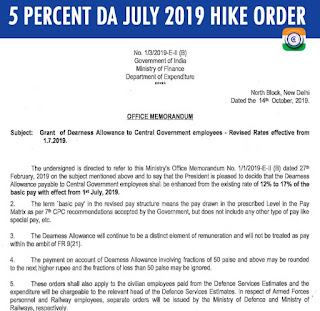
5 Percent DA July 2019 Hike Order - Grant of Dearness Allowance to Central Government employees

Grant of Dearness Allowance to Central Government employees 5 Percent DA July 2019 Hike Order  No. 1/3/2019-E- II (B) Government of...

Blog Archive

About The Author