A complete reference blog for Indian Government Employees

Monday, 17 November 2014

Posting of Government employees who have differently abled dependents – reg.

Dopt decided to include ‘Autism’ in the term ‘disabled’ – Orders issue
 
The autism spectrum disorder child requires constant caregiver support and it would be imperative for the Government employees to take care of their autism spectrum disorder child on continuous basis, it has been decided to include ‘Autism’ in the term ‘disabled’, as defined in Para 3 of the above-mentioned O.M. dated 06.06.2014
No.42011/3/2014-Estt.(Res.)
Government of India
Ministry of Personnel, Public Grievances and Pensions
Department of Personnel & Training
North Block, New Delhi
Dated the 17th November. 2014
Office Memorandum

Sub: Posting of Government employees who have differently abled dependents – reg.


The undersigned is directed to refer to this Department’s OM of even number dated 06.06.2014 (copy enclosed) exempting a Government employee, who is also a care giver of disabled child, from the routine exercise of transfer/rotational transfer subject to the administrative constraints. The word ‘disabled’ includes (i) blindness or low vision (ii) hearing impairment (iii) locomotor disability or Cerebral Palsy (iv) leprosy cured (v) mental retardation (vi) mental illness and (vii) multiple disabilities.

2. The matter regarding the scope of ‘disabled’ has been examined in consultation with the Department of Disability Affairs. Considering the fact that the autism spectrum disorder child requires constant caregiver support and it would be imperative for the Government employees to take care of their autism spectrum disorder child on continuous basis, it has been decided to include ‘Autism’ in the term ‘disabled’, as defined in Para 3 of the above-mentioned O.M. dated 06.06.2014.

3. This issues with the approval of the MoS (PP).

4. All the Ministries/Departments, etc. are requested to bring these instructions to the notice of all concerned under their control.
sd/-
(G. Srinivasan)
Deputy Secretary to the Govt. of India

Source: http://ccis.nic.in/WriteReadData/CircularPortal/D2/D02adm/42011_3_2014-Estt.Res-17112014.pdf
Share:

Inclusion of eligible officers who are due to retire before the likely date of vacancies, in the panel for promotion

Inclusion of eligible officers who are due to retire before the likely date of vacancies, in the panel for promotion

DPCs often do not consider such eligible officers who are retiring before the occurrence of the vacancy in the panel year. These undesirable trends negate the very purpose of the above said Office Memorandum No. 22011/4/98-Estt(D) dated October 12, 1998 and it is also against the principle of natural justice.


No. 22011/1/2014-Estt(D)
Government of India
Ministry of Personnel, Public Grievances and Pensions
(Department of Personnel and Training)

North Block, New Delhi – 110001
Dated- 14th November, 2014
OFFICE MEMORANDUM

Subject: – Inclusion of eligible officers who are due to retire before the likely date of vacancies, in the panel for promotion-Regarding

The undersigned is directed to invite reference to the Department of Personnel and Training Office Memorandum No. 22011/4/98-Estt(D) dated October 12, 1998 regarding consideration of retired employees who were within the zone of consideration in the relevant year(s) but are not actually in service when the DPC is being held. The said OM provides as follows:-

“…….There is no specific bar in the aforesaid Office Memorandum dated April 10, 1989 or any other related instructions of the Department of Personnel and Training for consideration of retired employees, while preparing year-wise panel(s), who were within the zone of consideration in the relevant year(s). According to legal opinion also it would not be in order if eligible employees, who were within the zone of consideration for the relevant year(s) but are not actually in service when the DPC is being held, are not considered while preparing year-wise zone of consideration/panel and, consequently, their juniors are considered (in their places), who would not have been in the zone of consideration if the DPC(s) had been held in time. This is considered imperative to identify the correct zone of consideration for relevant Year(s). Names of the retired officials may also be included in the panel(s). Such retired officials would, however, have no justify for actual promotion. The DPC(s) may, if need be, prepare extended panel(s) following the principles prescribed in the Department of Personnel and  Training Office Memorandum No.22011/8/87-Estt.(D) dated April 9, 1996.”
Appointment Committee of Cabinet has observed that DPCs often do not consider such eligible officers who are retiring before the occurrence of the vacancy in the panel year. These undesirable trends negate the very purpose of the above said Office Memorandum No. 22011/4/98-Estt(D) dated October 12, 1998 and it is also against the principle of natural justice.

3. All the Ministries/Departments are therefore advised to ensure strict compliance of the instructions of the Department of Personnel & Training issued vide this Department’s OM No. 22011/4/98-Estt(D) dated October 12, 1998.

4. These instructions may please be brought out to the notice of all concerned including attached and subordinate offices.

sd/-
(S.K.Prasad)
Under Secretary to the Govt of India

Source; www,persmin.gov.in
[http://ccis.nic.in/WriteReadData/CircularPortal/D2/D02est/22011_1_2014-Estt.D-14112014.pdf]
Share:

7th CPC DA Calculation – Important factor of AICPI (IW) BY 2001 continue or not..?

7th CPC DA Calculation – Important factor of AICPI (IW) BY 2001 continue or not..?

Dearness Allowance is one of the important issues that the Pay Commission deals with. The calculation method that was recommended by the 6th Pay Commission was radically different from the ones suggested by all the previous Pay Commissions. Dearness Allowance, which was increasing by 1 or 2% until the 5th Pay Commission suddenly shot up to the peak of double-digit numbers.

Until the 5th CPC, the Consumer Price Index Number for Industrial Workers 1982 = 100 was used for calculating dearness allowance. From the 6th Pay Commission onwards, CPI (IW) 2001=100 was used for calculating the DA.

There was another crucial change that the 6th CPC made. It recommended that the Reference Base Index be changed from 306.33. As a result, 115.76 became the new Reference Base Index from 01.01.2006 onwards.

Will the 7th CPC introduce a new CPI (IW)? Or will it bring about changes in the Reference Base Index?

This is something that everybody wants to know.

Just watch the difference between 5th and 6th CPC DA Calculation methods…


5th CPC calculation method is given below…

The extant formula for calculation of DA till 1-1-2004 was:

12 Monthly Average – 306.33
——————————————————–  x 100 = percentage increase in prices
306.33

The Fifth Pay Commission had recommended that DA should be converted into DP each time the CPI increased by 50% over the base index. The Government merged 50% of DA with the
basic pay w.e.f. 1-4-2004. The formula for calculation of DA for the period from 1-7-2004 is:

12 Monthly Average – 306.33
{  ————————————————  x 100} – 50 = percentage increase in prices
306.33

6th CPC calculation method is given below…

(12 Monthly Average) – 115.76
——————————————————–      x 100 = percentage increase in prices
115.76

Share:

Recruitment of sportspersons against Sports Quota and out-of-turn promotion to Railway sportspersons on sports account-modification/changes in policy

Recruitment of sportspersons against Sports Quota and out-of-turn promotion to Railway sportspersons on sports account-modification/changes in policy: Railway Board Order

RBE No. 117/2014
Clarification/Corrigendum No. 51
 
Government of India
Ministry of Railways
(Railway Board)
 
No. 2014/E(Sports)/4(1)/1/Policy Clarifications
New Delhi, dated 22 nd October 2014
The General Managers (P),
All Zonal Railways including
CLW, DLW, ICF, RCF, RWF, Metro Railway/Kolkata,
The CAO(R), DMW/Patiala,
The DG, RDSO/Lucknow.
Sub.: Recruitment of sportspersons against Sports Quota and out-of-turn promotion to Railway sportspersons on sports account-modification/changes in policy.
Ref.: Railway Board's policy letter Nos. (i) 2010/E(Sports)/4(1)/1(Policy) dated 31.12.2010 (RBE No. 1893/2010), (ii) 2012/E(Sports)/4(1)/1/ Policy Clarifications dated 18.04.2012 (RBE No. 52/2012) & (iii) 2010/E(Sports)/4(1)/3/OTP/DOPT dated 23.05.2013 (RBE No. 50/2013).
 
In partial modification of existing policy,Mi nistry of Railways (Railway Board) have decided as under:
SN
Reference/ Existing Para
Revised Para (Read as)
MODIFICATIONS TO EXISTING PARAS
(i)Para No. 8.1.3 of letter no. 2010/E(Sports)/4(1)/1(Policy) dated 31.12.2010 (RBE No. 1893/2010)modified vide letter no. 2012/E(Sports)/4(1)/1/ Policy Clarifications dated 18.04.2012 (RBE No. 52/2012):
For recruitment through Talent Scouting, all the eligible candidates of declared games and events, must be given  opportunity for trials. Any eligible candidate of declared game & event,  approaching the Railway for recruitment through Talent Scouting should immediately be registered and given a date for trial in due course.
Trials of the candidates shall be  conducted and completed within one month from the date of receipt of the  application from the candidate or receipt of case from Railway Board/RSPB and all other formalities including issue of offer of appointment must be completed within three months from the date of receipt of application/ case.
In the case of receipt of application/ case before the game-wise distribution of sports quota, the one month period for Trials and three months period for completing all formalities, shall be counted from the date of approval of Competent Authority for game-wise distribution of
For recruitment through Talent Scouting, all the eligible candidates of declared games and events, must be given opportunity for trials. Any eligible candidate of declared game & event, approaching the Railway for recruitment through Talent Scouting should immediately be registered and given a date for trial in due course.
Trials of the candidates shall be  conducted and completed within one month from the date of receipt of the application from the candidate or  receipt of case from Railway Board/RSPB and all other formalities including issue of offer of appointment must be completed within three months from the date of receipt of application/ case. However, with the approval of General Manager/Head of Organization of the concerned Railway/Unit three months period can be extended maximum up to six months, within the some financial year.
In the case of receipt of application case before the game-wise distribution of sports quota, the one month period for Trials and three months period for completing all formalities, shall be counted from the date of approval of Competent Authority for game-wise
(ii)Para No. 9.2.6 (C) added vide letter no. 2010/E($ports)/4(1)/3/OTP/DOPT dated 23.05.2013 (RBE No. 50/2013):
In case of a team event, a sportsperson will qualify for out-of-turn promotion only if he/she has played at least 50% of the matches in the same event. Reserve player, is any, shall not be entitled for any out-of-turn promotion unless he/she has played at least 50% of the matches in the same event
In case of a team event, a sportsperson will qualify for out-of-turn promotion if he/she has played
at least 50% of the matches in the same event
or
played in any match in quarterfinal and above in that event.
Sportspersons shall not be entitled for out-of-turn promotion unless he/she fulfills any one of the above two conditions
 
(Rakesh Rawat)
Dy. Director, Estt.(Sports)
Source: http://www.airfindia.com/Orders%202014/RBE_117_2014.pdf
Share:

Air Travel LTC to J&K, N.E.R and A&N extended by 2 Years

Leave Travel Concession to travel via air to Jammu & Kashmir, the North Eastern Regions and the Andaman and Nicobar islands has been extended for another two years for Central Government employees.
The LTC scheme, which is granted to Central Government employees and their family members, has now been extended up to September 2016. Click here for the detailed DOPT order.

Air Travel LTC to J&K, N.E.R and A&N extended by 2 Years
DOPT has also released an order regarding LTC scheme for new recruits. Explanations have been given in the form of questions and answers. The order contains answers to 8 very important questions, explanations for them and 4 pictorial examples.

Foreign Tour for CG Employees, demanded by NC JCM Staff Side. Explore the possibility of allowing an employer to undertake tour outside India once in his life time in lieu of the LTC.

The facility provides him with an opportunity to be away from the monotonous daily routine and be with his family without the botherisation of the official duties. It is an established fact that if employer is encouraged to take such holidays they will reform rejuvenated and the employer is benefitted through his increased productivity.

Over the years, on representation from employees, the concession has been widened. However, some aspects of this facilities require certain further relaxations/improvements. Staff Side enumerate those as under:-

1. Permission for air journey for all categories of employees to and from NE Region.
2. Permission for personnel posted in NE Region for a journey within NE Region.
3. To increase the periodicity of the LTC once in two years.
4. Explore the possibility of allowing an employer to undertake tour outside India once in his life time in lieu of the LTC.

7th CPC to consider recommending our suggestion for improvements to the Government.

Source: http://centralgovernmentemployeesnews.in

Share:

Sunday, 16 November 2014

NPS is far beneficial than Government Pension

NPS is far beneficial than Government Pension

GConnect has published an article titled, ‘NPS is far beneficial than Government Pension’ – Comparison of New Pension Scheme (National Pension Scheme) and Central Government Pension

A very popular website among Central Government employees, GConnect, which began functioning more than 8 years ago, continues to be a strong line of communication between the Central Government and its employees.

The article that was published yesterday seeks to answer critics who claim that the new pension scheme is outright bad. GConnect has made it very clear that the opinions expressed in the article belong to its writer, Mr. Dorai, Deputy Director, ESIC Model Hospital and that the website doesn’t necessarily subscribe to them.

The ‘study report,’ that compares the salient features of the old(Central Government Pension Scheme) and new pension schemes, is bound to create controversies.

While various Central Govt employees associations and federations are putting pressure on the Government to withdraw the new pension scheme and enforce the previous one, we believe that this article is going to make a huge impact.

The writer begins the article by stating that those who are opposing the new pension scheme, with more benefits than the old pension scheme, are doing so due to their ignorance. The article also explains how the new pension scheme could create huge wealth.

The report gives as an example, the case of an employee who joins the Central Government employment as a Upper Division Clerk(UDC) in 2014 and retires after 35 years service, in 2049. The report gives a comparative study of how the pension fund grow each of these 35 years. The study also assumes a regular dearness allowance of 6% every six months, and an annual increment of 3%.

The study also assumes that, at an interval of 10 years, the employee gets 3 promotions during his service tenure. Most importantly, it is assumed that matching the employee’s contribution, the Government’s contribution too would witness an 8.7% increase per annum.

At the time of retirement, the employee is likely to get Rs. 2,87,26,201, which is split into two shares – 40% and 60%, which amounts to Rs. 1,14,90,481, and Rs. 1,72,35,720, respectively. 60% of the lumpsum pension wealth is given at the time of retirement. The remaining 40% is invested in an annuity scheme.

It is stated that the monthly pension will be a minimum Rs. 83,306. In addition to this, at the age of 70, the employee gets the remaining 40% back. The article strongly claims that this money could be the gift that the person leaves behind for his future generation.

The article’s highlight feature is the claim that if the Pay Commission recommendations are taken into account, the amount could be much higher and that the UDC could get as much as Rs. 5 crores at the time of retirement.

According to the old Govt pension scheme, the employee’s monthly pension amount would be Rs. 1,00,934, and after his demise, his spouse would get Rs. 10,317 plus Dearness Allowance. After his/her death, there are no more benefits for the family.

The article is indirectly stating that the absence of gratuity and other such benefits is not a huge issue. According to the old Govt pension scheme, at the time of retirement, the employee would make only Rs. 38,32,550, which is Gratuity (16.5 months) + EL Encashment + Commutation.

While discussing the General Provident Fund (GPF), the article assumes that since nobody leaves anything much in this fund, its overall impact on the total pension fund would be minimal.

The writer concludes his article by declaring that those who oppose the new pension scheme lack intelligence.

Source: 7thpaycommissionnews.in 
Share:

Estimated 7th CPC Pay Scale with a Touch of Fiction

Estimated 7th CPC Pay Scale with a Touch of Fiction

Everybody has the justify to let their imagination run wild before an official announcement is made..! Its impact differs based on the number of people who eagerly await the announcement.

The 7th Central Pay Commission, constituted by the Central Government, is busy formulating its recommendations for the new pay scale. Constant stream of information has confirmed that the 7th Pay Commission, chaired by Justice Ashok Kumar Mathur, is working at an astonishing pace. After receiving memorandums from all the leading employee federations, the Commission is now touring the entire country in order to gather opinions. The tour began in June and continues till date. The Commission is involved in visiting pre-determined cities and talking to the various Central Government employee associations and individuals in order to hear their opinion.

The Centre has given the Commission 18 months time to present its recommendations. The Commission was constituted on February 4, 2014, the Terms and Reference for the committee given on February 28. This means that the 18-month duration ends in August 2015.

Since nearly half the duration has ended, we can now expect some rapid action from the Commission in preparing the recommendations. Meanwhile, in order to cater to the expectations of employees who are curious to know what the Commission has in store for them, many websites and blogs are competing with each other to give their own possible list of recommendations of revised pay scale and allowances. Reactions from Central Government employees like shock, surprise, jubilation and disappointment are unavoidable.
Yet, not all estimates go completely wrong.

Source: www.7thpaycommissionnews.in
Share:

Featured post

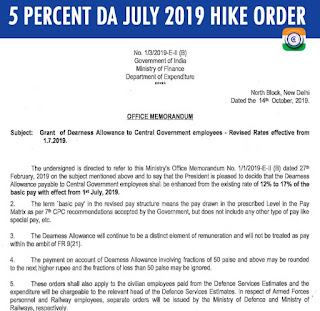
5 Percent DA July 2019 Hike Order - Grant of Dearness Allowance to Central Government employees

Grant of Dearness Allowance to Central Government employees 5 Percent DA July 2019 Hike Order  No. 1/3/2019-E- II (B) Government of...

Blog Archive

About The Author