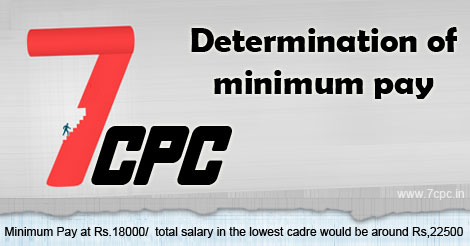
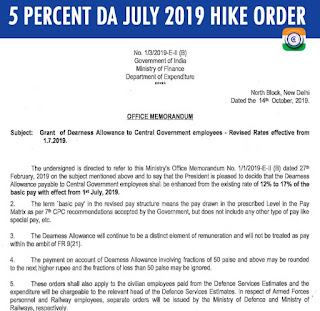
7th Pay commission report on determination of minimum pay
7th CPC has fixed the Minimum Pay at Rs.18000/- as per Indian Labor
Conference recommendations considering 3 units of a family of 2 + 2. The
amount was arrived by the prices sourced from Labor Bureau, Shimla. 7th
CPC claims that this amount is more than twice than that of a private
sector employee.
Minimum Wage Fixed by 7th Pay Commission at Rs.18000/- and along with
allowance proposed, total salary in the lowest cadre would be around
Rs,22500
7th Pay Commission has fixed the minimum wages for the lowest cadre employee is Rs.18000 w.e.f 01.01.2016.
Determination of Minimum Pay
The first step in Wage Revision is to fix the minimum wage that is
required to be paid to the lowest ranked Staff to meet the expenditure
for himself and his family in a dignified manner.
Minimum Pay Estimated by the V and VI CPC
V CPC adopted the ‘Constant Relative Income Approach’ which means the
real minimum pay should grow in line with the cost of living and added
to it the DA of Rs.1,110 to arrive at the ‘price protected’ minimum pay
of Rs.1,860 as on 01.01.1996 and finally increased to Rs.2550 at the
implementation stage.
To estimate the minimum pay in the government, the VI CPC used the
norms set by the 15th Indian Labor Conference (ILC) in 1957 to determine
the need-based minimum wage for a single industrial worker. The norms
set by the ILC are as below:
i. A need-based minimum wage for a
single worker should cover all the needs of a worker’s family. The
normative family is taken to consist of a spouse and two children below
the age of 14. With the husband assigned 1 unit, wife, 0.8 unit and two
children, 0.6 units each, the minimum wage needs to address 3
consumption units;
ii. The food requirement were derived from the recommendations
of Dr. Wallace Aykroyd, the noted nutritionist, which stated that an
average Indian adult engaged in moderate activity should, on a daily
basis, consume 2,700 calories comprising 65 grams of protein and around
45-60 grams of fat. The animal proteins, such as milk, eggs, fish, liver
and meat, are biologically more efficient than vegetable proteins and
suggested that they should form at least one-fifth of the total protein
intake;
iii. The clothing requirements should be based on per capita
consumption of 18 yards per annum, which gives 72 yards per annum (5.5
meters per month) for the average worker’s family.
iv. For housing, the rent corresponding to the minimum
area provided under the government’s industrial housing schemes is to
be taken. The 15th ILC kept it at 7.5 percent of the total minimum
wage;
v. Fuel, lighting and other items of expenditure should constitute an additional 20 percent of the total minimum wage.
As per Supreme Court Directives the VI CPC considered additional
components of expenditure towards Children’s education, medical
treatment, recreation, festivals and ceremonies which this amount at 25
percent of the total minimum wage calculated from the first five
components. Since Government is providing medical facilities to all its
employees the VI CPC arrived at a minimum wage of Rs.5,479. This was
enhanced by about 22 percent to Rs.6,660, which was recommended as the
minimum pay in the government. The enhancement quantified the skill
factor that Group D staff would acquire through training, upon their
merger into Group `C’. Ultimately, at the implementation stage, the
minimum pay was fixed at Rs.7,000 per month on 01.01.2006.
Demand made by JCM-Staff Side to the Commission
In its representation the JCM-Staff Side has submitted that the
Commission must determine a ‘need-based minimum pay’. In addition they
have also sought the inclusion of a quantified skill factor on the lines
of the VI CPC’s approach for addressing the merger of the Group D staff
into Group `C’. They insisted on seven components (five ILS components
+ additional 25 percent provisioning + skill factor).
JCM-Staff Side has reported that the minimum pay should be Rs.26,000
per month, as on 01.01.2014, the date from which it wants the
Commission’s recommendations to be implemented.
Approach of the Commission
VI CPC adopted the 15th ILC norms to arrive at a base figure, to
which was added additional 25 percent for various additional items plus
the skill factor. The Commission has thus noted that directly or
indirectly, the ILC norms have always been at the core of the minimum
pay calculations made by the previous Pay Commissions. The Commission is
also of the view that the ILC norms, along with other supplements (the
entire set of seven components), are the best approach to estimating the
minimum pay as it is a need-based wage calculation that directly costs
the requirements, normatively prescribed to ensure a healthy and a
dignified standard of living.
The 7th Pay Commission has estimated the minimum pay (the
calculations for which have been tabulated below) through the following
steps:
Step 1: The food, clothing and detergent products listed and
their respective quantities specified by the 15th ILC have been adopted.
These quantities indicate the monthly consumption of the listed
products by a family comprising three consumption units. [For e.g. for
the product ‘Dal’ the quantity specified for daily consumption is 80
grams per consumption unit per day. The monthly consumption of Dal by a
consumption unit thus works out to 2.4 kg (80 x 30). Accordingly the
monthly consumption of Dal by a family comprising 3 units is 7.2 kgs
(2.4 x 3).]
Step 2: The quantities have been multiplied by their respective
product prices to arrive at product wise cost. The price of an item is
the average of its prices prevailing in each month from July, 2014-June,
2015
The prices of all items have been sourced from Labor Bureau, Shimla.
These prices are used in the calculation of the CPI (IW) and
subsequently the calculation of Dearness Allowance. In the current
exercise the prices of all items are for the period July 2014-June 2015
and have been used in the calculation of DA at 119 percent operative
from 01.07.2015.
Step 3: The cost of food, clothing and detergent products obtained
from Step 2 has been divided by 0.8 to arrive at a total, of which 20
percent provides for fuel and lighting expenses.
Step 4: The cost estimated from Step 3 is divided by 0.85 to arrive
at a total, of which 15 percent is towards recreation, ceremonies and
festivities. The prescribed provision of 25 percent to cover education,
recreation, ceremonies, festivals and medical expenses has been
moderated to 15 percent because expenses on educational and medical
necessities are being separately provided for through relevant
allowances and facilities and thus need not be provided here. This
partially addresses the first of the two components outside the 15th ILC
norms.
Step 5: The cost estimated from Step 4 is increased by 25 percent
to account for the skill factor, following the reasoning that there is
no unskilled staff in the government after the merger of Group D staff
in Group `C’. This addresses the second of the two components outside
the 15th ILC norms.
Step 6: The cost estimated from Step 5 is divided by 0.97 to arrive
at a total, of which 3 percent provides for housing expenses. This is
done in view of the observation that license fees for government
accommodation is about 3 percent of the total pay. This addresses the
fourth component stated under para 3 but partially so, as the 15th ILC
norms had fixed the housing provision at 7.5 percent.
Step 7: The cost estimated from Step 6 is as on 1 July, 2015 when
the DA was 119 percent. The DA is assumed to be 125 percent as on 1
January, 2016, the day from which the Commission expects its
recommendations to be implemented by the government. Accordingly the
cost estimated from Step 6 has been increased by 3 percent (2.25/2.19 =
1.027 or nearly 3%).
The cost estimated from Step 7 is next rounded off to Rs.18,000,
which is the minimum pay being recommended by the Commission, operative
from 01.01.2016. This is 2.57 times the minimum pay of Rs.7,000 fixed by
the government while implementing the VI CPC’s recommendations from
01.01.2006. Accordingly, basic pay at any level on 01.01.2016 (pay in
the pay band + grade pay) would need to be multiplied by 2.57 to fix the
pay of an employee in the new pay structure. Of this multiple, 2.25
provides for merging of basic pay with DA, assumed at 125 percent on
01.01.2016, while the balance is the real increase being recommended by
the Commission. The real increase works out to 14.2 percent (2.57÷2.25 =
1.1429). The following table shows the real increase given by each
CPC/Government over the previously set minimum pay:
(in percent)
| II CPC |
14.2 |
| III CPC |
20.6 |
| IV CPC |
27.6
|
| V CPC |
31.0 |
| VI CPC |
54.0 |
| VII CPC |
14.3 |
The real pay in government is protected by providing Dearness Allowance (DA), which is
that percentage of pay by which the CPI (IW) increases over a fixed base value.
Consequently the absolute amount of DA keeps on
growing with every point increase in CPI (IW). On the other hand the real value of the industrial minimum wage is protected by providing Variable Dearness Allowance (VDA), which is a
fixed amount
of money given per point increase in CPI (IW) as notified by the Chief
Labour Commissioner (central sphere) from time to time. Consequently,
over a period of time, the minimum pay + DA in government becomes larger
than the minimum wage + VDA in the private sector even though the basic
minimum wage in both the sectors is calculated on the basis of the 15th
ILC norms. As on 01.01.2015 the minimum pay in government was
Rs.14,910 whereas minimum wage for a skilled worker was in the range of Rs.9,000–Rs.11,000 per month.
Besides DA, government provides house rent, transport, location and
function specific allowances besides Leave Travel Allowance (LTA) which,
along with the basic pay, constitute the gross pay of a government
employee. If one were to only take HRA at 30 percent of the basic pay
and transport allowance at Rs.400+DA, as are admissible in A1/A class
cities, together with educational allowances for two children at the
rate of Rs.1,500 per month, the gross pay further increases to Rs.20,870
(20870 = 14910 +2100+860+3000) as on 01.01.2015. In addition government
gives a host of other benefits that can be measured under the CTG (Cost
to Government of an employee) concept. From these numbers it is clear
that benefits given to the lowest ranked government employees, whether monetized or not, are significantly higher than the minimum basic pay
and also much higher than the emoluments of skilled industrial workers.
On comparison with the private sector emoluments of a Govt General
Helper, who is the lowest ranked employee in the government is
Rs.22,579, more than two times the emoluments of a General Helper in the
private sector organizations surveyed at Rs.8,000-Rs.9,500.
After considering all relevant factors the Commission is of the view that the minimum pay in government recommended at Rs.18,000 per month,
w.e.f. 01.01.2016, is fair and reasonable and one which, along with
other allowances and facilities, would ensure a decent standard of
living for the lowest ranked employee in the Central Government.
Annexure to Chapter 4.2
| Calculation of Minimum Pay as on 01.01.2016 by the Commission |
|
|
Per dayPCU |
Unit |
Per month3 PCU |
Unit |
Price/ Unit
(Rs.)
|
Expenses(Rs.) |
| 1. |
Rice/Wheat |
475
|
gm |
42.75 |
kg
|
25.93 |
1108.30 |
| 2. |
Dal (Toor/Urad/Moong) |
80
|
gm |
7.20
|
kg
|
97.84 |
704.44 |
| 3. |
Raw Vegetables |
100
|
gm |
9.00
|
kg
|
58.48 |
526.28 |
| 4. |
Green Vegetables |
125
|
gm |
11.25 |
kg
|
38.12 |
428.85 |
| 5. |
Other Vegetables |
75
|
gm |
6.75
|
kg
|
32.80 |
221.42 |
| 6. |
Fruits |
120
|
gm |
10.80 |
kg
|
64.16 |
692.93 |
| 7. |
Milk |
200
|
ml |
18.00 |
litre |
37.74 |
679.26 |
| 8. |
Sugar/Jaggery |
56
|
gm |
5.04
|
kg
|
37.40 |
188.48 |
| 9. |
Edible Oil |
40
|
gm |
3.60
|
kg
|
114.02 |
410.46 |
| 10. |
Fish |
|
|
2.50
|
kg
|
268.38 |
670.95 |
| 11. |
Meat |
|
|
5.00
|
kg
|
400.90 |
2004.51 |
| 12. |
Egg |
|
|
90.00 |
no.
|
4.27 |
383.98 |
| 13. |
Detergents etc |
|
|
Rs./month
|
291.31 |
291.31 |
| 14. |
Clothing |
|
|
5.50
|
meter |
164.88 |
906.83 |
| 15. |
Total (1-14)
|
9217.99 |
| 16. |
Fuel, Electricity, Water Charges |
2304.50 |
| 17. |
Total-(15) divided by 0.8
|
11522.49 |
| 18. |
Marriage, Recreation, Festivals, etc. |
2033.38 |
| 19. |
Total-(17) divided by 0.85 |
13555.87 |
| 20. |
Provide for Skill by adding 25% to (19) |
3388.97 |
| 21. |
Sum (19+20)
|
16944.84 |
| 22. |
Housing @
|
524.07 |
| 23. |
Total-Divide no.21 by 0.97 |
17468.91 |
| 24. |
Step up of 3% on No.23 as DA is projected at 125% on 01.01.2016 |
524.07 |
| 25. |
Final Minimum Pay as on 01.01.2016 (23+24) |
17992.98 |
| 26. |
Rounding off
|
18000 |
Source:
gconnect.in