A complete reference blog for Indian Government Employees

Tuesday, 24 November 2015

7th Pay Commission proposes field staff pay parity with secretariat staff

Arun-Jaitley-A-K-Mathur-7th-CPC
Finance Minister Arun Jaitley Thursday receiving the report of Seventh Pay Commission from its Chairman Justice A K Mathur.
New Delhi: The Seventh Pay Commission on Thursday proposed to restore field staff pay parity with the central secretariat staff for coming under uniform pay package in its 900-page report, which was presented to Finance Minister Arun Jaitley by the commission, headed justice A K Mathur.

The Pay Commission decided similar ranks and salaries for the field staff and central secretariat staff.

The Assistants and Section Officers get pay grade Rs 4600 and Rs 4800 in central Secretariat service while the Assistants and Section Officers in field offices get pay grade Rs 4200 and Rs 4600 respectively.

The field staff had demanded pay parity earlier before Sixth Pay Commission and that commission accepted it but the government didn’t give its nod about it.

The field staff again put their demand of  pay parity before the new Pay Commission to permanent settle this matter on the following grounds.

The Assistants in central secretariat were recruited through Union Public Service Commission (UPSC) till 1986 and field staff through Staff Selection Commission (SSC). So, they are they were allowed to to retain an ‘edge’.

The recruitment of Assistants in central secretariat was also brought under the SSC in 1987 and is now carried out through a common examination called the Combined Graduate Level Exam (CGLE) and an All India Merit List.

It is to note that there is no difference in the nature of functions discharged by both staff in central secretariat and field offices.

The Assistants in central secretariat and Assistants in field offices, the examination process is common although the grade pay for the two sets are different i.e Rs 4,600 and Rs 4,200 respectively.

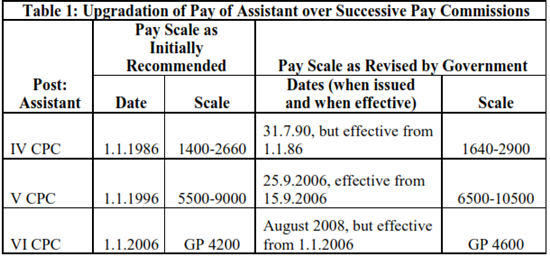
Every pay commission from Fourth Pay Commission to Sixth Pay Commission had recommended for field staff pay parity with central secretariat staff but the central government had not accepted it. This is elucidated in the table below:

Pay-Parity-pay-commissions


It may be seen from the above table that the recommendations of successive Pay Commissions with regard to pay of Assistants in central Secretariat, even if initially implemented, the central government has invariably modified at a later point and they have been placed at one higher level. As a corollary to this, the level of Section Officers in central Secretariat also is at one level higher than that of Section Officers in the field.

After considering the above facts, the Seventh Pay Commission strongly recommended that the level of Assistants in central Secretariat be brought at par with Assistants in the field offices who are presently drawing Grade Pay 4200.

So, in the new pay matrix the Assistants of both central Secretariat as well as field offices will come to lie in Level 6 in the pay matrix  and pay fixed accordingly. This level corresponds to pre-revised Grade Pay 4200. The corresponding posts in the Stenographers cadre will also follow similar pay parity between field and central Secretariat staff.

Consequently,  Section Officers of both central Secretariat as well as field offices will come to lie in Level 7 in the pay matrix  and pay fixed accordingly.

However, the pay of those Assistants and Stenographers who have, in the past, been given higher Grade pay would be protected.

The Commission also recommends withdrawal of non-functional selection grade to Grade Pay 4200 in respect of Upper Division Clerks in central Secretariat, which is not exist in field offices in current  scenario.

The Seventh Pay Commission recommended to make field staff pay parity with central secretariat staff but it is the big matter, will the central government accept it without a question?

The government may accept  the pay  in Level 7 in the new pay matrix, corresponds to current Grade Pay 4600 for the Assistants of both central Secretariat as well as field offices  as  the dispute between over pay parity is to be permanent settled.

TST
Share:

7th CPC recommendations to reduce House Rent Allowance

7th CPC recommendations to reduce House Rent Allowance

The 7th Central Pay Commission has been recommended to reduce the percentage of House Rent Allowance for all categories of Central Government employees rationalized to 24 percent, 16 percent and 8 percent of the Basic Pay for Class X, Y and Z cities respectively.

The Commission also recommends that the rate of HRA will be revised to 27 percent, 18 percent and 9 percent when DA crosses 50 percent, and further revised to 30 percent, 20 percent and 10 percent when DA crosses 100 percent.


7th CPC HRA: HRA is the most important factor of allowance issuing to existing Central Government employees, it is given for compensate to live in rented house. The HRA rules are allowed for getting allowance even if he/she living in own house.

A major changes had been made in 6th CPC on HRA rules. The percentages were prescribed on basic pay according to the cities in India. The cities are classified as X, Y and Z and the rates of percentage respect of the cities are 30%, 20% and 10% on basic pay (Grade pay including).

Central Government employees are expecting changes in the rate of percentage according to cities.

NC JCM STAFF SIDE SUGGESTION ON HOUSE RENT ALLOWANCE

National Council JCM Staff Side given suggestion on House Rent Allowance for Central Government employees as under…

House Rent allowance. 


The present scheme of HRA is based on the recommendation of the 6th CPC, which is as follows:


We reproduce hereunder the recommendation made by the third Central Pay Commission in the matter of grant of house rent allowance. (Para 29 Part I. Vol. IV.Chapter 56), which would be the best if implemented even today. While we find it difficult to accept the kind of parity suggested above, we are aware of the acute problem caused by the lack of adequate government housing and by the inadequate government housing and by the inadequacy of the existing rates of house rent allowance and recommend as follows:-

Government should take houses on long lease and make residential accommodation available to its employees on payment of 10% of their pay.

(ii) Government should lay down appropriate house rent allowance rates in different cities and towns based not on population criteria, but on an actual assessment of the prevailing levels of rent in different cities and towns. Alternatively, certain notional rents for different types of accommodation meant for officers and personnel of specified pay groups should be laid down for particular cities after studying the actual conditions in that city. The difference between the actual rent paid and 10% of pay should be reimbursed subject to a maximum of the difference between the notional rent and 10% of the pay. The existing norms in regard to entitlement of accommodation, size of rooms etc. could, if necessary, be reduced depending on the housing situation and the norms usually adopted by different income groups in renting accommodation in the various cities. Such notional rents should, to start with, be applied to all stations falling under the description of classified cities for purposes of House Rent Allowance, Additions could also be made to the list later on by including other cities deserving similar treatment.

 (iii) Till the Government is able to make arrangements recommended in the preceding sub-paragraphs, the rates of HRA should be as follows:-

The above said recommendations is still to be acted upon by the Government and the transitory provisions suggested by them i.e. payment of allowances at a pre-determined rate on the basis of classification made of the cities depending upon the population continue to be employed. The non-implementation of the above recommendation of the third CPC , has without exception, gone to depress the wage of all sections of Central Government employees as they are perforce to spend more than what they receive as HRA for obtaining and retaining the accommodation.
The rates prescribed by the 6th CPC, though an improvement over its predecessor Commission, it has not improved the situation. The real estate value throughout the country has skyrocketed and owning an accommodation within the city/Municipal limit has become impossible for Government employees. There is not a single town/village where the real estate boom has remained unaffected. The phenomenal increase in the value of land has naturally impacted the rent, one is to pay on leasing house/flat. The house rent allowance does not bear even a small percentage of the rent. The 7th CPC may recommend to the Government to act upon the suggestion made by the 3rd CPC without any further delay. Pending action on the part of the Government, the Commission may suggest the following rates of House Rent allowance;
Share:

Meetings with 7th CPC and Cabinet Secretary – NC JCM Staff Side

Meetings with the VII CPC and the Cabinet Secretary – resentment conveyed to Govt. of India

Shiva Gopal Mishra 
Secretary
Ph.: 23382286
National Council (Staff Side)
Joint Consultative Machinery
Central Government Employees
13-C, Ferozshah Road, New Delhi – 110001
E Mail : nc.jcm.np@gmail.com
No.NC/JCM/2015
Dated: November 20, 2015
All Constituents of the
National Council(JCM)

Dear Comrades,
Sub: Meetings with the VII CPC and the Cabinet Secretary

Today I met the Chairman, VII CPC, Justice Shri Ashok Kumar Mathur, and expressed our anguish against retrograde recommendations of VII CPC, particularly reg. Minimum Wage, reduction in HRA and CCL, non-redressal of NPS, abolition of various allowances, examination of MACP benefit, etc. etc.

Tough he had given argument, but I told him about the anguish of all the constituents of the JCM(Staff Side), who feel that they have been betrayed by the VII CPC.

Comrades! I have also met the Cabinet Secretary, Shri P.K. Sinha, in the afternoon and handed him over a copy of the attached letter and requested him to convene meeting of the NC/JCM at an earliest as well as to intervene in the matters raised by the JCA in case of report of VII CPC at an earliest. The Cabinet Secretary has promised that he would try to fix the meeting at an earliest and also look into the points raised by the NC/JCM(Staff Side) for VII CPC.

With fraternal greetings!
Yours faithfully,
sd/-
(Shiva Gopal Mishra)
Secretary
Source : http://ncjcmstaffside.com/
Share:

7th Pay Commission Report: Person with Disabilities

7th Pay Commission Report: Person with Disabilities

 Introduction
9.6.1 As per the Persons with Disabilities (Equal Opportunities, Protection of Rights and Full Participation) Act, 1995, a “person with disability” means a person suffering from not less than 40 percent of any disability as certified by a medical authority. “Disability” as defined in Section 2(i) of the Act means– (i) blindness (ii) low vision (iii) leprosy cured (iv) hearing impairment (v) locomotor disability (vi) mental retardation (vii) mental illness.
9.6.2 As per the Census of India, 2011, there are nearly 26.8 million Persons with Disabilities (PWDs) in the country, which is nearly 2.21 percent of the total population.

PWDs in Central Government
9.6.3 The government provides three percent reservation in jobs for PWDs. Apart from this reservation at the entry stage, DoPT has issued instructions regarding identification of jobs, post-recruitment and pre-promotion training, providing aids/ assistive devices, accessibility and barrier free environment at work place, preference in government accommodation, grievance redressal, and preference in transfer/posting for PWDs. In a recent notification, a provision has been made for ten years’ (fifteen years in case of SC/ST and thirteen years in case of OBC candidates) relaxation in the upper age limit for direct recruitment to civil posts/services under the Central Government.
9.6.4 Moreover, there are certain special entitlements as given below:
i. Special Allowance for Child Care for Women with Disabilities at the rate of Rs.1,500 pm;
ii. Transport Allowance at double the normal rate, subject to a minimum of Rs.1,000 pm; iii. Constant Attendance Allowance for retired employees with 100 percent disablement at the rate of Rs.4,500 per month;
iv. Special Casual Leave for four days in a calendar year for specific requirements relating to disabilities;
v. Special Casual Leave for ten days in a calendar year for participation in Conferences/ Seminars/Trainings/Workshops related to disability and development.

9.6.5 In case the disability is work related, the following additional provisions are available:
a. Special Disability Leave;
b. Disability Pension;
c. Educational Concession to children of Defence personnel who are disabled in action.

9.6.6 For employees with differently abled children, Children Education Allowance and Hostel Subsidy is granted at double rate.


Demands

9.6.7 Associations of employees with disabilities made the following demands before the Commission:
i. Suitable enhancement in the existing provisions
ii. Provision of Common Room in offices with suitable recreational facilities
iii. Additional rebate in House Building Advance and Automobile Advance
iv. Establishment of Welfare Committees in the ministries
Analysis and Recommendations

9.6.8 The National Policy for Persons with Disabilities, 2006, enunciates the measures that need to be taken by the government to ensure equal opportunities, protection of rights and full participation in society for PWDs, in consonance with the principles enshrined in the Indian Constitution. India is also a signatory to the UN Convention on the Rights for Persons with Disabilities. Thus, provision of appropriate measures for employees with disabilities is the responsibility of the Union Government.
9.6.9 The Commission has made various recommendations regarding PWDs at different places in the report. They are consolidated here for ready reference:
i. In recognition of the singular responsibility faced by differently abled women in raising their children, the Special Allowance for Child Care for Women with Disabilities has been enhanced from the present rate of Rs.1,500 pm to Rs.3,000 pm
ii. Transport Allowance at double the normal rate has been retained, and the minimum amount has been increased from Rs.1,000 pm to Rs.2,250 pm
iii. Children Education Allowance and Hostel Subsidy have been kept at double rate for differently abled children
iv. Constant Attendance Allowance has been enhanced from Rs.4,500 pm to Rs.6,750 pm
v. Special Disability Leave has been subsumed in Work Related Illness and Injury Leave (WRIIL), with improved provisions
vi. Educational Concession, hitherto available only to the children of Defence personnel killed/missing/disabled in action, has been extended to similarly placed personnel of CAPFs, Indian Coast Guard, RPF and police forces of Union Territories mutatis mutandis

9.6.10 Besides the above recommendations, there are a few suggestions that can go a long way in improving the working environment for these employees:
i. In our interactions, it has been highlighted that easy access, particularly to toilets, remains an issue of concern. Hence, it is suggested that Guidelines and Space Standard for Barrier Free Built Environment for Disabled and Elderly Persons, issued by CPWD, Ministry of Urban Affairs and Employment, should invariably be followed while designing new government premises. Their application in the existing offices may also be explored.
ii. Every ministry should have a Welfare Committee, with due representation of differently abled employees, to address their concerns.
iii. The grievance redressal machinery should be strengthened and made more effective.
Share:

Monday, 23 November 2015

7th Pay Commission Report: General Provident Fund (GPF) for Central Government employees

7th Pay Commission Report: General Provident Fund (GPF) for Central Government employees

9.4.1 General Provident Fund (GPF) for Central Government employees was started w.e.f. 1 April, 1960. It covers those government employees who joined service before 01.01.2004 and are not governed by the Contributory Provident Fund Scheme. The scheme was introduced to foster the habit of saving amongst government employees and to provide them financial help in times of need. The Commission has not received any demands regarding modifications in this scheme.

Analysis and Recommendations

9.4.2 The Commission has analyzed the views of the previous Pay Commissions regarding GPF. The IV CPC and the V CPC did not favour making the scheme optional on the grounds that the fund provided relief to employees in times of need and that accretions to the fund also improved the government’s ways and means position. The VI CPC had, however, recommended that the “future investments in GPF should be allowed purely on voluntary basis with no minimum being prescribed.” Their rationale was that the resource position of Central Government is comfortable and the revenues are showing a steady growth, employees have the option of a variety of market instruments to choose from for investment purposes, and with the proposed increase in monthly subscription under the CGEGIS (70% of which is for saving purposes), the government employees will, in any case, be making a much higher saving.

9.4.3 The Commission notes that the recommendations of the VI CPC regarding CGEGIS and GPF were not accepted by the government; neither the CGEGIS rates were revised, nor GPF was made voluntary.

9.4.4 This Commission is of the view that, with the introduction of NPS w.e.f. 01.01.2004, the number of subscribers under the GPF scheme will decrease as time goes by. Moreover, the scheme has worked well over the past 65 years and has provided pecuniary relief to the subscribers in times of need. Accordingly the Commission does not find merit in any disturbance at this point of time. Hence, status quo is recommended.
Share:

Massive demonstrations to protest against retrograde recommendations of the 7th CPC


Massive demonstrations to protest against retrograde recommendations of the VII CPC

Today, in the meeting held in the office of NC/JCM(Staff Side), 13-C, Ferozshah Road, New Delhi, it has been decided that, all the constituents of NJCA shall give direction to their affiliates to hold massive demonstrations, bearing black badges, on 27th November, 2015, against the following retrograde recommendations of the VII CPC

All India Railwaymen’s Federation
No.AIRF/24(C)
Dated: November 20, 2015
The General Secretaries,
All Affiliated Unions,

Dear Comrades,
Reg.: Massive demonstrations to protest against retrograde recommendations of the VII CPC

Today, in the meeting held in the office of NC/JCM(Staff Side), 13-C, Ferozshah Road, New Delhi, it has been decided that, all the constituents of NJCA shall give direction to their affiliates to hold massive demonstrations, bearing black badges, on 27th November, 2015, against the following retrograde recommendations of the VII CPC.

Against the demand of the Staff Side, National Council(JCM) for Minimum Wage Rs.26,000, the VII CPC has recommended Rs.18,000, thereby widening the gap between Minimum and Maximum Wage as 1:13.8 while our demand was to keep this ratio not more 1:8.
The present rate of HRA, i.e. 30%, 20% and 10% has been reduced to 24%, 16% and 8% respectively.
The number of interest-free advance, like Festival Advance, etc. have been recommended to be stopped.
Instead of removing the existing anomalies in the MACPS, the Pay Commission has introduced examination for granting MACP benefit.
The Pay Commission has also refused to make any recommendation against the NPS.
In case of Child Care Leave for women employees, leave wage shall be reduced to 80% for second spell of 365 days CCL.
All of you are requested to comply with the aforementioned decision of the NJCA, and the report of the same should be sent to NJCA Headquarters Office, i.e. 4 State Entry Road, New Delhi.
Yours faithfully,
sd/-
(Shiva Gopal Mishra)
General Secretary
Source: AIRF
Share:

7TH PAY COMMISSION RECOMMENDATION LDC-UDC ISSUE

7TH PAY COMMISSION RECOMMENDATION LDC-UDC ISSUE-GOVERNMENT STAND REITERATED

On the issue of LDC/UDC 7th Pay Commission reiterated the deceiving stand of the Government. Despite of realizing the issue as genuine, Government had not taken a positive decision at their level. The tens of thousands of LDC & UDC, solely responsible for the smooth running of many of the subordinate offices, were hoping that 7th Pay Commission will study the problem faced by them and take a positive decision. Staff Side JCM having convinced the importance of the issue, had also recommended merger & upgradation of the Grade Pay of LDC & UDC to Rs. 2800. But here we see that 7th Pay Commission has not taken any decision on the issue except giving some confusing and misleading statements to vindicate the stand taken by the Government as true. Extracts of some of their views on LDC UDC issue spread over various chapters of the reports is given below:

Higher GP 2400 to LDC and consequent upgradation of pay for other civilian posts in the Ministerial hierarchy.

11.22.100 The Academy has urged that LDC should be placed in higher GP 2400 as against the existing GP 1900 at par with grade pay of Data Entry Operator (DEO), on the grounds that both LDC and DEO enter service on the basis of same educational qualification i.e., Class XII and that the functions of LDC are more complex than that of a DEO. This issue has been dealt in Chapter 7.7. Recommendations made there would apply in this case also.

11.52.32 They have demanded upgradation in pay of certain category of non-industrial posts viz., LDC, UDC, Accountant, Junior Head Clerk, Head Clerk, Office Superintendent and Assistant Manager (Admin).


Analysis and Recommendations

11.52.33 The Commission has not received the views of the ministry/department on the issue. However, posts like LDC, UDC, Accountant are common to a number of ministries/ departments. Recommendations regarding their pay are contained in Chapter 7.7 and Chapter 11.35. The Commission does not find any justification for increase in pay scale of the other cadres.

But in Chapter 7.7 no direct recommendation except to decline the demand of LBSNAA to increase the promotional quota of MTS to LDC, is visible. The extract of Para 7.7.37 is give below:


Analysis and Recommendations

7.7.37 Looking at the qualification requirements and their job profile, the Commission does not recommend any changes in the pay structure or the promotional prospects of the MTS. Regarding MTS in Delhi Police, the Commission is of the view that since MTS is a common category, any special dispensation to MTS in Delhi Police is not justified. In so far as the MTS of LBSNAA are concerned, the Commission notes as per the recruitment rules for LDC, presently only 5 percent of MTS can get promoted to LDC through limited departmental examination. However, since the government has stopped direct recruitment for the clerical cadre and gradually phasing out the existing incumbents, their demand cannot be accepted.

LDCs

11.35.27 There are demands that 50 percent posts of LDCs be earmarked for filing up by promotion/departmental examination by MTS. It has been argued that the educational qualification for the post of MTS is Class X and they are recruited through SSC for performing the work of Peon, Mali, Cobbler, and Sweeper etc. Since most of the MTS join the post with higher qualification of Higher Secondary and Graduation, there is high rate of attrition in the MTS cadre.

Analysis and Recommendations

11.35.28 As per the recruitment rules for LDC, presently 5 percent of MTS can get promoted to LDC through limited departmental examination. Since government has already stopped direct recruitment for the clerical cadre and gradually phasing out the existing incumbents, this demand cannot be accepted. Moreover enhancement of promotional quota is an administrative matter to be considered by the relevant administrative ministry.

Between the lines it can be read that the Government prevented the 7th Pay Commission to not consider the LDC/UDC issue positively and reiterated the wrong statement of the Government that that Government of India has stopped direct recruitment of LDC through Staff Selection as its recommendation. But the fact is that Staff Selection Commission is frequently conducting recruitment for the post of LDC and without the permission of the Government how they can done at their own. Combined higher secondary examination for the selection of LDC also has been conducted recently. If we take the intention of Government of phasing out the LDC post as true, then where is the alternative recommendation? Who will do the arduous work done by the young and energetic LDCs in the subordinate offices? It is to be noted that the normal ratio of LDC and UDC in subordinate offices is 5:2 and thus LDCs have been allocated responsible sections and in many smaller offices LDC alone is handling the work of entire Administration.

On the other hand rejecting Central Secretariat Clerical service demand of parity with DEO the commission observes “Even though the entry requirements are similar, historically the pay scales of the two posts have been different. Besides, they comprise two distinct cadres with different set of roles and responsibilities. Hence, the demand for parity of pay of LDC with DEOs cannot be acceded to by the Commission.”(Para 11.35.38).

Our view is that historically these cadres may be different set of roles but the fact is that functions of LDC are more complex than that of DEO and same was brought before the commission by various  Associations/Administrative Authorities. Earlier pay Commissions have fixed Pay Scale to DEO considering their work on computer. But today LDCs are more expertise in computer than DEO for doing work in computer, but the demand of parity with DEO is rejected. Extract of Para 11.35.38 is given below:

Central Secretariat Clerical Service

11.35.38 The Central Secretariat Clerical Service (CSCS) consists of the following grades:

i. Upper Division Clerk (GP 2400)
ii. Lower Division Clerk (GP 1900)
LDC and Data Entry Operator (DEO)

11.35.39 It has been demanded that LDC of CSCS drawing pay in GP 1900 be placed in GP 2400 at par with the DEOs on the grounds that post VI CPC, the entry requirements for the two posts is almost similar.

Analysis and Recommendations

11.35.40 Even though the entry requirements are similar, historically the pay scales of the two posts have been different. Besides, they comprise two distinct cadres with different set of roles and responsibilities. Hence, the demand for parity of pay of LDC with DEOs cannot be acceded to by the Commission.
From the above it is clear that Government is adamant on not granting pay scale to LDC & UDCs in subordinate offices at par with the duties assigned to them. Even though the 7th CPC claimed that they have recommended pay scales on the principle of equal pay for equal work, the genuine issue of LDC/UDC is ignored. Thus we are forced to represent against the recommendation to the Government/JCM (Staff Side).

All our LDC/UDC friends are requested to raise the issue in their respective Association/Office to force them to represent the issue to the implementation committee for consideration. Also please join all action programmes including strike action, called by the JCM (Staff Side), as published in this web site from time to time, to combat the situation.
TKR Pillai
General Secretary
Mob: 09425372172
Source: http://aiamshq.blogspot.in/
Share:

Featured post

5 Percent DA July 2019 Hike Order - Grant of Dearness Allowance to Central Government employees

Grant of Dearness Allowance to Central Government employees 5 Percent DA July 2019 Hike Order  No. 1/3/2019-E- II (B) Government of...

Blog Archive

About The Author