A complete reference blog for Indian Government Employees

Tuesday, 22 September 2015

Change in timings for booking train tickets through internet – Railway Board Orders on 18.9.2015

Change in timings for booking train tickets through internet – Railway Board Orders on 18.9.2015

GOVERNMENT OF INDIA
MINISTRY OF RAILWAYS
(RAILWAY BOARD)
No.2010/TG-I/10/ITS
New Delhi, dated 18.9.2015.
MD/CRIS
Chanakyapuri, New Delhi.
Managing Director / IRCTC,
11th Floor, Statesman House,
Barakhamba Road,
New Delhi.

(COMMERCIAL CIRCULAR NO.58 OF 2015)

Sub:- Change in timings for booking through internet.

Please refer to this office letter no. 2010/TG-I/10/P/ITS dated 22.04.2010 on the subject quoted above wherein the timings for booking of reserved tickets through internet were advised.

2. The matter been reviewed and it been decided that the facility of booking revised tickets through internet will be available from 0030 hours to 2345 hours daily w.e.f 20.09.2015.

3. Since the timings of functioning of PRS will be changed 0030 hours to 2345 hours w.e.f. 20.09.2015, the current counters at train originating stations will also be able to function from 0030 hours to 2345 hour.

4. Wide publicity should be given for information of general public by IRCTC and Zonal Railways.

(Vikrnm Singh)
Director Passenger Marketing
Railway Board
Authority : Indian Railways
Share:

New Pension Scheme (NPS) v/s Old Pension Scheme

NPS is far beneficial than Government Pension – Comparison of New Pension Scheme (National Pension Scheme) and Central Government Pension 

The Central Government employees who have joined after 1/1/2004 and are put under National Pension Scheme (NPS) have been demanding abolition of NPS and have been persuading the Central Government to make the government pension scheme applicable to them.

This only exhibits their ignorance of the fact that the New Pension Scheme is highly lucrative and make the government employees who joined after 1/1/2004 far richer than the government employees who enjoy government pension scheme. By doing so they are in the process of ruining the great fortunes that lies in store under New Pension Scheme. Let me compare both the scheme:

Comparison of New Pension Scheme (National Pension Scheme) and Central Government Pension

Benefits under NPS

Let me take a case of Upper Division Clerk(UDC) who joins government service in 2014 at the age of 25 and renders 35 years of service till attaining 60 years of age. He / She gets 3% annual increment every year and gets one promotion every 10 year under M.A.C.P. Although he / she is likely to get 14 to 20% increase in D.A every year as per Consumer Price Index I just take 12%(assuming 6 + 6%) 2 times D.A in a year
* MACP / Promotion Years
(A) Therefore, the total pension wealth of a government servant who joined in 2014 and retiring under New Pension Scheme shall at the time of his retirement be Rs. 2,87,26,201/-

(B) 60% of the lump-sum pension wealth which he / she will be getting on retirement:
Rs.1,72,35.720

(C) 40% invested in an annuity scheme which he / she can receive before 70 years:
Rs.1,14,90,481

(D) Earned Leave Encashment: Rs. 215625 x 10 months : Rs. 21,56,250
TOTAL of (A) (B) (C) and (D) will be Rs. 3,08,82,451
Death Gratuity:
Although not entitled for retirement gratuity, but eligible for Death Gratuity If died during the service

Monthly Pension:
At the assumed Interest at the rate of 8.7% per annum on the other 40% of pension wealth of Rs.1,14,90,481 invested in annuity shall fetch  monthly pension of at least : Rs.83,306/ –
Not only this, before he / she attains the age of 70 he / she can withdraw the remaining 40% of his pension wealth of Rs. 1,14,90,481/- which if invested in Fixed Deposit of a nationalised bank can fetch interest and take care of not only of his wife and children but his descendants also for generations to come.
This is just a tip of the iceberg. If we consider the other 4 pay commission benefits that materialize on1/1/2016, 1/1/2026, 1/1/2036 and 1/1/2046 which a NPS pensioner who joins as UDC shall be getting before his retirement in 2049,his total pension wealth will be undoubtedly double the above amount which comes to more than Rs.5 crores. While a person who joins as U.D.C. gets this much, one will be rocked out of stupor to know what a Group A officer who renders 35 years of service may get – undoubtedly his total pension wealth will be more than Rs.10 crores.

Benefits under Central Government Pension Scheme
Now let us see what will be the retirement benefits of the above person if he / she is put in government pension scheme:

1.Gratuity for 16.5 months :
Rs.2,15,625 x 16.5 months = Rs.35,57,812/- Restricted to Rs.10,00,000

2. Earned Leave Encashment:
Rs. 215625 x 10 months : Rs.21,56,250

3. Pension Commutation:
Rs.17195 x 40% = Rs.6878 x 12 x 8.194 years Rs 6,76,300
Total Benefits under Central Government Pension Scheme: Rs.38,32,550

4. GPF Balance:
As it is a general tendency of the government servants to withdraw from GPF frequently, there will be very
little left at the time of retirement

5. Monthly pension
i) Rs.34390 / 2 = Rs.17195 (basic pension being 50% of pay and grade pay Less 40% of basic pension towards commutation (Rs 6878) which will be restored after 15 years
Balance basic pension is Rs. 10317

ii) DA @ 527% of basic pension of Rs.17195 = Rs. 90617 (subject to increase in DA every 6 months based on consumer price index)
Total pension is Rs.1,00,934 per month.
After the death of government servant say after 67 years, spouse can take only 60% of the basic pension i.e.Rs.17195 x 60% = Rs.10317 plus D.A.at the prevailing rates. After spouse’s death children are unlikely to draw the pension as they would have already crossed the age limit. Thus, unlike the dependents of NPS pensioners, there will be nothing left for financial security of the dependents of the government pensioners .
Thus it is unwise on the part of government servants who have joined after 1/1/2004 to demand for abolition of NPS scheme and grant of government pension.
Mr.M.Dorai
Deputy Director
ESIC Model Hospital,
Bangalore (Ministry of Labour, Government of India) is the author of this Article
Share:

Monday, 21 September 2015

Government pulls up ministries on pension delay issue, sets October 15 deadline for report

Government pulls up ministries on pension delay issue, sets October 15 deadline for report

NEW DELHI: The government has raised objections to delay in starting pensions to retiring officials because their respective departments fail to issue a certificate validating the service five years before they actually retire. All ministries have now been asked to study the case of each soon-to be retiring employee to avoid such an occurrence.

The PM-led ministry of personnel has written to all ministries on September 16 that they need to submit a report by October 15 in this regard and non-compliance with the statutory requirement of issuing the said certificate “may be viewed seriously”.

As per the existing rules, a certificate regarding ‘qualifying service’ is required to be issued by the Heads of Offices after completion of 18 years of service of an employee and again 5 years before the date of the person’s retirement. “It has been noticed that the certificates regarding qualifying service are not invariably issued to the government servant as required under the rules,” the letter stated.


“It has been observed by this department that processing of pension cases of the employees retiring quite often get delayed on account of the issues relating to verification of service. Although detailed instructions regarding verification of service have been issued by DoPT and by this department, these instructions are not meticulously adhered to resulting in delay in sanctioning of retirement benefit of the employees,” said the September 16 letter.

The letter specifies a format under which all ministries have to furnish a statement now by October 15 regarding the status of issue of service verification certificates. Each ministry has to specify the number of employees to whom the certificate has been issued after 18 years of their service and 5 years before their retirement, to whom the certificate is due and number of eligible employees in respect of whom the issue of certificates is in due process. The government is streamlining the system of pension issue, including introducing an Aadhaar-based online ‘annual life certificate’ submission system.

Source:http://m.economictimes.com/
Share:

Grant of Night Duty Allowance on the basis of Actual Salary – BPMS writes to OFB

Grant of Night Duty Allowance on the basis of Actual Salary – BPMS writes to OFB

BHARATIYA PRATIRAKSHA MAZDOOR SANGH
(AN ALL INDIA FEDERATION OF DEFENCE WORKERS)
(AN INDUSTRIAL UNIT OF B.M.S.)
(RECOGNISED BY MINISTRY OF DEFENCE, GOVT. OF INDIA)

REF: BPMS / OFB / NDA / 200 (8/2/L)
Dated: 14/09/2015
To,
The DDG (IR),
Ordnance Factory Board,
10 A, S.K.Bose Road,
Kolkata – 700001

Subject: Grant of Night Duty Allowance on the basis of Actual Salary

Reference: PC of A (Fys) Kolkata letter No. Pay/Tech-II/1206/2015/13, dated 09.09.2015

Respected Sir,
With due regards, it is submitted that the issue of payment of Night Duty Allowance based on actual salary, instead of notional pay of Rs.2200/- was resolved vide MOD ID No. 17(4)/2012/D(Civ-II), Dated 08.05.2015 in compliance of Contempt Petition (CP No. 200/2014 Shri Arvind Girija Singh & Ors versus UOI & Ors.) based on the CAT Jodhpur directions in CA No 34/2008 dated 5.11.2009 and subsequent ratifications by Hon’ble High Court and Supreme Court of India.

We are surprised to see the PC of A (Fys) letter cited under reference whereby ceiling for entitlement of Night Duty Allowance has been revised to Rs. 12380/- pay in Pay Band. We have strong objection on the issuance of this letter because PC of A (Fys) is not the competent authority to revise the ceiling of entitlement for NDA unilaterally as the original order has been issued by Ministry of Defence in consultation with Min of Finance, DoP&T, Def (Finance) and if there was any doubt regarding eligibility, PC of A (Fys) should have asked for clarification from the competent authorities through prescribed channels.

Further, all the court cases regarding revision of night duty allowance was related to the notional ceiling of Rs. 2200/- per month and this issue was resolved by ordering the NDA on the actual salary and nowhere court further fixed any real or notional ceiling. Even it has been already clarified in the earlier order which states that entitlement ceiling of Rs. 2200/- is not applicable to existing categories who are getting NDA. Prior to implementation of recommendations of 6th CPC, IEs / NIEs / NGOs upto Assistant Foreman (Technical) was entitled for Night Duty Allowance being a non-gazetted supervisory staff but now the post of Assistant Foreman is merged with JWM which is a gazetted supervisory post in OFB. Hence, all the Industrial / Non-Industrial & Non – Gazetted Supervisory staff are entitled for NDA on the basis of actual salary.

Therefore, you are requested to intervene into the matter so that all IEs/NIEs/NGOs may get the NDA as per actual salary in compliance with the court pronouncements in letter and spirit.

Thanking you.
Sincerely yours
sd/-
(M P SINGH)
General Secretary
Source: BPMS
Share:

Sunday, 20 September 2015

Seventh Pay Commission: Employees’ delight, government's despair

7th Pay Commission: Employees’ delight, government's despair

New Delhi: The Seventh Pay Commission report is awaited, the new pay scales will be applicable to Central government employees with effect from January 2016.

50 lakh central government employees and 56 lakh pensioners including dependents hope to get this gift from April next year. The revised pay scales are likely to be implemented retrospectively starting 1 January 2016.

Many commentators say that the average increase in basic fair pay for all government employees will be in the region of 40-45%.

This is a very rough average because for senior level officers, like the Cabinet Secretary or officials at the secretary level, the payback could increase by more than 50%.

As the Pay Commission numbers come through there could be a 30-40 per cent increase for each central government employee.

An increase of salary and allowances would boost middle class central government employees to spend more time with their families for marketing.

The economy would get a major boost from a pickup in consumption, resulting from an increase in salaries but the flip side to the hike will be a spike in inflation.

The reports of Seventh Pay Commission will be implicated from April next year as Finance Minister Arun Jaitley said in the Parliament on February 27, “The Seventh Pay Commission impact may have to be absorbed in 2016-17.”

Finance Minister Arun Jaitley said above statement in his pre-budget speech. His statement indicates that the government may implement Seventh Pay Commission report from April 2016.

The strongest criticism of Pay Commission awards is that they play havoc with government finances. The pervious pay commissions’ rollout has been negative for fiscal balances.

The recommendations of the second pay commission were accompanied with a financial impact of about Rs 39 crore. The financial burden of the implementation of the third, fourth, fifth pay and sixth pay commission recommendations has been estimated at around Rs 144 crore, Rs 1,282 crore, Rs 17,000 crore and Rs 20,000 crore respectively.

Initial estimates suggest the seventh pay commission could add Rs 1,00,619 crore to the central government’s wage bill.

The central government pay and allowances amount to 1 per cent of GDP today. State wages amount to another 4 per cent, making for a total of 5 per cent of GDP.

The medium-term expenditure framework recently presented to Parliament by Finance Minister Jaitley, which looks at an increase in pay of 16 per cent for 2016-17 consequent to the Seventh Pay Commission award. That would amount to an increase of 0.8 per cent of GDP. This is a one-off impact.

One Rank One Pension is also a rider to enforcement of the seventh pay commission’s recommendation. The government is committed to OROP for the armed forces. This would impose an as yet undefined burden on Central government finances.
TST
Share:

NPS returns are market linked

NPS returns are market linked

An investor within the scheme has an option to choose funds based on her level of safety and risk in addition to choosing her own fund manager

The National Pension System (NPS) has been advertising a lot about the new tax deduction of Rs.50,000 for tax payers. I wanted to know more about the new deduction under section 80CCD(1)(b). Is this available only for people whose employers are investing in NPS on their behalf, or is this available for general public as well? How does the deduction work with respect to other tax benefits?
—Praveen Aggarwal

NPS is a voluntary pension scheme regulated by the Pension Fund Regulatory & Development Authority (PFRDA). It was introduced as an investment option to provide for the country’s growing working community to ensure that they have an option to save for their retirement needs. The purpose was to replace the existing system of defined benefit pension to a defined contribution-based pension system.
An investor within the scheme has an option to choose funds based on her level of safety and risk in addition to choosing her own fund manager. The returns are market-linked and, hence, do not give any form of guarantee.

NPS follows an EET (exempt-exempt-tax) model—exempt at the time of contribution or investment, exempt at the time of earnings and taxable at the time of withdrawals.

Section 80CCD under the Income-tax Act, 1961, provides the tax incentive at the first stage of investment—for getting the benefit of deduction for contributions made towards NPS.

This deduction is available to all individuals—salaried as well as non-salaried. This deduction was earlier restricted to Rs.1 lakh for each financial year under section 80CCD(1) and was subsequently increased to Rs.1.50 lakh.

To further boost savings, in Budget 2015, a new section, 80CCD 1B, was introduced, under which an additional deduction of up to Rs.50,000 was allowed for contribution made towards NPS. This made the total deduction under section 80CCD to Rs.2 lakh.

If we go through the provisions of section 80CCD, there is a lack of clarity whether the additional deduction of Rs.50,000 is after exhausting the limit of 10% of salary. Is the cap on deduction of up to 10% of salary (basic + dearness allowance) under section 80CCD (1) and within the overall ceiling of Rs.1.50 lakh or is it over and above the ceiling of Rs.1.50 lakh?

While this ambiguity remains, the intent was clarified in an example quoted by the finance minister in his budget speech this year, in which it was clarified that the assessee can claim additional deduction and the deduction of Rs.50,000 was over and above the ceiling of Rs.1.50 lakh.

Let’s take an example. If you have exhausted your Rs.1.50 lakh limit of deduction under section 80C by savings in Public Provident Fund (PPF), insurance premiums, repayment of housing loan, among other things, you can further increase your tax savings by contributing up to Rs.50,000 towards NPS.

You could open an NPS Tier I account, which is the first level, to claim the tax benefits.

Source: LiveMint
Share:

Full Pension on less than 30 years & more than 20 years of Qualifying Service for Pre-2006 pensioners

FULL PENSION FOR THOSE WITH LESS THAN 30 YEARS but MORE THAN 20 YEARS QS

In view of the fact that review Petition filed by UOI RP (C) NO. 2565/2015 in SLP (C) No. 6567/2015 UOI Vs M.O. Inasu dismissed by HSC on 28.8.2015, and Following file notings of DOPW (obtained under RTI) let us hope DOP&PW will now issue necessary instructions extending benefit of full min. pension to all pre 2006 pensioners irrespective of Q.S. rendered.

The extract from the File Noting obtained from DOP&PW under RTI ACT, on pro rata pension matter.

    Extract from File Noting of DOP&PW OM 30.7.2015 obtained under RTIA:

12. It may be mentioned that in its order dated 22.1.2013 and 16.8.2013 in OA No. 715/2012 and OA No. 1015/2012 respectively, Hon’ CAT Ernakulam Bench directed that the revised pension fixed in terms of para 4.2 of OM dt. 1.9.2008 would not be reduced pro rata in cases where the qualifying service of a pre 2006 pensioner was less than 33 yrs. This order of Hon CAT was challenged by D/o Revenue in the H.C. of Kerala in OP(CAT) No. 4/2012 and No. 8/2012. Hon’ H.C. of Kerala dismissed the Op(CAT) No. 4/2012 and No. 8/2012 vide order dt. 7.1.2014. The SLP filed by the Dept. of Revenue against the order dt. 7.1.2014 has also been dismissed by Hon’ S/C. in its order dated 20.2.2015. Learned ASG, Sjri P.S.Narsimha has advised to file a Review Petition. The concerned file is presently with MOL(CA Section) and Ms. Rekha Pandey, Adv. is drafting the RP.

13. As already mentioned above, in the order dt. 29.4.2013 of Hon HC of Delhi in WP No. 1535/2012, it was observed that the only issue which survived was, with ref. to para 9 of OM dt. 28.1.2013 which makes it applicable from 24.9.2012 instead of 1.1.2006. In view of this observation of the Hon H.C. of Delhi, we may issue orders for giving effect to the OM dated 28.1.2013 w.e.f. 1.1.2006 instead of 24.9.2012. The question whether or not the revised pension in terms of OM 28.1.2013 would be reduced proportionally would be examined once the order of the Hon S.C. in the RP to be filed against dismissal of SLP 21044/2014 is available ( para 12 above)
( emphasis added)

Sd.
S.K. Makkar US
17.4.2015

   Noting of Secy(P)

6. Thus the court ruling has become law of the land

7. Given the fact the review/curative petition in the same matter has once been dismissed by Hon. Apex Court, as also the fact that Civil Appeal of Ministry of Defence with which the SLPs in question got tagged, has also failed, there is no chance that a review petition may yield a different result. On the other hand this will not only engage the govt. machinery in uncessary litigation but will also result in attendant avoidable expenditure. ( emphasis added)

Sd.
Alok Rawat Secy/ Pension
22.4.2015

Hon MOS(PP)
Sd.
7.5.2015

Source: BPS
Share:

Featured post

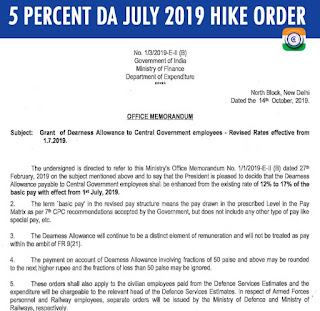
5 Percent DA July 2019 Hike Order - Grant of Dearness Allowance to Central Government employees

Grant of Dearness Allowance to Central Government employees 5 Percent DA July 2019 Hike Order  No. 1/3/2019-E- II (B) Government of...

Blog Archive

About The Author